
NanJi E-Commerce(002127)

Search documents
南极电商涉5亿余元诉讼,还是“卖吊牌”惹的祸
经济观察报· 2026-01-06 09:57
Core Viewpoint - The article discusses the ongoing legal disputes faced by Nanjing E-commerce Co., Ltd. (南极电商) related to its brand licensing model, particularly with its partner Shanghai Xinhe Zhao Enterprise Development Co., Ltd. (上海新和兆), highlighting the decline of its once profitable licensing business and the associated risks [1][2][9]. Group 1: Legal Disputes - Nanjing E-commerce announced two lawsuits involving Shanghai Xinhe Zhao, with one case amounting to 565 million yuan, primarily concerning the unauthorized use of the "Cardi Le Crocodile" brand [2][4]. - The timeline of the lawsuits shows that Shanghai Xinhe Zhao initially filed a claim for approximately 20 million yuan in January 2025, which was later increased to 565 million yuan in December 2025 [4]. - Nanjing E-commerce claims that Shanghai Xinhe Zhao violated the licensing agreement by unauthorized modifications and sublicensing, leading to multiple trademark infringement lawsuits against both companies [5][6]. Group 2: Decline of Licensing Model - The licensing model, once a significant revenue driver for Nanjing E-commerce, has seen a drastic decline, with revenues from brand licensing dropping from 747 million yuan in 2021 to 235 million yuan in 2023, a decrease of over 70% [9]. - In 2020, the licensing business contributed 30% of Nanjing E-commerce's total revenue, but by 2024, the overall revenue fell to 3.358 billion yuan, with a net loss of 237 million yuan [9][10]. - The rapid expansion of authorized dealers from 6,079 in 2020 to 10,311 in 2021 has led to quality control issues, resulting in multiple products being listed as substandard by regulatory authorities [9][10]. Group 3: Strategic Transformation - In response to the challenges posed by the licensing model, Nanjing E-commerce initiated a strategic transformation in 2023, focusing on "fashion licensing + strategic cooperation licensing + self-operated retail" [10]. - The company aims to shift from merely selling licenses to building its own brand, with self-operated products targeting the "affordable alternatives" market [10]. - In the first half of 2025, self-operated revenue reached 52.54 million yuan, a year-on-year increase of 152.01%, although overall sales expenses rose significantly, indicating ongoing financial challenges [11].



互联网电商板块1月6日涨0.19%,南极电商领涨,主力资金净流出1.23亿元
Zheng Xing Xing Ye Ri Bao· 2026-01-06 09:00
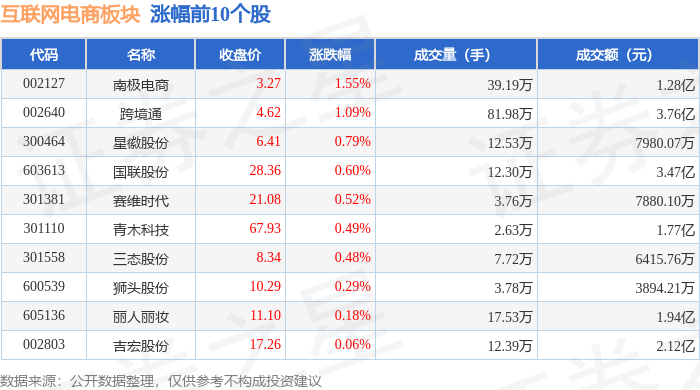
Market Overview - The internet e-commerce sector increased by 0.19% on January 6, with Nanji E-commerce leading the gains [1] - The Shanghai Composite Index closed at 4083.67, up by 1.5%, while the Shenzhen Component Index closed at 14022.55, up by 1.4% [1] Stock Performance - Key stocks in the internet e-commerce sector showed varied performance, with Nanji E-commerce closing at 3.27, up by 1.55%, and Kuaijingtong at 4.62, up by 1.09% [1] - Other notable stocks included Xinghui Co., which rose by 0.79% to 6.41, and Guolian Co., which increased by 0.60% to 28.36 [1] Trading Volume and Value - The trading volume and value for Nanji E-commerce reached 391,900 shares and 128 million yuan, respectively [1] - Kuaijingtong had a trading volume of 819,800 shares with a transaction value of 376 million yuan [1] Capital Flow - The internet e-commerce sector experienced a net outflow of 123 million yuan from institutional investors, while retail investors saw a net inflow of 155 million yuan [2] - The overall capital flow indicates a mixed sentiment, with institutional investors withdrawing funds while retail investors increased their positions [2] Individual Stock Capital Flow - Xinghui Co. had a net inflow of 10.24 million yuan from institutional investors, while retail investors showed a net outflow of 9.05 million yuan [3] - Nanji E-commerce saw a net inflow of 2.46 million yuan from institutional investors, with retail investors contributing a net inflow of 1.11 million yuan [3]


南极电商涉5亿余元诉讼,还是“卖吊牌”惹的祸
Jing Ji Guan Cha Wang· 2026-01-06 01:26
Core Viewpoint - Nanji E-commerce Co., Ltd. is involved in two lawsuits with Shanghai Xinhe Zhao Enterprise Development Co., Ltd., with claims related to trademark usage of the "Cardi Le Crocodile" brand, including a significant claim of 565 million yuan [2][3]. Group 1: Lawsuit Details - The first lawsuit was initiated by Shanghai Xinhe Zhao in January 2025, initially seeking approximately 20 million yuan, which was later increased to 565 million yuan in December 2025 [3]. - Nanji E-commerce filed a counter lawsuit in April 2025, seeking compensation of around 80 million yuan from Shanghai Xinhe Zhao [3]. - The lawsuits are set to be heard in January and March 2026, respectively [6]. Group 2: Background of the Dispute - Nanji E-commerce and Shanghai Xinhe Zhao began their partnership in 2018, signing a trademark licensing agreement that allowed the latter to use the Cardi Le series trademarks until December 31, 2027 [3]. - Nanji E-commerce alleges that Shanghai Xinhe Zhao violated the agreement by sublicensing the trademarks to downstream distributors and modifying the trademark styles, leading to quality management issues [3][5]. - The disputes have resulted in Nanji E-commerce being implicated in third-party trademark infringement lawsuits, affecting its business reputation and financial standing [3][5]. Group 3: Financial Impact and Business Model - The brand Cardi Le, acquired for nearly 600 million yuan in 2016, was a significant revenue driver for Nanji E-commerce, contributing 10.80% of total GMV in 2021 [7]. - However, revenue from brand licensing has declined sharply from 747 million yuan in 2021 to 235 million yuan in 2023, indicating a more than 70% decrease over three years [7][8]. - In 2024, Nanji E-commerce reported total revenue of 3.358 billion yuan with a net loss of 237 million yuan, reflecting a significant drop in profitability compared to previous years [7]. Group 4: Strategic Response - In response to the challenges posed by the licensing model, Nanji E-commerce has initiated a strategic transformation, focusing on "fashion licensing + strategic cooperation licensing + self-operated retail" [8][9]. - The company has also begun to restructure its supply chain and enhance product quality control, aiming to improve its self-operated product offerings, which saw a revenue increase of 152.01% in the first half of 2025 [9]. - Despite these efforts, the overall financial performance remains under pressure, with sales expenses rising significantly [9].

南极电商(002127) - 关于公司使用闲置自有资金购买理财产品的进展公告
2026-01-05 10:45
证券代码:002127 证券简称:南极电商 公告编号:2026-001 南极电商股份有限公司 关于公司使用闲置自有资金购买理财产品的进展公告 本公司及董事会全体成员保证信息披露内容的真实、准确、完整,没有 虚假记载、误导性陈述或重大遗漏。 南极电商股份有限公司(以下简称"公司")2024年年度股东大会审议通过了《关于使用 闲置自有资金购买理财产品的议案》,授权董事长审批使用公司及合并报表范围内下属子公 司暂时闲置的自有资金用于购买理财产品的额度为250,000万元(人民币);投资类型为安 全性高、流动性好、保本型或低风险型的理财产品或固定收益类证券(除股票、证券投资基 金、无担保债券等有价证券及其衍生品),期限不超过12个月,在上述额度及期限范围内可 循环滚动使用。 现将公司 2025 年 12 月份使用闲置自有资金购买理财产品的事项公告如下: | 序 | 受托人名称 | 产品名称 | 产品 | 委托理 财金额 | 预计年化收 | 起始日 | 到期日 | 资金 | 关联 | | --- | --- | --- | --- | --- | --- | --- | --- | --- | --- | | 号 | ...
超6亿元“天价互诉”!南极电商与旧盟友对簿公堂
Shen Zhen Shang Bao· 2026-01-04 12:02
Core Viewpoint - The company, Nanji E-commerce, is involved in two lawsuits with Shanghai Xinhengzhao, with a total amount exceeding 600 million yuan, stemming from trademark disputes and claims of infringement [1][2]. Group 1: Legal Disputes - Shanghai Xinhengzhao has filed a lawsuit against Nanji E-commerce, seeking to reduce the licensing fee and claiming damages, with the lawsuit amount changing from 95.25 million yuan to 565 million yuan [2][3]. - Nanji E-commerce has counter-sued Shanghai Xinhengzhao for losses and penalties due to infringement, with a claim amount of 81.69 million yuan [2][3]. - The disputes originated from a trademark licensing agreement signed in March 2018, which allowed Shanghai Xinhengzhao to use the "Kadi Le" trademark until December 2027, with stipulated payments for licensing fees [2][3]. Group 2: Financial Performance - In 2024, the company reported a loss of 237 million yuan, and in the first three quarters of 2025, revenue and net profit both declined, with revenue approximately 1.991 billion yuan, a year-on-year decrease of 17.29% [4][5]. - The net profit attributable to shareholders was about 42.79 million yuan, down 21.09% year-on-year, and the net profit after excluding non-recurring gains and losses dropped by 87.76% [5][6]. - The decline in revenue is attributed to strategic adjustments in subsidiary Time Internet and a general downturn in the advertising market, particularly affecting major clients in e-commerce and social media [6]. Group 3: Market Position - As of December 31, 2025, Nanji E-commerce's stock closed at 3.37 yuan per share, with a total market capitalization of approximately 8.273 billion yuan, reflecting a decline of over 20% throughout the year [6].
南极电商(002127) - 关于公司重大诉讼情况的公告
2026-01-04 07:45
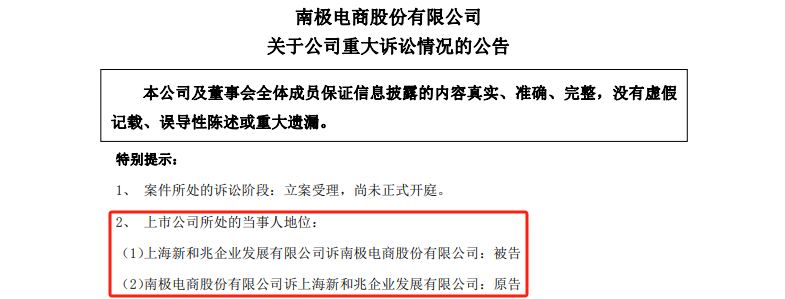
证券代码:002127 证券简称:南极电商 公告编号:2025-064 南极电商股份有限公司 关于公司重大诉讼情况的公告 本公司及董事会全体成员保证信息披露的内容真实、准确、完整,没有虚假 记载、误导性陈述或重大遗漏。 特别提示: 1、 案件所处的诉讼阶段:立案受理,尚未正式开庭。 2、 上市公司所处的当事人地位: (1)上海新和兆企业发展有限公司诉南极电商股份有限公司:被告 (2)南极电商股份有限公司诉上海新和兆企业发展有限公司:原告 3、 涉案的金额: (1)本次诉讼案件上海新和兆企业发展有限公司原起诉南极电商股份有限公司所涉调降许可费 及损失等金额合计为 95,250,000.00 元,变更后诉讼金额为 565,404,284.89 元(不含利息)。 (2)南极电商股份有限公司另案起诉上海新和兆企业发展有限公司金额为 81,690,733.00 元(暂 计) 4、 对上市公司损益产生的影响:该客户本年未确认收入,鉴于案件尚未正式开庭,其对公司 本期利润或期后利润的具体影响存在不确定性,公司将根据案件进展情况及时履行信息披露义务。 一、公司与诉讼方的合同情况 南极电商股份有限公司(以下简称"公司"或"本公 ...
南极电商:公司百家好品牌整体追求高品质的稳健发展
Zheng Quan Ri Bao Zhi Sheng· 2025-12-29 14:12
Core Viewpoint - The company, Nanji E-commerce, is focused on the steady development of its Baijiahao brand, emphasizing high quality and targeted expansion in online channels [1] Group 1: Brand Development - The Baijiahao brand aims for robust growth with a focus on high quality [1] - The company is expanding its online store presence according to established goals [1] Group 2: Channel Performance - The Douyin channel is being refined to deepen its core women's clothing category [1] - The Tmall channel is experiencing rapid growth, with ongoing high-quality store expansion [1] Group 3: Product Categories - Expansion is occurring in women's clothing, lingerie, and bags [1] - The MindBridge brand has achieved store openings in Tmall, Douyin, and Vipshop channels [1]
互联网电商板块12月29日跌0.56%,华凯易佰领跌,主力资金净流出1.14亿元
Zheng Xing Xing Ye Ri Bao· 2025-12-29 09:06
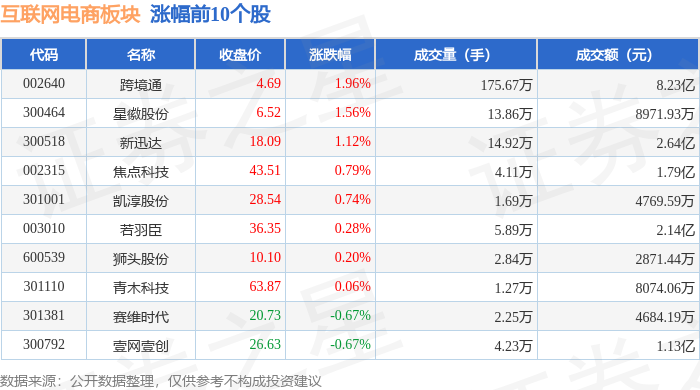
Core Viewpoint - The internet e-commerce sector experienced a decline of 0.56% on December 29, with Huakai Yibai leading the drop. The Shanghai Composite Index closed at 3965.28, up 0.04%, while the Shenzhen Component Index closed at 13537.1, down 0.49% [1]. Group 1: Stock Performance - The following stocks in the internet e-commerce sector showed notable performance: - Kuaijingtong (002640) closed at 4.69, up 1.96% with a trading volume of 1.7567 million shares and a transaction value of 8.23 billion [1]. - Lianghui Co., Ltd. (300464) closed at 6.52, up 1.56% with a trading volume of 138,600 shares and a transaction value of 89.7193 million [1]. - Xinxunda (300518) closed at 18.09, up 1.12% with a trading volume of 149,200 shares and a transaction value of 264 million [1]. - Huakai Yibai (300592) closed at 10.45, down 2.15% with a trading volume of 102,600 shares and a transaction value of 108 million [2]. Group 2: Capital Flow - The internet e-commerce sector saw a net outflow of 114 million from main funds, while retail investors experienced a net inflow of 81.33 million [2]. - The following stocks had significant capital flow: - Ruoyuchen (003010) had a main fund net inflow of 11.45 million, while retail investors had a net outflow of 9.14 million [3]. - Xinxunda (300518) had a main fund net inflow of 5.83 million, with retail investors experiencing a net outflow of 17.84 million [3]. - Kuaijingtong (002640) had a main fund net inflow of 4.92 million, while retail investors had a net outflow of 17.13 million [3].



南极人跑了,雅鹿们还在狂欢:起底5毛一个的吊牌生意
Xin Lang Cai Jing· 2025-12-27 21:27
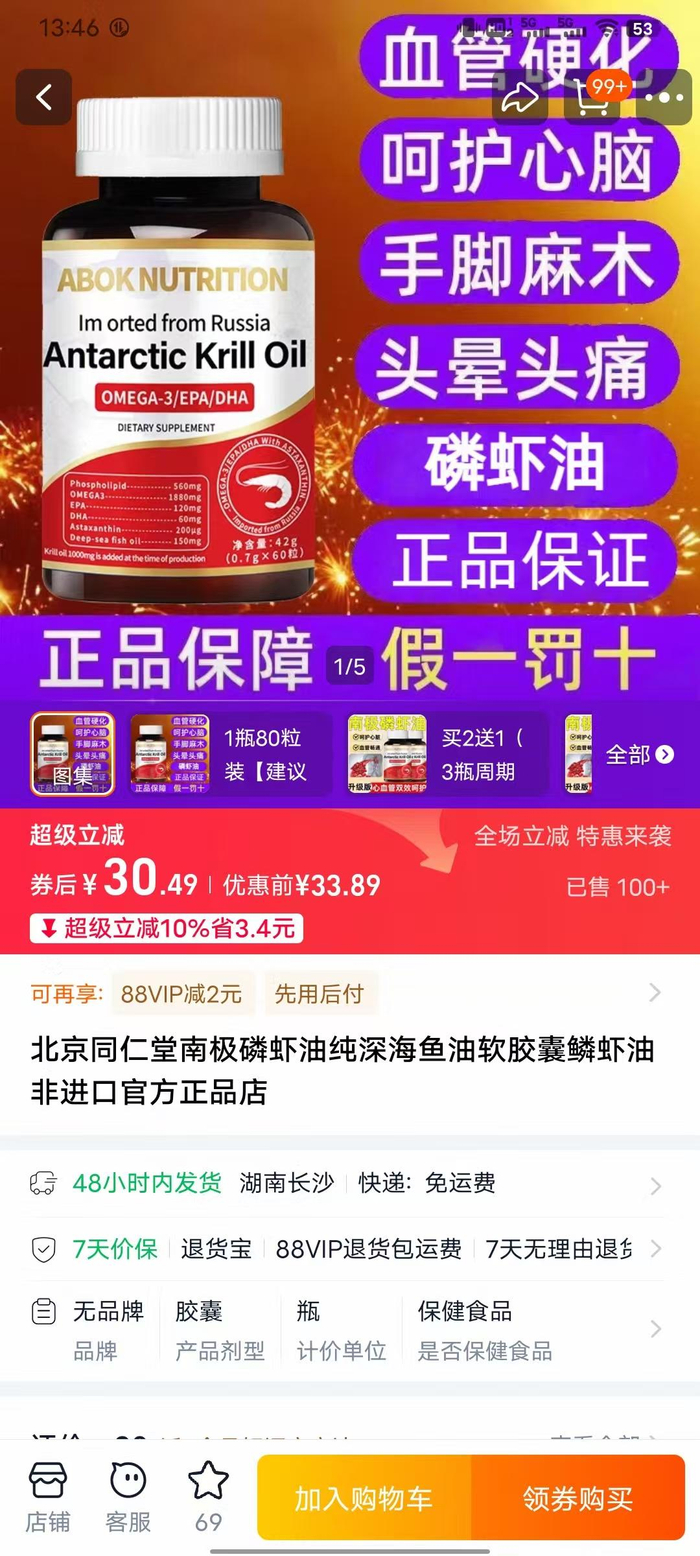
Core Viewpoint - The article highlights the issue of brand dilution and consumer confusion caused by the "label-selling" business model, particularly in the case of products claiming to be from "Beijing Tongrentang" that do not meet quality standards [1][6]. Group 1: Brand Misrepresentation - A product labeled as "Beijing Tongrentang 99% high-purity Antarctic krill oil" was found to have a phospholipid content of zero, despite claims of 43% [1]. - The involved manufacturer, Beijing Tongrentang (Sichuan) Health Pharmaceutical Co., Ltd., was ordered to remove the product from sale, yet it remained available on some e-commerce platforms [1][5]. - The company has warned consumers to recognize the authentic "Double Dragon Trademark" and noted that unauthorized use of their trademarks constitutes infringement [5]. Group 2: Trademark Confusion - Multiple similar trademarks, such as "Neiting Shangyong" and "Zhenhuang," have been registered by affiliated companies, leading to consumer confusion regarding the authenticity of products [5][6]. - The complexity of brand identification on e-commerce platforms results in a mix of products from different affiliated companies, which can mislead consumers about the quality and origin of the products [6]. Group 3: Business Model Shift - The brand "Nanji Ren" transitioned from a manufacturer to a brand licensing company in 2008, capitalizing on the e-commerce boom [7]. - In 2023, "Nanji Ren" announced a shift away from the "label-selling" model, ceasing to charge licensing fees and focusing on self-developed products [7]. - Despite "Nanji Ren" exiting the label-selling business, other brands like "Yalu" continue to thrive in this model, with low barriers to entry for obtaining brand licenses [8]. Group 4: Consumer Complaints and Quality Issues - The "label-only" business model has led to a surge in consumer complaints, with over 2,400 complaints related to the "Yalu" brand alone, citing issues like counterfeit products and poor workmanship [9]. - "Nanji Ren" has also faced significant consumer complaints, indicating a disconnect between brand identity and product quality [11]. Group 5: Regulatory and Legal Implications - Legal experts emphasize that trademark owners have a responsibility to supervise the quality of products bearing their trademarks, and failure to do so can lead to liability for damages caused by defective products [12]. - The lack of stringent quality checks on e-commerce platforms exacerbates the issue, as they primarily focus on verifying seller qualifications rather than product quality [12].
南极电商:时间互联2025年通过苹果业务线逐步打开国内外市场业务空间
Zheng Quan Ri Bao Wang· 2025-12-25 10:43
Core Viewpoint - Nanji E-commerce (002127) is strategically optimizing its traditional business lines and organizational structure to enhance operational efficiency while expanding its market presence through the Apple business line by 2025 [1] Group 1 - The company plans to gradually open up domestic and international market opportunities through its Apple business line by 2025 [1] - As part of its business strategy adjustment, the company is actively optimizing certain traditional business lines to improve operational quality [1] - The company aims to deepen penetration in vertical industries while maintaining existing customer business and gradually exploring opportunities in emerging industries [1]