
Bank of Ningbo(002142)

Search documents
宁波银行率先落地知识产权科技创新资产支持证券
Xin Hua Cai Jing· 2025-09-12 06:31
宁波银行有关负责人表示,本期科技创新资产支持证券是宁波银行推进金融赋能实体经济的一次生动实 践,是深入创新发展赋能新质生产力的有益探索。 (文章来源:新华财经) 新华财经北京9月12日电(记者吴丛司)记者12日从宁波银行获悉,由宁波银行独立主承销的"国联信托 股份有限公司2025年度第一期飞凤2号知识产权科技创新定向资产支持证券"10日成功缴款起息,发行金 额0.7亿元,期限370天。 本期资产支持证券是全国率先落地的知识产权科技创新资产支持证券,通过知识产权质押方式,为无锡 市新吴区军工智能、扬贺扬微电子、红旗印染、佳利达国际物流、意进隆科技、隆玛科技、安特源科技 和艾比德泵业8家优质科创企业提供了创新融资渠道,有效盘活企业知识产权33项,帮助民营企业降低 融资成本,后续募集资金将用于企业在集成电路、新能源、高端装备等领域的生产研发投入。同时,本 期资产支持证券由宁波银行同步创设CRMW,不再要求企业提供额外担保,减轻了企业融资负担。 ...
在宁波银行工作怎么样?多维成长平台锻造未来翘楚
Jin Tou Wang· 2025-09-12 02:09
在金融行业的广阔版图中,宁波银行正以独特的姿态脱颖而出,吸引着众多怀揣梦想的专业人士。对于那 些渴望在金融领域一展身手的人来说,"在宁波银行工作怎么样?" 是一个备受关注的问题。在这里,工作 不仅是一份职业,更是一段充满机遇与挑战的成长旅程。 宁波银行深知员工是企业发展的核心动力,因此构建了全面且完善的培养体系。考虑到员工专业背景的 多样性,银行专门开设专业、系统的金融课程,帮助非金融经济专业的员工快速提升金融知识储备和专业 素养。各部门每年针对不同岗位员工开设专业课程,采用线上线下相结合的灵活学习方式,让员工能够充 分利用碎片时间,实现系统化的技能提升。从新员工入职,到普通员工的持续成长,再到向管理岗位的晋升, 每个层级都有明确的培养机制和针对性的课程。这种全方位、多层次的培养体系,为员工的职业发展提 供了清晰的方向和有力的支持,确保员工在职业生涯的每一个阶段都能得到充分的培养和发展。 积极工作氛围:领导关怀与同事协作共进 在宁波银行,积极向上的工作氛围浓厚。领导们平易近人,会定期与员工沟通交流,给予宝贵的建议和鼓励, 帮助员工解决工作和生活中的困惑。同事之间相处融洽,互帮互助,形成了良好的团队合作氛围。在 ...
私行业务跑出加速度成银行扩中收重要引擎
Zhong Guo Zheng Quan Bao· 2025-09-11 20:17
Core Insights - The private banking business has shown significant growth in both client numbers and AUM (Assets Under Management), becoming a key driver for retail banking growth amid pressure on net interest margins [1][2][3] Client Growth - Major state-owned banks lead in private banking client numbers, with Agricultural Bank of China having 279,000 clients, followed by China Construction Bank with 265,500, and Bank of China with 216,900 [1] - China Construction Bank added 34,000 private banking clients in the first half of the year, while Postal Savings Bank saw a growth of over 21% in its client base [1][2] - In the joint-stock banks, China Merchants Bank leads with 182,700 clients, followed by Ping An Bank and CITIC Bank, each exceeding 90,000 clients [2] AUM Growth - Private banking AUM growth outpaces overall retail AUM growth, with Agricultural Bank of China reporting AUM of 3.5 trillion yuan, an increase of 11.11% from the beginning of the year [2][3] - Other state-owned banks also reported significant AUM growth, with China Construction Bank at 3.18 trillion yuan, reflecting a 14.39% increase [2][3] Business Strategy and Service Development - Banks are focusing on enhancing client services, with China Construction Bank integrating personal client management and supporting private entrepreneurs [3][4] - CITIC Bank is emphasizing tiered services for ultra-high-net-worth clients, while China Everbright Bank is targeting families, women, and business owners [4] - Future developments in private banking are expected to focus on digitalization, service ecosystem integration, and global investment opportunities [4]





小微企业融资平台市场洞察:政策赋能与模式创新双轮驱动下的服务升级与增长空间头豹词条报告系列
Tou Bao Yan Jiu Yuan· 2025-09-11 05:06
Investment Rating - The report does not explicitly state an investment rating for the small and micro enterprise financing platform industry Core Insights - The small and micro enterprise financing platform industry is experiencing continuous expansion driven by policy support and market demand, with innovative service models emerging to address financing challenges [3][21] - The industry is characterized by a concentration of leading players, with a significant market share held by top companies, while smaller firms are adopting differentiated strategies to capture market share [20][23] - The transition towards the "drip irrigation" model is anticipated, as it aligns better with the financing needs of small and micro enterprises compared to traditional credit models [56][57] Summary by Sections Industry Definition - Small and micro enterprise financing platforms integrate resources from financial institutions, government, data technology, and industry ecosystems to provide customized financing solutions, addressing issues like information asymmetry and insufficient collateral [4] Industry Characteristics - The market is expanding rapidly, with the balance of inclusive small and micro loans reaching 32.9 trillion yuan by Q3 2024, a year-on-year increase of 14.5% [21] - Continuous product and service innovation is evident, with platforms like Drip Irrigation Group utilizing the Revenue-Based Financing (RBF) model to enhance service efficiency [22] - The competitive landscape shows a concentration of market share among leading firms, with state-owned banks holding 42.77% of the inclusive small and micro loan market [23] Development History - The industry has evolved through various stages, from initial support for small enterprises in the 1990s to the rapid development phase post-2000, and now to a high-quality development phase characterized by digitalization and green finance [24][30] Industry Chain Analysis - The industry chain consists of upstream funding sources, midstream financing service providers, and downstream small and micro enterprises, with a focus on addressing structural mismatches in financing needs [31][32] - Upstream funding is characterized by a dual structure of policy-driven and market-driven sources, with commercial banks being the primary funding providers [37] - Midstream service providers are leveraging technology to enhance risk assessment and improve service delivery, transitioning from traditional asset-based evaluations to cash flow-based assessments [43] Market Size and Growth - The small and micro enterprise financing platform industry has seen rapid growth from 2019 to 2024, driven by policy support, technological advancements, and improvements in the credit system [53] - The market is expected to continue expanding as new tools like digital currency and cross-border payment systems are introduced [54] Future Trends - The industry is shifting towards the Drip Irrigation model due to mismatches between traditional credit models and the financing needs of small enterprises, with a focus on real-time cash flow monitoring and digital infrastructure [56][58]

多家银行调整贵金属业务应对 金价波动风险
Zheng Quan Ri Bao· 2025-09-11 00:24
Core Viewpoint - The recent surge in international gold prices has prompted multiple banks to adjust their precious metals business, indicating rising investment risks and the need for more prudent investor behavior [1][2][3]. Group 1: Market Signals - The increase in gold prices is accompanied by a simultaneous rise in investment risks related to gold [1]. - Banks are issuing clear risk warnings against speculative and imprudent investment behaviors [1][3]. - There is a push to guide investors towards more rational participation in gold investments [1]. Group 2: Adjustments by Banks - Major banks such as Bank of China, Agricultural Bank of China, and others have raised investment thresholds and adjusted margin levels and trading rules for precious metals [2][3]. - The Shanghai Gold Exchange has also modified margin levels and price fluctuation limits for gold and silver contracts in response to market volatility [2]. - Ningbo Bank has increased the minimum purchase amount for gold accumulation from 800 yuan to 900 yuan due to significant price fluctuations [3]. Group 3: Risk Management Strategies - Banks are implementing measures to filter out investors with lower risk tolerance to prevent significant losses during market volatility [3]. - The adjustments aim to strengthen banks' risk management and protect against extreme situations like client margin calls [3]. - These changes are also in response to regulatory guidance on enhancing investor suitability management [3]. Group 4: Investment Considerations - The core drivers of the current rise in gold prices include expectations of Federal Reserve interest rate cuts, increased gold allocations by central banks, and heightened geopolitical risks [4]. - Investors are advised to reassess their risk tolerance, as gold investments are not guaranteed profits, especially with leveraged products that can lead to total capital loss [4][5]. - A rational asset allocation framework is recommended, distinguishing between low-risk products like physical gold and higher-risk leveraged trading products [5].
多家银行调整贵金属业务应对金价波动风险
Zheng Quan Ri Bao Zhi Sheng· 2025-09-10 16:37
Core Viewpoint - The recent surge in international gold prices has prompted multiple banks to adjust their precious metals business, indicating rising investment risks and the need for more prudent investor behavior [1][2][3] Group 1: Market Signals - The increase in gold prices is accompanied by a simultaneous rise in investment risks related to gold [1] - Banks are issuing clear risk warnings against speculative and imprudent investment behaviors [1][3] - There is a push for investors to engage in gold investments more rationally, avoiding excessive leverage and controlling the proportion of gold in their asset portfolios [1][4] Group 2: Adjustments by Banks - Major banks, including Bank of China, Agricultural Bank of China, and others, have raised investment thresholds and adjusted margin levels and price fluctuation limits for gold-related businesses [2][3] - The Shanghai Gold Exchange has also modified margin levels and price fluctuation limits for certain contracts, prompting banks to respond with similar adjustments [2][3] - Ningbo Bank has increased the minimum purchase amount for gold accumulation from 800 yuan to 900 yuan due to significant price volatility [3] Group 3: Risk Management Strategies - Banks are implementing measures to filter out investors with lower risk tolerance, thereby protecting them from significant losses during market volatility [3] - The adjustments aim to enhance banks' risk management and prevent extreme situations that could impact operational stability [3] - These changes also align with regulatory guidance on improving investor suitability management [3] Group 4: Investor Guidance - Investors are advised to reassess their risk tolerance in light of the rising gold prices and the associated risk premiums [4][5] - It is emphasized that precious metal investments are not guaranteed profits, especially with leveraged products that can lead to total capital loss during price fluctuations [5] - A balanced asset allocation framework is recommended, distinguishing between low-risk products and more complex leveraged trading instruments [5]
19只个股大宗交易超5000万元
Zheng Quan Shi Bao Wang· 2025-09-10 14:50
Summary of Key Points Core Viewpoint - On September 10, a total of 103 stocks were traded on the block trading platform, with a cumulative trading volume of 174 million shares and a total transaction amount of 3.529 billion yuan, indicating active trading in the market [1]. Group 1: Trading Highlights - The stock with the highest transaction amount was Zijin Mining, with a single block trade amounting to 288 million yuan [1]. - Following Zijin Mining, Guangqi Technology had three block trades totaling 173 million yuan [1]. - Other notable stocks included Yahui Long with 144.89 million yuan, CITIC Securities with 141.03 million yuan, and BOE Technology with 133.78 million yuan [1]. Group 2: Stock Performance - Zijin Mining experienced a slight decline of 0.04% with a closing price of 25.18 yuan [1]. - Guangqi Technology saw an increase of 0.86%, closing at 45.77 yuan [1]. - Yahui Long increased by 1.00%, closing at 15.15 yuan, while CITIC Securities decreased by 0.14%, closing at 29.48 yuan [1]. Group 3: Transaction Details - The average transaction price for Zijin Mining was 25.19 yuan, reflecting a premium of 0.04% [1]. - Guangqi Technology's average transaction price was 44.40 yuan, showing a discount of 2.99% [1]. - The trading volume for Zijin Mining was 11.44 million shares, while Guangqi Technology had a volume of 3.90 million shares [1].



宁波银行大宗交易成交215.21万股 成交额6307.81万元
Zheng Quan Shi Bao Wang· 2025-09-10 12:04
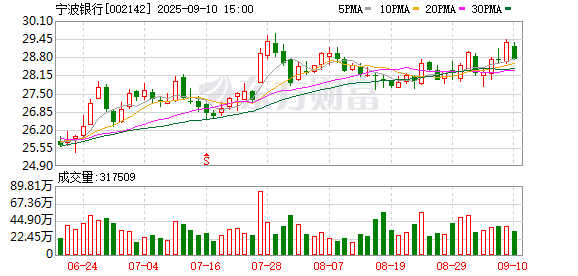
Summary of Key Points Core Viewpoint - On September 10, a block trade of Ningbo Bank occurred with a transaction volume of 2.1521 million shares and a transaction amount of 63.0781 million yuan, indicating a premium of 2.02% over the closing price of the day [2] Trading Activity - The closing price of Ningbo Bank on the same day was 28.73 yuan, reflecting a decline of 1.98% with a turnover rate of 0.48% and a total transaction amount of 917 million yuan [2] - The net outflow of main funds for the day was 62.2395 million yuan, while the stock has seen a cumulative increase of 1.88% over the past five days, with a total net outflow of 140 million yuan [2] Margin Financing Data - The latest margin financing balance for Ningbo Bank is 1.947 billion yuan, which has decreased by 136 million yuan over the past five days, representing a decline of 6.55% [2]

今日共103只个股发生大宗交易,总成交35.29亿元


Di Yi Cai Jing· 2025-09-10 09:56
Group 1 - A total of 103 stocks experienced block trading on the A-share market today, with a total transaction value of 3.529 billion yuan [1] - The top three stocks by transaction value were Zijin Mining at 288 million yuan, Guangqi Technology at 173 million yuan, and Yahui Long at 145 million yuan [1] - Among the stocks, 18 were traded at par, 20 at a premium, and 65 at a discount; the highest premium rates were for Dingjia Precision at 11.02%, Zhejiang Meida at 9.17%, and Chongqing Steel at 4.17% [1] Group 2 - The ranking of institutional buy amounts was led by Zijin Mining at 288 million yuan, followed by CITIC Securities at 141 million yuan and BOE Technology at 134 million yuan [2] - Other notable institutional purchases included Ningde Times at 99.2 million yuan, Northern Huachuang at 98.5 million yuan, and Muyuan Foods at 92.1 million yuan [2] - The total buy amounts for the top 30 stocks reflect significant institutional interest in these companies [2] Group 3 - The ranking of institutional sell amounts was also led by Zijin Mining at 288 million yuan, with CITIC Securities at 141 million yuan and BOE Technology at 134 million yuan [3] - Other significant sell amounts included Ningde Times at 121 million yuan, Northern Huachuang at 98.5 million yuan, and Muyuan Foods at 92.1 million yuan [3] - The data indicates a consistent pattern of institutional trading activity in these key stocks [3]
宁波银行今日大宗交易溢价成交215.21万股,成交额6307.81万元
Xin Lang Cai Jing· 2025-09-10 08:50
Group 1 - The core transaction of Ningbo Bank involved a block trade of 2.1521 million shares, with a total transaction value of 63.0781 million yuan, accounting for 6.44% of the total trading volume on that day [1] - The transaction price was 29.31 yuan per share, which represents a premium of 2.02% over the market closing price of 28.73 yuan [1]