CITC(002190)

Search documents
9月3日龙虎榜 机构青睐这13股


Zheng Quan Shi Bao Wang· 2025-09-03 14:13
Core Insights - On September 3, the Shanghai Composite Index fell by 1.16%, with institutional investors appearing on the trading lists of 26 stocks, net buying 13 and net selling 13 [1][2]. Institutional Trading Summary - The stock with the highest net buying from institutional seats was Chenxin Pharmaceutical, which closed at the daily limit with a gain of 10.02% and a turnover rate of 5.97%, with a total transaction amount of 696 million yuan. Institutional seats accounted for a net purchase of 115.76 million yuan [2][5]. - Xiaocheng Technology saw a decline of 3.46% and a high turnover rate of 33.97%, with a total transaction amount of 1.812 billion yuan. Institutional seats net bought 110.91 million yuan, but the stock experienced a net outflow of 70.78 million yuan [2][5]. - Airo Energy rose by 19.15% with a turnover rate of 10.07% and a transaction amount of 707 million yuan. Institutional seats net bought 72.55 million yuan, while there was a net outflow of 44.77 million yuan [3][5]. Performance of Net Bought Stocks - Stocks with net institutional buying averaged a gain of 7.73%, outperforming the Shanghai Composite Index. Notable performers included Kexin Machinery and Shangneng Electric, both closing at the daily limit [3][4]. - The probability of stocks with net institutional buying rising the next day is 48.60%, with a 46.11% chance of outperforming the index [3]. Performance of Net Sold Stocks - The stock with the highest net selling by institutions was Julun Intelligent, which had a turnover rate of 32.87% and a net selling amount of 98.80 million yuan. The stock experienced a net outflow of 727 million yuan [3][5]. - Fourchuang Electronics and Chengfei Integration also saw significant net selling, with net outflows of 72.35 million yuan and 73.89 million yuan, respectively [4][5]. Stock Connect Activity - On September 3, 21 stocks on the trading list had either Shanghai or Shenzhen Stock Connect participation, with net buying seen in stocks like Yanshan Technology and Sanwei Communication, amounting to 280 million yuan and 114 million yuan, respectively [7][8]. - Notable net selling included Huasheng Technology and Chenxin Pharmaceutical, with net selling amounts of 270 million yuan and 54.72 million yuan, respectively [7][8].
龙虎榜 | 温州帮高位套现“8天5板”长飞光纤,作手新一、成都系联手主封岩山科技
Ge Long Hui A P P· 2025-09-03 10:32
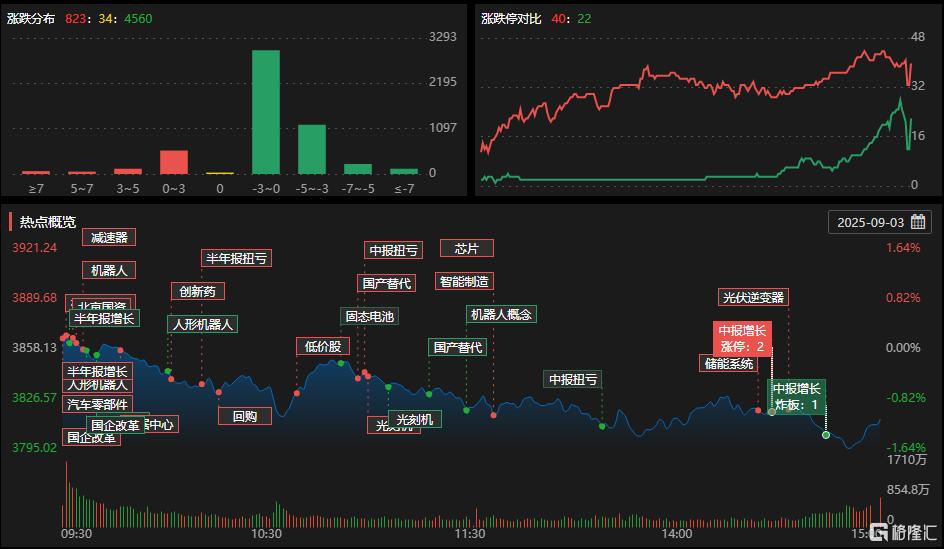
Market Overview - On September 3, the total trading volume of the Shanghai and Shenzhen stock markets was 2.36 trillion yuan, a decrease of 510.9 billion yuan compared to the previous trading day [1] - The sectors that saw gains included photovoltaic, precious metals, fentanyl, BC batteries, and gaming, while military equipment, small metals, securities, satellite navigation, and software development experienced significant declines [1] Stock Performance - Notable stocks with significant gains included: - Dajin Banjia (605255) with a 10.00% increase, reaching a price of 62.81 yuan, driven by the acquisition of Zhonghao Xinying and automotive components, marking its 9th consecutive rise [2] - Changfei Optical Fiber (601869) also rose by 10.00% to 91.06 yuan, supported by developments in hollow core fibers and its semi-annual report, achieving 5 rises in 8 days [2] - Other notable performers included Jishi Media (626109) with a 9.94% increase, Bojie Co. (002975) with a 10.00% increase, and Xibu Gold (690109) with a 10.00% increase [2] Trading Dynamics - The top three net purchases on the day were: - Yanshan Technology with a net purchase of 639 million yuan [4] - Sudavige with a net purchase of 163 million yuan [4] - Taihe Technology with a net purchase of 150 million yuan [4] - Conversely, the top three net sales were: - Huasheng Tiancai with a net sale of 371 million yuan [5] - Julu Intelligent with a net sale of 268 million yuan [5] - Chengfei Integration with a net sale of 97.49 million yuan [5] Sector Highlights - Yanshan Technology reported a 9.07% increase in stock price, with a trading volume of 160.57 billion yuan and a turnover rate of 32.05% [4] - Sudavige's stock rose by 11.00%, with a trading volume of 23.59 billion yuan and a turnover rate of 35.81% [10] - Taihe Technology achieved a trading volume of 10.15 billion yuan, with a significant focus on solid-state batteries and photolithography [17] Institutional Activity - Institutional investors showed strong interest in several stocks, with notable net purchases in: - Yanshan Technology with 280 million yuan [19] - Sudavige with 357.96 million yuan [20] - Conversely, significant net sales were observed in stocks like Julu Intelligent and Chengfei Integration, indicating a shift in institutional sentiment [6][22]




成飞集成今日跌停 有1家机构专用席位净卖出7388.94万元
Mei Ri Jing Ji Xin Wen· 2025-09-03 09:36
Group 1 - Chengfei Integration (002190) experienced a limit down on September 3, with a trading volume of 1.774 billion yuan and a turnover rate of 11.00% [1] - The post-market data from the Longhu list indicates that the Shenzhen Stock Connect special seat bought 32.3068 million yuan and sold 67.2929 million yuan, resulting in a net sell of 73.8894 million yuan by one institutional special seat [1]
成飞概念下跌4.76%,8股主力资金净流出超5000万元
Zheng Quan Shi Bao Wang· 2025-09-03 09:01
Group 1 - The Chengfei concept sector experienced a decline of 4.76% as of the market close on September 3, with several stocks, including Lijun Co. and Chengfei Integration, hitting the daily limit down [1][2] - Major stocks within the Chengfei concept that faced significant declines include AVIC Chengfei, Aileda, and Haige Communication, which had the largest drops in the sector [1][2] - The sector saw a net outflow of 1.875 billion yuan in capital, with 35 stocks experiencing net outflows, and 8 stocks seeing outflows exceeding 50 million yuan [2][3] Group 2 - The stock with the highest net outflow was AVIC Chengfei, which had a net outflow of 529 million yuan and a decline of 14.34% [2][3] - Other notable stocks with significant net outflows include Haige Communication and Chengfei Integration, with net outflows of 272 million yuan and 271 million yuan, respectively [2][3] - In contrast, stocks such as Tianyi New Materials and *ST Lihang saw net inflows of 3.99 million yuan and 2.20 million yuan, respectively [2][3]


龙虎榜|成飞集成今日跌停 有1家机构专用席位净卖出7388.94万元
Mei Ri Jing Ji Xin Wen· 2025-09-03 08:37
Core Viewpoint - Chengfei Integration experienced a limit down on September 3, with a trading volume of 1.774 billion yuan and a turnover rate of 11.00% [1] Trading Activity - The data from the post-market dragon and tiger list indicates that the Shenzhen Stock Connect special seat bought 32.3068 million yuan and sold 67.2929 million yuan [1] - One institutional special seat had a net sell of 73.8894 million yuan [1]
成飞概念震荡走弱,成飞集成触及跌停
Xin Lang Cai Jing· 2025-09-03 05:45
Group 1 - The concept of Chengfei is experiencing a downturn, with Chengfei Integration hitting the daily limit down [1] - Other companies such as AVIC Chengfei, Zhong Wulian, Aileda, Qifeng Precision, Zhongguang Lightning Protection, and Guangyun Da are also seeing declines [1]
成飞概念下跌0.61%,主力资金净流出33股
Zheng Quan Shi Bao Wang· 2025-09-01 09:16
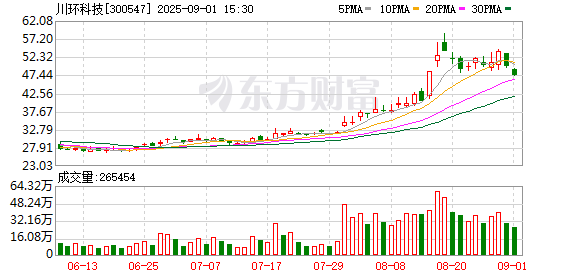
Market Performance - Chengfei concept declined by 0.61%, ranking among the top declines in the concept sector, with leading decliners including Chuanhuan Technology and *ST Xinyan [2] - Among the 14 stocks that rose, Xindazhou A, Guangyunda, and Duopule saw increases of 4.85%, 4.63%, and 3.86% respectively [2] Concept Sector Overview - The top-performing concept sectors included Zinc (up 4.95%), Lead (up 4.94%), and Gold (up 4.39%), while the Chengfei concept was among the laggards [3] - The Chengfei concept experienced a net outflow of 800 million yuan, with 33 stocks seeing net outflows, and 6 stocks with outflows exceeding 50 million yuan [3] Major Stocks in Chengfei Concept - The stock with the highest net outflow was Hualichuantong, with a net outflow of 198 million yuan, followed by Chuanhuan Technology and Haige Communication [3][4] - Notable stocks with net inflows included Zhonghang Chengfei, Zhonghang Optoelectronics, and Tianyi New Materials, with inflows of 132 million yuan, 130 million yuan, and 833 thousand yuan respectively [5]


成飞集成吉文汽车零部件取得一种汽车零部件激光焊接工装专利,实现对汽车零部件的高效焊接
Jin Rong Jie· 2025-09-01 05:22
Group 1 - Sichuan Chengfei Integration Jiwen Automotive Parts Co., Ltd. has obtained a patent for a "Laser Welding Tool for Automotive Parts," with the authorization announcement number CN 223277346 U, and the application date is October 2024 [1] - The patent describes a laser welding tool that includes components such as symmetrical pressure arms, cylinders, contour blocks, support blocks, and support bases, designed to achieve efficient and precise welding of automotive parts, thereby improving production efficiency and reducing scrap rates and costs [1] - The company was established in 2012 and is located in Chengdu, primarily engaged in the automotive manufacturing industry, with a registered capital of 197.2282 million RMB [1] Group 2 - Sichuan Chengfei Integration Jiwen Automotive Parts Co., Ltd. has made investments in one other company, participated in 39 bidding projects, and holds 64 patent records, along with 81 administrative licenses [1]
调研速递|成飞接受国金证券等45家机构调研 聚焦业绩、军贸及发展规划要点
Xin Lang Zheng Quan· 2025-08-31 14:52
Core Viewpoint - The online performance exchange meeting held by Chengfei on August 29, 2025, highlighted the company's challenges in revenue and profit for the first half of the year, while outlining strategies for cost management and future growth in various sectors, including military trade and supply chain management [1]. Group 1: Financial Performance - In the first half of 2025, Chengfei experienced a year-on-year decline in both revenue and profit, primarily due to low sales in the first quarter when the company was in the component production phase, contrasted with a high delivery base in the first quarter of 2024 [1]. - Although the second quarter saw an improvement in revenue due to the commencement of delivery cycles, the cumulative deliveries for the first half still did not reach the levels of the same period last year [1]. Group 2: Cost Management Strategies - The company emphasizes cost control by developing annual specialized plans integrated into its operational strategy, focusing on enhancing material and equipment utilization through process research and optimization [1]. - Chengfei plans to address cost management pain points and promote cost reduction through multi-business domain collaboration [1]. Group 3: Military Trade Developments - Chengfei has over 40 years of experience in military trade and has seen increased attention on military trade products since the regional conflicts began in May, leading to multiple foreign visits and participation in exhibitions [1]. Group 4: Subsidiary Development - Following its restructuring and listing, Chengfei has shifted its main business focus to aircraft equipment, enhancing its industrial chain and control capabilities, with subsidiaries like Guifei and Guochuang Center forming a comprehensive industrial layout [1]. Group 5: Supply Chain Management - Chengfei has developed an integrated capability of "production, preparation, and maintenance" through its business layout, leveraging its complete equipment to drive the "1+1+N" model for creating an aviation industrial park [1]. - The company is building an efficient supplier management system to ensure supply chain stability [1]. Group 6: "14th Five-Year" Planning - During the "14th Five-Year" period, Chengfei aims to establish a coordinated development framework led by technological innovation across defense equipment, civil aviation, and military product trade, while enhancing organizational transformation to become a world-class high-tech aviation enterprise [1]. Group 7: Capital Operations Plan - The company is attentive to capital market dynamics and plans to strategize refinancing in alignment with its "14th Five-Year" layout, while also establishing long-term incentive mechanisms to align the interests of management, employees, and the company [1].

明星基金经理二季度调仓路线图:科技医药成共识,消费现分歧
Nan Fang Du Shi Bao· 2025-08-29 13:36
Core Viewpoint - The article highlights the strategic adjustments made by prominent fund managers in response to the market's structural characteristics, focusing on sectors like AI, innovative pharmaceuticals, and consumer goods, while also indicating a clear divergence in the consumer sector's performance [2][3][4]. Group 1: Fund Manager Strategies - Prominent fund managers have collectively increased their positions in high-growth sectors such as AI and innovative pharmaceuticals while making structural adjustments within the consumer sector [2]. - The technology and pharmaceutical sectors have emerged as core allocation directions, with significant investments in companies like BYD (increased by 184.78%) and Alibaba (increased by 161.10%) [2]. - Fund managers are focusing on "hard technology" in the tech sector, with AI computing and robotics becoming key investment areas [4]. Group 2: Consumer Sector Dynamics - The consumer sector has shown significant structural differentiation, with fund managers displaying contrasting attitudes towards traditional liquor and new consumption trends [3]. - Some fund managers have increased their holdings in traditional liquor stocks like Wuliangye and Moutai, while others have reduced their positions in these stocks, indicating a shift towards new consumption opportunities [3][4]. - The performance of consumer companies has influenced fund adjustments, with companies like Yili achieving strong revenue growth while others like Yanghe experienced profit declines [4]. Group 3: Future Outlook - Looking ahead to the third quarter, there is optimism regarding the innovative pharmaceutical sector, driven by global collaborations and anticipated clinical data disclosures [5]. - The consumer healthcare sector is expected to continue benefiting from rising health awareness among residents, with demand for home medical devices projected to grow steadily due to an aging population [5]. - The overall economic environment is seen as favorable for investment, although structural pressures may persist, with policies aimed at reducing excessive competition likely to improve corporate profitability [5].