
IFLYTEK(002230)

Search documents
科大讯飞加码自主可控大模型训练 拟投入24亿元用于算力租赁项目
Zheng Quan Ri Bao Wang· 2025-09-30 06:42
Group 1 - Company plans to invest 2.4 billion yuan in computing power leasing projects to enhance its autonomous and controllable computing foundation [1] - The adjustment in fundraising usage includes 800 million yuan for working capital and 2.4 billion yuan for computing power leasing [1] - The computing power leasing project is essential for the continuous growth and competitiveness of the company's research and various business lines [1][2] Group 2 - The company launched the "Feixing No. 1" platform, supporting trillion-parameter model training, and plans to train the first domestic billion-parameter model by January 30, 2024 [2] - The computing power leasing project is expected to meet the increasing demands for computing power as large models evolve, with each token input requiring 6 to 8 floating-point operations per parameter [2] - The company has served 806,000 enterprise users with its large model, covering over 300 application scenarios, and sufficient autonomous computing power will lower the customization threshold for industry models [2] Group 3 - The investment in computing power reflects the company's commitment to autonomous controllable technology and strategic investment in the AI industry [3] - The continuous strengthening of the computing power foundation is expected to lead to breakthroughs in more core areas for the company's large model [3] - The company emphasizes the importance of autonomous innovation and competitive advantages in key areas to seize strategic development opportunities [3]

科大讯飞成立科技新公司,含AI软件开发业务
Zheng Quan Shi Bao Wang· 2025-09-30 05:44
人民财讯9月30日电,企查查APP显示,近日,星火智法(上海)科技有限公司成立,法定代表人为雍文 渊,注册资本1000万元,经营范围包括人工智能应用软件开发、计算机软硬件及辅助设备零售、电力电 子元器件销售等。企查查股权穿透显示,该公司由科大讯飞(002230)旗下讯飞智元信息科技有限公司 全资持股。 ...
千亿AI巨头,定增大幅调整
中国基金报· 2025-09-30 05:04
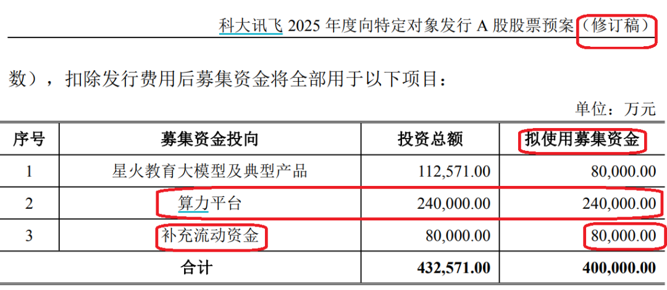
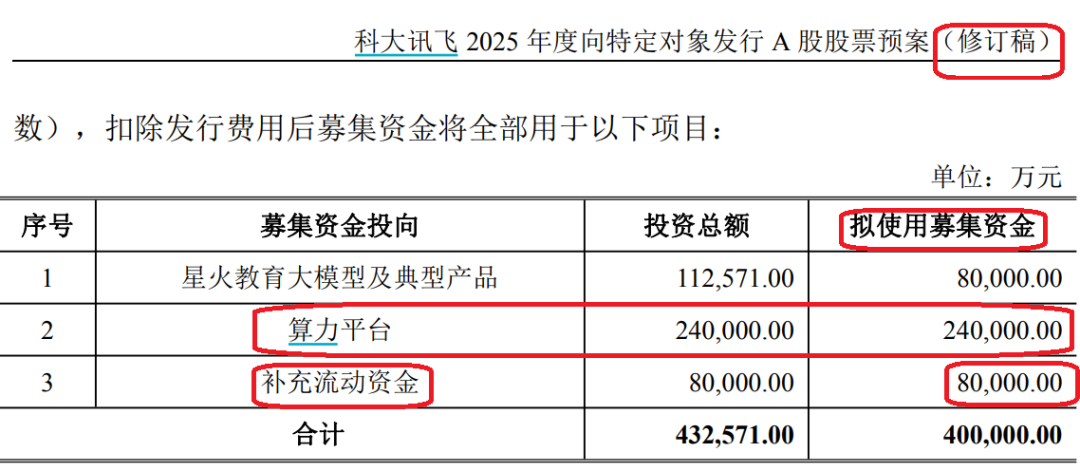
Core Viewpoint - Keda Xunfei has significantly adjusted its private placement plan, changing the use of raised funds while maintaining the total fundraising amount at 4 billion yuan [2][3]. Fundraising Allocation - The total investment amount for the fundraising plan is 432.57 million yuan, with 400 million yuan allocated for use [3]. - The funding for the Spark Education large model and typical products remains at 80 million yuan, while the amount for supplementing working capital has been reduced from 3.2 billion yuan to 800 million yuan [3][4]. - A new allocation of 2.4 billion yuan has been added for the computing power platform project, which now accounts for approximately 60% of the total fundraising scale [3][4]. Strategic Importance of Computing Power - The computing power platform project aims to support the upgrade and iteration of the underlying model for Xunfei's Spark cognitive large model, ensuring the optimization of various large models, including deep reasoning and multilingual models [4]. - The Chinese government's emphasis on the construction of autonomous and controllable large model computing power enhances the rationale for the rental computing power model [4][5]. Collaboration with Domestic Suppliers - Keda Xunfei has established long-term collaborative mechanisms with domestic computing power suppliers such as Huawei and Cambrian, addressing hidden issues in the underlying software and hardware of domestic computing power [5]. - The implementation of the computing power platform project is expected to enhance the multilingual support capabilities of the Spark large model, creating new revenue growth points for the company [5]. Market Position and Valuation - As of September 29, Keda Xunfei's stock closed at 53.95 yuan per share, with a market capitalization of 124.7 billion yuan [6].


科大讯飞大幅调整定增方案
Zhong Guo Ji Jin Bao· 2025-09-30 05:04
Core Viewpoint - The company Keda Xunfei has significantly revised its fundraising plan for the issuance of A-shares, changing the allocation of raised funds while maintaining the total amount at 4 billion yuan [1]. Fundraising Allocation - The revised fundraising plan includes a total investment of 432.571 million yuan, with 400 million yuan allocated for specific uses. The allocation is as follows: - 80 million yuan for the Spark Education large model and typical products - 240 million yuan for the computing power platform - 80 million yuan for supplementing working capital - Compared to the previous plan released on August 22, the amount for working capital has been reduced from 320 million yuan to 80 million yuan, while an additional 240 million yuan has been allocated to the computing power platform project, which now accounts for approximately 60% of the total fundraising [2][3]. Computing Power Platform Project - The computing power platform project aims to expand computing resources to support the iterative upgrades of the Spark cognitive large model. It will also provide computational support for the continuous optimization of various large models, including the Spark X1 model and multi-modal large models [3]. - The project aligns with national policies that emphasize the importance of autonomous and controllable large model computing power construction, making the rental of computing power more reasonable under government support [4]. National Policy Support - The recent government policy encourages the strengthening of intelligent computing power coordination and supports innovation in artificial intelligence chips. This includes accelerating breakthroughs in large-scale intelligent computing clusters and enhancing the operational models of intelligent computing infrastructure [4][5]. Global Market Strategy - Keda Xunfei plans to enhance the multi-language support capabilities of its large models, targeting overseas market demands. The company aims to optimize its technology to fit local language habits, cultural contexts, and industry applications, particularly for partners in countries along the "Belt and Road" initiative [5]. Stock Performance - As of September 29, Keda Xunfei's stock closed at 53.95 yuan per share, with a market capitalization of 124.7 billion yuan [5].
千亿AI巨头,定增大幅调整
Zhong Guo Ji Jin Bao· 2025-09-30 05:01
Core Viewpoint - The company Keda Xunfei has revised its fundraising plan, maintaining a total fundraising amount of 4 billion yuan while reallocating funds to enhance its computing power platform project, which is now prioritized over working capital [4][5]. Fundraising Allocation - The revised plan keeps the total fundraising amount at 4 billion yuan, with 800 million yuan allocated for the Spark Education large model and typical product project remaining unchanged [4]. - The amount for working capital has been reduced from 3.2 billion yuan to 800 million yuan, while an additional 2.4 billion yuan is now designated for the computing power platform project, which accounts for approximately 60% of the total fundraising [4][5]. Strategic Importance of Computing Power - The computing power platform project aims to support the upgrade and iteration of the underlying model for the Spark cognitive large model, as well as provide computational support for the continuous optimization of various large models, including deep reasoning and multilingual models [5]. - The project aligns with national policies emphasizing the importance of autonomous and controllable large model computing power, making the rental of computing power more reasonable under government support [4][6]. Collaboration with Domestic Suppliers - The company has established long-term collaborative mechanisms with domestic computing power suppliers such as Huawei and Cambrian, focusing on addressing hidden issues in the underlying software and hardware of domestic computing power [6]. - The implementation of the computing power platform project is expected to enhance the multilingual support capabilities of the Spark large model, creating new revenue growth points for the company [6]. Market Position and Future Plans - The company plans to target overseas markets with its multilingual large model, optimizing for regional language habits, cultural contexts, and industry application scenarios to better meet local demands [6]. - As of September 29, the company's stock closed at 53.95 yuan per share, with a market capitalization of 124.7 billion yuan [6].
机器人ETF(159770)盘中净申购超3700万份,机构:Q4全面看多人形机器人行情
2 1 Shi Ji Jing Ji Bao Dao· 2025-09-30 03:14
Group 1 - The core viewpoint of the article highlights the active performance of the robotics sector in the A-share market, with a notable increase in the robotics ETF (159770) and significant capital inflow [1] - As of September 30, the robotics ETF (159770) rose by 0.7% with a trading volume of 187 million yuan and a net subscription of 37.5 million units [1] - The component stocks of the robotics ETF saw substantial gains, with Yuntian Lifei-U increasing over 6%, and other stocks like Yijiahe and Keda Xunfei also showing strong performance [1] Group 2 - Data from Wind Financial Terminal indicates that the robotics ETF (159770) has experienced three consecutive days of net capital inflow, totaling nearly 470 million yuan [1] - The robotics ETF (159770) tracks the CSI Robotics Index, selecting securities from listed companies related to robotics as index samples [1] - The Ministry of Industry and Information Technology, along with five other departments, released the "Mechanical Industry Stabilization and Growth Work Plan (2025-2026)" [1] Group 3 - CITIC Securities anticipates a comprehensive bullish trend in the humanoid robotics sector for Q4, driven by optimistic business communication volumes for Tesla's humanoid robots and active shipments of domestic humanoid robots [1] - Recommendations include focusing on the T-chain and suggesting attention to sectors with better industrial trends, faster growth in sensors, dexterous hands, vertical applications, and domestic supply chains [1]


国产半导体技术突破,数字经济ETF(560800)盘中涨超1%
Xin Lang Cai Jing· 2025-09-30 02:19
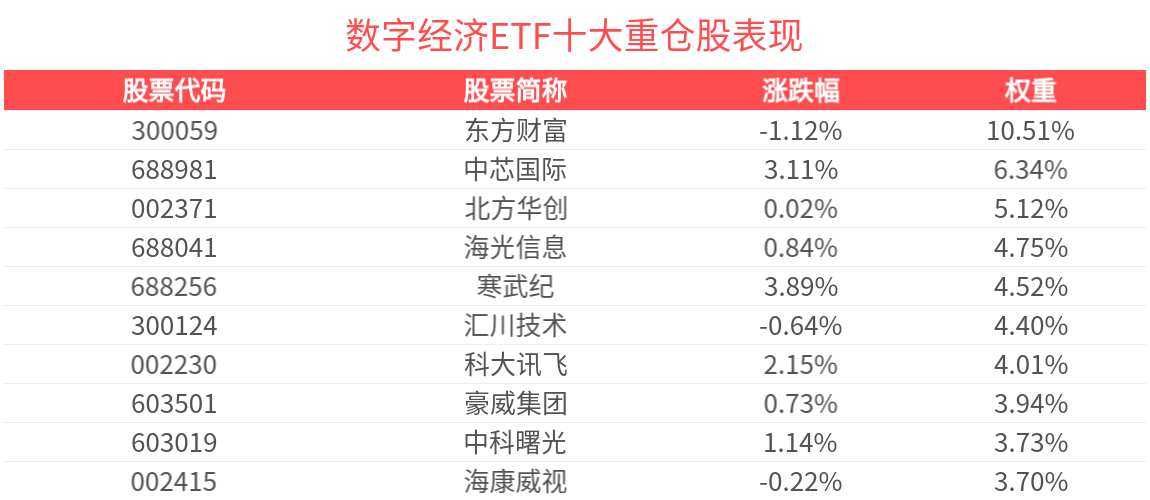
Core Viewpoint - The digital economy sector is experiencing strong growth, driven by advancements in semiconductor technology, AI demand, and domestic production capabilities [1][2]. Group 1: Market Performance - As of September 30, 2025, the CSI Digital Economy Theme Index (931582) rose by 1.28%, with notable gains from stocks such as Zhaoyi Innovation (603986) up 5.85% and Deepin Technology (300454) up 4.19% [1]. - The Digital Economy ETF (560800) increased by 1.11%, with a trading volume of 3.29 million yuan and a turnover rate of 0.46% [1]. - Over the past month, the average daily trading volume of the Digital Economy ETF was 33.59 million yuan [1]. Group 2: Technological Advancements - The Wuhan National Information Optoelectronics Innovation Center achieved a significant breakthrough by launching a fully autonomous 12-inch silicon photonics solution, which has been deployed in over 40 domestic research institutions and enterprises [1]. - Global semiconductor foundry prices are experiencing significant fluctuations, with TSMC's 2nm process pricing up 50% compared to the previous 3nm process, and major players like Samsung and Micron raising DRAM and NAND flash prices by over 30% for certain models [1]. Group 3: Industry Insights - The semiconductor industry is showing robust performance, driven by AI computing demand, domestic substitution logic, and policy support [2]. - The digital chip sector is propelled by AI computing needs, while the semiconductor equipment sector benefits from AI data center demand and deepening domestic substitution [2]. - The CSI Digital Economy Theme Index includes companies involved in digital economy infrastructure and high digitalization applications, reflecting the overall performance of digital economy-related stocks [2]. Group 4: Key Stocks - As of August 29, 2025, the top ten weighted stocks in the CSI Digital Economy Theme Index accounted for 53.36% of the index, with notable companies including Dongfang Wealth (300059) and Cambricon (688256) [2].






讯飞星原创新实践 助力数字经济飞跃发展
Xin Hua Ri Bao· 2025-09-29 21:23
Core Insights - The article highlights the evolution and achievements of iFlytek, showcasing its advancements in AI technologies and its commitment to building a self-controlled general artificial intelligence system [1][2][5] Group 1: Technological Advancements - iFlytek officially launched the iFlytek Spark model on May 6, 2023, and the iFlytek Spark 4.0 Turbo on October 24, 2024, which surpassed GPT-4 Turbo in seven core capabilities within the Chinese language domain [2] - The company introduced the first deep reasoning model based on a fully domestic computing platform, iFlytek Spark X1, in January 2025, and upgraded the Spark 4.0 Turbo with industry-first mixed-domain knowledge search technology [2] - iFlytek Spark X1 saw significant improvements in various tasks such as mathematics, coding, logic reasoning, text generation, language understanding, and knowledge Q&A, while maintaining a parameter count an order of magnitude lower than competitors [2] Group 2: Strategic Development - iFlytek Spark, based in Nanjing Xuanwu, aims to create a self-controlled general AI system and serve as a digital economy innovation engine across the nation [3] - The company has established a "three-in-one" full-stack service capability encompassing basic research, scenario implementation, and ecosystem co-construction [3] - iFlytek Spark has been involved in the formulation of national industry standards and has developed a complete technical system covering algorithm research, system security, and engineering implementation [3] Group 3: Ecosystem and Collaboration - iFlytek Spark actively participates in the construction of the national new generation AI governance system and collaborates with industry partners like Cambricon and Huawei Ascend to achieve full-stack technology ecosystem adaptation [4] - The company has developed benchmark products such as the iFlyCode intelligent programming assistant, which has received top-level certification for trustworthy AI coding tools [3][4] Group 4: Vision and Mission - iFlytek's mission emphasizes creating social value and addressing public needs through technological advancements, aiming to liberate productivity and unleash imagination with AI [5] - The company is focused on strategic directions such as code models and intelligent coding, continuously increasing investment in cutting-edge technology research and development [5] - iFlytek aims to become a globally competitive digital economy innovation hub, driving high-quality development in the digital economy [5]

科大讯飞股份有限公司第六届董事会第十五次会议决议公告
Shang Hai Zheng Quan Bao· 2025-09-29 21:20
Group 1 - The company held its 15th meeting of the 6th Board of Directors on September 29, 2025, where all 10 attending directors approved the proposal to adjust the plan for issuing A-shares to specific targets for 2025 [2][5][9] - The total amount of funds raised from the issuance of A-shares is not to exceed 400,000 million yuan, and the funds will be used for specific projects after deducting issuance costs [3][19] - The proposal to adjust the use of raised funds was reviewed and approved by the Board's Audit Committee, and it will be submitted to the shareholders' meeting for approval [4][6][8] Group 2 - The company has prepared a feasibility analysis report for the use of raised funds, which was also approved by the Board [7][22] - The company has developed measures to mitigate the dilution of immediate returns for shareholders due to the issuance of new shares, ensuring that these measures will be effectively implemented [9][23][36] - The company will hold a second extraordinary shareholders' meeting on October 15, 2025, to discuss the approved proposals [46][48]
科大讯飞调整募集资金用途 拟投入24亿元用于算力平台建设
Zheng Quan Shi Bao Wang· 2025-09-29 15:00
Core Viewpoint - The company, iFlytek, is revising its fundraising plan for 2025 to include a new "computing power platform" project, allocating 2.4 billion yuan for this initiative while maintaining the total fundraising amount at 4 billion yuan [1] Group 1: Fundraising and Investment Plans - iFlytek plans to raise up to 4 billion yuan, with 800 million yuan allocated for the Spark Education large model and typical products, and 3.2 billion yuan initially intended for working capital [1] - The revised plan introduces a third project, the "computing power platform," which will receive 2.4 billion yuan, while the working capital allocation is reduced to 800 million yuan [1] - The adjustments are subject to approval at the shareholders' meeting [1] Group 2: Computing Power Strategy - iFlytek will implement the computing power platform project through a computing power leasing model, aiming to expand computing capacity to support large model research and algorithm innovation [2] - The demand for computing power is increasing due to the growing scale of model parameters and training data, alongside the rising computational requirements of deep reinforcement learning [2] - The company faces challenges due to the relatively late start of domestic AI chips and a weak domestic computing power software ecosystem, leading to a "bottleneck" issue in computing power [2] Group 3: Collaboration and Recognition - iFlytek has established long-term collaborations with domestic computing power manufacturers such as Huawei and Cambrian, focusing on utilizing domestic computing clusters to address hidden issues in the underlying software and hardware [3] - The company's efforts in optimizing the use of computing resources have garnered recognition and support from national and local governments [3]