
SZHL(002255)

Search documents
调研速递|苏州海陆重工接受华西证券等3家机构调研,核电业务成关注要点
Xin Lang Cai Jing· 2025-09-16 07:57
Group 1 - The core focus of the investor meeting was on the company's main business, nuclear power operations, production and operational status, and future strategic planning [1][2]. - The company has been involved in the manufacturing and sales of industrial waste heat boilers, large and special material pressure vessels, nuclear safety equipment, and environmental remediation services, with no changes reported in its main business [3]. - The nuclear power business has been developed since 1998, with the company completing several first-of-their-kind manufacturing tasks both internationally and domestically, and the fourth-generation nuclear power equipment project is progressing as planned [3]. Group 2 - The company plans to enhance its core business while increasing technological innovation and management efforts, focusing on management and cost control, and optimizing resource allocation to improve profitability and market competitiveness [3]. - The production and operational performance from 2025 to the present has met expectations, with all projects progressing normally [3].

海陆重工(002255) - 002255海陆重工投资者关系管理信息20250916
2025-09-16 07:26
Group 1: Company Overview - The company specializes in the manufacturing and sales of industrial waste heat boilers, large and special material pressure vessels, and nuclear safety equipment [1] - It also provides environmental comprehensive governance services for solid waste and wastewater treatment and recycling [1] - The company operates photovoltaic power plants [1] Group 2: Nuclear Power Business - The company has been manufacturing nuclear power equipment since 1998, completing several domestic and international first-piece manufacturing tasks over 20 years [2] - Key nuclear safety equipment includes various cooling systems and storage tanks, contributing to domestic nuclear power construction [2] - The fourth-generation nuclear power equipment project disclosed at the beginning of the year is progressing smoothly, expected to alleviate current capacity bottlenecks and enhance production capabilities [2] Group 3: Production and Operational Status - The production and operational status from 2025 to date is in line with expectations, with all projects progressing normally [2] Group 4: Future Strategic Planning - The company plans to deepen its core business while increasing technological innovation and management efforts [2] - Focus will be on enhancing management and cost control, optimizing resource allocation to improve profitability and market competitiveness [2]
2025年1-7月中国工业锅炉产量为10.3万蒸发量吨 累计下降11%
Chan Ye Xin Xi Wang· 2025-09-16 03:29
Group 1 - The core viewpoint of the news highlights a decline in the production of industrial boilers in China, with a reported decrease of 6.1% year-on-year in July 2025, resulting in a total production of 16,000 tons of evaporation capacity [1] - Cumulative production from January to July 2025 reached 103,000 tons of evaporation capacity, marking an 11% decline compared to the previous year [1] Group 2 - Listed companies in the industrial boiler sector include Huaguang Huaneng (600475), Chuanrun Co., Ltd. (002272), Hailu Heavy Industry (002255), Huaxi Energy (002630), and Dongfang Electric (600875) [1] - The data is sourced from the National Bureau of Statistics and compiled by Zhiyan Consulting, which specializes in industry research and consulting services [2]





海陆重工(002255) - 2025年第一次临时股东大会决议公告
2025-09-12 11:30
证券代码:002255 证券简称:海陆重工 公告编号:2025-036 苏州海陆重工股份有限公司 2025 年第一次临时股东大会决议公告 互联网投票时间为:2025 年 9 月 12 日上午 9:15 至下午 15:00 期间的任何时 间。 2、会议召开地点:江苏省张家港市东南大道一号公司会议室。 本公司及董事会全体成员保证信息披露的内容真实、准确、完整,没有虚假 记载、误导性陈述或重大遗漏。 特别提示: 一、本次股东大会未出现否决提案的情形。 二、本次股东大会未涉及变更以往股东大会已通过的决议。 一、会议召开和出席情况: 1、会议召开时间: (1)现场会议召开时间:2025 年 9 月 12 日 14:30 (2)网络投票时间: 交易系统投票时间为:2025 年 9 月 12 日上午 9:15-9:25,9:30-11:30,下午 13:00-15:00; 3、会议召开方式:本次股东大会采取现场表决与网络投票相结合的方式。 4、会议召集人和主持人:本次会议由公司董事会召集,公司董事长徐元生 先生主持。 5、出席本次会议的股东共计 551 名,代表股份数 206,780,998 股,占公司有 表决权股份总数的 ...
海陆重工(002255) - 国浩律师(上海)事务所关于苏州海陆重工股份有限公司2025年第一次临时股东大会法律意见书
2025-09-12 11:30
关 于 苏州海陆重工股份有限公司 2025 年第一次临时股东大会 法律意见书 国浩律师(上海)事务所 上海市静安区山西北路 99 号苏河湾中心 25-28 楼 邮编:200040 25-28th Floor, Suhe Center, No. 99 North Shanxi Road, Shanghai 200040, China 电话/Tel: +86 21 5234 1668 传真/Fax: +86 21 5234 1670 网址/Website: http://www.grandall.com.cn 2025 年 9 月 国浩律师(上海)事务所 法律意见书 国浩律师(上海)事务所 关于苏州海陆重工股份有限公司 2025 年第一次临时股东大会法律意见书 致:苏州海陆重工股份有限公司 苏州海陆重工股份有限公司(以下简称"公司")2025 年第一次临时股东大 会于 2025 年 9 月 12 日召开。国浩律师(上海)事务所(以下简称"本所")经公 司聘请,委派律师出席见证公司 2025 年第一次临时股东大会(以下简称"本次 股东大会")。 本所律师根据《证券法》第一百六十三条的要求,按照律师行业公认的业务 标 ...
海陆重工上半年净利增50%,71岁徐元生与儿子分任董事长和总裁、同领百万年薪
Sou Hu Cai Jing· 2025-09-05 07:03
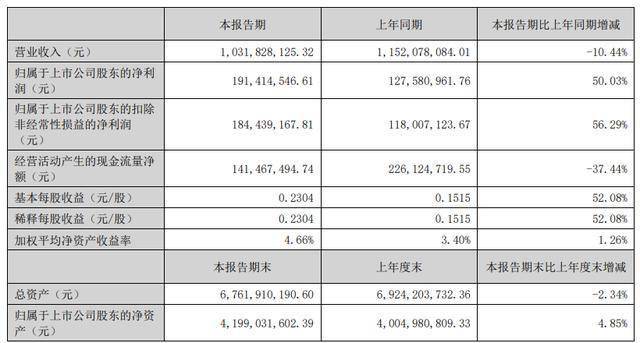
Financial Performance - In the first half of 2025, the company reported operating revenue of 1.032 billion yuan, a year-on-year decrease of 10.44% [1] - The net profit attributable to shareholders was 191 million yuan, an increase of 50.03% year-on-year [1] - The net profit after deducting non-recurring gains and losses was 184 million yuan, reflecting a year-on-year growth of 56.29% [1] - Basic earnings per share were 0.23 yuan [1] Profitability Metrics - The gross profit margin for the first half of 2025 was 30.32%, up by 6.74 percentage points year-on-year [1] - The net profit margin was 18.55%, an increase of 7.73 percentage points compared to the same period last year [1] Expense Management - Total operating expenses for the first half of the year were 102 million yuan, a decrease of 21.23 million yuan compared to the previous year [1] - The expense ratio was 9.90%, down by 0.81 percentage points year-on-year [1] - Sales expenses decreased by 2.90%, management expenses decreased by 4.31%, R&D expenses decreased by 26.05%, and financial expenses decreased by 69.51% [1] Executive Compensation - The chairman, Xu Yuansheng, received a salary of 980,000 yuan in 2024, while the president, Xu Ran, earned 1.38 million yuan [3] - Xu Yuansheng has a background in various leadership roles within the company and related entities [3] Company Overview - The company achieved operating revenue of 2.789 billion yuan in 2024, a slight decrease of 0.23% year-on-year [5] - The net profit attributable to shareholders was 377 million yuan, reflecting a year-on-year increase of 10.86% [5] - The company specializes in manufacturing industrial waste heat boilers, large and special material pressure vessels, and nuclear safety equipment, as well as environmental remediation services [5]
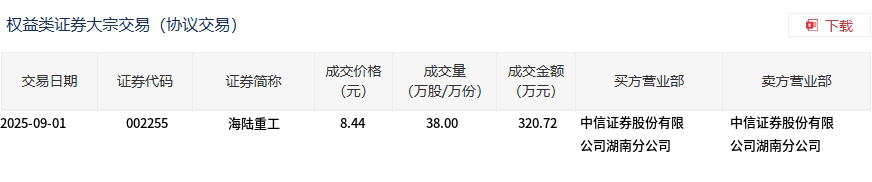
海陆重工今日大宗交易折价成交38万股,成交额320.72万元
Xin Lang Cai Jing· 2025-09-01 08:56
Group 1 - On September 1, 2025, Hailu Heavy Industry executed a block trade of 380,000 shares, with a transaction value of 3.2072 million yuan, accounting for 1.26% of the total trading volume for that day [1] - The transaction price was 8.44 yuan per share, which represents a discount of 1.97% compared to the market closing price of 8.61 yuan [1]
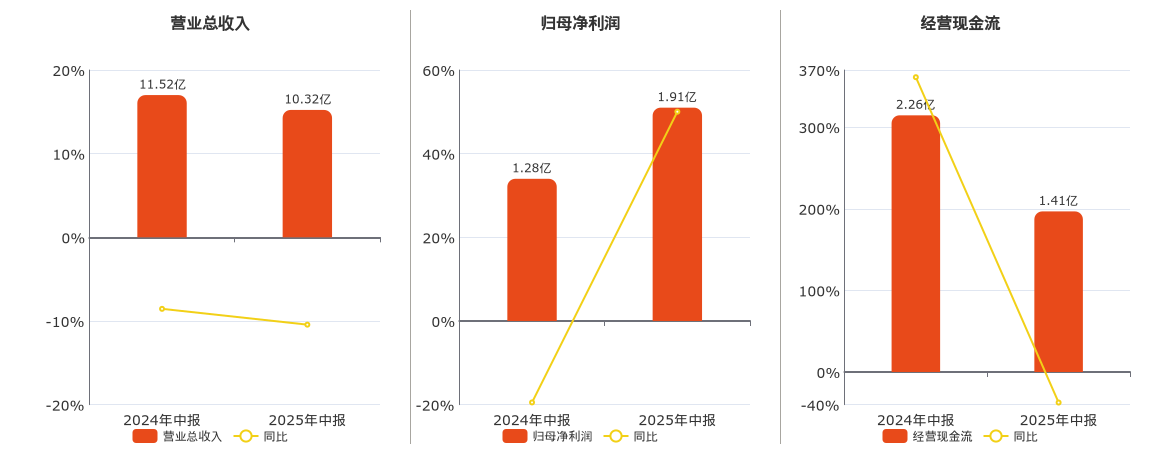
海陆重工(002255.SZ):2025年中报净利润为1.91亿元、较去年同期上涨50.03%
Xin Lang Cai Jing· 2025-08-26 02:47
Core Insights - Company reported a total revenue of 1.032 billion yuan for the first half of 2025, with a net profit attributable to shareholders of 191 million yuan, representing an increase of 63.83 million yuan or 50.03% year-on-year [1] Financial Performance - Operating cash flow net inflow was 141 million yuan [1] - Latest debt-to-asset ratio stands at 36.87%, a decrease of 3.26 percentage points from the previous quarter and a decrease of 3.77 percentage points year-on-year [3] - Gross profit margin is 30.32%, up 1.15 percentage points from the previous quarter and up 6.74 percentage points year-on-year [3] - Return on equity (ROE) is 4.56%, an increase of 1.21 percentage points year-on-year [3] - Diluted earnings per share (EPS) is 0.23 yuan, an increase of 0.08 yuan or 52.08% year-on-year [3] - Total asset turnover ratio is 0.15 times, and inventory turnover ratio is 0.42 times [3] Shareholder Structure - The number of shareholders is 87,900, with the top ten shareholders holding 260 million shares, accounting for 31.29% of total equity [3] - The largest shareholder is Xu Yuansheng with a holding of 11.5% [3]
海陆重工公布2025半年度分配预案 拟10派0.55元
Zheng Quan Shi Bao Wang· 2025-08-26 01:45
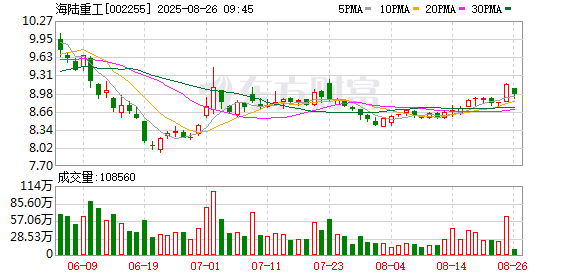
Core Viewpoint - The company announced its semi-annual distribution plan for 2025, proposing a cash dividend of 0.55 yuan per 10 shares, which represents a total cash payout of approximately 40.34 million yuan, accounting for 21.07% of its net profit [4]. Financial Performance - The company reported a revenue of 1.032 billion yuan for the first half of 2025, reflecting a year-on-year decline of 10.44%. However, net profit increased by 50.03% to 191 million yuan, with basic earnings per share at 0.2304 yuan [1]. Capital Flow - The stock experienced a net inflow of 58.31 million yuan in main funds today, while the net outflow over the past five days was 10.60 million yuan [2]. Margin Trading - The latest margin trading balance for the stock stands at 161 million yuan, with an increase of 26.20 million yuan over the past five days, marking a growth rate of 19.49% [3]. Industry Comparison - Among the 24 companies in the power equipment sector that announced their semi-annual distribution plans for 2025, the highest cash payout was from Ningde Times at 4.568 billion yuan, followed by Samsung Medical and Hengdian East Magnetic with payouts of 679 million yuan and 609 million yuan, respectively [3].
海陆重工(002255.SZ):上半年净利润1.91亿元 拟10派0.55元
Ge Long Hui A P P· 2025-08-25 20:04
Core Viewpoint - The company reported a decline in revenue for the first half of 2025, while net profit showed significant growth compared to the previous year [1] Financial Performance - The company achieved operating revenue of 1.032 billion yuan, a year-on-year decrease of 10.44% [1] - The net profit attributable to shareholders was 191 million yuan, reflecting a year-on-year increase of 50.03% [1] - The net profit attributable to shareholders after deducting non-recurring gains and losses was 184 million yuan, up 56.29% year-on-year [1] - Basic earnings per share were 0.2304 yuan [1] Dividend Distribution - The company proposed a cash dividend of 0.55 yuan (including tax) for every 10 shares to all shareholders [1]