LANCY(002612)

Search documents
朗姿股份:境外子公司阿卡邦上半年净利润下降13.29%
Bei Jing Shang Bao· 2025-08-14 13:29
Group 1 - The core viewpoint of the article is that Akabong, a subsidiary of Langzi Co., reported a decline in key financial metrics for the first half of 2025, indicating challenges in revenue generation and profitability [1] Group 2 - For the first half of 2025, Akabong's operating revenue was 452 million yuan, a year-on-year decrease of 3.27% [1] - The operating profit for the same period was 36.18 million yuan, reflecting a year-on-year decline of 22.22% [1] - The total profit amounted to 38.76 million yuan, down 16.72% compared to the previous year [1] - The net profit was reported at 28.77 million yuan, which is a decrease of 13.29% year-on-year [1] Group 3 - As of June 30, 2025, Akabong's total assets reached 1.193 billion yuan, representing a year-on-year growth of 6.96% [1] - The total liabilities were 287 million yuan, showing a year-on-year decrease of 1.77% [1] - The total equity stood at 905 million yuan, which is a year-on-year increase of 10.07% [1] Group 4 - The decline in profits is attributed to increased mall expenses due to the expansion of self-operated stores and the impact of currency fluctuations [1]

朗姿股份股价下跌3.04% 境外子公司半年度净利润下滑
Sou Hu Cai Jing· 2025-08-14 12:38
风险提示:股市有风险,投资需谨慎。 公司境外控股子公司阿卡邦2025年半年度报告显示,其净利润为2877万元,同比下降13.29%。营业收 入4.52亿元,同比下降3.27%。利润下滑主要由于自营店铺增加导致商场费用上升,以及汇率变化影 响。 截至2025年8月14日15时,朗姿股份股价报17.21元,较前一交易日下跌0.54元,跌幅3.04%。当日开盘 价为17.75元,最高触及17.78元,最低下探至17.20元,成交量为94110手,成交金额达1.65亿元。 8月14日主力资金净流出4059.90万元,占流通市值0.93%。近五个交易日累计净流出7755.09万元,占流 通市值1.77%。 朗姿股份主营业务涵盖服装设计、生产和销售,同时涉及医疗美容服务等业务领域。公司旗下拥有多个 自主品牌,并通过境外子公司阿卡邦开展业务。 来源:金融界 ...
朗姿股份(002612) - 关于境外控股子公司发布2025年半年度报告的提示性公告
2025-08-14 08:45
朗姿股份有限公司 关于境外控股子公司发布2025年半年度报告的提示性公告 本公司及董事会全体人员保证公告信息披露的内容真实、准确和完整,没有 虚假记载、误导性陈述或者重大遗漏。 朗姿股份有限公司(以下简称"公司")境外控股子公司株式会社阿卡邦 (韩国KOSDAQ上市公司,证券代码:"013990",以下简称"阿卡邦")于2025 年8月13日发布了2025年半年度报告,经公司财务管理中心按中国企业会计准则 和公司会计政策调整后,主要财务数据如下: 证券代码:002612 证券简称:朗姿股份 公告编号:2025-045 | | | | | | 单位:人民币万元 | | | --- | --- | --- | --- | --- | --- | --- | | 项目 | 2025 | 年半年度 | 2024 | 年半年度 | 增减率 | | | 营业收入 | | 45,200.47 | | 46,730.39 | -3.27% | | | 营业利润 | | 3,618.34 | | 4,652.06 | -22.22% | | | 利润总额 | | 3,876.20 | | 4,654.47 | -16.72% ...
商贸零售行业周报:武商集团布局仓储会员店,探索本土化成长路径-20250810
KAIYUAN SECURITIES· 2025-08-10 11:45
Investment Rating - The industry investment rating is "Positive" (maintained) [1] Core Insights - The report highlights the emergence of differentiated membership stores, such as the WS Jiangtun membership store launched by Wushang Group in Wuhan, which focuses on unique products and services [5][24] - The report emphasizes the importance of emotional consumption themes and recommends high-quality companies in sectors like gold jewelry, offline retail, cosmetics, and medical aesthetics [8][29] Summary by Sections Retail Market Review - The retail industry index reported a decline of 0.38% for the week of August 4 to August 8, 2025, underperforming the Shanghai Composite Index, which increased by 2.11% [14][21] - The jewelry sector showed the highest growth among retail sub-sectors, with a weekly increase of 6.07% and a year-to-date increase of 32.99% [16][19] Retail Insights - Wushang Group's WS Jiangtun membership store adopts a "paid membership + selected products" model, aiming to provide a differentiated shopping experience [5][24] - The store features a dual membership structure with basic and diamond tiers, enhancing customer engagement and loyalty [25] Investment Recommendations - Focus on gold jewelry brands with differentiated product offerings and consumer insights, recommending companies like Laopu Gold and Chaohongji [8][29] - Highlight the potential of offline retail companies that adapt to consumer trends, recommending Yonghui Supermarket and Aiyingshi [8][29] - Emphasize the growth of domestic cosmetics brands, recommending companies like Maogeping and Pola [8][29] - Suggest investment in medical aesthetics firms with differentiated product lines, recommending Aimeike and Kedi-B [8][29] Company Performance Highlights - Laopu Gold achieved a revenue of 8.506 billion yuan in FY2024, with a net profit increase of 253.9% [31][36] - Yonghui Supermarket reported a revenue of 17.479 billion yuan in Q1 2025, with a significant decline in net profit [31] - Chaohongji's Q1 2025 revenue increased by 25.4%, driven by its focus on fashion jewelry [43]



朗姿股份:公司参投的朗曦姿颜目前的产品研发、生产能力测试等事项均按计划在有序推进中
Mei Ri Jing Ji Xin Wen· 2025-08-07 03:05
Core Viewpoint - The company is progressing as planned with the product development and production capacity testing of Langxi Ziyan, which is expected to be launched in the market after successful completion [2]. Group 1 - Investors inquired about the production timeline for Langxi Ziyan and its supply targets, questioning whether it would serve only Langzi's medical beauty hospitals or also other entities outside its ecosystem [2]. - Langzi Co., Ltd. confirmed that the product development and production capacity testing for Langxi Ziyan are proceeding in an orderly manner as scheduled [2].

朗姿股份股价微跌0.17%,毛发医疗业务受关注
Sou Hu Cai Jing· 2025-08-06 14:44
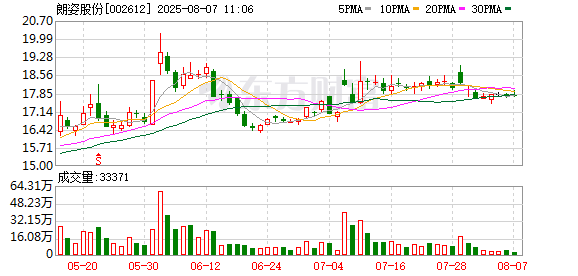
Group 1 - The stock price of Langzi Co., Ltd. on August 6 was 17.78 yuan, a decrease of 0.03 yuan or 0.17% from the previous trading day [1] - The trading volume on that day was 53,422 hands, with a transaction amount of 95 million yuan [1] - The company’s main business includes clothing design, production, and sales, as well as involvement in medical beauty and cosmetics [1] Group 2 - As a listed company in Beijing, Langzi Co., Ltd. holds a certain influence in the textile and apparel industry [1] - On August 6, the net outflow of main funds for Langzi Co., Ltd. was 14.4672 million yuan, with a cumulative net outflow of 39.0282 million yuan over the past five trading days [1]
朗姿股份有限公司 关于公司和全资子公司融资相互提供担保并接受关联方担保的公告
Zhong Guo Zheng Quan Bao - Zhong Zheng Wang· 2025-08-06 00:10
登录新浪财经APP 搜索【信披】查看更多考评等级 本公司及董事会全体成员保证信息披露的内容真实、准确、完整,没有虚假记载、误导性陈述或重大遗 漏。 特别提示: 1、朗姿股份有限公司(以下简称"朗姿股份"或"公司")第五届董事会第二十九次会议和2024年度股东 大会分别审议通过了《关于2025年度对外担保额度的议案》,同意2025年度公司及其控股子公司的对外 担保总额不超过30.50亿元(以下除非特别注明,所称"元"均指"人民币元"),其中对资产负债率未超 过70%的控股子公司担保额度为24.00亿元,对资产负债率超过70%的控股子公司担保额度为6.50亿元。 该担保额度的有效期自公司2024年度股东大会审议批准本议案之日起至2025年度股东大会召开之日止。 截至本公告披露日,公司及控股子公司对外担保总余额为116,716万元,占公司2024年度经审计净资产 的41.87%;其中,实际被担保方北京莱茵服装有限公司资产负债率超过70%,公司对资产负债率超过 70%的控股子公司担保余额为1,000万元。 2、公司及其控股子公司对合并报表外单位提供的担保总余额为36,000万元,占公司2024年度经审计净 资产的12 ...
朗姿股份有限公司关于公司和全资子公司融资相互提供担保并接受关联方担保的公告
Shang Hai Zheng Quan Bao· 2025-08-05 17:58
Core Viewpoint - The announcement details the approval of a guarantee framework for 2025, allowing the company and its subsidiaries to provide external guarantees totaling up to 3.05 billion RMB, with specific allocations based on the subsidiaries' debt ratios [2]. Summary by Sections 1. Guarantee Overview - The company has approved a total external guarantee limit of 3.05 billion RMB for 2025, with 2.4 billion RMB allocated for subsidiaries with a debt ratio not exceeding 70% and 650 million RMB for those exceeding 70% [2]. - As of the announcement date, the total external guarantee balance is 1.16716 billion RMB, representing 41.87% of the company's audited net assets for 2024 [2][14]. 2. Guarantee Details - The company provides a maximum joint liability guarantee of 160 million RMB for its subsidiary, Beijing Medical Management Co., Ltd. (Beijing Medical), which is borrowing from Hangzhou Bank [5]. - Beijing Medical also provides a joint liability guarantee for the company’s borrowing of 30 million RMB from Shanghai Pudong Development Bank [6]. 3. Financial Data - Beijing Medical has a registered capital of 1 billion RMB and was established on August 31, 2022 [8]. - The company has a registered capital of approximately 442.45 million RMB and was founded on November 9, 2006 [8]. 4. Guarantee Agreements - The guarantee for Beijing Medical's loan includes a maximum guarantee amount of 176 million RMB, covering all principal, interest, penalties, and related costs [9]. - The guarantee for the company's loan from Shanghai Pudong Development Bank has a maximum amount of 30 million RMB, covering similar costs as the previous agreement [10][11]. 5. Board Opinion - The board believes that the mutual guarantees between the company and its subsidiary will support business development and enhance operational stability without negatively impacting the company or its shareholders [12]. 6. Related Transactions - From January 1 to June 30, 2025, the company engaged in related transactions totaling approximately 54.62 million RMB with its actual controller and related parties [13]. 7. Guarantee Status - The company has no overdue guarantees or guarantees involved in litigation, ensuring a stable financial position [3][14].
朗姿股份: 关于公司和全资子公司融资相互提供担保并接受关联方担保的公告
Zheng Quan Zhi Xing· 2025-08-05 16:10
证券代码:002612 证券简称:朗姿股份 公告编号:2025-044 朗姿股份有限公司 关于公司和全资子公司融资相互提供担保并接受关联方担保的 公告 本公司及董事会全体成员保证信息披露的内容真实、准确、完整,没有虚假 记载、误导性陈述或重大遗漏。 特别提示: 第二十九次会议和 2024 年度股东大会分别审议通过了《关于 2025 年度对外担保 额度的议案》,同意 2025 年度公司及其控股子公司的对外担保总额不超过 30.50 亿元(以下除非特别注明,所称"元"均指"人民币元"),其中对资产负债率 未超过 70%的控股子公司担保额度为 24.00 亿元,对资产负债率超过 70%的控股 子公司担保额度为 6.50 亿元。该担保额度的有效期自公司 2024 年度股东大会审 议批准本议案之日起至 2025 年度股东大会召开之日止。截至本公告披露日,公 司及控股子公司对外担保总余额为 116,716 万元,占公司 2024 年度经审计净资 产的 41.87%;其中,实际被担保方北京莱茵服装有限公司资产负债率超过 70%, 公司对资产负债率超过 70%的控股子公司担保余额为 1,000 万元。 占公司 2024 年度 ...
朗姿股份40天内借款3.6亿元
Jing Ji Guan Cha Wang· 2025-08-05 12:43
Core Viewpoint - Langzi Co., Ltd. has been actively seeking bank loans to support its daily operational cash flow, indicating a focus on maintaining liquidity amid its expansion in the medical aesthetics sector [2][3]. Group 1: Loan Applications - On August 5, Langzi Co., Ltd. announced a loan application of 160 million yuan from Hangzhou Bank, following a previous application for 10 million yuan and 1 million yuan from other banks, totaling 360 million yuan in loans applied for within 40 days [2]. - Since 2025, Langzi has issued 15 announcements related to loan guarantees, including applications for bank credit lines and working capital loans, with a total borrowing amount of 232 million yuan in 2024 alone [2]. Group 2: Purpose of Loans - The company stated that the recent bank loans are primarily for daily operational cash flow, including employee salaries and supplier payments, with some funds potentially allocated for acquisition loans [3]. - The company has set a total external guarantee limit of 3.05 billion yuan for 2025, with different limits based on the subsidiaries' debt ratios [3]. Group 3: Financial Health - As of August 5, 2025, Langzi's total external guarantee balance is approximately 1.17 billion yuan, with 10 million yuan guaranteed for subsidiaries with a debt ratio exceeding 70% [4]. - The company has seven subsidiaries in the medical aesthetics sector with debt ratios above 70%, the highest being Chengdu Gaoxin Milan Baiyu Medical Aesthetic Hospital at 133.08% [4]. Group 4: Business Performance - Langzi Co., Ltd. transitioned into the medical aesthetics sector in 2016 and currently operates multiple brands across various cities, contributing significantly to its revenue [5]. - From 2022 to 2024, the company's debt ratio increased from 49.1% to 57.4%, with 2024 revenues reported at 5.691 billion yuan, a slight decrease of 0.24% year-on-year, while net profit increased by 1.38% to 257 million yuan [5]. - The medical aesthetics business generated 2.78 billion yuan in revenue in 2024, accounting for approximately 49% of the company's total revenue, with a 3.47% year-on-year growth [5].