
Guosen Securities(002736)

Search documents
国信证券完成收购股本增至102.4亿股 经纪和投资收益驱动净利连增4季
Chang Jiang Shang Bao· 2025-09-14 23:19
Core Viewpoint - Guosen Securities has successfully acquired Wanhe Securities, with the newly issued shares listed on September 10, 2025, marking a significant expansion for the company in the securities industry [1][2]. Acquisition Details - Guosen Securities completed the acquisition of 96.08% of Wanhe Securities from seven institutions for a total transaction value of 5.192 billion yuan, issuing 629 million shares at a price of 8.25 yuan per share [2][3]. - The acquisition process involved multiple regulatory approvals, including from the Shenzhen State-owned Assets Supervision and Administration Commission and the China Securities Regulatory Commission [2][3]. Financial Performance - In the first half of 2025, Guosen Securities reported operating revenue of 11.075 billion yuan and a net profit attributable to shareholders of 5.367 billion yuan, representing year-on-year growth of 51.84% and 71%, respectively [4][5]. - The company's net profit has shown continuous growth over four consecutive quarters, with significant increases in the second quarter of 2024 and the first half of 2025 [5][6]. Business Segments - The growth in Guosen Securities' revenue is primarily driven by investment income and brokerage services, with investment income accounting for 40.93% of total revenue in 2024 [5][6]. - In the first half of 2025, investment income reached 5.066 billion yuan, up 78.99% year-on-year, while brokerage service income also saw substantial growth [6]. Industry Context - The securities industry has witnessed a surge in mergers and acquisitions, with six completed transactions in the past year, indicating a trend towards consolidation [3]. - The overall bond issuance by securities firms has increased significantly, with a year-on-year growth of 66.18% as of September 11, 2025, driven by the need for business expansion and capital optimization [7].

券商8月份发债近3000亿创年内新高 自营、两融业务驱动“补血”需求激增
Zheng Quan Shi Bao· 2025-09-14 22:15
Core Viewpoint - The recent surge in bond issuance by securities firms is driven by a combination of active market trading, low interest costs, policy encouragement, and the need for debt structure adjustment and business expansion [1][4]. Group 1: Bond Issuance Trends - In August, securities firms issued a record 141 bonds, raising a total of 2,935 billion yuan, marking the highest monthly figures of the year [2][3]. - As of September 12, the total bond issuance by securities firms for the year reached 1.06 trillion yuan, a significant increase from 673.63 billion yuan in the same period last year [2][3]. - Six securities firms have issued over 500 billion yuan in bonds this year, with China Galaxy Securities leading at 1,025 billion yuan [3]. Group 2: Business Development and Financing Needs - The financing demand from securities firms surged significantly from July to August, coinciding with a notable rise in the A-share market, where the Shanghai Composite Index broke through several key points [4]. - The primary uses of the raised funds include refinancing existing debts and supplementing working capital to support business expansion [4]. - The shift in the securities industry towards capital-driven growth necessitates increased capital scale, which can be achieved through bond issuance [4]. Group 3: Margin Financing and Competitive Landscape - The balance of margin financing reached 2.34 trillion yuan by September 11, indicating a growing demand for leveraged funds among high-net-worth clients [7]. - The average bond issuance interest rate for securities firms this year is 1.89%, with larger firms enjoying lower rates around 1.85% [7][8]. - Some leading firms are offering competitive margin financing rates as low as 2.8% for high-net-worth clients, while smaller firms face pressure due to higher financing costs [8].






海外债市系列之七:海外央行购债史:欧洲央行篇
Guoxin Securities· 2025-09-14 08:02
Report Industry Investment Rating No relevant content provided. Core Viewpoints - The "History of Overseas Central Bank Bond Purchases" series systematically analyzes key stages of bond - purchase policies of the Bank of Japan, the Federal Reserve, and the European Central Bank. Their policies have similarities and differences in approach, implementation timing, and scale [1]. - The Bank of Japan and the Federal Reserve's bond - purchase policies evolved from traditional to innovative tools. The Bank of Japan was a pioneer in unconventional monetary policies, starting quantitative easing in 2001. The Federal Reserve launched quantitative easing in 2008. The ECB was more cautious about unconventional policies and started full - scale quantitative easing in 2015 [1]. - The bond - purchase policies of the Federal Reserve, ECB, and the Bank of Japan have been complex. The Federal Reserve ended QE in 2014, then had a slow balance - sheet reduction (QT), which was halted early in 2019. It restarted QE in 2022 due to the pandemic and then QT due to high inflation. The ECB stopped APP net purchases in 2018, restarted in 2019, and ended bond - buying in 2022 and started passive QT in 2023. The Bank of Japan ended negative interest rates and started balance - sheet reduction in March 2024. The Bank of Japan's exit was more cautious and delayed, the Federal Reserve's policy cycle was more flexible, and the ECB's policy shift was more sluggish [2]. - The bond - purchase scales of the three central banks are huge. As of August 20, 2025, the Bank of Japan's scale was 574.8 trillion yen, the Federal Reserve's was $6.5 trillion, and the ECB's was 4.2 trillion euros, accounting for 79.5%, 98.6%, and 69.2% of their total assets respectively. Relative to economic aggregates, the Bank of Japan's balance - sheet expansion was more significant [3]. - The Federal Reserve and the ECB have a wider range of bond - purchase categories. The Federal Reserve mainly buys MBS and Treasury bonds. The ECB's bond - purchase scope includes government bonds, covered bonds, asset - backed securities, and corporate bonds. The Bank of Japan, besides buying Treasury bonds, also buys a large amount of stock ETFs and J - REITs [3]. - The Bank of Japan's YCC policy directly sets an interest - rate ceiling, marking a new stage in monetary policy by shifting from controlling bond - purchase quantity to controlling bond interest rates [3]. Summary by Relevant Catalog First Stage (2009 - 2010): First Attempt during the Sub - prime Crisis - **Macro Background and Bond - purchase Policy Goals**: Provide liquidity to the bond market. After the 2008 financial crisis, the euro - area banking system faced a liquidity crisis, especially in the covered - bond market [14][15]. - **Bond - purchase Method**: Continuously make small - scale purchases in the primary and secondary markets. In May 2009, the ECB announced the CBPP, buying 600 billion euros of covered bonds from July 2009 to June 30, 2010, with a maximum holding of 611.4 billion euros [16]. - **Bond - market Impact Analysis**: The CBPP had a certain boosting effect on the covered - bond market, reducing the yield and spread of bank - issued covered bonds and enhancing bank financing ability. However, due to its limited scale, its impact on the overall bond market and economy was relatively mild [17]. Second Stage (2010 - 2012): Emergency Response during the European Debt Crisis - **Macro Background and Bond - purchase Policy Goals**: Provide liquidity to the bond market. After the Greek debt crisis, market panic spread to peripheral countries, causing a sell - off of their sovereign bonds and a surge in yields. The ECB launched the "Securities Markets Programme" (SMP) to address market liquidity and financing difficulties [22]. - **Bond - purchase Method**: Buy sovereign bonds of troubled countries in the secondary market. The SMP aimed to buy public and private - sector bonds in the secondary market without disclosing the quantity, time frame, or target level. It initially focused on Greece, Ireland, and Portugal, then expanded to Italy and Spain. The ECB also sterilized the injected liquidity. In 2011, SMP was restarted and expanded. The SMP's total reached a maximum of 2,195 billion euros by March 5, 2012. In 2011, the ECB launched CBPP2 with a planned scale of 400 billion euros but only bought 164 billion euros. In 2012, the "Outright Monetary Transactions" (OMT) plan was introduced but never activated [23][24]. - **Bond - market Impact Analysis**: The SMP had an immediate positive impact on the bond market, reducing the yields of Spanish and Italian bonds. The OMT had an "announcement effect", significantly reducing the yields of Spanish and Italian bonds. However, as the economic recovery was weak, the effectiveness of the SMP decreased [25]. Third Stage (2013 - 2018): Full - scale Quantitative Easing under Persistent Low Inflation - **Macro Background and Bond - purchase Policy Goals**: Implement QE in the euro area. After the European debt crisis, the euro - area economy recovered slowly, with low inflation and high financing costs. The ECB introduced negative interest rates and launched multiple bond - purchase programs [31]. - **Bond - purchase Method**: Use a combination of measures. In 2014, the ECB announced CBPP3 and the Asset - Backed Securities Purchase Program (ABSPP). CBPP3 bought covered bonds, with a holding of 2,702 billion euros by the end of 2018. ABSPP bought asset - backed securities, with a holding of 276 billion euros by the end of 2018. In 2015, the Expanded Asset Purchase Programme (APP) was launched, including the Public Sector Purchase Programme (PSPP) and the Corporate Sector Purchase Programme (CSPP). The APP ended net purchases in December 2018, with a cumulative net purchase of about 2.65 trillion euros [32][33][35]. - **Bond - market Impact Analysis**: The ECB's large - scale bond purchases led to a significant decline in long - term government bond yields in the euro area. The yields of German 10 - year government bonds fell into negative territory in 2016, and the yields of French bonds also dropped close to zero. The spread between peripheral and core countries generally narrowed [39]. Fourth Stage (2019 - 2023): Emergency Bond - purchase Plan during the Pandemic - **Macro Background and Bond - purchase Policy Goals**: Intervene promptly to maintain financial stability. In 2019, due to economic slowdown and low inflation, the ECB restarted QE. In 2020, the "Pandemic Emergency Purchase Programme" (PEPP) was launched to deal with the impact of the COVID - 19 pandemic [42]. - **Bond - purchase Method**: Systematically increase purchases. In September 2019, the ECB restarted QE with a monthly purchase of 200 billion euros. In March 2020, an additional 1,200 billion euros of purchases were announced. The PEPP was launched in March 2020 with an initial scale of 7,500 billion euros, which was later expanded to 1.85 trillion euros. The PEPP ended net purchases in March 2022, with a cumulative purchase of about 1.71 trillion euros [43][45]. - **Bond - market Impact Analysis**: The PEPP effectively alleviated market panic, stabilized investor confidence, and reduced excessive market volatility. During the implementation and scale - expansion of the PEPP, the 10 - year bond yields in Europe generally declined. When the purchase speed slowed down, bond yields generally rose [52]. Summary and Insights from Overseas Central Bank Bond Purchases - Similarities and differences exist among the bond - purchase policies of the Bank of Japan, the Federal Reserve, and the ECB in terms of approach, implementation timing, and scale, as detailed in the core viewpoints above [53].
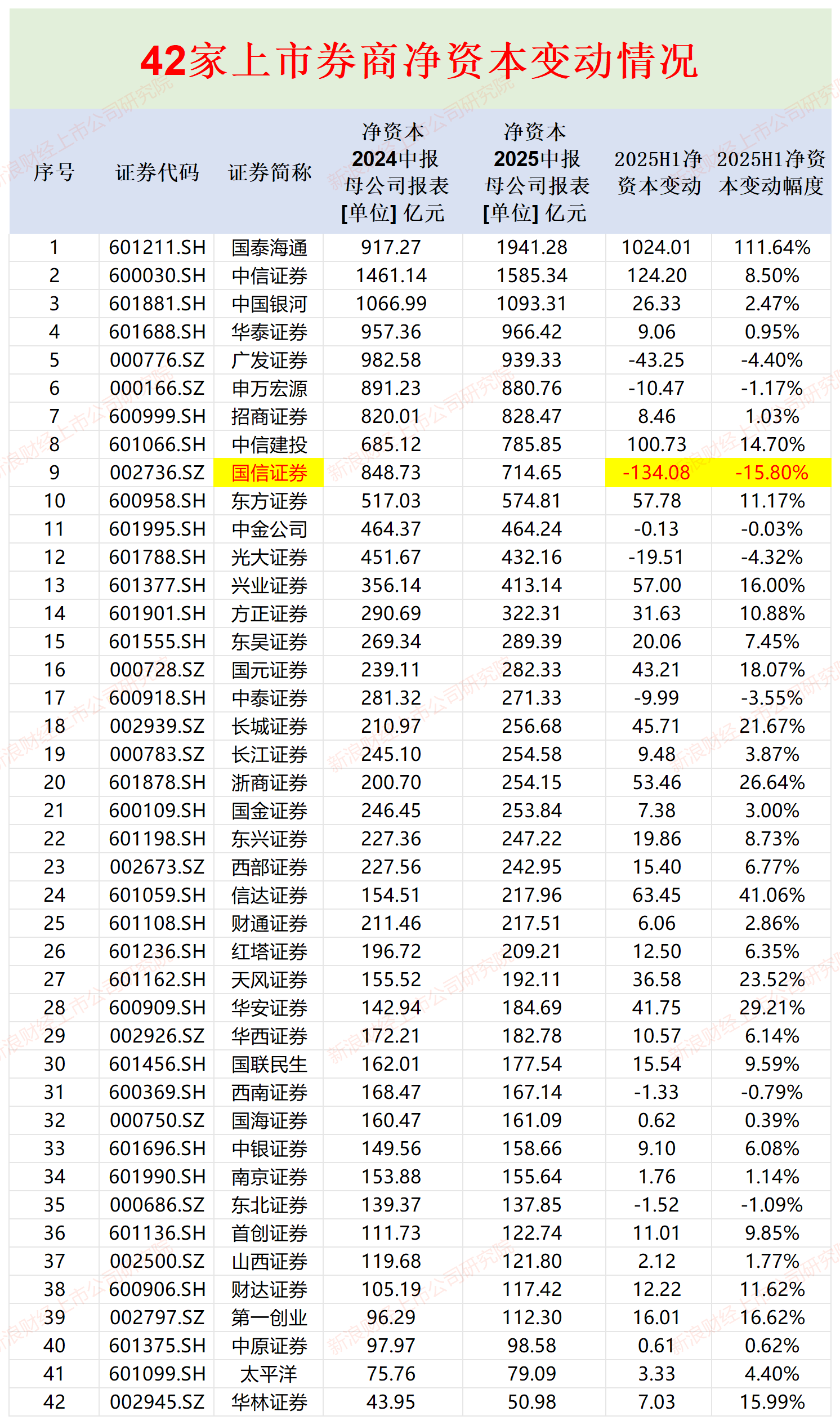
国信证券净资本减少金额及降幅皆最大 收购万和证券也难弥补下降缺口|券商半年报
Xin Lang Zheng Quan· 2025-09-12 10:27
Core Insights - The 42 listed securities firms reported a total operating revenue of 251.9 billion yuan for the first half of 2025, a year-on-year increase of 31%, and a net profit attributable to shareholders of 104 billion yuan, up 65% [1] - Guotai Junan surpassed CITIC Securities in net capital, reaching 194.1 billion yuan, marking an increase of 102.4 billion yuan, or 111.64% [1][8] - Guoxin Securities experienced the largest decrease in net capital, dropping by 13.4 billion yuan to 71.5 billion yuan, a decline of 15.8% [3][6] Revenue and Profit Performance - Guoxin Securities achieved a revenue of 11.1 billion yuan, a year-on-year growth of 51.84%, and a net profit of 5.4 billion yuan, up 71% [1][2] - The total net capital of the 42 listed securities firms increased by 168.4 billion yuan to 1547.6 billion yuan, reflecting a growth rate of 10.88% [5] Capital Structure and Implications - Net capital is a critical indicator of a securities firm's capital adequacy and liquidity, with a decrease potentially limiting business expansion and risk tolerance [6][7] - Guoxin Securities' significant drop in net capital may hinder its ability to engage in capital-intensive business activities [6][7] Competitive Landscape - Guotai Junan's rise in net capital positions it as a potential leader in the industry, challenging CITIC Securities' previous dominance [8] - Despite Guotai Junan's higher net profit, its underlying performance may be influenced by non-recurring gains, raising questions about its sustainable growth compared to CITIC Securities [8]

国信证券:拟发行不超过43亿元公司债券
Xin Lang Cai Jing· 2025-09-12 08:25
Core Viewpoint - Guosen Securities plans to issue a public bond for professional investors, with a total scale not exceeding 4.3 billion yuan, aimed at repaying interest-bearing debts and supplementing operational funds [1] Group 1 - The bond issuance is the sixth phase and will have a term of 3 years [1] - The coupon rate will be determined after an inquiry process [1] - The bonds will be unsecured and will adopt a public inquiry method for professional institutional investors [1] Group 2 - The funds raised will be used to repay the company's interest-bearing debts and to supplement operational capital [1]
国信证券(002736) - 国信证券股份有限公司2025年面向专业投资者公开发行公司债券(第六期)募集说明书
2025-09-12 08:16
国信证券股份有限公司 2025 年面向专业投资者公开发行公司债券(第六期)募集说明书 声明 发行人将及时、公平地履行信息披露义务,发行人及其全体董事、监事、高 级管理人员或履行同等职责的人员保证募集说明书信息披露的真实、准确、完整, 不存在虚假记载、误导性陈述或重大遗漏。 主承销商已对募集说明书进行了核查,确认不存在虚假记载、误导性陈述和 重大遗漏,并对其真实性、准确性和完整性承担相应的法律责任。 发行人承诺在本期债券发行环节,不直接或者间接认购自己发行的债券。债 券发行的利率或者价格应当以询价、协议定价等方式确定,发行人不会操纵发行 定价、暗箱操作,不以代持、信托等方式谋取不正当利益或向其他相关利益主体 输送利益,不直接或通过其他利益相关方向参与认购的投资者提供财务资助、变 相返费,不会出于利益交换的目的通过关联金融机构相互持有彼此发行的债券, 不实施其他违反公平竞争、破坏市场秩序等行为。 发行人如有董事、监事、高级管理人员、持股比例超过 5%的股东及其他关 联方参与本期债券认购,发行人将在发行结果公告中就相关认购情况进行披露。 中国证券监督管理委员会、深圳证券交易所对债券发行的注册或审核,不代 表对债券的 ...
国信证券(002736) - 国信证券股份有限公司2024年面向专业投资者公开发行公司债券更名公告
2025-09-12 08:16
国信证券股份有限公司2024年面向专业投资者公开发行 公司债券更名公告 2024 年 11 月 29 日,中国证券监督管理委员会以证监许可[2024]1722 号文 同意国信证券股份有限公司面向专业投资者公开发行公司债券的注册。 由于债券跨年及分期发行,按照公司债券命名惯例,征得主管部门同意,本 期债券名称由"国信证券股份有限公司 2024 年面向专业投资者公开发行公司债 券"变更为"国信证券股份有限公司 2025 年面向专业投资者公开发行公司债券 (第六期)",债券简称"25 国证 10"。 本期债券名称更变不改变原签订的与本期公司债券发行相关的法律文件效 力,原签署的法律文件对更名后的公司债券继续具有法律效力。前述法律文件包 括但不限于:《国信证券股份有限公司 2024 年面向专业投资者公开发行公司债券 之受托管理协议》《国信证券股份有限公司 2024 年面向专业投资者公开发行公司 债券债券持有人会议规则》。 (以下无正文) 1 (此页无正文,为《国信证券股份有限公司 2024 年面向专业投资者公开发行公 司债券更名公告》之盖章页 ) 2 (此页无正文,为《国信证券股份有限公司 2024 年面向专业投资者 ...
国信证券(002736) - 国信证券股份有限公司2025年面向专业投资者公开发行公司债券(第六期)发行公告
2025-09-12 08:15
发行人 牵头主承销商、债券受托管理人 住所:北京市丰台区西营街 8 号院 1 号楼 7 至 18 层 101 联席主承销商 国信证券股份有限公司 2025 年面向专业投资者公开发行公司债券 (第六期) 发行公告 住所:深圳市福田区福田街道福华一路 119 住所:广东省深圳市福田区福田街道金田路 号安信金融大厦 2026 号能源大厦南塔楼 10-19 层 签署时间:二〇二五年九月 本公司及其董事、监事、高级管理人员保证公告内容真实、准确和完整,并对公告 中的虚假记载、误导性陈述或者重大遗漏承担责任。 重要事项提示 1.国信证券股份有限公司(以下简称"发行人"或"公司")已于 2024 年 11 月 29 日 获得中国证券监督管理委员会证监许可[2024]1722 号文,可向专业投资者公开发行面值 总额不超过 200 亿元的公司债券(以下简称"本次债券")。 发行人本次债券采取分期发行的方式,"国信证券股份有限公司 2025 年面向专业投 资者公开发行公司债券(第六期)"(以下简称"本期债券")为本次债券项下第八期, 发行规模为不超过人民币 43 亿元(含 43 亿元),债券简称"25 国证 10"。 2.本期债 ...
国信证券(002736) - 国信证券股份有限公司2025年面向专业投资者公开发行公司债券(第六期)信用评级报告
2025-09-12 08:14
跟踪评级安排 中诚信国际信用评级有限责任公司 2025 年 9 月 8 日 2 国信证券股份有限公司 2025 年面向专业投资者公开发行 公司债券(第六期)信用评级报告 编号:CCXI-20253435D-01 国信证券股份有限公司 2025 年面向专业投资者公开发行 公司债券(第六期)信用评级报告 声 明 本次评级为委托评级,中诚信国际及其评估人员与评级委托方、评级对象不存在任何其他影响本次评级行为独立、 客观、公正的关联关系。 本次评级依据评级对象提供或已经正式对外公布的信息,以及其他根据监管规定收集的信息,中诚信国际按照相关 性、及时性、可靠性的原则对评级信息进行审慎分析,但中诚信国际对于相关信息的合法性、真实性、完整性、准 确性不作任何保证。 中诚信国际及项目人员履行了尽职调查和诚信义务,有充分理由保证本次评级遵循了真实、客观、公正的原则。 评级报告的评级结论是中诚信国际依据合理的内部信用评级标准和方法、评级程序做出的独立判断,未受评级委托 方、评级对象和其他第三方的干预和影响。 本评级报告对评级对象信用状况的任何表述和判断仅作为相关决策参考之用,并不意味着中诚信国际实质性建议任 何使用人据此报告采取 ...
国信证券跌2.02%,成交额5.17亿元,主力资金净流出3572.25万元
Xin Lang Cai Jing· 2025-09-12 06:28
Group 1 - The core viewpoint of the news is that Guosen Securities has experienced fluctuations in its stock price and trading volume, with a notable year-to-date increase of 29.40% as of September 12 [1] - As of June 30, 2025, Guosen Securities reported a net profit of 5.367 billion yuan, representing a year-on-year growth of 71.00% [2] - The company has distributed a total of 27.626 billion yuan in dividends since its A-share listing, with 8.555 billion yuan distributed in the last three years [3] Group 2 - The stock price of Guosen Securities was reported at 14.04 yuan per share, with a market capitalization of 143.794 billion yuan [1] - The company’s main business segments include investment and trading (44.64%), wealth management and institutional business (43.68%), investment banking (5.21%), asset management (4.23%), and other businesses (2.24%) [1] - As of June 30, 2025, the number of shareholders decreased by 8.98% to 97,000, while the average circulating shares per person increased by 9.87% to 94,215 shares [2]