QRCB(002958)

Search documents
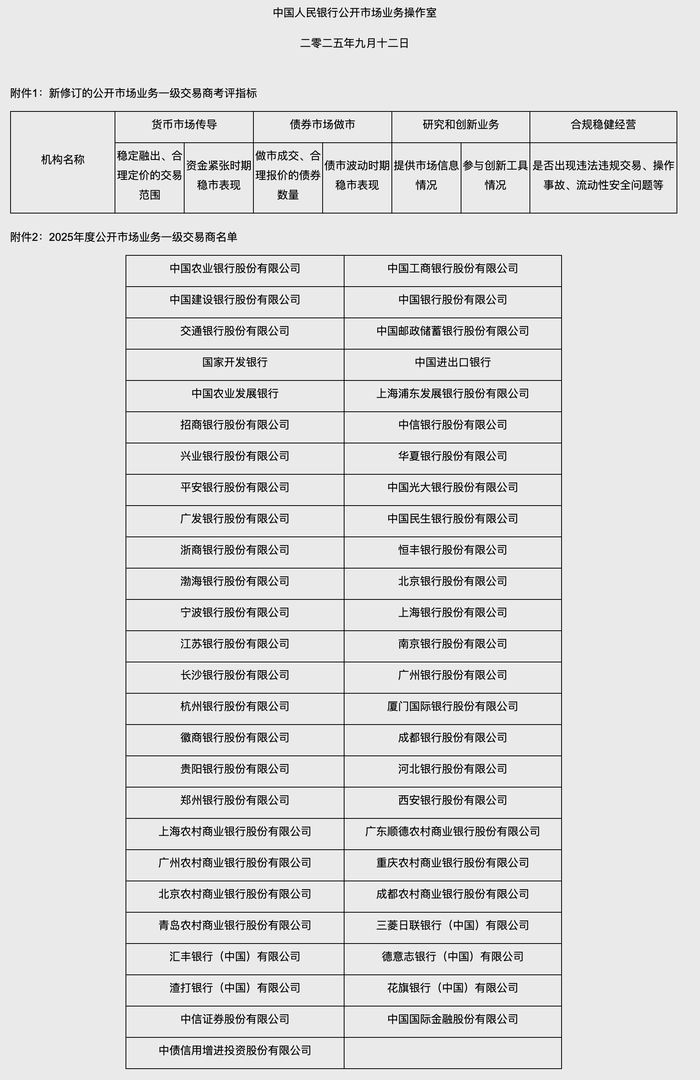
央行:调整后的一级交易商考评办法将从2025年启用,考评期内行为不当的一级交易商将被暂停参与公开市场操作
Sou Hu Cai Jing· 2025-09-12 10:45
Core Viewpoint - The People's Bank of China (PBOC) has established a new evaluation mechanism for primary dealers in the open market, which will be implemented in 2025, aiming to enhance the transmission of monetary policy and adapt to the evolving financial market [1]. Group 1: Evaluation Mechanism - The PBOC's evaluation mechanism for primary dealers was first established in 2004 and adjusted in 2018 to support smooth open market operations [1]. - The new evaluation method will focus on optimizing and simplifying assessment indicators, categorizing institutions for evaluation, and strengthening the linkage with bond market makers [1]. - The list of primary dealers for the year 2025 will remain unchanged, and any dealer exhibiting inappropriate behavior during the evaluation period may be suspended from participating in open market operations [1]. Group 2: Institutions Involved - A comprehensive list of institutions that will be evaluated includes major banks such as Agricultural Bank of China, Industrial and Commercial Bank of China, China Construction Bank, and Bank of China, among others [3][4]. - The evaluation will consider factors such as stable lending, reasonable pricing, market performance during tight funding periods, and compliance with operational standards [3].







青岛农商行吸收合并青岛平度惠民村镇银行获批
Bei Jing Shang Bao· 2025-09-12 09:18
Group 1 - The National Financial Regulatory Administration of Qingdao approved the merger of Qingdao Rural Commercial Bank with Qingdao Pingdu Huimin Village Bank, allowing the latter to be transformed into a branch of the former [1] - Qingdao Rural Commercial Bank is required to follow relevant laws and regulations during the merger process and ensure the dissolution of Qingdao Pingdu Huimin Village Bank is completed [1] - After the merger preparations are completed, Qingdao Rural Commercial Bank must submit applications for branch establishment and other related matters to regulatory authorities [1] Group 2 - The merger will involve the transfer of assets, liabilities, business, employees, and rights and obligations from Qingdao Pingdu Huimin Village Bank to Qingdao Rural Commercial Bank [1] - The regulatory body emphasized the importance of maintaining stability in personnel and business during the merger process, as well as managing public opinion risks and strengthening risk control [1]

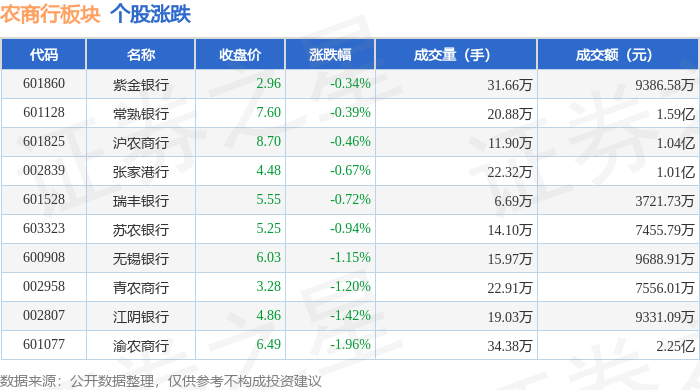
农商行板块9月12日跌1.2%,渝农商行领跌,主力资金净流出1.18亿元
Zheng Xing Xing Ye Ri Bao· 2025-09-12 08:38
Core Points - The rural commercial bank sector experienced a decline of 1.2% on September 12, with Yunnan Rural Commercial Bank leading the drop [1] - The Shanghai Composite Index closed at 3883.69, up 0.22%, while the Shenzhen Component Index closed at 12996.38, up 0.13% [1] Stock Performance - The closing prices and changes for key rural commercial banks are as follows: - Zijin Bank: 2.96, -0.34% - Changshu Bank: 7.60, -0.39% - Shanghai Rural Commercial Bank: 8.70, -0.46% - Zhangjiagang Bank: 4.48, -0.67% - Ruifeng Bank: 5.55, -0.72% - Sunong Bank: 5.25, -0.94% - Wuxi Bank: 6.03, -1.15% - Qingnong Bank: 3.28, -1.20% - Jiangyin Bank: 4.86, -1.42% - Yunnan Rural Commercial Bank: 6.49, -1.96% [1] Capital Flow - The rural commercial bank sector saw a net outflow of 118 million yuan from main funds, while retail investors contributed a net inflow of 108 million yuan [1] - Detailed capital flow for individual banks shows: - Ruifeng Bank: Main funds -189.46 thousand, Retail funds +66.01 thousand - Shanghai Rural Commercial Bank: Main funds -543.89 thousand, Retail funds +117.60 thousand - Zijin Bank: Main funds -740.49 thousand, Retail funds +762.08 thousand - Wuxi Bank: Main funds -831.59 thousand, Retail funds +881.56 thousand - Zhangjiagang Bank: Main funds -1087.07 thousand, Retail funds +1526.36 thousand - Qingnong Bank: Main funds -1198.02 thousand, Retail funds +899.30 thousand - Sunong Bank: Main funds -1200.33 thousand, Retail funds +764.96 thousand - Jiangyin Bank: Main funds -1627.70 thousand, Retail funds +850.10 thousand - Changshu Bank: Main funds -1722.64 thousand, Retail funds +2455.71 thousand - Yunnan Rural Commercial Bank: Main funds -2678.88 thousand, Retail funds +2524.52 thousand [2]



中小行半年报:有银行房地产不良率超21%
Di Yi Cai Jing· 2025-09-11 12:52
Core Insights - The operating conditions of small and medium-sized banks in China have shown significant differentiation and competition, with new changes emerging in their performance during the first half of the year [2][5]. Group 1: Performance of Listed Banks - As of mid-2023, the total asset scale of 42 A-share listed banks reached approximately 321 trillion yuan, with 27 city commercial banks and rural commercial banks accounting for about 36 trillion yuan, an increase of over 3 trillion yuan compared to the end of last year [3]. - City and rural commercial banks have seen their share of total assets among listed banks rise from less than 11% at the end of last year to approximately 11.21% [4]. - Jiangsu Bank has overtaken Beijing Bank to become the new leader among city commercial banks, with an asset scale of 4.79 trillion yuan, growing at a rate of 21.16%, the highest among all listed banks [5][6]. Group 2: Financial Metrics - Jiangsu Bank reported revenue of 448.64 billion yuan and a net profit of 202.38 billion yuan for the first half of the year, with growth rates of 7.08% and 8.05% respectively, while Beijing Bank's revenue and net profit growth were only 1.02% and 1.12% [5][6]. - The net interest margin (NIM) among listed banks shows significant variation, with the highest being 2.58% for Changshu Bank and the lowest at 1.08% for Xiamen Bank [9][10]. - The overall NIM for commercial banks was reported at 1.42%, with city commercial banks at 1.37% and rural commercial banks at 1.58% [9]. Group 3: Asset Quality and Risks - The non-performing loan (NPL) ratio for city and rural commercial banks remains a critical risk factor, with the highest NPL ratio reported at 1.81% for Lanzhou Bank, and several banks exceeding 1.7% [10][12]. - Qingnong Bank's NPL ratio for real estate loans surged from 7.17% to 21.32%, indicating significant risk exposure in this sector [12][13]. - The report highlights that personal loans and loans to the real estate sector are primary areas of risk exposure for banks [12]. Group 4: Non-Listed Banks - Non-listed small and medium-sized banks have also experienced changes, with some rural commercial banks seeing significant declines in asset scale, such as Ningbo Yinzhou Rural Commercial Bank, which dropped by 15.45% [14]. - The reliance on financial investments has increased among banks, particularly rural commercial banks, with some reporting financial investments constituting over 45% of their total assets [14][15].



中小行半年报:有银行房地产不良率超21%
第一财经· 2025-09-11 12:23
Core Viewpoint - The article discusses the operational performance of small and medium-sized banks in the first half of the year, highlighting the ongoing differentiation and competitive landscape among these banks, as well as some new developments in the sector [3]. Group 1: Performance of Listed Banks - As of mid-2023, the total asset scale of 42 A-share listed banks reached approximately 321 trillion yuan, with 27 city commercial banks and rural commercial banks accounting for about 36 trillion yuan, an increase of over 3 trillion yuan compared to the end of last year [4]. - City and rural commercial banks have seen their share of total assets among listed banks rise from less than 11% at the end of last year to around 11.21% [5]. - Jiangsu Bank has overtaken Beijing Bank to become the new "leader" among city commercial banks, with an asset scale of 4.79 trillion yuan, while Beijing Bank has 4.75 trillion yuan [6][7]. - Jiangsu Bank's revenue and net profit for the first half of the year were 448.64 billion yuan and 202.38 billion yuan, respectively, with growth rates of 7.08% and 8.05%, while Beijing Bank's figures were 362.18 billion yuan and 150.53 billion yuan, with growth rates of 1.02% and 1.12% [6][8]. Group 2: Profitability and Asset Quality - The net interest margin (NIM) among listed city and rural commercial banks varies significantly, with the highest NIM at 2.58% for Changshu Bank and the lowest at 1.08% for Xiamen Bank [12]. - The overall NIM for commercial banks was reported at 1.42%, with city commercial banks at 1.37% and rural commercial banks at 1.58% [12]. - The article notes that the asset quality remains a critical factor affecting the risks of small and medium-sized banks, with several banks reporting high non-performing loan (NPL) ratios, particularly in the real estate sector [14][15]. - Qingnong Bank's real estate loan NPL ratio surged from 7.17% at the end of last year to 21.32%, indicating significant risk exposure in this area [15]. Group 3: Changes in Non-Listed Banks - Non-listed small and medium-sized banks have also experienced notable changes, with some rural commercial banks seeing significant declines in asset scale, such as Ningbo Yinzhou Rural Commercial Bank, which saw a decrease of 15.45% [16]. - The reliance on financial investments has increased among banks, particularly rural commercial banks, with some banks reporting financial investments accounting for over 45% of their total assets [16].

息差下滑趋势出现分化 零售不良走高再引关注
Jin Rong Shi Bao· 2025-09-11 03:21
Core Viewpoint - The performance of A-share listed rural commercial banks in the first half of 2025 shows overall profit growth despite a declining net interest margin, with asset quality improving amidst increasing uncertainties [1][9]. Group 1: Financial Performance - All 10 A-share listed rural commercial banks reported year-on-year growth in net profit for the first half of 2025, despite a general decline in net interest margins [1]. - Jiangyin Rural Commercial Bank led the growth with a revenue of 2.401 billion yuan and a net profit of 846 million yuan, representing increases of 10.45% and 16.63% respectively [2]. - Changshu Rural Commercial Bank achieved revenue and net profit growth rates of 10.1% and 13.51%, maintaining a relatively high net interest margin of 2.58% [2]. Group 2: Net Interest Margin Trends - The net interest margin for several banks has shown a slowing decline, with some banks like Ruifeng Rural Commercial Bank experiencing a minimal drop of only 0.08 percentage points [4]. - Chongqing Rural Commercial Bank had the smallest decline in net interest margin, reducing by just 0.03 percentage points, while still achieving a 5.98% increase in interest income [4]. - However, banks like Zhangjiagang and Suzhou Rural Commercial Banks faced larger declines in net interest margins, with drops of 0.19 and 0.16 percentage points respectively [5]. Group 3: Asset Quality Improvement - The non-performing loan (NPL) ratio for rural commercial banks improved overall, with the average NPL ratio at 2.77%, a decrease of 0.03 percentage points from the end of 2024 [9]. - Qingdao Rural Commercial Bank showed the most significant improvement, with its NPL ratio decreasing by 0.04 percentage points to 1.75% [10]. - Despite improvements, challenges remain in retail loan quality, with some banks experiencing rising NPL ratios in specific sectors [11]. Group 4: Strategic Adjustments - Banks are adjusting their business structures and pricing strategies to mitigate the impact of declining net interest margins, with Chongqing Rural Commercial Bank effectively managing interest costs [6][7]. - The focus on enhancing non-interest income has been a key strategy, with banks like Changshu Rural Commercial Bank integrating financial and non-financial services to strengthen their competitive edge [7]. - Digital tools and data analytics are being utilized by banks to enhance customer targeting and service delivery, particularly in small and micro-business financing [12][13].



农商行板块9月10日涨0.58%,渝农商行领涨,主力资金净流出3471.47万元
Zheng Xing Xing Ye Ri Bao· 2025-09-10 08:37
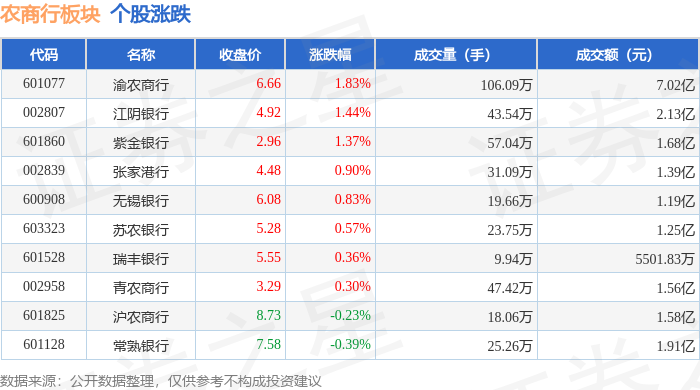
Core Insights - The agricultural commercial bank sector experienced a rise of 0.58% on September 10, with Yunnan Agricultural Commercial Bank leading the gains [1] - The Shanghai Composite Index closed at 3812.22, up 0.13%, while the Shenzhen Component Index closed at 12557.68, up 0.38% [1] Stock Performance - Yunnan Agricultural Commercial Bank (601077) closed at 6.66, with an increase of 1.83% and a trading volume of 1.061 million shares, amounting to 702 million yuan [1] - Jiangyin Bank (002807) closed at 4.92, up 1.44%, with a trading volume of 435,400 shares and a turnover of 213 million yuan [1] - Zijin Bank (601860) closed at 2.96, up 1.37%, with a trading volume of 570,400 shares and a turnover of 168 million yuan [1] - Other notable performances include Zhangjiagang Bank (002839) at 4.48 (+0.90%), and Wuxi Bank (600908) at 6.08 (+0.83%) [1] Capital Flow - The agricultural commercial bank sector saw a net outflow of 34.71 million yuan from institutional investors, while retail investors contributed a net inflow of 51.18 million yuan [1] - The detailed capital flow for individual stocks indicates that Changshu Bank (601128) had a net inflow of 20.62 million yuan from institutional investors, while it faced a net outflow of 15.01 million yuan from retail investors [2] - Yunnan Agricultural Commercial Bank (601077) experienced a significant net outflow of 42.29 million yuan from institutional investors, despite a retail net inflow of 36.90 million yuan [2]
本周聚焦:2025上半年银行确认了多少金融资产处置收益?OCI浮盈有多少?
GOLDEN SUN SECURITIES· 2025-09-07 08:20
Investment Rating - The report maintains an "Increase" rating for the banking sector, indicating a positive outlook for the industry [1]. Core Insights - In the first half of 2025, the contribution of financial asset disposal gains from AC and OCI accounts to revenue reached 5.2%, an increase of 2.9 percentage points compared to 2024 [1][2]. - The investment income growth rate for 42 listed banks was 23.6%, with AC, OCI, and TPL gains showing year-on-year growth rates of 134.7%, 79.0%, and -8.4% respectively [1]. - The report highlights that the increase in disposal gains does not necessarily indicate a significant increase in asset disposal scale, as market conditions and strategies vary among banks [2]. Financial Asset Disposal Gains - The contribution of AC and OCI financial asset disposal gains to revenue was 5.2%, up 2.9 percentage points from 2024, with AC asset disposal gains contributing 2.6% [2]. - Among different types of banks, rural commercial banks had the highest contribution from AC and OCI disposal gains, reaching 11.0%, an increase of 6.2 percentage points from 2024 [2]. - Specific banks such as Jiangyin Bank, Sunong Bank, and Zijin Bank had high disposal gain ratios relative to their revenue, at 28.9%, 26.7%, and 22.7% respectively [2]. OCI Floating Profit Situation - The overall OCI floating profit decreased compared to the end of the previous year, accounting for 12.6% of the estimated profit for 2025 [3]. - Major state-owned banks like CCB and ABC reported significant OCI floating profits, with balances exceeding 30 billion [3]. - The average contribution of OCI floating profits to profits for city and rural commercial banks was notably high, with Ningbo Bank's ratio reaching 35% [3][6]. Sector Trends - The banking sector is expected to benefit from expansionary policies aimed at stabilizing the economy, with a focus on real estate and consumer spending [7]. - The report suggests a focus on banks with improving fundamentals, such as Ningbo Bank, and those with dividend strategies like Jiangsu Bank and Chengdu Bank [7]. - Attention is also drawn to banks with potential convertible bond conversion expectations, including Shanghai Bank and Industrial Bank [7].


上市银行1H25业绩总结:营收利润边际改善,看好板块配置价值有限
Dongxing Securities· 2025-09-05 09:38
Investment Rating - The report maintains a positive outlook on the banking sector's allocation value, suggesting continued investment interest in the sector [4][10]. Core Viewpoints - The performance of listed banks in the first half of 2025 shows a marginal improvement in revenue and profit margins, with year-on-year growth of 1.0% in revenue and 0.8% in net profit attributable to shareholders [4][5]. - The recovery in the bond market during the second quarter has alleviated some of the pressures on bond investment returns, contributing to the overall performance improvement [4][5]. - The report anticipates that the banking sector's revenue and net profit growth will remain around 1% year-on-year for 2025, despite ongoing pressures on the banking fundamentals [4][10]. Summary by Sections Performance Overview - In the first half of 2025, listed banks experienced a year-on-year revenue growth of 1.0% and a net profit growth of 0.8%, with quarter-on-quarter improvements of 2.8 percentage points and 2 percentage points respectively [4][5]. - The growth in interest-earning assets was 9.7% year-on-year, with a stable credit growth of 8% and a significant increase in financial investments by 14.9% [4][11]. - The net interest margin for the first half of 2025 was 1.33%, showing a year-on-year decline of 13 basis points, which is less than the decline seen in the same period last year [4][5]. Non-Interest Income - Non-interest income showed a positive trend, with a year-on-year increase of 10.8% in other non-interest income and a 3.1% increase in fee income [4][5][10]. - The report highlights that the recovery in the capital market has contributed to the improvement in non-interest income [4][10]. Asset Quality - The report notes that while the non-performing loan ratio remains stable, there is an increase in the generation rate of overdue and non-performing loans, particularly in retail banking [4][10]. - The provision coverage ratio remained stable, with an increase in provisioning efforts during the first half of 2025 [4][10]. Future Outlook - The banking sector is expected to face continued pressure in 2025, but signs of a potential turning point are emerging, with improved net interest margins and non-interest income [4][10]. - The report suggests that the demand for bank stocks will increase from long-term funds, driven by favorable policies encouraging investment in the banking sector [4][10].
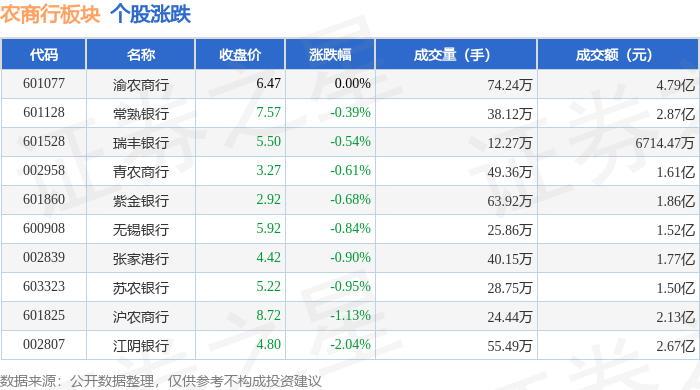
农商行板块9月5日跌0.73%,江阴银行领跌,主力资金净流入3366.67万元
Zheng Xing Xing Ye Ri Bao· 2025-09-05 08:56
Market Performance - The rural commercial bank sector experienced a decline of 0.73% on September 5, with Jiangyin Bank leading the drop [1] - The Shanghai Composite Index closed at 3812.51, up 1.24%, while the Shenzhen Component Index closed at 12590.56, up 3.89% [1] Individual Stock Performance - The closing prices and changes for key rural commercial banks are as follows: - Yunnan Rural Commercial Bank: 6.47, unchanged - Changshu Bank: 7.57, down 0.39% - Ruifeng Bank: 5.50, down 0.54% - Qingnong Bank: 3.27, down 0.61% - Zijin Bank: 2.92, down 0.68% - Wuxi Bank: 5.92, down 0.84% - Zhangjiagang Bank: 4.42, down 0.90% - Sunong Bank: 5.22, down 0.95% - Hunan Rural Commercial Bank: 8.72, down 1.13% - Jiangyin Bank: 4.80, down 2.04% [1] Capital Flow Analysis - The rural commercial bank sector saw a net inflow of 33.67 million yuan from main funds, while retail funds experienced a net outflow of 29.91 million yuan [1] - The detailed capital flow for individual banks indicates: - Zijin Bank: Main net outflow of 26.33 million yuan, retail net outflow of 3.10 million yuan - Sunong Bank: Main net inflow of 12.23 million yuan, retail net outflow of 7.43 million yuan - Wuxi Bank: Main net inflow of 6.05 million yuan, retail net inflow of 2.68 million yuan - Jiangyin Bank: Main net outflow of 10.44 million yuan, retail net inflow of 7.44 million yuan [2]