TRS(300229)

Search documents
计算机行业研究:动态漫Agent,景气的极致
SINOLINK SECURITIES· 2026-01-25 07:50
Investment Rating - The report indicates a positive investment outlook for the industry, highlighting a "golden window period" for the short drama sector, with expectations for significant growth in the coming years [2][11]. Core Insights - The short drama industry has reached a scale of nearly 1 trillion yuan, surpassing both the film and long video sectors, with a projected compound annual growth rate (CAGR) of over 50% from 2023 to 2026 [11]. - The market for animated dramas is expected to exceed 22 billion yuan by 2026, contributing 50% of the incremental growth in the short drama industry [11]. - ByteDance is positioned as the absolute leader in the animated drama sector, leveraging its "traffic + IP + AI" integrated strategy to dominate the market [2][17]. - The application of AI technology is transforming the production paradigm of animated dramas, reducing production cycles from over 50 days to under 30 days and significantly lowering costs [3][21]. Summary by Sections Section 1: The Golden Window for Short Dramas - The short drama market has surpassed 1 trillion yuan, with user engagement increasing, and the average daily viewing time expected to exceed 100 minutes by 2025 [11]. - The market has entered a phase of rapid growth and commercialization, with significant increases in both supply and demand for animated dramas [11][12]. Section 2: AI Reshaping Production Paradigms - AI technologies are enabling a shift from manual production to industrialized generation, with production costs dropping to the thousand-yuan level [3][21]. - The integration of AI in production processes is expected to streamline workflows, reducing the number of steps from 11 to 5 and cutting costs by 60% [3][24]. Section 3: Trends in AI Applications - The report anticipates a significant uptick in AI applications by 2026, driven by the need for software to leverage substantial computational investments [4][31]. - Companies are increasingly integrating AI into their business models, with some reporting that AI-related revenues account for over 10% of total income [4][31]. Section 4: Related Investment Targets - Key investment targets include companies such as DeCai Co., Zhaochi Co., and Wanxing Technology, among others, which are positioned to benefit from the growth in the animated drama and AI sectors [5][40].



计算机行业周报20260124:Token需求“通胀”:从CPU到云服务
Guolian Minsheng Securities· 2026-01-24 13:25
Investment Rating - The report maintains a "Recommended" rating for the industry [4] Core Insights - The demand for Tokens is driving inflation across the AI industry chain, with price increases being observed from storage to CPUs and now extending to cloud services, marking a significant shift in the pricing dynamics of the cloud computing sector [14][30] - AWS has initiated a price increase for its EC2 machine learning capacity blocks by approximately 15%, breaking a long-standing trend of declining prices in the cloud services industry, which may lead to a revaluation of cloud computing and related service providers [14] - The report highlights potential investment opportunities in cloud computing, CPUs, and databases, suggesting companies such as Alibaba, Kingsoft Cloud, and Inspur for cloud computing; Haiguang Information and Longxin for CPUs; and companies like StarRing Technology and DM Database for databases [30] Summary by Sections 1. Cloud Computing Price Trends - The report indicates that the AI industry chain is experiencing a price transmission trend, with cloud computing being the next area to see price increases following storage and CPU price hikes [14] - AWS's price adjustment reflects anticipated supply-demand dynamics, suggesting that successful price increases could lead to further adjustments in the future [14] 2. CPU Market Dynamics - The report notes a persistent supply-demand imbalance in the CPU market, particularly with Intel facing production limitations that may lead to continued shortages into 2026 [16] - The importance of CPUs is expected to rise significantly due to the increasing demand from AI applications, with the report emphasizing the need for optimization across both CPU and GPU resources [24][25] 3. Database Sector Growth - The report anticipates a rapid increase in the number of database PCU nodes driven by the demand for AI agents, which could lead to significant revenue growth for database providers [26] - The emergence of AI-native databases is highlighted as a key trend, with companies like Alibaba's PolarDB gaining traction in the market [29] 4. Investment Recommendations - The report suggests focusing on companies in the cloud computing sector such as Alibaba, Kingsoft Cloud, and UCloud, as well as CPU manufacturers like Haiguang Information and Longxin, and database firms like StarRing Technology and DM Database [30]




突发,资金尾盘重金杀入!金融科技ETF(159851)放量涨逾1%,净申购飙增超4亿份!谁在抢筹?
Xin Lang Ji Jin· 2026-01-23 12:03
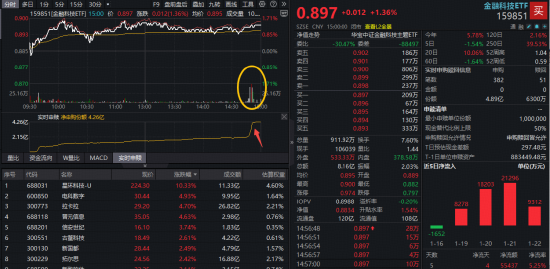
Core Insights - The A-share market experienced a significant increase on January 23, with the financial technology sector showing strong performance, particularly led by companies like Xinghuan Technology, which rose over 10% [1] - The financial technology ETF (159851) saw a 1.36% increase, with a total trading volume of 816 million yuan and a net inflow of 426 million shares, indicating strong investor interest [1] - The overall market analysis suggests that the financial technology sector's rise is driven by positive earnings forecasts and market expectations [2] Earnings Catalysts - A-share trading volume has exceeded 2 trillion yuan for 19 consecutive trading days, with internet brokerage firms expected to continue reporting strong earnings. For instance, Tonghuashun's 2025 profit forecast indicates a year-on-year growth of 50% to 80%, reaching 2.735 to 3.282 billion yuan, benefiting from AI investments and market recovery [1][2] Market Expectations - CITIC Securities noted that the market is transitioning to a slow bull phase, with the securities sector expected to participate in this trend. The activity level in the stock market is a key indicator of the valuation and performance of the securities industry [2] AI Empowerment in Financial IT - Guotai Junan Securities highlighted that AI is driving the upgrade of the financial technology industry, enhancing efficiency and experience across financial services. This presents new investment opportunities in the sector [2] ETF Performance - As of January 23, the financial technology ETF (159851) has a scale exceeding 10.5 billion yuan, with an average daily trading volume of 800 million yuan over the past six months, leading among eight ETFs tracking the same index in terms of scale and liquidity [2]




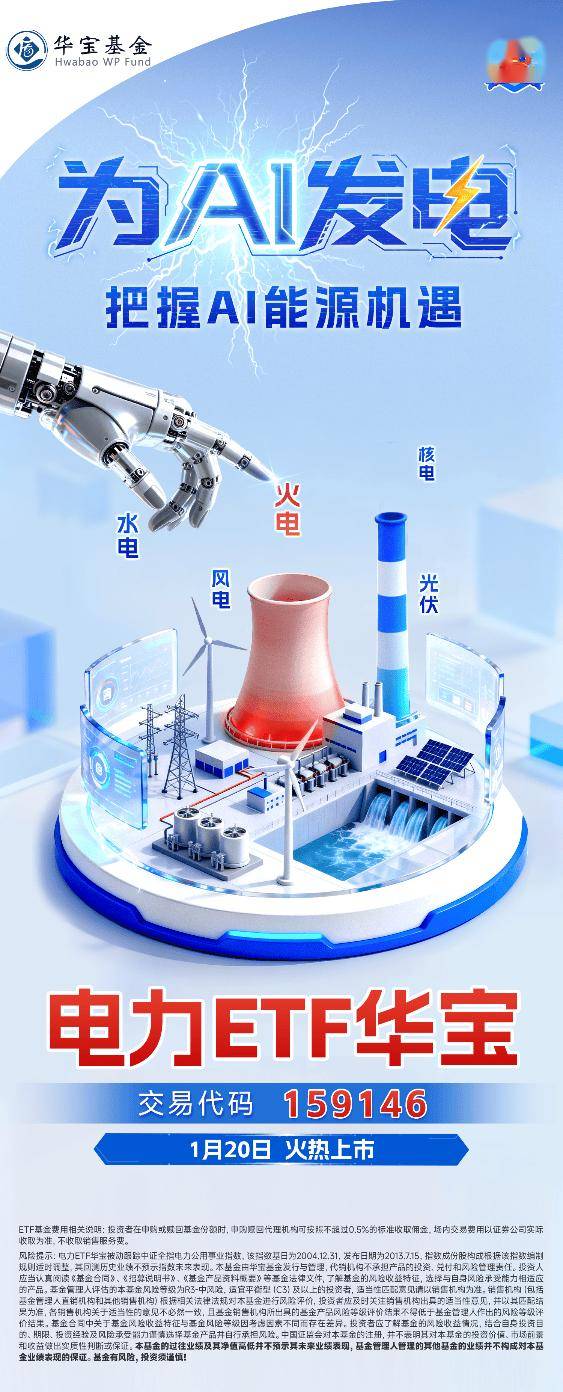
ETF复盘资讯|化工、贵金属逆市爆发!化工ETF(516020)劲涨1.27%续创阶段新高!电力ETF(159146)上市首日开门红!
Sou Hu Cai Jing· 2026-01-20 13:47
Market Overview - Major Asia-Pacific indices showed a collective decline, with the A-share market also experiencing consolidation, as the Shanghai Composite Index fluctuated while the Shenzhen Component and ChiNext indices performed weakly. The total trading volume in Shanghai, Shenzhen, and Beijing reached 2.8 trillion yuan, an increase of 72 billion yuan compared to the previous day [1] Real Estate Sector - The real estate sector rebounded strongly, with a notable increase in the price of a real estate ETF (159707) by 3.22%, marking multiple consecutive gains. According to the National Bureau of Statistics, the sales price of newly built commercial residential properties in first-tier cities decreased by 0.3% month-on-month in December 2025, with Shanghai seeing a slight increase of 0.2% [1] Chemical Sector - The chemical sector experienced a significant rally, with the chemical ETF (516020) reaching a new high since August 2022, closing up 1.27%. Major companies in the sector, such as BASF and Dow, have been raising prices across Europe, Asia, and the Middle East. The ETF attracted 1.148 billion yuan in the last ten days [1][4] - The chemical ETF has seen substantial net inflows, with over 5.8 billion yuan in net subscriptions in the last five trading days and 11 billion yuan in the last ten days. The Ministry of Industry and Information Technology has set guidelines for zero-carbon factory construction, which may limit new capacity in the chemical sector [6][7] Banking Sector - The banking sector showed resilience amid market volatility, with a significant number of bank stocks rising. The top bank ETF (512800) closed up 0.77%, ending a four-day losing streak. Historical data indicates that the banking sector has a high probability of generating absolute and excess returns before the Spring Festival, with an average return of 4.4% from 2017 to 2025 [8][11][14] - The banking sector is expected to benefit from continued growth in credit, supported by stable growth policies and a favorable low-interest-rate environment. The latest dividend yield for the banking index stands at 4.78%, significantly higher than the 10-year government bond yield of 1.84% [14][15] AI and Technology Sector - The AI and technology sectors faced a downturn, with the entrepreneurial AI ETF (159363) experiencing a four-day decline. Despite this, the sector remains attractive for future investments, particularly in light of ongoing developments in AI applications and infrastructure [16][18] - The communication and semiconductor industries are expected to see increased attention due to their potential for earnings upgrades, with significant growth anticipated in the coming years [18][20]





拓尔思跌2.08%,成交额11.63亿元,主力资金净流入5148.65万元
Xin Lang Cai Jing· 2026-01-20 05:44
Group 1 - The core viewpoint of the news is that Tuolisi's stock has experienced fluctuations, with a recent decline of 2.08% and a year-to-date increase of 20.70% [1] - As of January 20, Tuolisi's stock price is 24.02 yuan per share, with a total market capitalization of 20.984 billion yuan [1] - The company has seen significant trading activity, with a net inflow of 51.49 million yuan from main funds and a notable presence on the "Dragon and Tiger List" [1] Group 2 - Tuolisi operates in the computer software development sector, focusing on vertical application software, and is involved in AI products, big data services, and data security [2] - For the period from January to September 2025, Tuolisi reported a revenue of 337 million yuan, a year-on-year decrease of 45.57%, and a net profit loss of 160 million yuan, a decrease of 460.24% [2] - The company has distributed a total of 325 million yuan in dividends since its A-share listing, with 55.67 million yuan distributed in the last three years [2] Group 3 - As of September 30, 2025, Tuolisi's top ten circulating shareholders include notable ETFs, with the Huabao Zhongzheng Financial Technology Theme ETF being the third-largest shareholder, increasing its holdings by 5.03 million shares [3] - The Hong Kong Central Clearing Limited is the fourth-largest shareholder, having reduced its holdings by 526,200 shares [3] - Other ETFs, such as the Southern Zhongzheng 1000 ETF and Huaxia Zhongzheng 1000 ETF, have also seen changes in their holdings, indicating active institutional interest [3]
6家深企上榜!2025胡润中国人工智能企业50强出炉
Shen Zhen Shang Bao· 2026-01-19 08:02
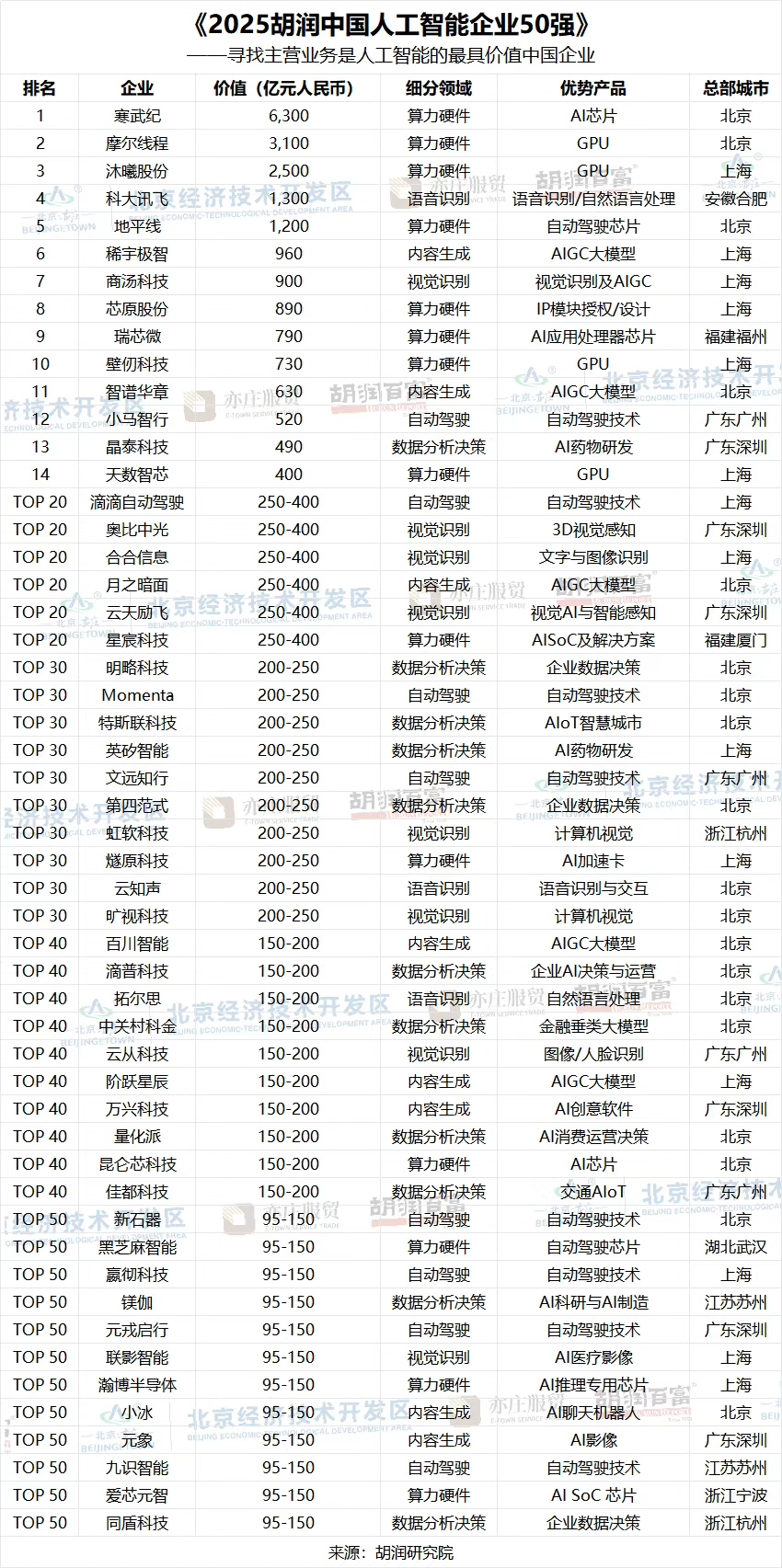
Core Insights - The "2025 Hurun China AI Companies Top 50" report ranks companies based on their value, highlighting the rapid growth and significance of AI in reshaping wealth in China [1][4]. Group 1: Company Rankings and Values - The top-ranked company is Cambricon, valued at 630 billion RMB, showing a 165% increase from the previous year [1][4]. - The ranking includes 21 non-listed companies, with the entry threshold set at 95 billion RMB, an increase of 35 billion RMB from last year [4]. - The average value of the listed companies is 540 billion RMB, which is 2.4 times higher than last year [4]. Group 2: Industry Trends and Growth - There is a notable increase in AI chip companies, with 14 firms making the list, up from 5 last year, driven by U.S. export controls on high-end AI chips [4][5]. - The report indicates that AI is transforming the wealth landscape in China, with significant wealth increases for key figures in the AI sector [4][6]. Group 3: New Entrants and Market Dynamics - 18 new companies joined the list, with 10 being AI chip-related, reflecting a shift in business focus for some firms from non-AI to AI [5]. - Companies like Chipone have seen a substantial increase in revenue from AI-related design services, indicating a strong market demand for AI capabilities [5][6]. Group 4: Sectoral Breakdown - The report categorizes AI companies into sectors: computing power (e.g., Cambricon), data analysis (e.g., Jingtaitech), machine vision (e.g., SenseTime), voice recognition (e.g., iFlytek), content generation (e.g., Kimi), and autonomous driving (e.g., Didi Autonomous Driving) [6][7]. - The focus on AI as a core business is emphasized, with only 31 companies meeting the criteria of having AI as their main business and a valuation above 9.5 billion RMB [4][6]. Group 5: Global Expansion and Future Outlook - AI companies are increasingly acting as "behind-the-scenes enablers" for industries like consumer electronics and new energy vehicles, with many still primarily focused on the domestic market [6][7]. - The long-term outlook suggests that companies with core technologies and practical applications will emerge as leaders, transitioning AI from a speculative concept to a foundational infrastructure [7].



拓尔思跌2.07%,成交额7.55亿元,主力资金净流出5339.04万元
Xin Lang Zheng Quan· 2026-01-19 02:52
Core Viewpoint - The stock of Tuolisi has experienced fluctuations, with a recent decline of 2.07% and a year-to-date increase of 23.72%, indicating volatility in its market performance [1]. Financial Performance - For the period from January to September 2025, Tuolisi reported a revenue of 337 million yuan, a year-on-year decrease of 45.57%, and a net profit attributable to shareholders of -160 million yuan, a significant decline of 460.24% [2]. Shareholder Information - As of September 30, 2025, the number of shareholders for Tuolisi was 116,700, a decrease of 2.78% from the previous period, with an average of 7,483 circulating shares per person, an increase of 2.86% [2]. Business Overview - Tuolisi, established on February 18, 1993, and listed on June 15, 2011, specializes in artificial intelligence products and services, big data products and services, and data security products and services. The revenue composition includes 44.49% from AI software products and services, 33.73% from big data software products and services, 11.07% from security products, and 10.70% from system integration and others [1]. Dividend Information - Since its A-share listing, Tuolisi has distributed a total of 325 million yuan in dividends, with 55.67 million yuan distributed over the past three years [3]. Institutional Holdings - As of September 30, 2025, the top ten circulating shareholders of Tuolisi include notable entities such as Huabao Zhongzheng Financial Technology Theme ETF, which increased its holdings by 5.03 million shares, and Hong Kong Central Clearing Limited, which decreased its holdings by 0.53 million shares [3].
Web3.0概念下跌3.84%,20股主力资金净流出超亿元
Zheng Quan Shi Bao Wang· 2026-01-15 09:13
Group 1 - The Web3.0 concept experienced a decline of 3.84%, ranking among the top declines in concept sectors, with stocks like Jinqiao Information, Zhejiang Wenlian, and Tianxiaxiu hitting the daily limit down [1] - Among the Web3.0 stocks, BlueFocus, Tuoer Si, and Insai Group saw significant declines, while only five stocks in the sector recorded gains, with 263, Zhongke Jincai, and Sanrenxing rising by 1.76%, 1.70%, and 0.58% respectively [1][2] Group 2 - The Web3.0 sector faced a net outflow of 9.493 billion yuan, with 58 stocks experiencing net outflows, and 20 stocks seeing outflows exceeding 100 million yuan [2] - BlueFocus led the outflow with a net outflow of 3.107 billion yuan, followed by Zhongwen Online, Kunlun Wanwei, and Tuoer Si with net outflows of 696.8 million yuan, 622.0 million yuan, and 463.9 million yuan respectively [2][3] Group 3 - The top gainers in the Web3.0 sector included 263, Quzhou Development, and Sanrenxing, with net inflows of 98.7 million yuan, 18.4 million yuan, and 13.2 million yuan respectively [4] - The stocks with the highest trading volume in the Web3.0 sector included BlueFocus, Zhongwen Online, and Tuoer Si, with trading volumes of 29.98%, 24.01%, and 19.20% respectively [3][4]





AI应用集体走低,金融科技ETF华夏(516100)跌3.5%,盘中成交活跃
Mei Ri Jing Ji Xin Wen· 2026-01-15 06:20
Core Viewpoint - The A-share market experienced a collective decline, with the Shanghai Composite Index down by 0.44%, the Shenzhen Component Index down by 0.13%, and the ChiNext Index down by 0.42%. The financial technology ETF, Huaxia (516100), fell by 3.90% to a latest price of 1.527 yuan, with a trading volume of 1.09 billion yuan and a turnover rate of 8.43% [1] Group 1: Market Performance - As of January 14, the financial technology ETF Huaxia recorded a cumulative increase of 14.32% over the past two weeks, outperforming the Wind All A index, which rose by 5.80% during the same period [1] - The financial technology ETF Huaxia reached an intraday high of 1.648 yuan, marking a new high in nearly a month [1] Group 2: Valuation Metrics - The latest price-to-earnings ratio (PE-TTM) for the financial technology ETF Huaxia is 83.42, which is in the 73.97th percentile over the past year, indicating that the valuation is lower than 26.03% of the time in the past year, suggesting a moderate valuation [1] Group 3: Index Composition - The financial technology ETF Huaxia tracks the financial technology index (930986.CSI), with significant weightings in software development (49.81%), IT services II (24.05%), securities II (9.57%), computer equipment (9.40%), and communication equipment (3.99%) [2]


低费率云计算ETF华夏(516630)年内涨超18%,持仓股石基信息、广联达涨停!谷歌发布两大开源模型
Mei Ri Jing Ji Xin Wen· 2026-01-15 03:29
Group 1 - The technology sector is experiencing accelerated fluctuations, with AI application stocks showing mixed performance as of January 15, 2023 [1] - The low-fee cloud computing ETF Huaxia (516630) decreased by 2.61%, while stocks like Shiji Information and Guanglianda hit the daily limit, and Yihualu, Zhongke Tuxing, and Tuershi led the decline [1] - The low-fee entrepreneurial board AI ETF Huaxia (159381) adjusted down by 2.32%, and the communication ETF Huaxia (515050) fell by 1.16% [1] Group 2 - Guojin Securities predicts that 2026 will be a pivotal year for AI applications transitioning from "technology validation" to "commercial promotion" [2] - Key recommended directions include: 1. Super entrance: Large models have evolved into dominant traffic entrances in the AI era 2. AI Infrastructure: Software-defined computing power to secure "shovel-selling" profits 3. High growth: AI technology is advancing, with marketing and animation becoming pioneers in commercialization 4. High barriers: Data flow and workflow create shields, particularly in medical, manufacturing, and management scenarios [2] Group 3 - The cloud computing ETF Huaxia (516630) tracks the cloud computing index (930851) and has the lowest fee rate among ETFs tracking this index, focusing on domestic AI software and hardware computing power [3] - The entrepreneurial board AI ETF Huaxia (159381) supports investment in AI-focused companies, with half of its weight in AI hardware computing power and the other half in AI software applications, offering high elasticity and representativeness [3] - The communication ETF Huaxia (515050) tracks the CSI 5G communication theme index, focusing on the supply chains of Nvidia, Apple, and Huawei, with top holdings including Zhongji Xuchuang, Xinyi Sheng, Lixun Precision, Industrial Fulian, and Zhaoyi Innovation [3]