Workflow
Keshun(300737)
icon
Search documents
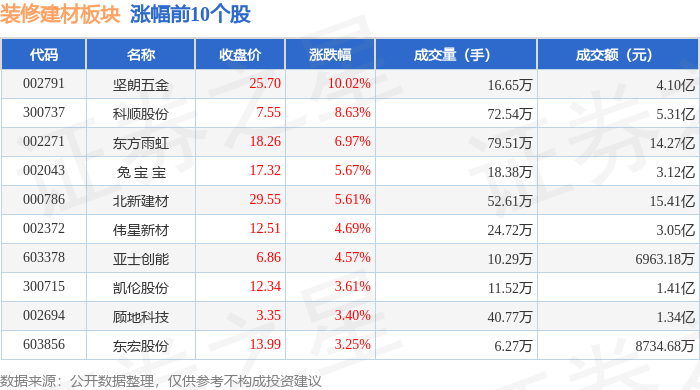
装修建材板块1月29日涨3.24%,科顺股份领涨,主力资金净流入1.41亿元
Core Viewpoint - The renovation and building materials sector experienced a significant increase of 3.24% on January 29, with Keshun Co., Ltd. leading the gains. The Shanghai Composite Index closed at 4157.98, up 0.16%, while the Shenzhen Component Index closed at 14300.08, down 0.3% [1]. Group 1: Stock Performance - Keshun Co., Ltd. (300737) closed at 7.61, up 13.58%, with a trading volume of 942,800 shares and a transaction value of 700 million yuan [1]. - Dongfang Yuhong (002271) closed at 17.95, up 7.87%, with a trading volume of 951,200 shares and a transaction value of 1.684 billion yuan [1]. - Sankeshu (603737) closed at 57.88, up 7.58%, with a trading volume of 108,600 shares and a transaction value of 620 million yuan [1]. - Jianlang Hardware (002791) closed at 24.27, up 6.92%, with a trading volume of 1,227,300 shares and a transaction value of 548 million yuan [1]. - Other notable stocks include Tubaobao (002043) at 16.68, up 6.45%, and Weixing New Materials (002372) at 12.51, up 4.86% [1]. Group 2: Capital Flow - The renovation and building materials sector saw a net inflow of 141 million yuan from institutional investors, while retail investors experienced a net outflow of 54.71 million yuan [2]. - The main capital inflow was observed in Dongfang Yuhong, with a net inflow of 134 million yuan, while Keshun Co., Ltd. had a net inflow of approximately 87.29 million yuan [3]. - Other companies like Wanlishi (002785) and Weixing New Materials (002372) also saw significant net inflows of 39.40 million yuan and 37.56 million yuan, respectively [3].
科顺股份20260123
2026-01-26 02:49
Summary of Key Points from the Conference Call of Keshun Co., Ltd. Company Overview - **Company**: Keshun Co., Ltd. (科顺股份) - **Industry**: Waterproofing materials and construction materials Core Insights and Arguments - **Price Increase Strategy**: Keshun plans to raise prices of its phenolic waterproof products by 5%-10% to counteract a 5-6% increase in raw material costs, expecting a 2% increase in gross margin by 2026 [2][6] - **Revenue Growth Projections**: The company anticipates a 10% revenue growth in 2026, amounting to approximately 600 million yuan. The civil construction sector (C-end retail) is expected to grow by 30% (around 300 million yuan), while overseas business is projected to grow by 50% (around 200 million yuan) [2][12] - **Tile Adhesive Business**: Keshun's tile adhesive revenue is expected to reach nearly 500 million yuan in 2025, with a growth rate of 20%-30% anticipated for 2026. The company sees significant growth potential in the tile adhesive market over the next 3-5 years [2][17] - **Overseas Market Strategy**: The company plans to adopt a light asset operation model for its overseas business, establishing small factories in Malaysia, Central Asia, and the Middle East through joint ventures and leasing existing facilities [2][22] Financial Performance and Projections - **2025 Financials**: Keshun's overseas revenue is projected to be around 450 million yuan, with a gross margin of 32%-33% and a net profit margin of 7%-8% (excluding impairments) [2][24] - **Credit Impairment Management**: The company aims to limit credit impairment to within 100 million yuan in 2026, with a focus on preparing for potential bad debts in 2025 [4][28] - **Cash Flow Expectations**: Keshun expects positive operating cash flow in 2025, similar to the 300 million yuan range seen in 2024 [4][29] Market Dynamics and Competitive Landscape - **Market Demand for Tile Adhesives**: The tile adhesive market is expected to continue growing, with a market size of approximately 60-70 billion yuan. The industry is fragmented, with leading companies like Deko and Yuhong having sales of 2-4 billion yuan each [19][20] - **Price Competition**: There is a small price difference among leading brands, while significant differences exist between leading brands and smaller companies. Keshun plans to expand its market share through channel collaboration and acquisitions of local small manufacturers [20] Challenges and Risks - **Customer Acceptance of Price Increases**: Some customers, particularly in the public construction sector, may resist price increases due to reduced business volume and intense competition [8][9] - **Implementation of Price Increases**: The company has successfully implemented price increases for its roll products, with a gradual realization of price adjustments expected to improve margins over time [10][11] Future Growth and Investment Plans - **Investment in New Materials**: Keshun is exploring high-end new materials in sectors like semiconductors and robotics to diversify its business and enhance resilience against market cycles [4][30] - **Convertible Bond Strategy**: The company aims to complete the conversion of all convertible bonds by 2026, targeting a market capitalization of around 10 billion yuan and a share price of approximately 9 yuan [4][32] - **Long-term Revenue Goals**: Keshun aims to return to a revenue scale of 10 billion yuan within 3-5 years, contingent on industry stabilization and recovery [34] Conclusion Keshun Co., Ltd. is strategically positioning itself for growth through price adjustments, expansion into overseas markets, and diversification into new materials. The company is focused on improving its financial health while navigating challenges in customer acceptance and market competition.
防水渠道专家交流
2026-01-26 02:49
Summary of Conference Call on Waterproofing Industry Company and Industry Overview - The conference call discusses **Keshun Company**, a player in the **waterproofing industry**. The company plans to implement price increases starting **February 1, 2026** due to various market factors [1][2]. Core Points and Arguments - **Price Increase Justification**: - The price increase is driven by rising raw material costs, particularly asphalt, which saw a **5% increase** in mid-December 2025. Additionally, the upcoming traditional sales peak and a new national policy extending the waterproofing warranty period to **25 years** are significant factors [2]. - **Market Demand Recovery**: - Unlike the price increase in July 2025, the current increase is expected to be more effective due to a recovery in market demand, especially in the **dispersal and photovoltaic sectors**. The anticipated financial impact will be reflected in the **2027 financial statements** [1][3]. - **Strategic Shift to High-End Products**: - Keshun has shifted its focus towards high-end products like **TPO**, which now account for **20%-25%** of total revenue with a gross margin of **40%**, significantly higher than standard products. This strategic pivot is supported by the acquisition of Fengze, enhancing growth in certification areas [1][9][10]. - **Customer Base Transformation**: - The company's customer structure has evolved, with the real estate sector's share decreasing from **70%-80%** to **40%-50%**. Non-real estate sectors, including infrastructure and photovoltaic roofing, have increased their share [3][11]. - **Industry Collaboration on Pricing**: - Major companies in the waterproofing sector, including **Yuhong**, have coordinated price increases to ensure profitability for both companies and distributors. This collaboration marks a shift from previous practices where Yuhong typically led price hikes [5][6][7]. Additional Important Insights - **Market Share Dynamics**: - Keshun's market share in the civil sector has risen to **over 10%**, while its share in the engineering sector has decreased to **40%-50%**. The top four companies in the waterproofing industry now hold a combined market share of over **50%**, with Keshun accounting for approximately **10%** [3][17]. - **Challenges for Small Enterprises**: - The waterproofing industry has seen many small enterprises exit due to shrinking demand, high inventory pressures, and inability to keep up with technological advancements. The remaining small players must either specialize or face market exit [14][15]. - **Future Demand Expectations**: - The company anticipates a gradual stabilization in the real estate market in 2026, driven by relaxed policies and urban renovation projects. Increased government investment in infrastructure, particularly in large-scale projects like hydropower and nuclear power stations, is expected to support growth [13][20]. - **Competitive Landscape**: - Competitors like Yuhong and Beixin have different pricing strategies, with Yuhong typically having higher prices. Beixin's pricing is more flexible, impacting Keshun's competitive positioning [18][19]. - **Regulatory Impact**: - New regulations mandating compliance with national standards for major projects are expected to influence demand. However, smaller projects may not adhere strictly to these standards, potentially affecting the market for high-end products [21][22].
没有一个春天不会到来-迎接建材新周期的起点
2026-01-26 02:49
Summary of Conference Call on Building Materials Industry Industry Overview - The building materials industry is showing signs of recovery, with significant increases in second-hand housing transaction volumes in early 2026 compared to the same period in 2025, indicating a rebound in market demand [1][3] - The real estate sector's contribution to cement demand has decreased to 18.9%, while the industrial glass sector's share has risen to 41.3%, suggesting a reduced sensitivity of traditional building materials to real estate demand [1][5] Key Points and Arguments - **Market Recovery Indicators**: - Core area housing prices in Beijing, Shanghai, and Shenzhen are recovering despite minimal policy changes, indicating an increased probability of the industry hitting a natural bottom [1][4] - The seasonal effect from March to April, traditionally a peak period for real estate, is expected to further enhance market sentiment [3] - **Supply Chain Dynamics**: - New construction starts have seen a significant decline, surpassing historical levels, leading to a contraction in capital expenditures in the building materials sector [1][8] - The waterproofing sector is experiencing the most severe supply-side clearing, with a high exit rate of companies and significant revenue declines among major players [2][7] - **Future Outlook**: - The building materials sector is at the beginning of a new cycle, with expectations of profitability bottoming out and stabilizing from 2026 onwards [2][12] - The industry has been in a downturn for five years, nearing a bottoming window, with historical data suggesting that real estate downturns typically last 4-7 years [5][8] Additional Important Insights - **Investment Opportunities**: - Focus on leading companies like 东方雨虹 (Dongfang Yuhong) and 科顺股份 (Keshun) for potential recovery opportunities, as well as undervalued stocks like 北新建材 (Beixin Building Materials) [2][11] - The waterproofing sector is highlighted as having the highest probability of recovery due to the severe supply-side clearing [10] - **Sector-Specific Trends**: - The engineering pipeline sector has maintained stable production levels, showing resilience compared to the more volatile waterproofing sector [9] - The waterproofing industry has seen a cumulative revenue decline of approximately 38% since 2021, reflecting significant profitability pressures [8] - **Strategic Recommendations**: - Investors are advised to avoid premature selling, as the cyclical nature of the market suggests that profitability will continue to improve with changing expectations [12]
建筑材料行业周报:新一轮城市更新开启,关注消费建材底部向上的弹性-20260125
East Money Securities· 2026-01-25 14:49
Investment Rating - The report maintains an "Outperform" rating for the construction materials sector, indicating a positive outlook compared to the broader market [2] Core Views - A new round of urban renewal is beginning, which is expected to provide significant opportunities in the consumer building materials sector, effectively countering the decline in new housing market demand [8] - The report highlights that after a prolonged downturn in the real estate sector, profitability in various segments of the construction supply chain is starting to recover, particularly for leading companies that have undergone strategic adjustments [8] - The report emphasizes the potential for price increases in certain segments, such as waterproofing and coatings, as companies respond to improved market conditions [8] Summary by Sections Cement - The cement market is entering a seasonal downturn, with demand expected to decline. The average shipment rate for major regions has dropped to 29%, a decrease of approximately 10 percentage points [27][34] - The national average price for cement remains stable at around 353 RMB per ton, with minor fluctuations observed in specific regions [28][34] - The report suggests that after the Spring Festival, demand may recover as new key projects are expected to commence, potentially stabilizing prices [34] Glass - The glass market is also experiencing a decline in demand, with production capacity decreasing to approximately 14.95 million tons, the lowest in recent years [53] - The average price for float glass has increased slightly to 1,139 RMB per ton, with inventory levels decreasing [38] - The report indicates that the glass industry is facing profitability challenges, leading to accelerated production line cold repairs, which may help stabilize the market [53] Fiberglass - The fiberglass market is seeing stable pricing for both roving and electronic fabrics, with the price of 7628 electronic fabric currently at approximately 4.4-4.85 RMB per meter [55] - The report anticipates continued high demand for electronic fabrics, supported by structural adjustments and a shortage of high-end products [55] - Key recommendations include focusing on leading companies like China Jushi, with additional attention on International Composite Materials and Zhongcai Technology [55] Carbon Fiber - Carbon fiber prices are expected to remain stable in the short term, with the rapid development of commercial aerospace potentially driving new demand [55] - The report notes that the current price stability is a necessary step for increased market penetration, with significant growth expected in the aerospace sector [55] Consumer Building Materials - The report highlights the resilience of consumer building materials, with leading companies like Sanke Tree and Rabbit Baby showing strong growth potential as they emerge from profitability challenges [8] - The urban renewal initiative is expected to create substantial market opportunities, particularly for high-quality consumer building materials [8]
非金属建材行业周报:继续推荐中国巨石、防水、utg玻璃、cte布-20260125
SINOLINK SECURITIES· 2026-01-25 12:52
Investment Rating - The report maintains a positive outlook on the price increase chain, particularly for traditional electronic fabrics, indicating a bullish sentiment for the sector [1][13]. Core Insights - The report highlights a significant price increase in 7628 electronic fabrics, rising from 4.15 CNY/m to 4.75 CNY/m since late September 2025, driven by supply constraints due to AI demand and copper price fluctuations [1][13]. - The waterproof coating sector is also experiencing price hikes, with a 5-10% increase announced by Keshun for certain products starting February 2026, reflecting a trend of consolidation and structural demand in non-real estate sectors [2][14]. - The report emphasizes the potential of UTG and TCO glass in the space photovoltaic sector, with SpaceX and Tesla aiming for an annual solar manufacturing capacity of 100GW within three years [3][15]. - In the AI-PCB upstream materials segment, there is a positive outlook for substrate materials driven by CPU shortages and price increases, with a notable 30% price hike planned by a leading Japanese company [4][16]. Summary by Sections Weekly Discussion - The report anticipates the continuation of the price increase chain through Q1 2026, particularly for traditional electronic fabrics, with a notable price increase observed since Q4 2025 [1][13]. - The electronic fabric market is transitioning to a supply-demand gap pricing model, with low inventory levels and bullish expectations for future prices [1][13]. Price Changes in Construction Materials - The report notes that the national average price for cement remains stable at 348 CNY/ton, with a significant drop in average shipment rates to 29.5% [5][17]. - The average price for float glass is reported at 1138.82 CNY/ton, with a slight increase observed, while the inventory levels are decreasing [5][17]. Market Performance - The construction materials index showed a strong performance with an 8.82% increase, outperforming the Shanghai Composite Index [20][23]. - Specific sectors such as glass manufacturing and fiberglass also reported significant gains, indicating robust market conditions [20][23]. Important Developments - The waterproof coating sector is seeing price increases, with Keshun announcing a price hike for certain products [6][14]. - The report highlights the ongoing expansion in solar energy production capabilities by major companies, indicating a shift towards renewable energy solutions [6][15].
研判2026!中国水泥基渗透结晶型防水材料行业政策汇总、发展现状、市场竞争及发展趋势分析:行业需求受到冲击,未来将拓宽应用场景以获取增量[图]
Chan Ye Xin Xi Wang· 2026-01-25 01:19
Core Viewpoint - The cement-based crystalline waterproofing materials have gained widespread application in China since the late 1980s, supported by national standards and policies, and are expected to see increasing acceptance due to their unique advantages in waterproofing performance and construction processes [1][7]. Industry Overview - Cement-based crystalline waterproofing materials are rigid waterproof materials made from silicate cement and quartz sand, which penetrate various active chemical substances to form insoluble crystals that block capillary pores in concrete, enhancing its density and waterproofing [3][4]. - The market size for cement-based crystalline waterproofing materials in China showed an upward trend from 2020 to 2021, but experienced a 4.8% decline in 2022 due to the ongoing adjustment in the real estate market. However, demand began to recover in 2023, with a projected market size of 9.66 billion yuan in 2024, reflecting a 3.8% year-on-year increase [1][7]. Industry Policies - Recent national policies, such as the "Implementation Plan for High-Quality Development of the Green Building Materials Industry" released in December 2023, emphasize the need for enhanced supervision and quality control in the waterproofing materials sector, which will help standardize the industry [5]. - The "2024-2025 Energy Saving and Carbon Reduction Action Plan" aims to regulate production capacity and output in the building materials industry, benefiting the supply of cement-based crystalline waterproofing materials [5]. Industry Chain - The upstream of the industry includes raw materials like silicate cement and quartz sand, while the midstream involves the production of waterproofing materials. The downstream applications span construction, roads, water conservancy projects, and industrial sectors [6]. Competitive Landscape - The industry is characterized by a "leading enterprises dominate, while small and medium-sized enterprises differentiate" structure, with major players leveraging their full-chain advantages, while smaller firms seek survival in niche markets [7][8]. Development Trends - The application scenarios for cement-based crystalline waterproofing materials are expanding beyond traditional residential buildings to include underground comprehensive pipe corridors, sponge city construction, and major engineering projects, driven by infrastructure development and urbanization [10]. - The industry is moving towards brand and standardization, with smaller firms lacking core technology and quality control being gradually eliminated, while leading companies capture more market share through customized solutions and lifecycle services [11]. - There is a shift towards green and low-carbon production methods in response to stricter environmental policies, with companies adopting clean production technologies to reduce carbon emissions and waste [12].
近期防水行业涨价解读及后市展望
2026-01-23 15:35
Summary of Conference Call on Waterproof Industry Price Increase and Future Outlook Company and Industry Overview - The conference call primarily discusses the waterproof industry, focusing on 科顺公司 (Keshun Company) and its strategies in a competitive market environment [1][2]. Core Points and Arguments - **Price Increase Strategy**: Keshun Company has adopted a price increase strategy to enhance brand image and profit margins despite facing intense low-price competition in the Northeast market [1][2]. - **Market Response**: Other companies in the industry have varied responses to the price increase; some maintain or lower their prices, while Keshun aims to differentiate itself through quality and brand positioning [3][4]. - **Dealer Relations**: Dealers are generally resistant to price increases due to profit margin pressures, but long-term relationships and product quality are expected to facilitate acceptance over time [6][7]. - **Economic Impact**: The overall economic environment has worsened payment terms and collection cycles, affecting dealer profitability. However, dealers can still maintain some profit through high sales volume [8][9]. - **Market Outlook**: Keshun Company remains optimistic about future market opportunities despite a shrinking market size, believing that increasing market share can sustain profitability [10][11]. - **Pricing Mechanism**: Pricing adjustments with dealers depend on credit terms; shorter credit periods lead to lower prices, while longer terms result in higher prices [12][25]. - **Product Price Changes**: Waterproof coatings have seen significant price increases, while the increase in membrane products has been modest [13][14]. Additional Important Insights - **Seasonal Challenges**: The upcoming traditional off-season due to the Spring Festival poses challenges for implementing price increases, requiring time for adjustment [5]. - **Shift in Customer Base**: There has been a notable decrease in real estate clients, with a shift towards municipal and public construction projects, which have less favorable payment conditions [18][19]. - **Market Dynamics**: The competitive landscape is characterized by the exit of smaller brands, while larger brands continue to compete aggressively. Keshun aims to eliminate smaller competitors to avoid price wars [11][23][24]. - **Service Model**: Keshun Company emphasizes a comprehensive service model from project initiation to maintenance, planning to deepen this approach [16]. - **Sales Targets**: The sales targets for 2026 are expected to remain stable compared to 2025, reflecting a cautious approach in light of market uncertainties [21][22]. This summary encapsulates the key discussions and insights from the conference call, highlighting the strategic positioning of Keshun Company within the waterproof industry amidst current market challenges.
科顺股份20260122
2026-01-23 15:35
科顺股份 20260122 摘要 科顺股份 2025 年计提历史减值损失,旨在优化 2026 年财务报表,为 新一年轻装上阵,预计此举将大幅减少 2026 年应收账款计提,使报表 更清晰地反映经营成果。 公司发布丙烯酸类涂料涨价函,预计 2026 年毛利率提升约两个百分点。 原材料沥青价格预计同比下降 8~10%,采购均价降至 3,100~3,200 元/吨,显著改善成本结构,提升盈利水平。 地产市场两极分化,央国企积极拿地开工,利好科顺股份。市政基建项 目因政府资金改善而加速,工商建筑板块高端项目增多,民建领域保持 30%增长,共同推动业务增长。 海外市场采取"小步快跑"策略,预计 2026 年收入接近 7 亿元,未来 三到四年内计划布置 3 至 4 个工厂。转型升级包括扩充协同性强的新业 务、投资前沿技术和收并购,构建第二增长曲线。 公司积极管理应收账款和工抵房,全面核算地产项目,实现动态平衡。 预计 2025 年清理所有风险点,2026 年应收账款计提大幅减少,财务 状况逐步改善。 Q&A 2025 年科顺股份的整体经营情况如何?近期涨价函的覆盖范围和涨幅如何? 2025 年,科顺股份的全年收入趋势与前 ...
装修建材板块1月23日涨0.24%,鲁阳节能领涨,主力资金净流出4864.38万元
Core Viewpoint - The renovation and building materials sector experienced a slight increase of 0.24% on January 23, with Luoyang Energy leading the gains. The Shanghai Composite Index rose by 0.33%, while the Shenzhen Component Index increased by 0.79% [1]. Group 1: Stock Performance - The top-performing stocks in the renovation and building materials sector included: - Luoyang Energy (002088) with a closing price of 12.87, up 10.00% and a trading volume of 198,000 shares, totaling 247 million yuan [1]. - Youbang Ceiling (002718) closed at 67.38, up 6.99% with a trading volume of 30,700 shares, totaling 200 million yuan [1]. - Zhonggang Luonai (611889) closed at 7.52, up 6.67% with a trading volume of 755,000 shares, totaling 562 million yuan [1]. Group 2: Market Trends - The overall market saw a net outflow of 48.64 million yuan from the renovation and building materials sector, with retail investors contributing a net inflow of 233 million yuan [2]. - The main funds showed a mixed trend, with significant outflows from several stocks, including: - Zhonggang Luonai (611889) with a net inflow of 73.53 million yuan from main funds but a net outflow of 15.64 million yuan from speculative funds [3]. - Luoyang Energy (002088) had a net inflow of 52.05 million yuan from main funds, while speculative funds saw a net outflow of 20.99 million yuan [3].