Yunnan Botanee Bio-Technology (300957)

Search documents
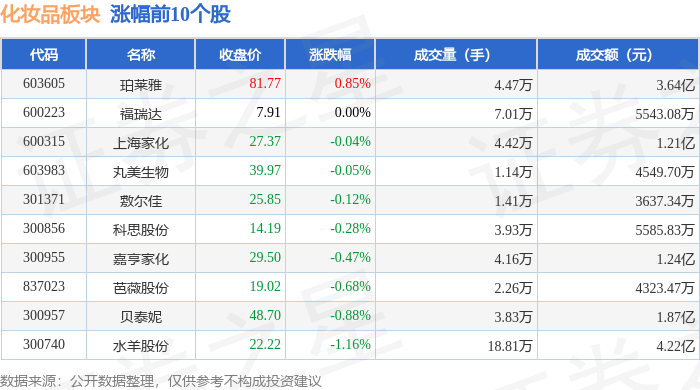
化妆品板块9月17日跌0.24%,青松股份领跌,主力资金净流出1.05亿元
Zheng Xing Xing Ye Ri Bao· 2025-09-17 08:52
Market Overview - On September 17, the cosmetics sector declined by 0.24% compared to the previous trading day, with Qingsong Co. leading the decline [1] - The Shanghai Composite Index closed at 3876.34, up 0.37%, while the Shenzhen Component Index closed at 13215.46, up 1.16% [1] Individual Stock Performance - Notable stock performances in the cosmetics sector included: - Tian Cai Ya (603605) closed at 81.77, up 0.85% with a trading volume of 44,700 shares and a transaction value of 364 million [1] - Fu Rui Da (600223) remained unchanged at 7.91 with a trading volume of 70,100 shares [1] - Shanghai Jahwa (600315) closed at 27.37, down 0.04% with a trading volume of 44,200 shares [1] - Other stocks like Marubi (603983) and Beitaini (300957) also experienced slight declines of 0.05% and 0.88% respectively [1] Capital Flow Analysis - The cosmetics sector saw a net outflow of 105 million from institutional investors, while retail investors experienced a net inflow of 54.72 million [2] - The overall capital flow for individual stocks showed varied trends, with some stocks like Jia Heng Jia Hua (300955) experiencing significant net outflows from institutional investors [3] Detailed Capital Flow for Selected Stocks - Jia Heng Jia Hua (300955) had a net outflow of 13.34 million from institutional investors, while retail investors contributed a net inflow of 17.15 million [3] - Other stocks like Fu Rui Da (600223) and Shui Yang Co. (300740) also showed mixed capital flows, with institutional outflows and retail inflows [3]




化妆品板块9月16日涨0.03%,水羊股份领涨,主力资金净流出4320.22万元
Zheng Xing Xing Ye Ri Bao· 2025-09-16 08:52
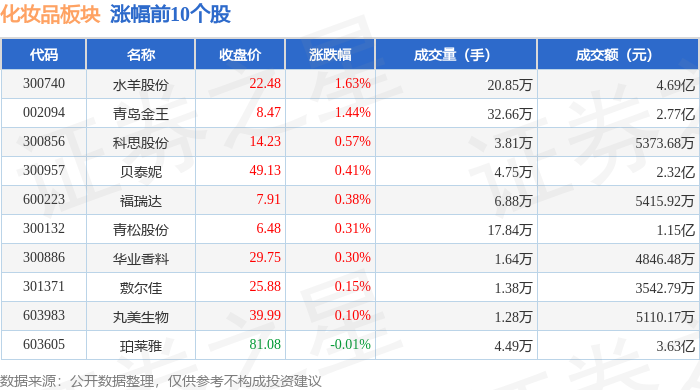
Market Overview - On September 16, the cosmetics sector rose by 0.03% compared to the previous trading day, with Shuiyang Co., Ltd. leading the gains [1] - The Shanghai Composite Index closed at 3861.87, up 0.04%, while the Shenzhen Component Index closed at 13063.97, up 0.45% [1] Individual Stock Performance - Shuiyang Co., Ltd. (300740) closed at 22.48, with a gain of 1.63% and a trading volume of 208,500 shares, amounting to a transaction value of 469 million yuan [1] - Qingdao Kingway (002094) closed at 8.47, up 1.44%, with a trading volume of 326,600 shares and a transaction value of 277 million yuan [1] - Other notable performers include: - Kezhou Co., Ltd. (300856) at 14.23, up 0.57% [1] - Beitaini (300957) at 49.13, up 0.41% [1] - Furuida (600223) at 7.91, up 0.38% [1] Fund Flow Analysis - The cosmetics sector experienced a net outflow of 43.2 million yuan from institutional investors, while retail investors saw a net outflow of 23.0 million yuan [2] - Conversely, speculative funds recorded a net inflow of 66.2 million yuan [2] Detailed Fund Flow for Key Stocks - Shuiyang Co., Ltd. (300740) had a net inflow of 41.1 million yuan from institutional investors, while retail investors faced a net outflow of 71.8 million yuan [3] - Qingdao Kingway (002094) saw a net inflow of 15.3 million yuan from institutional investors, but a net outflow of 7.2 million yuan from retail investors [3] - Other stocks with significant fund flow include: - Beitaini (300957) with a net inflow of 5.7 million yuan from institutional investors and a net outflow of 13.2 million yuan from retail investors [3] - Furuida (600223) faced a net outflow of 10.2 million yuan from institutional investors but a net inflow of 8.9 million yuan from retail investors [3]


化妆品板块9月15日跌0.18%,华业香料领跌,主力资金净流出8338.08万元
Zheng Xing Xing Ye Ri Bao· 2025-09-15 08:49
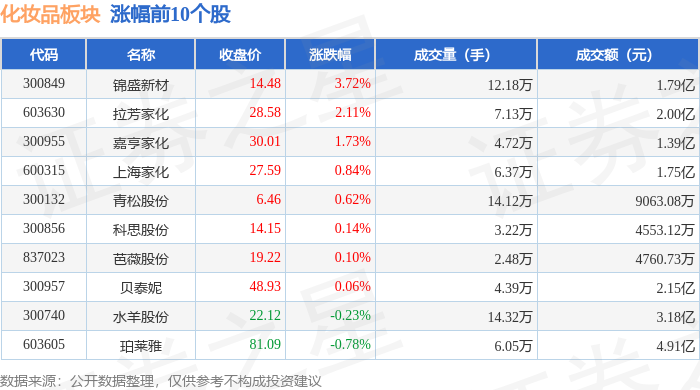
Market Overview - On September 15, the cosmetics sector declined by 0.18%, with Huaye Fragrance leading the drop [1] - The Shanghai Composite Index closed at 3860.5, down 0.26%, while the Shenzhen Component Index closed at 13005.77, up 0.63% [1] Individual Stock Performance - Notable gainers included: - Jinsong New Material (300849) with a closing price of 14.48, up 3.72% and a trading volume of 121,800 shares, totaling 179 million yuan [1] - Lafang Home (603630) closed at 28.58, up 2.11% with a trading volume of 71,300 shares, totaling 200 million yuan [1] - Notable decliners included: - Huaye Fragrance (300886) closed at 29.66, down 1.79% with a trading volume of 18,400 shares, totaling 55.05 million yuan [2] - Marubi Biological (603983) closed at 39.95, down 1.36% with a trading volume of 13,900 shares, totaling 55.49 million yuan [2] Capital Flow Analysis - The cosmetics sector experienced a net outflow of 83.38 million yuan from institutional investors, while retail investors saw a net inflow of 76.42 million yuan [2] - The overall capital flow for individual stocks showed: - Jinsong New Material had a net inflow of 18.50 million yuan from institutional investors, accounting for 10.31% of its total [3] - Huaye Fragrance had a net outflow of 4.23 million yuan from institutional investors, accounting for 6.58% of its total [3]



贝泰妮(300957):利润降幅大幅收窄,毛利显著改善
Changjiang Securities· 2025-09-14 11:12
Investment Rating - The investment rating for the company is "Buy" and is maintained [6]. Core Views - The company reported a significant narrowing of profit decline and notable improvement in gross margin in its 2025 mid-year report. For H1 2025, revenue was 2.37 billion yuan, a year-on-year decrease of 15.4%, while net profit attributable to shareholders was 250 million yuan, down 49% year-on-year. In Q2 alone, revenue was 1.42 billion yuan, down 16.7% year-on-year, and net profit was 220 million yuan, down 29% year-on-year, with a reduced decline compared to Q1 [2][4]. Summary by Sections Revenue and Profitability - In H1 2025, the company's revenue was 2.37 billion yuan, reflecting a 15.4% year-on-year decline. The net profit attributable to shareholders was 250 million yuan, down 49% year-on-year. In Q2, revenue was 1.42 billion yuan, a 16.7% year-on-year decline, and net profit was 220 million yuan, down 29% year-on-year, with a reduced decline from Q1's 84% [2][4]. Brand Performance - The main brand faced temporary pressure, while the sub-brand Aikeman showed impressive growth. In H1 2025, revenues for various brands were as follows: Winona (1.95 billion yuan, -18.4%), Winona Baby (110 million yuan, +8.6%), Aikeman (50 million yuan, +93.9%), Jirui (210 million yuan, -11.5%), and Pomei (20 million yuan, -4.7%) [10]. Gross Margin and Expenses - The gross margin improved by 3.4 percentage points to 76% in H1 2025, attributed to stable pricing strategies and reduced promotional expenses. The expense ratios for sales, management, R&D, and finance increased by 8.6, 1.9, 0.8, and 0.4 percentage points respectively, leading to a total expense ratio increase of 11.8 percentage points [10]. Future Outlook - The company is expected to see a recovery in profit margins driven by stable pricing of core products and continued growth in Aikeman. The projected EPS for 2025-2027 is 1.18, 1.55, and 1.67 yuan respectively, supporting the "Buy" rating [10].
贝泰妮攻坚 “最难市场”
虎嗅APP· 2025-09-13 13:19
Core Viewpoint - The article discusses the operational and strategic developments of Betaini, particularly focusing on its flagship brand Winona and the company's multi-brand strategy to mitigate reliance on a single brand while exploring international markets for growth [4][10][22]. Group 1: Company Overview - Betaini's central factory in Kunming, Yunnan, represents a significant investment of 500 million yuan, with an expected annual output value of 5 billion yuan when fully operational [6]. - The current output value of the central factory is approximately 2.6 billion yuan, with the Winona brand accounting for over 90% of production [7]. - Betaini operates multiple brands, including Aikeman (high-end anti-aging), Winona Baby (baby skincare), Beifuting (professional acne treatment), Jirui (mass-market cosmetics), and others, with Winona contributing over 80% of the company's revenue [7][10]. Group 2: Financial Performance - In the first half of 2025, Betaini reported a revenue of 2.372 billion yuan, a year-on-year decrease of 15.43%, and a net profit of 247 million yuan, down 49.01% [8]. - Despite the decline in revenue and profit, the company showed operational resilience with improved gross margins and cash flow in the second quarter [8]. - Aikeman's revenue reached 51.47 million yuan in the first half of 2025, marking a year-on-year growth of 93.90%, while Winona Baby generated 110 million yuan, up 8.62% [11]. Group 3: Strategic Initiatives - Betaini is focusing on a multi-brand strategy to reduce dependency on Winona, with significant resources allocated to new brands like Aikeman and Beifuting [10][14]. - The company has made strategic acquisitions, including a 5.36 billion yuan investment to acquire 51% of Yuejiang Investment, bringing in brands like Jirui and Beifuting, which contributed 551 million yuan in revenue in 2024 [12]. - The company is also implementing a "slimming plan" for Winona, focusing on five core product lines to enhance customer value [15]. Group 4: International Expansion - Betaini is targeting Southeast Asia for international expansion, with a focus on the Thai market, where Winona has established a presence through various channels [21][22]. - The company has set up research institutes in Tokyo and Paris to support its global strategy, with overseas revenue growing over 550% year-on-year in 2024 [21]. - The initial investment in overseas markets is substantial, but it is seen as crucial for breaking through domestic growth ceilings [22][23].

贝泰妮攻坚 “最难市场”
Hu Xiu· 2025-09-13 06:10
Core Insights - The article highlights the operational efficiency and production capabilities of Betaini's central factory in Kunming, Yunnan, which is crucial for the company's competitive edge in the sensitive skin care market with its Winona brand [1] - Betaini is facing revenue and profit pressures due to a slowdown in the domestic market, prompting a strategic shift towards international expansion, particularly in Southeast Asia [2][10] Group 1: Company Overview - Betaini's central factory, with an investment of 500 million yuan, is expected to achieve an annual output value of 5 billion yuan when fully operational, currently generating approximately 2.6 billion yuan, with Winona accounting for over 90% of production [1] - The company operates multiple brands under its umbrella, including high-end anti-aging brand Aikeman and children's skincare brand Winona Baby, with Winona contributing over 80% of total revenue [1][3] Group 2: Financial Performance - In the first half of 2025, Betaini reported a revenue of 2.372 billion yuan, a year-on-year decrease of 15.43%, and a net profit of 247 million yuan, down 49.01% [2] - Despite revenue declines, the company has shown operational resilience with improved gross margins and cash flow in the second quarter [2][6] Group 3: Brand Strategy - Betaini is accelerating its multi-brand strategy to reduce reliance on Winona, with Aikeman and Winona Baby showing significant growth potential [3][4] - Aikeman's revenue reached 51.47 million yuan in the first half of 2025, a year-on-year increase of 93.90%, while Winona Baby generated 110 million yuan, up 8.62% [4] Group 4: Market Expansion - Betaini's international strategy includes entering the Southeast Asian market, with a focus on Thailand, where Winona has established a presence through various channels [10][11] - The company has set up research institutes in Tokyo and Paris to support its global strategy, with overseas revenue expected to grow significantly [10] Group 5: Challenges and Opportunities - The company faces challenges in brand diversification and market competition, particularly in the high-end anti-aging and children's skincare segments [7][8] - Betaini's entry into the medical beauty sector is seen as a potential growth area, with plans to provide compliant products and professional services to medical institutions [8]
日化护肤半年报|贝泰妮2025年上半年业绩双降、归母净利润降49%却拿过半收入做营销
Xin Lang Cai Jing· 2025-09-12 10:41
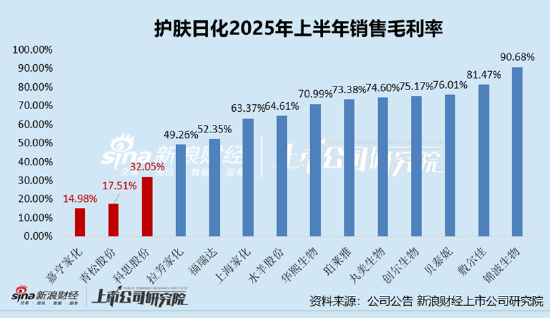
Core Insights - The skincare and daily chemical industry in A-share listed companies shows a persistent trend of high gross margins and low net margins, with over 80% of companies having a gross margin above 50% and more than half having a net margin below 10% [1][2] Group 1: Financial Performance - In the first half of 2025, the top three companies by gross margin are Jinbo Biological (90.68%), Fulejia (81.47%), and Beitaini (76.01%) [2] - Despite high gross margins, over half of the selected companies have net margins below 10%, with Jinbo Biological, Fulejia, and Proya leading in net margins at 45.5%, 26.61%, and 15.41% respectively [2] Group 2: Marketing and Expenses - The high gross margin and low net margin phenomenon is closely linked to the significant marketing expenditures in the industry, with companies like Marubi Biological having a sales expense ratio as high as 56.5% [1][3] - Many companies in the skincare and daily chemical sector are spending over 40% of their revenue on marketing, indicating a highly competitive marketing environment [3] Group 3: Research and Development - The investment in R&D is significantly lower than marketing expenditures, with Marubi Biological's R&D expense ratio being only 2.3% compared to its high sales expense ratio [3] - The focus on marketing over R&D has led to severe product homogeneity, limiting innovation and the ability to meet consumer skincare needs effectively [3]
日化护肤半年报|华熙生物业绩双降 存货周转效率下降、存货周转天数增至332天
Xin Lang Zheng Quan· 2025-09-12 09:29
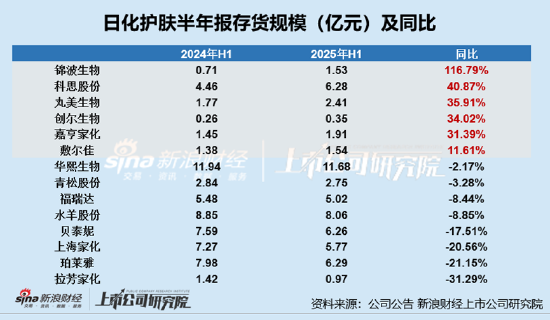
Core Insights - The skincare and daily chemical industry in A-share listed companies has shown improvements in inventory levels as of the first half of 2025, with only 6 out of 14 selected companies experiencing an increase in inventory size [1][2] Inventory Size Analysis - Jinbo Biological had the largest year-on-year increase in inventory, reaching 153 million yuan, a growth of 116.79% compared to the first half of 2024 [1][2] - Kesheng Co. also saw significant growth, with inventory at 628 million yuan, up 40.87% year-on-year [1][2] - Other companies with notable inventory increases include Marubi Biological (35.91%), Chuang'er Biological (34.02%), and Jiaheng Home Care (31.39%) [2] Inventory Turnover Days - Among the 14 selected companies, only 5 had inventory turnover days below 90 days, indicating efficient inventory management [3] - Companies with inventory turnover days exceeding 180 days include Huaxi Biological (331.61 days), Jinbo Biological (280.81 days), Kesheng Co. (230.92 days), and Betaini (195.78 days) [3][4] - The overall inventory turnover efficiency has not improved, with 8 companies experiencing longer turnover days, particularly those exceeding 180 days [3] Year-on-Year Changes in Inventory Turnover Days - Huaxi Biological's turnover days increased by 13.34%, Jinbo Biological by 15.66%, Kesheng Co. by 115.83%, and Betaini by 0.54% [3][4] - Notably, the turnover days for LaFang Home Care decreased by 27.40%, and Shanghai Home Care by 15.74%, indicating some companies are managing their inventory more effectively [4]


日化护肤半年报|贝泰妮2025年上半年业绩双降、归母净利润降49% 却拿过半收入做营销
Xin Lang Zheng Quan· 2025-09-12 09:24
Core Insights - The skincare and daily chemical industry in A-shares has shown a high gross profit margin but low net profit margin, with over 80% of companies having a gross profit margin above 50% and more than half having a net profit margin below 10% [1][4] - The significant gap between gross and net profit margins is attributed to high sales expenses, which consume profits, with Marubi Biological's sales expense ratio reaching 56.5%, making it the highest in the industry [1][6] Group 1: Financial Performance - The top three companies by gross profit margin in the first half of 2025 are Jinbo Biological (90.68%), Fulejia (81.47%), and Beitaini (76.01%) [2] - Only four companies reported a gross profit margin below 50%, namely Lafang, Kesi, Qingsong, and Jiaheng, with margins of 49.26%, 32.05%, 17.51%, and 14.98% respectively [2] - The leading companies in net profit margin are Jinbo Biological (45.5%), Fulejia (26.61%), and Polaroid (15.41%), while Jiaheng, Lafang, and Qingsong have low margins of -6.26%, 1.58%, and 2.66% respectively [4] Group 2: Marketing and R&D Expenditure - The high marketing expenses in the industry are closely linked to the high gross profit but low net profit, with many companies spending over 40% of their revenue on marketing [6][9] - Marubi Biological's sales expense ratio is 56.5%, while its R&D expense ratio is only 2.3%, indicating a heavy reliance on marketing over research and development [8] - The focus on marketing over R&D has led to severe product homogenization, limiting innovation and hindering brand development [8][9] Group 3: Industry Challenges - The industry faces challenges in balancing marketing and R&D expenditures, with a need to shift from marketing-driven to product-driven strategies [9]
护肤日化半年报|华熙生物、贝泰妮、敷尔佳、福瑞达难扭业绩颓势2025年上半年业绩双降
Xin Lang Cai Jing· 2025-09-12 09:14
Core Viewpoint - The skincare and daily chemical industry in A-share listed companies has shown significant performance divergence in the first half of 2025, with 14 representative companies analyzed for their financial results [1]. Group 1: Performance Analysis - Six companies experienced declines in both revenue and net profit: Lafang Jiahua, Furuida, Fulejia, Beitaini, Huaxi Biological, and Kesi Co. [1] - Lafang Jiahua reported revenue of 410 million yuan, a decrease of 4.27% year-on-year, and a net profit of 6 million yuan, down 82.89% compared to the previous year [1]. - Furuida achieved revenue of 1.79 billion yuan, a decline of 7.05% year-on-year, with a net profit of 108 million yuan [1]. - One company, Chuang'er Biological, saw revenue growth of 16.98% to 214 million yuan but a net profit decline of 55.99% to 13 million yuan [1]. - Jiaheng Jiahua reported revenue of 514 million yuan, an increase of 21.72% year-on-year, but a net loss of 32 million yuan, with losses widening compared to the previous year [1]. Group 2: Factors Influencing Performance - Jiaheng Jiahua's significant net loss is closely linked to its Huzhou base, with new business expansions impacting operational performance [2]. - Lafang Jiahua's dual decline in performance is attributed to changes in the domestic and international operating environment, compounded by intensified industry competition, despite increased market investment [2].