Yunnan Botanee Bio-Technology (300957)

Search documents
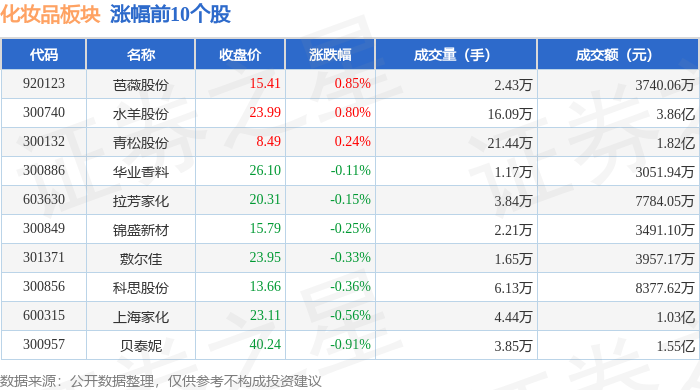
化妆品板块1月7日跌0.93%,嘉亨家化领跌,主力资金净流出5766.6万元
Zheng Xing Xing Ye Ri Bao· 2026-01-07 08:59
Group 1 - The cosmetics sector experienced a decline of 0.93% on January 7, with Jiaheng Jiahua leading the drop [1] - The Shanghai Composite Index closed at 4085.77, up 0.05%, while the Shenzhen Component Index closed at 14030.56, up 0.06% [1] - Key individual stock performances in the cosmetics sector included Bawei Co. up 0.85% and Jiaheng Jiahua down 4.96% [2] Group 2 - The net outflow of main funds in the cosmetics sector was 57.67 million yuan, while retail investors saw a net inflow of 39.72 million yuan [2] - The stock with the highest main fund inflow was Shuiyang Co. with 27.77 million yuan, while Jiaheng Jiahua had a significant outflow of 32.2 million yuan [3] - Retail investors showed a negative net flow in several stocks, including Shanghai Jahwa and Kesheng Co. [3]


化妆品板块1月6日涨0.46%,拉芳家化领涨,主力资金净流出8196.79万元
Zheng Xing Xing Ye Ri Bao· 2026-01-06 09:03
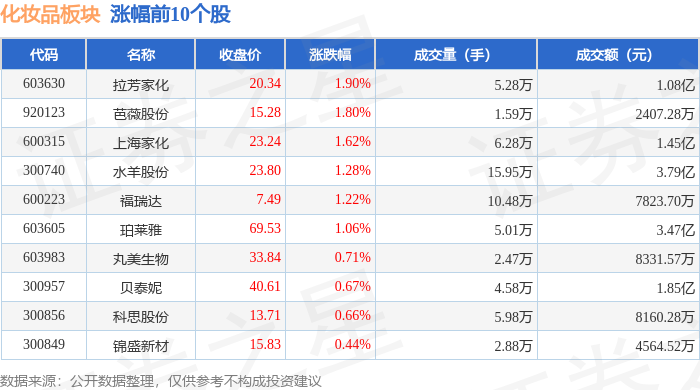
Group 1 - The cosmetics sector experienced a rise of 0.46% on January 6, with Lafang Jiahua leading the gains [1] - The Shanghai Composite Index closed at 4083.67, up by 1.5%, while the Shenzhen Component Index closed at 14022.55, up by 1.4% [1] - Lafang Jiahua's closing price was 20.34, reflecting a 1.90% increase, with a trading volume of 52,800 shares and a transaction value of 108 million yuan [1] Group 2 - The cosmetics sector saw a net outflow of 81.97 million yuan from institutional investors, while retail investors had a net inflow of 67.35 million yuan [2] - The trading data indicates that major stocks like Shanghai Jahwa and Lafang Jiahua had mixed net inflows and outflows from different investor types [3] - Shanghai Jahwa had a net inflow of 9.64 million yuan from institutional investors, while it faced outflows from retail investors [3]


贝泰妮:有针对性地开展特色植物基础理论研究、创新原料研发等多维度深层次研发项目
Zheng Quan Ri Bao Wang· 2026-01-06 01:47
Core Viewpoint - Betaini (300957) reported a decrease in R&D expenses for the first three quarters of 2025, attributed to the orderly execution of R&D activities based on established plans and research progress [1] Group 1: R&D Activities - The company utilizes resources and advantages from its Yunnan Province specialty plant extraction laboratory platform and Betaini Research Institute [1] - Collaborative efforts with research institutes in Japan and France, as well as cutting-edge joint laboratory resources, are aimed at targeted research in various areas [1] - The R&D projects include fundamental theoretical research on specialty plants, innovative raw material development, raw material screening, efficacy cosmetic development, functional food development, medical device development, new drug development for skin, and packaging development [1] Group 2: R&D Investment Alignment - The company's R&D investment is closely aligned with its research directions and progress [1]
贝泰妮:接受南方基金等投资者调研
Mei Ri Jing Ji Xin Wen· 2026-01-05 03:44
Group 1 - The core viewpoint of the article highlights that Beitaini has announced an investor meeting scheduled for December 2025, where the company's investor relations head, Zhang Shengye, will engage with investors and address their inquiries [1] Group 2 - The article also reports on the rapid sellout of the 1499 yuan Feitian Moutai, which became available on the iMoutai App, leading to the app reaching the top of the Apple shopping chart, with 100,000 users placing orders [1] - Additionally, it mentions that distributors are offering the same price as a promotional gesture, resulting in the quick sale of 1,000 boxes [1]
贝泰妮(300957) - 2025年12月投资者关系活动记录表
2026-01-05 02:20
Group 1: R&D and Innovation - R&D expenses decreased in the first three quarters of 2025, aligned with the company's established research plans and progress [1] - The company leverages resources from its Yunnan Province plant extraction laboratory and research institutes in Japan and France to conduct targeted research in various areas, including innovative raw material development and functional cosmetics [1] Group 2: Competitive Advantage - The company's core competitive advantage is a brand trust barrier formed by "medical endorsement + consumer mindset," which is difficult to replicate in the short term [2] - This trust is built on years of deep engagement with hospital channels, professional doctor recognition, and extensive clinical validation data, resulting in a large, loyal customer base of sensitive skin users [2] Group 3: Profitability Improvement - The company's product profitability has improved, primarily due to a focus on brand building and member operation strategies [2] - Strategies include differentiated member operations, maintaining stable pricing, reducing promotional benefits, and streamlining product lines to concentrate resources on core products [2]
解码美妆新质生产力:头部品牌的智造实践与研发深耕
艾瑞咨询· 2026-01-04 05:31
Core Viewpoint - The Chinese cosmetics industry is projected to reach a market size of 1.1 trillion yuan, with domestic brands surpassing international brands in market share and consumer preference [1][2]. Group 1: High-Quality Development and New Productive Forces - The domestic cosmetics market retail sales are expected to reach 470 billion yuan by 2025, indicating a significant growth trajectory for the industry [2]. - New productive forces are essential for the high-quality development of the cosmetics industry, transitioning from traditional manufacturing to intelligent and lean production [4]. - New productive forces enhance production efficiency and product consistency through automation and intelligent equipment, addressing quality control challenges [4]. Group 2: Intelligent Manufacturing Practices of Domestic Brands - The past decade has seen a shift in the cosmetics manufacturing industry from experience-driven to data-driven processes, evolving through three stages: semi-automated, automated, and now data-driven intelligent stages [6]. - Leading brands like Han Shu and Pechoin have made significant investments in intelligent manufacturing, achieving production capacity increases and improved quality control [8][10]. - Domestic brands have made historical advancements in intelligent manufacturing, with automation rates rising from approximately 40% to levels comparable to international brands [10]. Group 3: R&D Innovation and Cost Management - R&D expenditure rates vary across different categories, with skincare products averaging 1.5%-5% and medical beauty products at 2%-5%, reflecting a focus on compliance and clinical data [21][23]. - Domestic brands like Han Shu and Pechoin have R&D personnel ratios comparable to international leaders, indicating strong R&D capabilities [24]. - The production cost rates for various product categories range from 15% to 30%, with domestic brands leveraging self-researched technologies and integrated supply chains to maintain competitive pricing [27][28]. Group 4: International Competitiveness of Domestic Brands - Domestic brands have achieved significant breakthroughs in the cosmetics sector, enhancing core competitiveness through new productive forces [31]. - Intelligent manufacturing has enabled micro-level quality control, establishing trust in product quality [33]. - The integration of AI and 5G technologies in manufacturing processes positions domestic brands at the forefront of global standards, driving high-quality development in the industry [33].



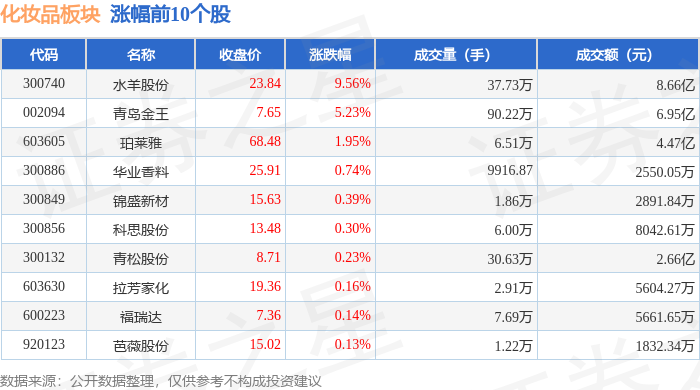
化妆品板块12月31日涨1.33%,水羊股份领涨,主力资金净流入5068.78万元
Zheng Xing Xing Ye Ri Bao· 2025-12-31 09:07
Group 1 - The cosmetics sector experienced a rise of 1.33% on December 31, with Shuiyang Co., Ltd. leading the gains [1] - The Shanghai Composite Index closed at 3968.84, up 0.09%, while the Shenzhen Component Index closed at 13525.02, down 0.58% [1] - Key stocks in the cosmetics sector showed varied performance, with Shuiyang Co., Ltd. closing at 23.84, up 9.56%, and Qingdao Kingking closing at 7.65, up 5.23% [1] Group 2 - The cosmetics sector saw a net inflow of 50.68 million yuan from institutional investors, while retail investors experienced a net outflow of 89.73 million yuan [2] - The stock performance of individual companies showed that Qingdao Kingking had a significant net outflow of 50.75 million yuan from institutional investors [3] - Shuiyang Co., Ltd. had a net inflow of 32.23 million yuan from institutional investors, indicating strong interest despite overall retail outflows [3]

贝泰妮:深耕植物原料研发 牢筑植萃科技根基
Ren Min Ri Bao· 2025-12-30 21:58
Core Viewpoint - The company, Betaini, is leveraging the rich plant resources of Yunnan to develop and register new plant-based raw materials for cosmetics, with a focus on biodiversity protection and innovative applications in skincare products [1][4]. Group 1: Plant Resource Development - Yunnan, known as the "Kingdom of Plants," has over 19,300 species of higher plants, many of which are unique or rare in China, providing a strong resource base for Betaini's new raw material development [1]. - Betaini's research team has screened over 2,000 local plants, identifying 266 with cosmetic efficacy, and has successfully registered 17 new plant raw materials [1]. - Seven of these new raw materials have been applied in products under the brands Winona, Aikeman, and Beifuting, focusing on soothing, moisturizing, and other skincare benefits [1]. Group 2: Technological and Intellectual Property Development - Winona has achieved core technology autonomy throughout the R&D and industrialization process, establishing a robust intellectual property protection system centered on patents [2]. - The company has integrated brand synergy and comprehensive intellectual property strategies to support high-quality development [2]. Group 3: Comprehensive Service Platform - Betaini is leading the establishment of a Yunnan characteristic plant extraction laboratory, focusing on the development of functional cosmetics, food, and pharmaceuticals [3]. - The laboratory provides a full-service platform for product development, including design, target research, raw material selection, formulation, safety, and efficacy evaluation [3]. - It aims to create a cluster of characteristic plant products and enterprises, extending the industrial chain and developing high-value health products [3]. Group 4: Biodiversity Protection and Sustainable Development - The R&D team collaborates with local planting bases and communities to build raw material bases, ensuring stable supply and quality while protecting biodiversity [4]. - Betaini is committed to long-term development and biodiversity education, with initiatives like the ecological restoration project in Haba Snow Mountain [6]. - The company aims to promote the innovative application of Yunnan's plant resources on a global scale, contributing to the cosmetics industry with unique Chinese characteristics [6].
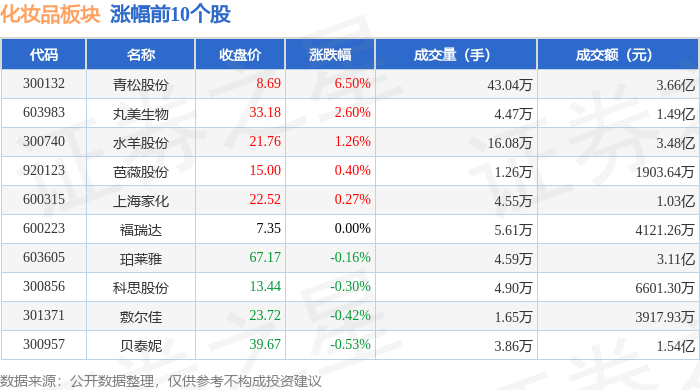
化妆品板块12月30日涨0.36%,青松股份领涨,主力资金净流入4663.64万元
Zheng Xing Xing Ye Ri Bao· 2025-12-30 09:08
Core Viewpoint - The cosmetics sector experienced a slight increase of 0.36% on December 30, with Qingsong Co., Ltd. leading the gains. The Shanghai Composite Index closed at 3965.12, showing no change, while the Shenzhen Component Index rose by 0.49% to 13604.07 [1]. Group 1: Stock Performance - Qingsong Co., Ltd. (300132) closed at 69.8, up by 6.50%, with a trading volume of 430,400 shares and a transaction value of 366 million yuan [1]. - Marubi Biological Technology (603983) closed at 33.18, increasing by 2.60%, with a trading volume of 44,700 shares and a transaction value of 14.9 million yuan [1]. - Shuiyang Co., Ltd. (300740) closed at 21.76, up by 1.26%, with a trading volume of 160,800 shares [1]. - Other notable stocks include Shanghai Jahwa (600315) with a slight increase of 0.27% and a closing price of 22.52, and Furuida (600223) remaining unchanged at 7.35 [1]. Group 2: Capital Flow - The cosmetics sector saw a net inflow of 46.64 million yuan from institutional investors, while retail investors experienced a net outflow of 68.77 million yuan [2]. - Qingsong Co., Ltd. had a significant net inflow of 34.30 million yuan from institutional investors, while retail investors showed a net outflow of 30.07 million yuan [3]. - Shanghai Jahwa recorded a net inflow of 17.15 million yuan from institutional investors, with a net outflow of 17.20 million yuan from retail investors [3].
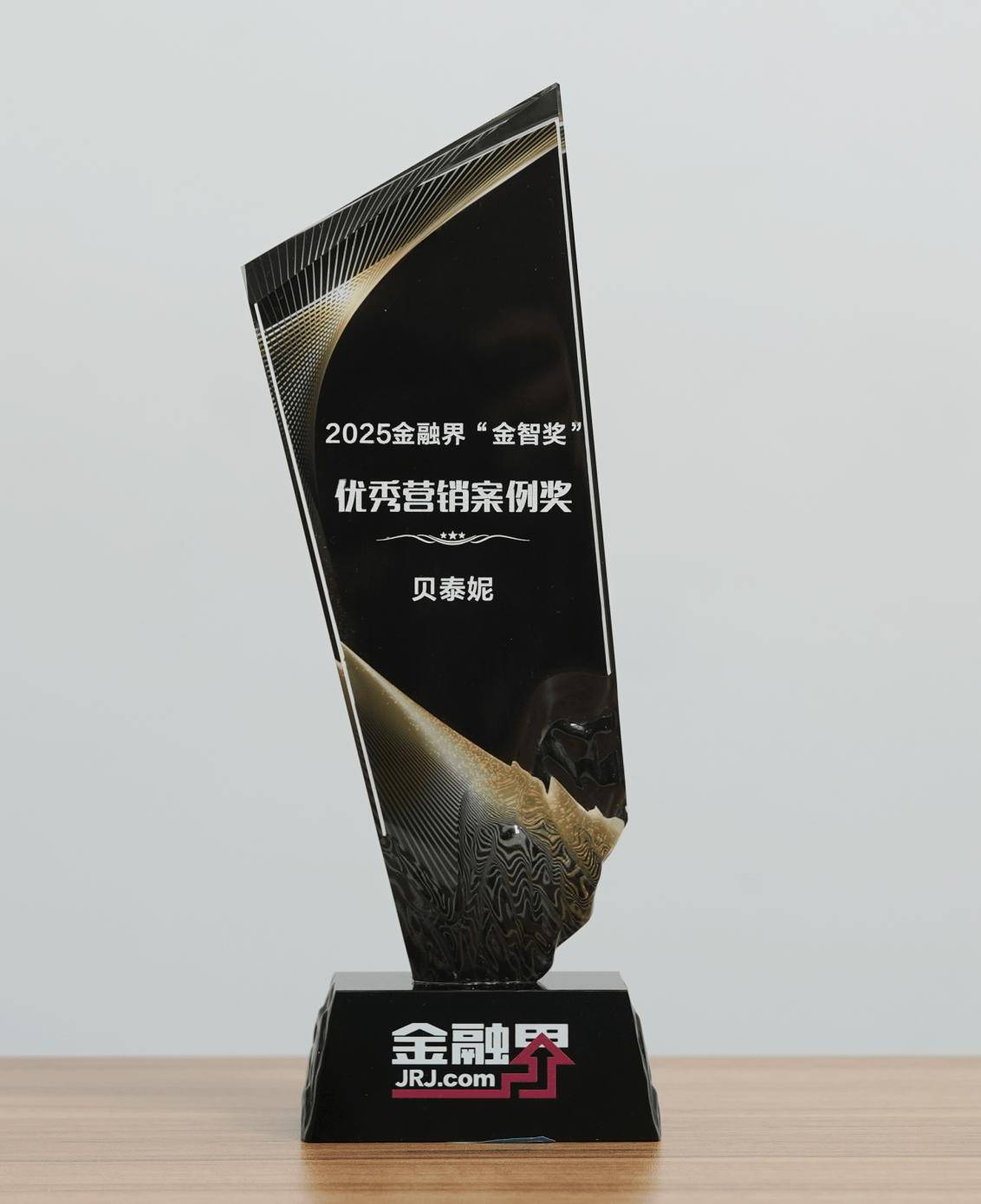
贝泰妮斩获第十四届金融界“金智奖”优秀营销案例奖
Sou Hu Cai Jing· 2025-12-29 22:18
Core Viewpoint - The "Qihang·2025 Financial Summit" held in Beijing highlighted the importance of high-quality development in the financial sector, with Betaini winning the "Outstanding Marketing Case Award" for its innovative marketing practices [1][3]. Group 1: Award Significance - The "Jinzhi Award" aims to set benchmarks for high-quality development, guiding listed companies to focus on core businesses, continuous innovation, and social responsibility [3]. - The award evaluation covered over 8,000 companies across A-shares, Hong Kong stocks, and Chinese concept stocks, with nearly 200 companies recognized for their achievements [3]. Group 2: Betaini's Marketing Strategy - Betaini's award-winning marketing strategy is based on a "full-domain collaboration + value deepening" system, focusing on user needs and employing an OMO (Online-Merge-Offline) channel integration model [4]. - The company maintains a strong online presence on platforms like Tmall, Douyin, and JD, while also deepening its engagement in professional channels such as OTC pharmacies [4]. Group 3: Brand Development - Betaini has established a multi-brand collaborative development framework, with its core brand, Winona, leading the sensitive skin market and achieving significant recognition [4]. - The brand has consistently ranked in the top 10 of Tmall's beauty industry for nine consecutive years and has been recognized as a "Chinese Consumer Brand" by the Ministry of Industry and Information Technology [4]. Group 4: International Expansion - Betaini has successfully entered mainstream channels in Thailand and established brand recognition through platforms like TikTok, as well as in Hong Kong and Macau [5]. - The company is focused on integrating international technology brands while promoting Chinese skincare wisdom, aiming to transition from a leader in sensitive skin to a global skin health ecosystem [5].