
Boeing(BA)

Search documents
美国监管机构需要进行更多测试才能解除波音737 Max产量限制
Shang Wu Bu Wang Zhan· 2025-08-28 10:30
Core Viewpoint - The FAA plans to conduct scenario-based planning with Boeing before considering lifting the production cap of 38 737 Max aircraft per month, focusing on quality assurance [1] Group 1: FAA and Boeing Production Plans - The FAA intends to perform desktop exercises to evaluate potential issues Boeing may face when increasing production [1] - The exercises are expected to be completed by the end of September [1] - The FAA imposed unprecedented production limits on Boeing following an emergency incident involving a 737 Max 9 aircraft in January 2024 due to missing critical bolts [1] Group 2: Boeing's Market Developments - Boeing's CEO expressed confidence in raising the production of the 737 Max to 42 aircraft per month [1] - Korean Air announced a $50 billion deal to purchase over 100 Boeing aircraft along with several spare engines, including a 20-year engine maintenance agreement [1] - The aircraft from the Korean Air deal are scheduled for phased delivery by the end of 2030 [1]

瑞安航空CEO对波音交付表示“乐观”
Sou Hu Cai Jing· 2025-08-28 08:30
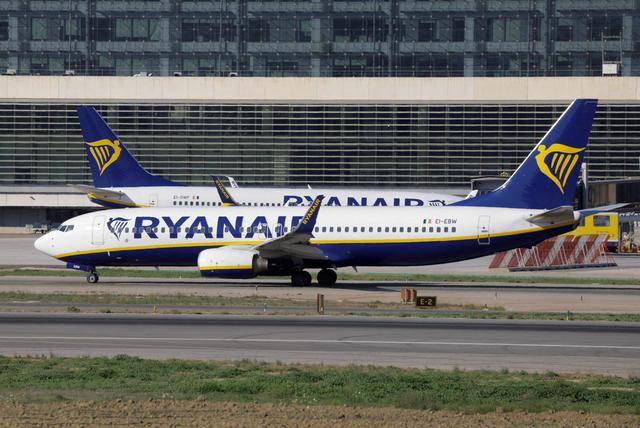
Core Insights - Ryanair's CEO Michael O'Leary revealed that Boeing has committed to increasing the monthly production of the 737 series from 38 to 42 aircraft by October [2] - Ryanair has placed firm orders for 150 Boeing 737 MAX 10 aircraft, which are expected to complete certification by early next year [2] - Boeing is projected to deliver the 737 MAX 10 jets by early 2027, and O'Leary expressed optimism regarding this timeline [2] - Ryanair has reached an agreement with Boeing to expedite the delivery of 25 new MAX 8 aircraft to October 2025 [2]


特朗普通告全球:美国筹码比北京厉害!话音未落,中方专机将抵美
Sou Hu Cai Jing· 2025-08-28 06:46
Group 1 - The core argument revolves around the ongoing economic and technological competition between the US and China, with Trump's claims of having stronger leverage over China being juxtaposed with China's proactive approach to engage in trade negotiations [1][8] - Trump's "killer cards" include imposing a 200% tariff on Chinese rare earths and threatening to cut off Boeing parts supply, but these measures may backfire on the US economy rather than significantly harm China [1][2] - The US heavily relies on China for rare earth processing, with over 90% of its rare earth imports coming from China, making any tariff increase potentially detrimental to the US economy, especially in terms of inflation [2][4] Group 2 - China's domestic production of key components for aircraft, such as the C919, has reached about 70% self-sufficiency, indicating a shift in dependency from Boeing [4][5] - Despite the US's threats, China has diversified its market by expanding exports to ASEAN and the Middle East, which have already surpassed exports to the US, showcasing resilience against potential market losses [5][8] - The ongoing negotiations are framed by China as a demonstration of its responsible global role rather than a sign of weakness, emphasizing its strategic positioning in the global supply chain [5][7] Group 3 - The competition between the US and China transcends simple tariff or supply cut strategies, revealing the US's vulnerabilities in its dependence on Chinese rare earths and market access [8] - China's advancements in technology and international cooperation, particularly in critical sectors like aviation and semiconductors, highlight its growing self-reliance and strategic depth [7][8] - Trump's rhetoric is seen as a domestic political maneuver to project strength ahead of elections, while China remains steadfast in its negotiation stance [8]
史上最快破万亿!美企以创纪录速度官宣股票回购,为美股注入强心剂
智通财经网· 2025-08-27 23:25
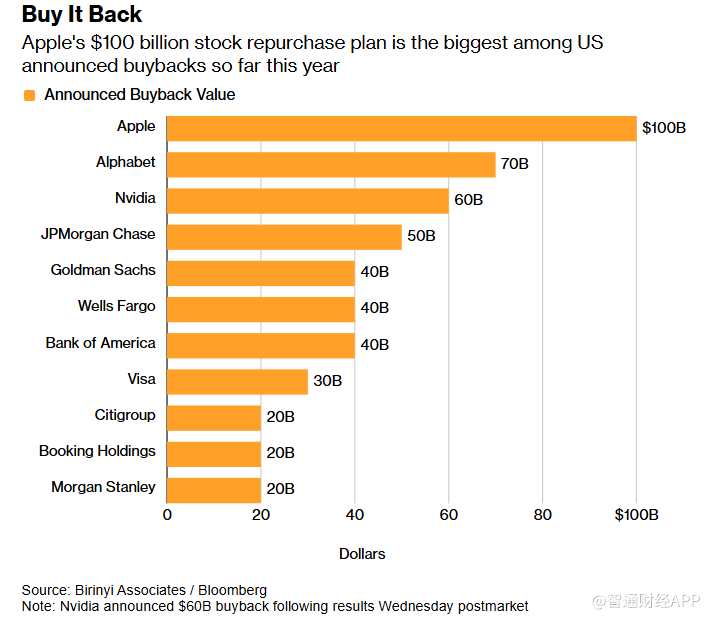
Group 1 - U.S. companies are planning record stock buybacks, indicating strong confidence in the economy, with Nvidia being the latest to announce a buyback plan worth $60 billion [1][3] - As of August 20, announced stock buybacks have exceeded $1 trillion, marking the fastest time to reach this level, surpassing the previous record set in October of the previous year [1] - Major companies, particularly in the financial and technology sectors, have approved large-scale buyback plans, including Apple with $100 billion, and others like Alphabet, JPMorgan, Goldman Sachs, Wells Fargo, and Bank of America committing at least $40 billion [1] Group 2 - In July, the total announced stock buybacks reached $166 billion, the highest amount recorded for that month, providing significant support to the U.S. stock market, with the S&P 500 index recently hitting a new all-time high [3] - The momentum of stock buybacks is expected to continue until the end of the year, with predictions of announced buybacks reaching $1.3 trillion and completed buybacks setting a historical record [4] - If the economy does not experience a significant slowdown, completed buybacks in 2026 are projected to reach $1.2 trillion, establishing a new record [4]





50%关税将生效!莫迪坚守底线,美国已经被印度逼疯,大赢家显现
Sou Hu Cai Jing· 2025-08-27 22:31
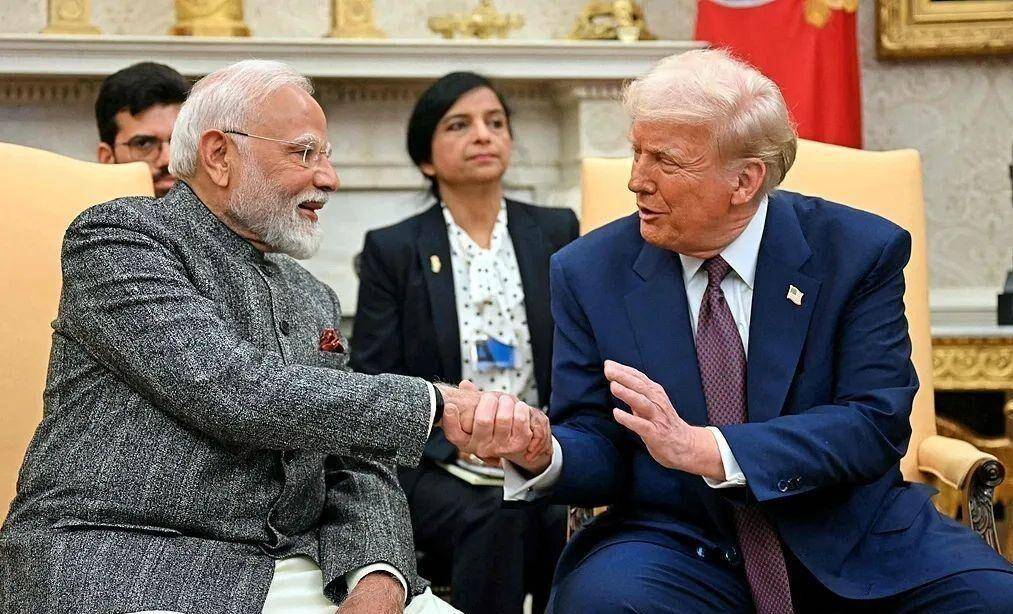
Core Viewpoint - The escalating trade conflict between India and the United States, triggered by the U.S. doubling tariffs on Indian goods, has led to significant retaliatory measures from India, highlighting the fragility of global trade dynamics and the potential for a broader economic fallout [1][3][4]. Group 1: Trade Measures and Responses - The U.S. has increased tariffs on Indian imports from 25% to 50%, targeting India's $54 billion export trade to the U.S. [3] - In retaliation, India has suspended a $3.6 billion order for Boeing P-8I aircraft and is continuing to import discounted oil from Russia [3][7]. - India has imposed retaliatory tariffs totaling $725 million on U.S. agricultural products, specifically targeting key crops from swing states [8][10]. Group 2: Economic Implications - The trade conflict has resulted in a 7% drop in Modi's approval ratings and a 4.5% increase in food prices in India [16]. - U.S. consumers are expected to bear 88% of the tariff costs, leading to an additional annual expense of $1,300 per household [16]. - The conflict has prompted a shift in supply chains, with orders moving from India to Southeast Asian countries like Vietnam and Thailand due to lower tariffs [15]. Group 3: Strategic Alliances and Energy - India has completed an $8.7 billion oil transaction with Russia, marking a significant shift in currency usage away from the dollar [11]. - The share of Russian oil in India's imports has surged to 42%, allowing India to save approximately $48 million daily [12]. - India is strengthening ties with China, evidenced by a record purchase of 150,000 tons of soybean oil and a relaxation of visa policies for Chinese citizens [13]. Group 4: Military and Defense - The cancellation of the Boeing military order is a direct hit to the U.S. defense industry, which relies heavily on the Indian market [7]. - India's defense procurement strategy is increasingly leaning towards Russian arms, including the accelerated purchase of S-400 missiles, raising concerns for U.S. strategic interests in the region [16].
美国财长:政府没有理由入股英伟达,可能介入造船业等行业
Ge Long Hui A P P· 2025-08-27 17:10
Core Viewpoint - The U.S. Treasury Secretary Scott Bessent stated that the U.S. government has no reason to take a stake in Nvidia, as the company does not require financial support [1] Group 1: Government Intervention - Bessent mentioned that the government might consider intervening in industries such as shipbuilding instead [1] Group 2: Corporate Behavior - Bessent criticized Boeing for engaging in large-scale stock buybacks rather than investing in research and development [1]
Boeing CEO Kelly Ortberg to Speak at Morgan Stanley Laguna Conference September 11
Prnewswire· 2025-08-27 15:00
Core Viewpoint - Boeing's President and CEO Kelly Ortberg will present at the Morgan Stanley Laguna Conference on September 11, 2025, at 11:30 a.m. PT, highlighting the company's ongoing engagement with investors and stakeholders [1]. Company Information - The event will be accessible via webcast, and a transcript will be available afterward on Boeing's investor relations website [1]. - Participants are advised to verify their access to the webcast prior to the event [1].
X @Bloomberg
Bloomberg· 2025-08-27 13:53
Boeing has accelerated 737 Max deliveries to Ryanair, the Irish airline’s chief executive officer said https://t.co/FSWjmUbkjM ...
X @Bloomberg
Bloomberg· 2025-08-27 11:00
Boeing investors aren’t paying much attention to the latest walkout by workers, and that's a problem for the union, @tomwblack says (via @opinion) https://t.co/3csbOPBTzr ...
大韩航空将购买103架波音飞机及19台备用发动机
Bei Jing Shang Bao· 2025-08-27 06:55
Core Points - Korean Air announced on August 25 that it will purchase 103 new generation aircraft from Boeing [1] - The total investment for this procurement is estimated to reach approximately $50 billion [1] - The aircraft order includes various advanced models, with deliveries planned in batches by the end of 2030 [1] Summary by Category Aircraft Procurement - Korean Air will acquire 103 new generation aircraft from Boeing, including 20 Boeing 777-9, 25 Boeing 787-10, 50 Boeing 737-10, and 8 Boeing 777-8F freighters [1] - The procurement is part of a broader strategy to modernize the airline's fleet [1] Engine Purchase and Maintenance - In addition to the aircraft, Korean Air will purchase 19 spare engines from GE Aviation and CFM International [1] - A comprehensive engine maintenance agreement with GE Aviation has also been signed, with a total cost of $13 billion over 20 years [1] Financial Overview - The total investment is broken down as follows: $36.2 billion for aircraft procurement, $690 million for spare engines, and $13 billion for maintenance services [1] - The total investment is approximately 70 trillion Korean Won [1]