
Bank of America(BAC)

Search documents
Bank of America Announces Redemption of $2,000,000,000 4.827% Fixed/Floating Rate Senior Notes, Due July 2026
Prnewswire· 2025-07-14 20:15
Group 1 - Bank of America Corporation will redeem $2 billion of its 4.827% Fixed/Floating Rate Senior Notes on July 22, 2025, at a price equal to 100% of the principal amount plus accrued interest [1][2] - The interest on the Notes will cease to accrue on the redemption date [1] - The payment of the redemption price will be facilitated through The Depository Trust Company, with The Bank of New York Mellon Trust Company acting as the trustee and paying agent [2] Group 2 - Bank of America is a leading financial institution providing a full range of banking, investing, asset management, and risk management services [3] - The company serves approximately 69 million consumer and small business clients through around 3,700 retail financial centers and approximately 15,000 ATMs [3] - Bank of America is a global leader in wealth management and corporate and investment banking, operating in over 35 countries [3]



Pre-Markets in the Red to Start a Fresh Week
ZACKS· 2025-07-14 16:05
Market Overview - Pre-market futures are lower across all major indexes due to new tariff threats from President Trump, which have dampened market enthusiasm after reaching near record highs last week [1][2] - Trump announced a new +35% tariff on all Canadian imports and a +30% tariff on both the EU and Mexico, effective if no new trade deals are reached by August 1st [2] Tariff Impact - Over $99 billion in revenues have been collected from tariff policies, marking an increase of more than +110% from the previous year [3] - Economists express concerns that higher tariffs could lead to increased prices for consumers as companies pass on costs to maintain profitability [3] Trade Deal Status - The U.S. has not established new trade deals, with only an incomplete agreement with the UK and a preliminary deal with China regarding rare earth materials [4][5] - The 90-day window for establishing new trade policies has closed without resolution, raising questions about the potential for further delays [5] Economic Data Releases - This week will see significant economic data releases, including the Consumer Price Index (CPI) and Producer Price Index (PPI), with CPI expected to rise to +2.7% from +2.4% [6] - Other economic reports include Empire State and Philly Fed manufacturing reports, Retail Sales, Industrial Production, Business Inventories, Homebuilder Confidence, and Housing Starts/Building Permits [7] Earnings Reports - Major banks such as JPMorgan, Citigroup, and Wells Fargo will report earnings on Tuesday, followed by Bank of America and Goldman Sachs later in the week [8] - Other companies reporting include Netflix, Johnson & Johnson, and 3M, contributing to a busy earnings week [8]

Evaluating BAC's Growth Drivers and Risks Ahead of Q2 Earnings
ZACKS· 2025-07-14 14:21
Core Viewpoint - Bank of America (BAC) is expected to report solid second-quarter 2025 results, with revenues projected at $26.59 billion, reflecting a 4.8% year-over-year growth, driven by strong trading performance and an increase in net interest income (NII) [1][2]. Financial Performance - The consensus estimate for BAC's earnings in the upcoming quarter has been revised down by 1.1% to 86 cents, indicating a 3.6% increase from the same quarter last year [2]. - The Zacks Consensus Estimate for NII is $14.86 billion, suggesting a 7.2% year-over-year increase, while trading revenues are expected to grow by 9.1% to $5.11 billion [8][14]. Earnings Surprise History - Bank of America has a strong earnings surprise history, having outperformed the Zacks Consensus Estimate in the last four quarters with an average surprise of 6.63% [5][7]. Loan Demand and NII - The Federal Reserve's decision to keep interest rates unchanged is likely to support BAC's NII, with solid demand for commercial, industrial, real estate, and consumer loans observed during the quarter [8][9]. - BAC is expected to see a modest rise in loan demand, similar to its peers JPMorgan and Citigroup [8]. Investment Banking Fees - Despite a challenging environment due to tariffs, global M&A activity improved towards the end of the quarter, likely leading to a marginal rise in advisory fees for BAC [10]. - The IPO market showed a revival, contributing to an increase in underwriting fees, which account for nearly 40% of total investment banking fees [11]. Trading Income - Strong client activity and market volatility are expected to boost BAC's trading revenues, projected to grow in the mid-to-high single-digit range [13][14]. Expenses and Asset Quality - Non-interest expenses are anticipated to rise by 4% year-over-year, driven by expansion efforts and digitization initiatives [15]. - The provision for credit losses is estimated at $1.54 billion, reflecting concerns over potential delinquent loans amid higher interest rates and tariff impacts [16]. Stock Performance and Valuation - BAC shares gained 18.6% in the second quarter, outperforming the S&P 500 Index, while trading at a price-to-tangible book (P/TB) ratio of 1.76X, below the industry average of 2.86X [21][24]. - Compared to JPMorgan and Citigroup, BAC's stock appears inexpensive, with JPMorgan at 3.04X and Citigroup at 0.97X [27]. Strategic Positioning - The company is focusing on aggressive branch expansion and technology investments to enhance customer relationships and drive NII growth over time [29]. - While the outlook remains promising, challenges such as high deposit costs and volatile capital markets may impact fee income growth [30].
Major banks to report Q2 earnings this week
CNBC Television· 2025-07-14 13:10
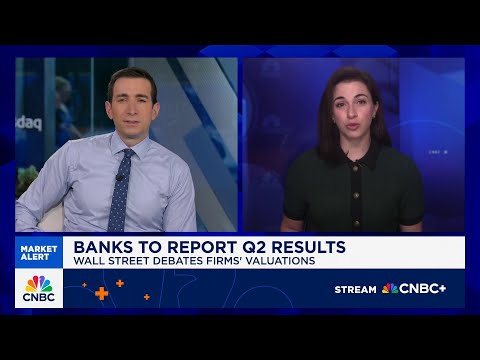
Market Performance & Expectations - US banks are up 33% on average over the last three months [1] - The cohort is trading at a 27% premium to its 10-year average when compared with the next 12 months projected earnings [2] - Street is questioning whether valuations are stretched or if new numbers will catalyze further upside [2] - Equity trading is expected to have another banner quarter [4] Macroeconomic & Regulatory Factors - Macro risks include tariff, inflation, lower income, consumer health, and rate uncertainty [2] - Regulatory reforms are expected to loosen capital requirements [3] - Banks are expected to redeploy excess capital in buybacks, M&A, or loan growth [3] M&A and IPO Activity - Global M&A volume is higher by 25% in the first half of the year [3] - IPO volume is up 14% [3] Private Credit Concerns - Concerns exist regarding private credit's potential impact during a financial crisis [6][7] - A report suggests private credit is safer than the banking system due to longer duration exposure [8]

特朗普新政“告别戒毒所,拥抱金三角”,美银Hartnett:全球股市All In!直到债券崩溃
华尔街见闻· 2025-07-14 10:07
Core Viewpoint - A policy-driven global stock market melt-up is underway, and investors should adopt an "All In" strategy until long-term bond yields breach critical levels, triggering a market collapse [1][2]. Group 1: Market Dynamics - The current market sentiment reflects a shift from fiscal detox to unrestrained spending, creating a "beautiful bubble" to cover massive bills, with risk assets like stocks and cryptocurrencies responding positively [2][9]. - The extreme indifference to policy risks is a key catalyst for the current rally, as evidenced by the low levels of volatility in both bond and stock markets [2][12]. - Hartnett suggests maintaining full exposure to risk assets until long-term Treasury yields reach "jailbreak" levels: 5.1% for the US 30-year Treasury, 5.6% for the UK, and 3.2% for Japan [2][3]. Group 2: Asset Performance - Hartnett emphasizes that bonds are the least favored asset class, with the trading logic of "Anything but Bonds" gaining traction globally [4]. - Over the past decade, gold has risen by 114%, outperforming other asset classes, while US Treasuries have declined by 1% [5]. - The ratio of European stocks to bonds has surpassed 2000 highs, indicating the end of a long-term deflationary era in Europe and Japan [5]. Group 3: Debt and Economic Outlook - The surge in US debt issuance is projected to push total debt beyond $50 trillion by 2032, with demand declining until interest rates rise sufficiently to attract investors [8]. - Hartnett warns that the inability to cut spending or significantly raise tariffs will lead to a "beautiful bubble" financed by massive deficits [9][11]. - A long-term bearish trend for the US dollar is anticipated, with recommendations to increase allocations to commodities, cryptocurrencies, and emerging markets in the latter half of the 2020s [11]. Group 4: Market Signals and Investor Sentiment - Despite a bullish stance, Hartnett notes increasing signs of bubbles, with a general optimism among investors leading to a lack of concern about economic conditions or valuations [12][13]. - The upcoming Fund Manager Survey (FMS) could signal a typical profit-taking or summer pullback if it shows extreme optimism [12]. - Hartnett highlights a divergence in market sentiment, with macro strategists fearing a bond market sell-off while equity and credit market participants remain optimistic due to anticipated economic prosperity ahead of midterm elections [13][14]. Group 5: Policy Environment - The global policy environment remains accommodative, with central banks continuing to lower interest rates, supporting risk appetite [14]. - Despite a reduction in fiscal stimulus in the US compared to 2024, upcoming tax cuts in 2026 and increasing fiscal stimulus from Europe and NATO are expected to provide effective counterbalances [14]. - The consensus is that any negative macro impacts from US tariff increases will be quickly mitigated, reinforcing investor risk appetite and driving the ongoing global stock market rally [14].

市场反应平淡,但别以为关税结束了,滞胀才是最需要关注的风险
Hua Er Jie Jian Wen· 2025-07-14 09:39
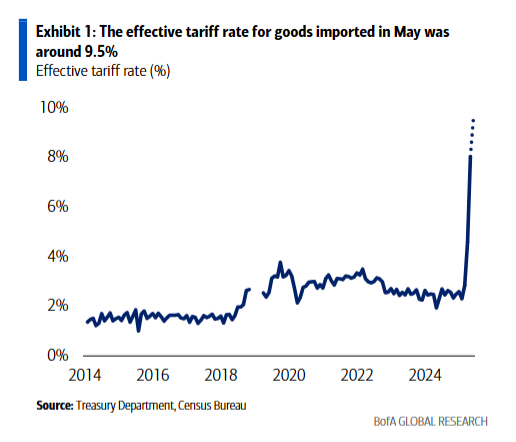
虽然市场对最新一轮关税威胁反应平淡,但投资者切不可掉以轻心。美银和摩根大通均发出警告,美国面临的滞胀风险正在上升,这可能比短期关税波动 更具威胁性。 美国政府此前宣布新一轮关税措施。据央视新闻报道,当地时间7月12日,美国总统特朗普在社交媒体平台"真实社交"上发布致墨西哥和欧盟的信件,宣 布自2025年8月1日起,美国将对来自墨西哥和欧盟的输美产品征收30%的关税。而根据之前信息,日本和韩国面临25%的关税税率,巴西则面临高达50% 的惩罚性关税。 据追风交易台信息,美银分析师在7月11日的报告中表示,如果这些威胁全面落实,美国有效关税税率将从目前的13.4%升至14.9%,而在"无协议"情景 下更可能达到18-20%的水平。 分析师警告,新关税措辞增加了滞胀的风险,即更高的通货膨胀和更低的经济活动,因为不确定性增加,且在关税提高和供应链中断共同导致的供应冲击 对通货膨胀预期影响的推动下,通胀预期上升。 在这种情况下,由于担心关税对通胀的滞后影响,美联储不太可能边际降息。企业为避免失去市场份额,会平稳地将成本转嫁到价格上。从时间上延 续"先升级再降级"的策略,而这只会增加美联储观望的可能。 下半年不确定性将持 ...
保障秋粮丰收 银行业大有可为
Zheng Quan Ri Bao· 2025-07-13 15:44
Core Viewpoint - The article emphasizes the importance of autumn grain production for national food security and highlights the need for banks to provide financial support to ensure a successful harvest during this critical period [1][3]. Group 1: Financial Support for Autumn Grain Production - The Ministry of Agriculture and Rural Affairs has initiated a 100-day action plan to enhance summer management and ensure a successful autumn grain harvest, focusing on key crops, regions, and agricultural practices [1]. - Banks are encouraged to increase credit support for grain farmers, especially in areas affected by adverse weather conditions, by offering specialized loan products and simplifying approval processes [1][2]. - Financial institutions should provide tailored financial service solutions to large-scale grain producers, family farms, and cooperatives in major grain-producing areas to meet their funding needs [1][2]. Group 2: Innovation in Financial Services - Banks should innovate financial products and service models that align with the seasonal characteristics and actual needs of autumn grain production, including the development of green financial products for sustainable agricultural practices [2]. - The advancement of financial technology, such as big data and artificial intelligence, can enhance the efficiency of financial services for autumn grain production, enabling precise marketing and risk management [2]. - Utilizing technologies like satellite remote sensing and the Internet of Things can help monitor autumn grain production in real-time, providing scientific support for credit decisions and assisting farmers in managing their fields [2]. Group 3: Collaboration for Success - Successful autumn grain production requires collaboration among banks, government departments, agricultural enterprises, and research institutions to create a unified support system [3]. - Establishing regular communication with agricultural departments can help banks stay informed about production conditions and policy directions, allowing for the development of effective financial service plans [3]. - Collaborating with agricultural enterprises and research institutions can lead to innovative financial solutions tailored to the needs of autumn grain production, ensuring stability in the agricultural supply chain [3].
银行业要全力写好“普惠金融”大文章
Zheng Quan Ri Bao· 2025-07-13 15:44
Group 1 - The release of the "Implementation Plan for High-Quality Development of Inclusive Finance in Banking and Insurance" provides direction for financial institutions in the inclusive finance sector [1] - Banks, as key players in inclusive finance, need to actively engage in inclusive credit business to better serve the real economy and promote social equity and common prosperity [1] - In serving small and micro enterprises, banks should increase effective credit supply, ensure sufficient funding support, and enhance credit approval efficiency by optimizing models and utilizing data platforms [1][2] Group 2 - For the "Three Rural Issues," banks should strengthen credit investment in key areas such as food security and rural infrastructure to support stable agricultural production and improve rural living conditions [2] - Banks are required to adhere to the "Four No Deductions" principle, increasing credit investment in poverty alleviation areas and supporting local industries to prevent poverty recurrence [2] - In supporting private enterprises, banks should enhance credit resource allocation and ensure that funds are directed towards supporting the real economy [2][3]
Unlocking Q2 Potential of Bank of America (BAC): Exploring Wall Street Estimates for Key Metrics
ZACKS· 2025-07-11 14:16
Core Viewpoint - Analysts project that Bank of America (BAC) will report quarterly earnings of $0.86 per share, a 3.6% increase year over year, with revenues expected to reach $26.61 billion, up 4.9% from the same quarter last year [1]. Earnings Estimates - Over the last 30 days, the consensus EPS estimate has been revised upward by 0.8%, indicating a collective reassessment by analysts [2]. - Changes in earnings estimates are crucial for predicting investor reactions, as empirical research shows a strong correlation between earnings estimate revisions and short-term stock performance [3]. Key Metrics Forecast - The 'Efficiency Ratio (FTE basis)' is expected to reach 64.5%, compared to 63.9% in the same quarter last year [5]. - The 'Book value per share of common stock' is projected at $36.85, up from $34.39 a year ago [5]. - 'Total earning assets - Average balance' is forecasted to be $2975.40 billion, compared to $2887.94 billion in the same quarter last year [6]. - 'Total nonperforming loans, leases and foreclosed properties' are expected to be $6.66 billion, up from $5.69 billion a year ago [6]. - The estimated 'Total Non-Performing Loans' is $6.62 billion, compared to $5.47 billion in the same quarter last year [7]. - The 'Tier 1 Capital Ratio' is projected at 13.0%, down from 13.5% a year ago [7]. - The 'Net Interest Income - Fully taxable-equivalent basis' is expected to reach $14.88 billion, compared to $13.86 billion last year [8]. - 'Total Noninterest Income' is projected at $11.80 billion, slightly up from $11.68 billion in the same quarter last year [8]. - 'Investment and brokerage services' are expected to reach $4.73 billion, compared to $4.32 billion a year ago [9]. - The consensus estimate for 'Investment banking fees' stands at $1.34 billion, down from $1.56 billion in the same quarter last year [9]. - 'Total fees and commissions' are expected to be $9.29 billion, compared to $8.97 billion last year [9]. Stock Performance - Shares of Bank of America have increased by 5.3% over the past month, outperforming the Zacks S&P 500 composite, which rose by 4.1% [10].
美银:英国央行或于10月放缓量化紧缩
news flash· 2025-07-11 11:34
Core Viewpoint - Bank of America suggests that the Bank of England may slow down its quantitative tightening from October, reducing the annual bond reduction from £100 billion to £60 billion [1] Group 1 - The potential slowdown in quantitative tightening is attributed to the tightening of monetary policy that is exerting additional pressure on the economy [1] - Adjusting the pace of quantitative tightening could help alleviate the impact on financial conditions and economic growth [1]