Bank of America(BAC)

Search documents
Could Buying Bank of America Stock Today Set You Up for Life?
Yahoo Finance· 2025-11-24 11:50
Core Viewpoint - Bank of America is positioned as a durable business critical to the economy, supported by significant investment from Berkshire Hathaway, indicating strong investor confidence [1]. Financial Performance - In the third quarter, Bank of America reported a revenue increase of 11% year over year, reaching $28.1 billion, primarily driven by robust investment banking activity [4]. Business Model and Competitive Advantage - The company benefits from a diversified business model, allowing it to mitigate weaknesses in one area with strengths in another, which is a significant advantage over smaller banking entities [5]. - Bank of America possesses a wide economic moat, characterized by a trusted brand name among retail and corporate clients, contributing to its long-term stability and competitive positioning [7][8]. Future Outlook - The company is expected to experience loan growth as the Federal Reserve begins to cut benchmark interest rates, potentially lowering borrowing costs and increasing loan demand, which would enhance revenue [6].

Bank of America: Risk-Reward Profile Is Favorable, Maintain Buy (NYSE:BAC)
Seeking Alpha· 2025-11-24 03:20
Core Viewpoint - The article discusses the performance and outlook of Bank of America Corporation (BAC), indicating that the analyst's previous rating has remained stable since the last coverage initiated in January [1]. Summary by Relevant Sections - The analyst expresses confidence in the long-term success of investments, emphasizing core values such as Excellence, Integrity, Transparency, and Respect [1]. - There is an invitation for reader feedback to improve the quality of future analyses, highlighting a commitment to continuous improvement [1].

Bank Of America: Risk-Reward Profile Is Favourable, Maintain Buy
Seeking Alpha· 2025-11-24 03:20
Core Viewpoint - The article discusses the performance and outlook of Bank of America Corporation (BAC), indicating that the analyst's previous rating has remained stable since the last coverage initiated in January [1]. Summary by Relevant Sections - The analyst expresses confidence in the long-term success of investments, emphasizing core values such as Excellence, Integrity, Transparency, and Respect [1]. - The article invites readers to provide constructive feedback to enhance the quality of future analyses [1].
美银:股市“卖出信号”出现!机构现金仓位降至3.7%的13年低位
Ge Long Hui A P P· 2025-11-24 02:44
Group 1 - The core viewpoint of the article indicates a rebound in risk appetite among institutional investors, with cash positions dropping to a 13-year low of 3.7% [1] - Historically, cash positions below 3.7% have occurred only 20 times since 2002, typically leading to stock market declines and stronger performance in government bonds within 1 to 3 months, signaling a "sell" [1] - There is a notable increase in stock allocations, with global equity overweight rising to a net 34%, the highest since February 2025 [1] Group 2 - Commodity overweight has also increased to a net 17%, marking the highest level since September 2022, indicating it as a core asset favored by institutions [1] - A significant shift in global institutional investor sentiment is observed, with 53% of fund managers believing in a smooth "soft landing" for the global economy, the highest proportion since January 2025 [1] - The global economic growth forecast has turned positive for the first time since December 2024, aligning overall expectations with stock market performance [1]
美银Hartnett:一切都达到“流动性峰值” 美联储将被迫“投降” 比特币率先嗅探救市信号
智通财经网· 2025-11-23 11:19
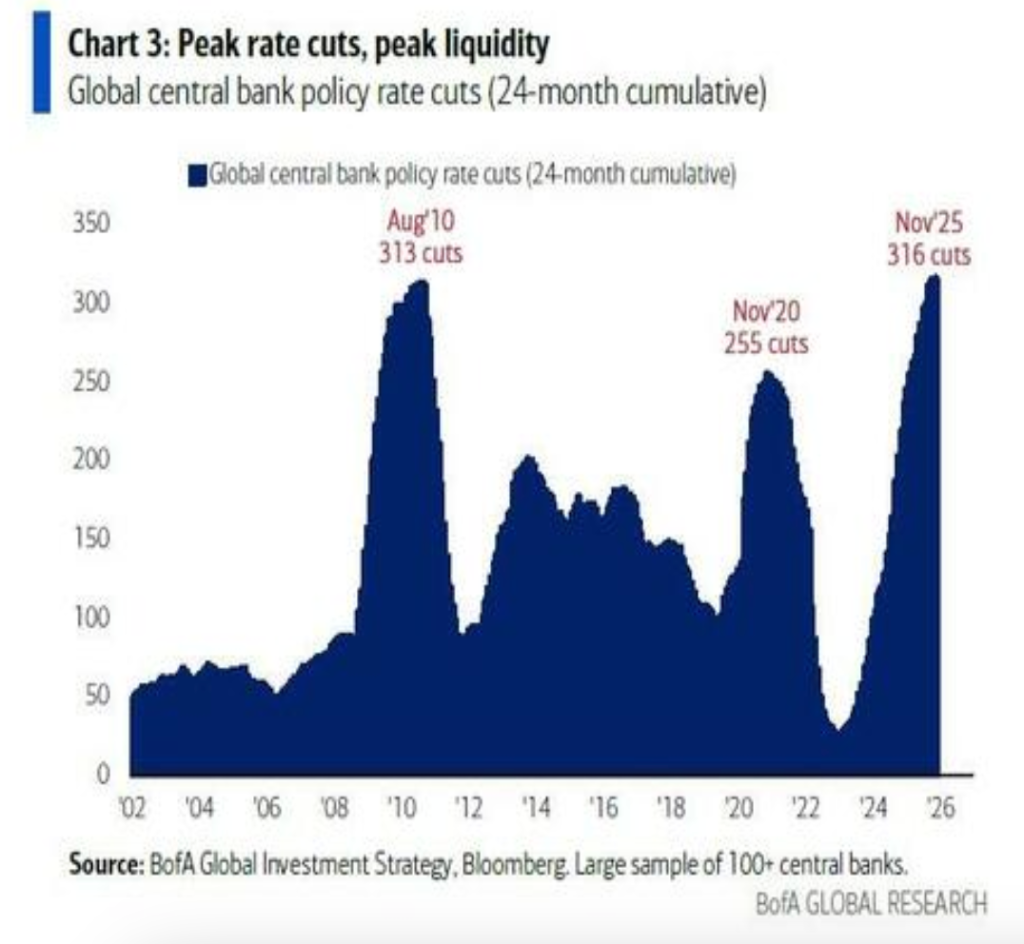
Group 1 - The market is experiencing significant divergence in expectations regarding the Federal Reserve's interest rate path for December, with previous optimism about rate cuts being tempered by recent hawkish statements from the Fed [1][4] - Michael Hartnett from Bank of America indicates that tightening liquidity is impacting multiple asset classes, suggesting that the cryptocurrency market will be the first to sense a shift in central bank policy [1][7] - Hartnett predicts that the current weakness in U.S. bank stocks is signaling a potential shift towards easing monetary policy, similar to signals observed in December 2018 [1][4] Group 2 - Hartnett forecasts that the Federal Reserve will likely initiate a rate-cutting cycle in 2026, benefiting long-duration zero-coupon bonds, Bitcoin, and mid-cap stocks [2] - Japan is facing a debt crisis, with a significant decline in 30-year government bonds and the yen nearing a 40-year low against the dollar, raising global liquidity concerns [3] - The combination of expansive fiscal policy and loose monetary policy in Japan is exacerbating the depreciation of the yen and pressure on government bonds [3] Group 3 - U.S. mid-cap stocks are showing a notable divergence in valuation and performance, indicating that the Fed's policy adjustments are lagging behind market demands [4] - The decline in bank and brokerage indices, which are sensitive to liquidity, serves as a leading indicator for potential policy shifts [4] - Hartnett emphasizes that the cryptocurrency market, particularly Bitcoin, will act as an early warning system for changes in central bank policy due to its sensitivity to liquidity changes [7][8]
Umicore - Transparency notification by Bank of America Corporation
Globenewswire· 2025-11-21 17:30
Core Points - Bank of America Corporation has crossed the legal threshold of 3% for direct voting rights and equivalent financial instruments in Umicore, reaching a total holding of 3.53% as of 18 November 2025 [2][8]. Company Overview - Umicore is a global advanced materials and recycling group, focusing on transforming precious and critical metals into functional technologies for everyday applications [6]. - The company operates with a unique circular business model that ensures continuous refinement and recycling of critical elements for reintegration into new applications [6]. Business Segments - Umicore has four main business groups: Catalysis, Recycling, Specialty Materials, and Battery Materials Solutions, which address resource scarcity and the demand for functional materials in clean technologies and mobility [7]. - The company emphasizes innovation and sustainability through tailored products and processes [7]. Financial Performance - In the first half of 2025, Umicore generated revenues of €1.8 billion (with a turnover of €8.7 billion), primarily focusing on clean mobility and recycling [10].

BofA to help L.A. Wildfire Clients Rebuild with Financing, Rate Preservation, Extended Forbearance
Prnewswire· 2025-11-21 17:00
Core Viewpoint - Bank of America has introduced a new Rebuild Solution aimed at assisting homeowners in Altadena and Pacific Palisades who were affected by recent wildfires, providing financial support to help them rebuild their homes [1][2]. Group 1: Rebuild Solution Features - The Rebuild Solution includes three main features: extended forbearance for up to two additional years, a Rebuild Line of Credit expected to launch in February 2026, and preservation of the current lower interest rate on existing mortgages [6]. - The extended forbearance is designed to help homeowners maintain cash flow while they plan their rebuilding efforts [2][6]. Group 2: Impact of Wildfires - The wildfires in Southern California have destroyed approximately 13,000 residential properties, with about half of the affected homeowners having a financial relationship with Bank of America [2]. - Bank of America has a long-standing presence in Los Angeles, with over 110 years of history and a leading market share in the region [2]. Group 3: Community Support Initiatives - The bank's Client Assistance Program has previously provided early loan payment relief, including mortgage and credit card forbearance, and personalized support for impacted clients and businesses [3]. - Bank of America is committed to rebuilding its financial centers in the affected areas and is directing significant capital to Community Development Financial Institutions (CDFIs) for ongoing small business and housing relief [3].

Here's why Wall Street is starting to place bets on BofA's famously risk-averse CEO
New York Post· 2025-11-21 14:34
Core Insights - Bank of America CEO Brian Moynihan is experiencing a positive response following the bank's first investor day in 14 years, where he presented the evolving business model to investors and analysts [1][2][6] - Investors reportedly appreciated Moynihan's presentation, which aimed to differentiate Bank of America from competitors like JPMorgan, led by Jamie Dimon [3][9] - Despite a slight decline in shares post-presentation, Bank of America’s stock performed better than the broader market and key competitors [9][11] Company Performance - Following the investor day, 20 analysts raised their price targets for Bank of America shares, with Morgan Stanley listing it as a top pick among big banks, setting a target of $70 while the stock trades around $50 [10] - The investor day was intended to signal a shift towards "responsible growth," indicating a more risk-on approach within the limits set by Moynihan [6][12] - After-hours trading showed a recovery in share prices, suggesting a positive investor sentiment despite initial declines during the event [11] Future Outlook - The success of Moynihan's strategy will depend on achieving better earnings growth and meeting the target return on tangible equity ratio of 18%, which is crucial for assessing bank performance [13] - If the recent positive trends are sustained, there is potential for Moynihan to extend his tenure beyond the planned retirement in five years [14]
个贷不良资产进入“盲拍时代”?银行不再向公众披露部分信息,但AMC仍可见
Hua Xia Shi Bao· 2025-11-21 05:59
Core Viewpoint - Recent changes in the disclosure of personal loan non-performing asset (NPA) transfer information by banks indicate a shift towards less transparency, with key data no longer available to the public, reflecting a strong demand for rapid capital recovery by banks [2][4][5]. Disclosure Changes - Since November, banks have stopped disclosing auxiliary valuation information such as starting prices, average outstanding principal and interest balances, and write-off statuses in their NPA transfer announcements [3][4]. - The announcements now include a watermark stating "unauthorized reproduction prohibited," indicating a tightening of information access [3]. Impact on Asset Management Companies (AMCs) - Although some information is hidden from public view, AMCs can still access most data through corporate accounts, except for write-off statuses, which are crucial for assessing asset value [4][5]. - The write-off status is significant as it indicates the bank's assessment of the likelihood of recovering the asset, affecting the discount rates of asset packages [4]. Market Dynamics - The pilot program for bulk transfers of personal non-performing loans began in 2021, initially involving a limited number of banks, but has since expanded to include more institutions, leading to a more standardized process [5]. - The decision to limit public information is seen as a necessary step as the market stabilizes, reducing the risk of misinterpretation by non-participants [5]. Transaction Process Changes - The transaction process has accelerated, with banks significantly shortening payment deadlines in recent announcements compared to earlier in the year [6]. - For example, a state-owned bank reduced the payment and agreement signing periods from five working days to three and two days, respectively [6]. Market Growth - The scale of personal non-performing loan transfers is expanding, with over 100 projects announced, indicating a faster pace of asset disposal [7]. - As of the end of Q1 this year, the scale of personal non-performing loan bulk transfers reached 37.04 billion, a year-on-year increase of 761.4% [7]. - The banking sector has disposed of 1.5 trillion in non-performing assets in the first half of the year, contributing to a decrease in both the balance and rate of non-performing loans [7].

银行直供房打折卖,能捡漏吗
21世纪经济报道· 2025-11-21 02:36
Core Viewpoint - The concept of "bank direct supply housing" is misleading as banks do not sell houses directly; they are promoting the disposal of non-performing assets, specifically properties acquired through loan defaults [1][2]. Group 1: Understanding "Bank Direct Supply Housing" - Banks are not licensed to sell real estate; their primary business is financial services such as deposits and loans [1]. - The term refers to banks promoting properties they have repossessed due to loan defaults, not direct sales by the banks themselves [1][2]. - The traditional method for banks to dispose of these properties involves bulk sales to asset management companies or public auctions on platforms like Alibaba and JD [2]. Group 2: Market Context and Trends - The popularity of "bank direct supply housing" has surged this year due to a low overall transaction rate of 13.1% for judicial auction properties in the first three quarters [2]. - The success rate for first-time auctions is only 39%, prompting banks to seek alternative methods to accelerate inventory turnover [2]. Group 3: Risks for Buyers - The property title typically remains under the original debtor's name, meaning buyers may inherit existing legal issues or disputes related to the property [2][3]. - Buyers should thoroughly investigate the property’s details, including any rights restrictions or potential eviction challenges post-purchase [3]. - The volume of "bank direct supply housing" is limited, with only a few hundred properties available, which is unlikely to impact the overall housing market significantly [3].