
Citi(C)

Search documents
Citigroup Analysts Increase Their Forecasts After Q4 Earnings - Citigroup (NYSE:C)
Benzinga· 2026-01-15 17:13
Core Viewpoint - Citigroup reported mixed fourth-quarter results, with earnings exceeding expectations but revenue falling short of estimates [1] Financial Performance - Fourth-quarter revenue was $19.87 billion, a 2% increase year over year, but below the analyst consensus of $20.53 billion; excluding divestiture impacts from the planned sale of AO Citibank in Russia, revenue increased by 8% [1] - Net income declined by 13% year over year to $2.5 billion, impacted by a $1.1 billion after-tax loss related to the exit from Russia; adjusted net income was $3.6 billion, with adjusted earnings per share at $1.81, surpassing expectations of $1.68 [2] Market Reaction - Citigroup's CFO Mark Mason indicated that the bank is closely monitoring market reactions and has minimal exposure to current geopolitical situations, having sold its operations in Venezuela in 2021; he refrained from commenting on future business plans regarding Venezuela [3] - Following the earnings announcement, Citigroup shares rose by 4.1% to trade at $117.00 [3] Analyst Ratings - Oppenheimer analyst Chris Kotowski maintained an Outperform rating on Citigroup and raised the price target from $141 to $144 [5] - Morgan Stanley analyst Betsy Graseck also maintained an Overweight rating and increased the price target from $134 to $135 [5]


Citigroup Analysts Increase Their Forecasts After Q4 Earnings
Benzinga· 2026-01-15 17:13
Core Viewpoint - Citigroup reported mixed fourth-quarter results, with earnings exceeding expectations but revenue falling short of estimates [1][2]. Financial Performance - Fourth-quarter revenue was $19.87 billion, a 2% increase year over year, but below the analyst consensus of $20.53 billion; excluding divestiture impacts, revenue increased by 8% [1]. - Net income declined by 13% year over year to $2.5 billion, impacted by a $1.1 billion after-tax loss related to the exit from Russia; adjusted net income was $3.6 billion, with adjusted earnings per share at $1.81, surpassing expectations of $1.68 [2]. Market Reaction - Citigroup's CFO Mark Mason indicated that the bank is closely monitoring market reactions and has minimal exposure to current geopolitical situations, having sold its Venezuelan operations in 2021; he refrained from commenting on future business plans regarding Venezuela [3]. - Following the earnings announcement, Citigroup shares rose by 4.1% to $117.00 [3]. Analyst Ratings - Oppenheimer analyst Chris Kotowski maintained an Outperform rating on Citigroup and raised the price target from $141 to $144 [5]. - Morgan Stanley analyst Betsy Graseck also maintained an Overweight rating, increasing the price target from $134 to $135 [5].

花旗集团通过新一轮裁员削减开支
Xin Lang Cai Jing· 2026-01-15 15:40
Group 1 - Citigroup (C) shares rose by 4.8% in early trading on Thursday [1][2] - The company plans to lay off approximately 1,000 employees this week as part of a restructuring initiative [1][2] - CEO Jane Fraser is implementing a results-oriented culture and a restructuring plan that could ultimately lead to a total of 20,000 job cuts [1][2]
Navigating a Mixed Market: Tech Shines Amidst Banking Cautions and Geopolitical Shifts
Stock Market News· 2026-01-15 15:07
Market Overview - U.S. equities opened with a mixed but generally positive tone, driven by strong earnings from the semiconductor sector and easing geopolitical tensions [1] - The S&P 500 Index rose to 6,969.46 points, a 0.62% gain, while the Nasdaq Composite Index surged to 23,693.97 points, up 0.95% [2] - The Dow Jones Industrial Average opened at 49,201.10 points, reflecting a 0.10% increase [2] Semiconductor Sector - Taiwan Semiconductor Manufacturing Company (TSM) reported a 35% surge in fourth-quarter profit, exceeding analyst estimates and marking its seventh consecutive quarter of double-digit growth [3] - TSM's U.S.-listed shares jumped 5.5% at the opening, with ASML Holding NV shares soaring 7%, pushing its market capitalization above $500 billion [3] - Other chip-related stocks, including Nvidia and Advanced Micro Devices, also saw gains of 2% and 3.8%, respectively [3] Banking Sector - Major financial institutions, including BlackRock, Goldman Sachs, and Morgan Stanley, reported earnings, with BlackRock exceeding expectations in revenue and assets under management [4] - Goldman Sachs beat earnings expectations but fell short on revenue, while Morgan Stanley advanced 3.3% after topping forecasts [4] - Wells Fargo shares sank 4.6% after reporting weaker-than-expected quarterly results, contributing to pressure on the broader banking sector [4] Economic Indicators - The Federal Reserve's monetary policy remains a focal point, with a 95% likelihood of interest rates remaining unchanged in January and expectations for one or two rate cuts in 2026 [5] - The U.S. Census Bureau released data indicating a 0.6% increase in retail sales for November, driven by auto sales recovery and holiday shopping [6] - Existing home sales rose 5.1% in December, reaching a nearly three-year high [6] Geopolitical Developments - Oil prices fell significantly, with U.S. benchmark crude down 4.5% to $59.13 per barrel, attributed to easing tensions surrounding Iran [8] - Gold futures slipped as fears of military action against Iran decreased, reducing demand for safe-haven assets [8] - The U.S. dollar index rose 0.3% to 99.38, reflecting changes in the geopolitical landscape [8] Summary - The stock market shows resilience in the technology sector, particularly in semiconductors, driven by strong earnings [9] - The banking industry faces challenges, and investors are closely monitoring economic data and the Federal Reserve's interest rate stance [9] - Geopolitical developments are impacting commodity prices, adding complexity to the market outlook [9]



华尔街大行Q4利润飙升:贷款需求增长,释放美国经济韧性信号
智通财经网· 2026-01-15 13:37
Core Viewpoint - The major U.S. banks reported significant profit growth in Q4, driven by sustained borrower demand, indicating a robust economic environment and optimistic future profitability for lending institutions [1]. Group 1: Bank Performance - Bank of America reported an 8% year-over-year increase in average loans, with net interest income soaring to a record $15.9 billion [1]. - JPMorgan Chase experienced a 9% growth in average loans, reflecting strong lending activity as a positive indicator for the banking sector and overall economy [1]. - Citigroup's average loan amount grew by 7% in Q4, supported by its market and personal banking services [2]. - Wells Fargo's commercial loans surged by 12% in Q4, with increased revenue from auto loans and credit cards [2]. Group 2: Economic Outlook - Analysts from S&P Global expressed optimism for sustained economic growth into 2026, attributing this to macroeconomic stability and favorable lending conditions, with a projected 5.3% loan growth by the end of 2025 [2]. - Bank of America anticipates a moderate single-digit percentage loan growth rate in 2026, despite challenges from tariffs and geopolitical tensions [1]. Group 3: Challenges and Concerns - Potential obstacles for lending institutions include geopolitical tensions and policy uncertainties, particularly regarding a proposed cap on credit card interest rates at 10% [3]. - Executives expressed concerns that such a cap could lead to a contraction in lending, negatively impacting economic growth [4]. - Citigroup's CFO noted that assessing the potential impact of the interest rate cap is premature due to the lack of specific implementation details [4]. Group 4: Federal Reserve Independence - Bank executives emphasized the importance of the Federal Reserve's independence for economic stability, with calls for the next Fed chair to maintain this independence [5]. - Concerns were raised about political interference in the Fed, which could lead to increased inflation expectations and higher interest rates over time [5].


Earnings live: Goldman Sachs and BlackRock profits beat, TSMC stock jumps on robust outlook
Yahoo Finance· 2026-01-15 13:02
Group 1 - The fourth quarter earnings season has commenced with reports from Delta Air Lines and JPMorgan Chase, with more bank earnings expected later in the week [1][5] - Wall Street analysts predict an 8.3% earnings per share growth rate for S&P 500 companies in Q4, marking the 10th consecutive quarter of annual earnings growth if realized [2] - Analysts have increased earnings expectations for tech companies, which have been significant contributors to earnings growth in recent quarters, with a prior estimate of 7.2% for Q4 [3] Group 2 - The earnings season will test the improved stock market breadth observed at the beginning of 2026, with ongoing themes such as artificial intelligence and economic policies from the Trump administration influencing market dynamics [4] - Major financial companies scheduled to report earnings this week include Bank of New York Mellon, Bank of America, Citigroup, Wells Fargo, BlackRock, Goldman Sachs, and Morgan Stanley [5]


Can Tech Offset Bank Weakness and Drive the S&P 500 Through 7,000?
Investing· 2026-01-15 12:11
Group 1 - The article provides a market analysis focusing on S&P 500 Futures and Taiwan Semiconductor Manufacturing [1] Group 2 - The analysis includes insights on the performance trends of S&P 500 Futures, indicating potential investment opportunities [1] - Taiwan Semiconductor Manufacturing is highlighted for its significant role in the semiconductor industry, reflecting broader market dynamics [1]

Tech Rebound Fuels Mixed Futures as Bank Earnings and Geopolitical Tensions Dominate Early Trading
Stock Market News· 2026-01-15 11:07
Market Overview - U.S. stock futures are mixed, with Nasdaq 100 and S&P 500 futures showing modest gains while Dow Jones futures are slightly down, indicating a cautious trading start [1] - The S&P 500 E-minis rose by 0.32%, Nasdaq 100 E-minis increased by 0.74%, and Dow E-minis saw a slight increase of 0.06% [2] - The U.S. stock market closed lower on Wednesday, with the S&P 500 Index down 0.53% to 6,926.60 points, Dow Jones Industrial Average down 0.09% to 49,149.63 points, and Nasdaq Composite Index down 1.00% to 23,471.75 points [4] Technology Sector - A strong earnings report from Taiwan Semiconductor Manufacturing Company (TSM) led to a rally in the semiconductor sector, with Applied Materials (AMAT) rising 6.2%, Lam Research (LRCX) gaining 5.4%, and KLA Corporation (KLAC) up 5% [2] - Big Tech companies like Microsoft (MSFT), Meta Platforms (META), and Amazon (AMZN) each dropped more than 2%, while Oracle (ORCL) and Broadcom (AVGO) slid 4% each [5] - Nvidia (NVDA) shares declined 1.4% due to news that China instructed domestic firms to avoid H200 purchases, reflecting a reevaluation of tech stock valuations [5] Financial Sector - Several prominent financial institutions, including Goldman Sachs (GS), Morgan Stanley (MS), and BlackRock (BLK), are set to report quarterly results, which will be closely monitored for signs of financial sector health [7] - Wells Fargo (WFC) dropped 4.6% after reporting weaker-than-expected Q4 revenue, negatively impacting other banking giants like Citigroup (C) and Bank of America (BAC), which both fell more than 3% [7] Geopolitical and Economic Factors - Geopolitical tensions are affecting market sentiment, with reports of Chinese authorities advising domestic firms to avoid U.S. and Israeli software vendors, contributing to declines in software stocks [10] - The U.S. 10-year Treasury yield increased to approximately 4.14%, while WTI crude oil futures fell to around $59.92 per barrel [3] - Upcoming economic data releases from the U.S. Labor Department on jobless claims and retail sales are expected to influence investor sentiment [6] Company Highlights - Taiwan Semiconductor Manufacturing Company (TSM) reported a 20.5% year-over-year revenue increase and a 35.0% rise in diluted earnings per share, projecting robust annual growth and plans for increased U.S. manufacturing capacity [13] - Hyundai Motor Group showcased its AI Robotics Strategy at CES 2026, earning industry recognition for its human-centered, AI-driven robotics [13] - VAALCO Energy, Inc. (EGY) provided a positive operational update, reporting strong 2025 sales volumes and a successful drilling program in Gabon and Egypt [13] - Amplifon was certified as a Global Top Employer in 2026, expanding its certification in the Asia-Pacific region [13] - ChainUp was recognized among Singapore's Top Fintech Companies 2026, highlighting its growth and reliability in the digital assets market [13]



热门资产,直线跳水!高盛,突然空袭!
Zheng Quan Shi Bao Wang· 2026-01-15 07:00
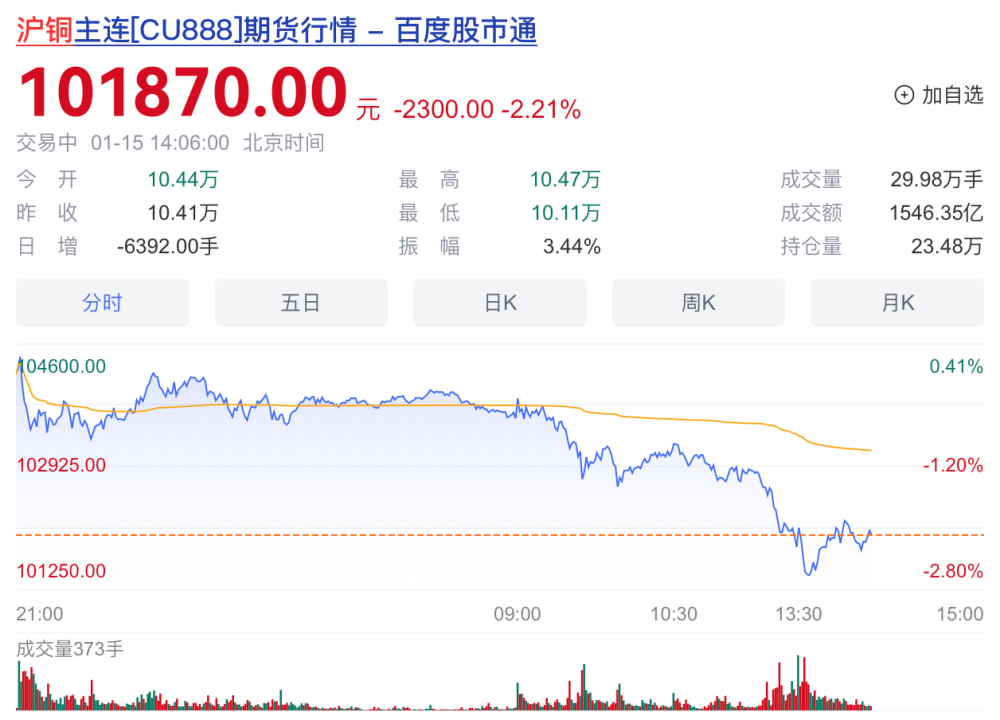
Core Viewpoint - Goldman Sachs warns that the recent surge in copper prices has likely peaked, with increasing risks of a price correction ahead [1][5]. Group 1: Market Performance - On January 15, the main copper contract on the Shanghai Futures Exchange experienced a sharp decline, dropping nearly 3% at one point, and closing down 2.21% at 101,870 yuan per ton [1]. - In the international market, most base metals also saw declines, with London copper down 1.27%, nickel down 1.55%, aluminum down 0.9%, and tin down 0.5% as of 14:00 Beijing time [3]. Group 2: Price Trends and Predictions - Copper prices have surged nearly 24% since November 20, 2025, but have recently retreated from historical highs due to easing concerns over potential U.S. tariffs on key minerals and a strengthening dollar [4]. - Citigroup's research team indicates that January may represent the peak price for copper in 2026, with a forecast of a return to around $13,000 per ton as a more sustainable level [6][7]. - Goldman Sachs also predicts that the current price surge is primarily driven by speculative trading and concerns over U.S. tariffs, suggesting that once tariff policies become clearer, accumulated metal inventories in the U.S. may flood the global market, exerting downward pressure on prices [4][5]. Group 3: Other Metals and Market Dynamics - Citigroup has raised the probability of a bullish scenario for copper prices reaching $15,000 per ton to 30%, reflecting a higher potential for price increases [8]. - Aluminum is highlighted as having significant structural opportunities, facing its most severe supply shortage in two decades, with short-term targets set at $3,400 per ton and mid-term at $3,500 per ton [8]. - Citigroup has also increased its three-month target price for lithium carbonate to $25,000 per ton, driven by preemptive stocking by downstream battery companies amid tight inventory conditions [9].
中国经济:出口强劲或支撑人民币、延缓降息-China Economics Strong Exports Likely Support the Renminbi and Delay Rate Cut
2026-01-15 02:51
Summary of Key Points from the Conference Call Industry Overview - **Industry**: China's Trade Sector - **Year**: 2025 Core Insights and Arguments - **Strong Export Performance**: China's exports grew by 5.5% year-on-year (YoY) to reach US$3.8 trillion in 2025, surpassing expectations and contributing to a trade surplus of US$1.2 trillion, a historic high [1][4][11] - **Monthly Trade Surplus**: In December 2025, the trade surplus reached US$114.1 billion, the highest in six months, with exports increasing by 6.6% YoY, significantly above market expectations [4][11] - **Import Growth**: Imports also showed improvement, rising to 5.7% YoY in December, up from 0.9% YoY previously, indicating a rebound in demand [4][6] - **Sector Contributions**: The growth in exports was primarily driven by technology and automotive sectors, with machinery and electrical sales increasing by 12.1% YoY and automobile exports surging by 71.7% YoY [7][18] - **Geographical Trends**: Exports to ASEAN countries grew by 11.1% YoY, while shipments to the US declined by 30.0% YoY, reflecting a shift in trade dynamics [7][12] Future Outlook - **Export Projections for 2026**: Export growth is expected to moderate to around 3.0% in 2026, supported by a stable global economy and sustained industrial competitiveness in China [8] - **Policy Adjustments**: Anticipated voluntary export curbs by Beijing, including cuts to export tax rebates for solar and battery products, which constituted approximately 5% of exports in 2025 [8][9] - **Currency Management**: A "managed" appreciation of the Renminbi (RMB) is expected, with a target of approximately 6.8 USDCNY in the next 6-12 months [9] Additional Important Insights - **Economic Impact**: The strong export performance is seen as a key driver for GDP growth, achieving a forecasted 5% growth for 2025 [1][8] - **Interest Rate Outlook**: The solid economic data and positive market sentiment may delay anticipated cuts in interest rates or reserve requirement ratios (RRR), although a cut in the Loan Prime Rate (LPR) remains plausible in Q1 2026 [9]