
Costco(COST)

Search documents
Costco Wholesale Corporation 2026 Q1 - Results - Earnings Call Presentation (NASDAQ:COST) 2025-12-11
Seeking Alpha· 2025-12-11 22:30
Group 1 - The article does not provide any relevant content regarding the company or industry [1]



Costco is firing on all cylinders — and shoppers are loving it
Business Insider· 2025-12-11 22:28
Core Insights - Costco reported net sales of $65.98 billion for the quarter, reflecting an 8.2% increase from $60.99 billion in the same period last year [1] - The company experienced strong comparable sales growth of 5.9% in US stores, driven by a 2.6% increase in traffic and a 3.2% increase in transaction size [1] - Memberships grew by over 5%, reaching nearly 146 million cardholders, with a total of 923 warehouses worldwide, including 633 in the US [2] Sales Performance - The food court sold 358,000 whole pizzas for Halloween and over 4.5 million pies in the three days leading up to Thanksgiving, averaging over 7,000 pies per warehouse during that period [2] - The success of new warehouse expansions has allowed Costco to drive top-line revenue significantly above comparable sales, gaining substantial market share [3] - Openings from the last fiscal year are generating annualized sales of more than $190 million per warehouse, an increase from $150 million two years ago [3] Legal Matters - Costco filed a lawsuit against the US government seeking a refund for all tariffs paid under President Donald Trump's executive order [4]

Costco posts quarterly beat on revenue and earnings
CNBC Television· 2025-12-11 22:14
Hi Morgan. So this is Costco's fiscal first quarter. They're they're turning in earnings per share of $4.50%.That is better than expectations for 427. Revenues also stronger than expected. This is total revenues inclusive of membership fees 67307 billion.The street was looking for 67.137% billion. Comp sales, we know we still get these from Costco regularly, but total for the quarter up 6.4%. Digitally enabled sales up 20.5%.The company did recently change how they're reporting that number. So, it's going t ...
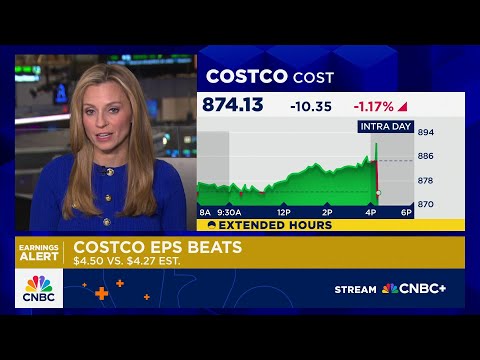
Costco posts quarterly beat on revenue and earnings
Youtube· 2025-12-11 22:14
Core Insights - Costco reported earnings per share of $4.50, exceeding expectations of $4.27 [1] - Total revenues, including membership fees, reached $67.307 billion, surpassing the anticipated $67.137 billion [1] - Comparable sales increased by 6.4% for the quarter, with digitally enabled sales rising by 20.5% [1][2] Revenue Breakdown - Membership fees included in total revenues grew by 14% year-over-year [2] - The reporting method for digitally enabled sales has changed, making comparisons to previous quarters different [2] Market Reaction - Shares of Costco experienced a slight decline following the earnings report [2]

Costco(COST) - 2026 Q1 - Earnings Call Presentation
2025-12-11 22:00
Sales Performance - Net sales reached $66.0 billion, reflecting an 8.2% growth[4] - Comparable sales increased by 6.4%[4] - Adjusted comparable sales also grew by 6.4%[4] - Digitally-enabled comparable sales surged by 20.5%[4, 16] - Adjusted digitally-enabled comparable sales also increased by 20.5%[4, 16] - US comparable sales increased by 5.9%, Canada by 6.5%, and Other International by 8.8%[8] Financial Highlights - Gross margin was 11.32%, a 4 bps increase compared to Q1 FY'25[9] - SG&A was 9.60%, a 1 bp decrease compared to Q1 FY'25[9] - The company reported a tax benefit of $72 million, or $0.16 per diluted share, related to stock-based compensation[9] Membership Metrics - Membership income grew by 14.0%[11] - The worldwide membership renewal rate was 89.7%, with the US/CN renewal rate at 92.2%[11] - Paid memberships reached 81.4 million, a 5.2% increase[14] - Total cardholders amounted to 145.9 million, a 5.1% increase[14] - Executive memberships totaled 39.7 million, representing 74.3% penetration of sales to executive members[14] Digital Performance - Ecommerce site traffic increased by 24%[18] - Ecommerce average order value grew by 13%[18] Warehouse Expansion - The company plans to increase its total warehouses from 914 to an estimated 942 by the end of FY'26[19]
Costco's profits are rising. But what about its sales?
MarketWatch· 2025-12-11 21:56
Core Insights - Costco presented a mixed financial performance to investors, indicating both strengths and weaknesses in its recent results [1] Financial Performance - The company reported a revenue increase, but the growth rate showed signs of slowing down compared to previous quarters [1] - Membership fees contributed significantly to the overall revenue, highlighting the importance of this segment for Costco's business model [1] Market Reaction - Investors reacted cautiously to the financial snapshot, reflecting concerns over the sustainability of growth amid changing consumer behaviors [1] - The stock price experienced fluctuations following the announcement, indicating mixed investor sentiment [1]

Earnings Season Heats Up: Costco and Broadcom Beat, Lululemon’s Mixed Results and CEO Transition, Markets Close Mixed
Stock Market News· 2025-12-11 21:38
Group 1: Company Earnings Reports - Costco (COST) reported Q1 earnings per share (EPS) of $4.50, exceeding the estimated $4.28, with total revenue reaching $67.31 billion against an estimate of $67.07 billion, and comparable sales rose 6.4% [3][9] - Broadcom (AVGO) posted Q4 adjusted net revenue of $18.02 billion, surpassing the $17.47 billion estimate, with semiconductor solutions revenue at $11.07 billion, beating the $10.74 billion estimate, and adjusted EPS of $1.95, exceeding the $1.87 consensus [4][9] - Lululemon (LULU) announced Q3 net revenue of $2.57 billion, topping the $2.48 billion estimate, and EPS of $2.59, significantly higher than the $2.22 forecast, but projected Q4 net revenue between $3.50 billion and $3.59 billion, below the consensus estimate of $3.59 billion [5][6][9] Group 2: Market Performance - U.S. equity markets showed mixed performance, with the Dow Jones Industrial Average closing up 650.12 points (1.35%) at 48,707.87, while the Nasdaq Composite dipped 65.89 points (0.28%) to close at 23,588.26, and the S&P 500 posted a modest gain of 12.46 points (0.18%) at 6,899.14 [7][9] Group 3: Leadership Changes - Lululemon announced a significant leadership change with CEO Calvin McDonald set to step down, introducing uncertainty alongside its mixed Q4 guidance [6][9]



Costco Q1 Earnings: Revenue, EPS Top Estimates, Comparable Sales Climb 6.4%
Benzinga· 2025-12-11 21:36
Core Insights - Costco Wholesale Corp reported first-quarter revenue of $67.31 billion, surpassing analyst estimates of $67.14 billion [2] - The company achieved adjusted earnings of $4.50 per share, exceeding estimates of $4.27 per share [2] Financial Performance - Net sales for the fourth quarter increased by 8.2% year-over-year [3] - Total comparable sales rose by 6.4% on a year-over-year basis [3] - Membership fees reached approximately $1.33 billion, up from $1.17 billion in the prior year's quarter [4] Operational Metrics - Costco operates 923 warehouses, including 633 in the U.S. [4] - The company ended the first quarter with approximately $16.22 billion in cash and cash equivalents [4] Regional Sales Growth - Comparable sales growth in the U.S. increased by 5.9% [6] - Comparable sales growth in Canada increased by 6.5% [6] - Comparable sales growth in Other International markets increased by 8.8% [6] Stock Performance - Costco shares were down 0.18% in after-hours trading, priced at $883.22 at publication time [5]

Costco tops Wall Street's sales and revenue expectations
CNBC· 2025-12-11 21:24
Core Insights - Costco surpassed Wall Street's quarterly expectations with an 8.2% year-over-year sales increase [1] - The company reported a net income of $2 billion, or $4.50 per share, compared to $1.80 billion, or $4.04 per share, in the same quarter last year [3] - Revenue rose to $67.31 billion from $62.15 billion year-over-year, with comparable sales increasing by 5.9% in the U.S. and 6.4% globally [3] Financial Performance - Earnings per share were $4.50, exceeding the expected $4.27 [4] - Revenue of $67.31 billion was higher than the anticipated $67.14 billion [4] - Digital sales experienced a significant increase of 20.5% year-over-year [3] Membership Growth - Costco has attracted younger customers, contributing to an increase in membership sign-ups [2] - The company benefited from a membership fee increase in the U.S. and Canada, effective September 2024, which positively impacted new and renewing members [2]

Costco(COST) - 2026 Q1 - Quarterly Results
2025-12-11 21:22
Financial Performance - Net sales for Q1 FY 2026 increased by 8.2% to $65.98 billion, up from $60.99 billion in the same period last year[2] - Net income for the quarter was $2,001 million, or $4.50 per diluted share, compared to $1,798 million, or $4.04 per diluted share, last year[3] - Total revenue for the quarter reached $67.31 billion, up from $62.15 billion in the previous year[9] - Operating income rose to $2,463 million, compared to $2,196 million in the same quarter last year[9] Membership and Fees - Membership fees increased to $1,329 million from $1,166 million year-over-year[9] Sales Growth - Comparable sales growth for the U.S. was 5.9%, Canada 6.5%, and Other International 8.8%, with total company growth at 6.4%[2] Operational Metrics - Costco operates 923 warehouses globally, with 633 located in the U.S. and Puerto Rico[4] - Cash and cash equivalents at the end of the period were $16,217 million, up from $14,161 million at the beginning of the year[13] - Net cash provided by operating activities was $4,688 million, compared to $3,260 million in the prior year[13] Future Outlook - The company anticipates continued growth despite potential risks including economic conditions and competition[6]