GM(GM)

Search documents
Earnings Preview: Who Will Do Better Between Ford And GM? My Money Is On GM
Seeking Alpha· 2025-10-17 13:39
Group 1 - General Motors (GM) has shown strong performance in the stock market, returning significant alpha in the past six months, particularly after Liberation Day [1] - The focus on sustained profitability, characterized by strong margins, stable and expanding free cash flow, and high returns on invested capital, is emphasized as a more reliable driver of returns than valuation alone [1] - The investment strategy includes a dual emphasis on undervalued growth stocks and high-quality dividend growers, indicating a long-term investment approach [1] Group 2 - The article does not contain any specific risk warnings or disclaimers related to the investment in GM or the automotive industry [2][3]



有车型上市10天大定破万台!合资新能源车突然成“爆款”,销售直呼“没想到”
Mei Ri Jing Ji Xin Wen· 2025-10-17 11:10
Core Insights - The recent launch of several joint venture electric vehicles (EVs) has led to significant sales success, with models like Buick's Zhijing L7 and Changan Mazda's EZ-60 achieving impressive order volumes shortly after their release [6][9][10] Group 1: Sales Performance - Buick's Zhijing L7 achieved over 12,000 pre-orders within just 10 days of its launch, indicating strong market interest [9] - Changan Mazda's EZ-60 has also seen robust demand, with over 30 units sold in its first 20 days, accounting for half of the store's total sales for October [3][9] - Other models like Dongfeng Nissan's N7 and GAC Toyota's BZ3X have also reported increasing sales, with N7's cumulative sales reaching 32,900 units and BZ3X at 42,800 units since their respective launches [9][10] Group 2: Market Dynamics - The influx of customers at dealerships has increased significantly, with some stores reporting a 50% rise in foot traffic due to the popularity of new EV models [3][6] - The sales strategies for these new models differ from traditional approaches, with some vehicles being sold at full price without discounts, indicating strong demand and limited supply [8][9] Group 3: Competitive Landscape - Joint venture brands are narrowing the gap with domestic brands by enhancing their product offerings, focusing on competitive pricing and advanced technology [10][11] - The new EV models are built on entirely new platforms, moving away from previous "oil-to-electric" conversions, which is expected to strengthen their market position [11] - Future plans for joint venture brands include launching additional EV models, with companies like FAW-Volkswagen planning to introduce 11 new models by 2026, 10 of which will be electric [11]



下周财报前,美银“谨慎看多”福特(F.US)和通用(GM.US):强劲基本面难抵短期风险
智通财经网· 2025-10-17 08:50
Core Viewpoint - Both Ford and General Motors are expected to report stronger-than-expected retail sales and pricing performance for Q3, but face significant challenges in Q4 due to tariffs, supply chain disruptions, and slowing electric vehicle demand [1][2]. Group 1: Q3 Performance - Ford's retail sales increased by 8.2% year-over-year, while General Motors' sales rose by 7.7%, outperforming the industry average growth of 5.2% [1]. - The average transaction price (ATP) for Ford rose by 1.7% year-over-year, and for General Motors, it increased by 4.8% [1]. - General Motors' incentive spending as a percentage of vehicle price was only 6.1%, below the industry average, indicating stronger pricing power [1]. - General Motors' adjusted EBIT for Q3 is projected at $2.81 billion, exceeding market expectations by 3.5%, while Ford's EBIT is expected to be $2.11 billion, surpassing expectations by 3.9% [1]. Group 2: Q4 and Future Risks - In Q4, General Motors faces risks from metal tariffs and potential 25% tariffs on medium/heavy trucks, which could reduce EBIT by $650 million in 2025 [2]. - Ford is impacted by a fire at a key aluminum supplier's plant, leading to an expected production cut of 120,000 to 150,000 units for F-150/250 models, resulting in an estimated gross profit loss of $700 million [2]. - Ford's Q4 EBIT forecast has been significantly reduced from $1.79 billion to $1.33 billion, with EPS lowered from $0.30 to $0.21, falling short of market expectations [2]. Group 3: Long-term Projections - General Motors' 2026 EBIT forecast has been revised down from $13.4 billion to $11.8 billion due to a 3% decline in North American sales expectations [2]. - Ford's 2026 EBIT forecast has been adjusted from $9.7 billion to $8 billion, attributed to slower margin improvement in Ford Pro and continued losses in the Model e electric vehicle business [2]. - Free cash flow projections indicate General Motors will have $7.9 billion in 2025, supporting ongoing buybacks and dividends, while Ford's free cash flow is expected to drop from $4 billion to $2.5 billion in 2026, potentially limiting buyback capacity [2]. Group 4: Valuation and Market Outlook - Current valuations reflect most negative expectations, with projected EV/EBITDA for General Motors at 2.8x and Ford at 2.6x for 2026, indicating some margin of safety [3]. - Key variables influencing stock price volatility in the short term include tariff policies, supply chain recovery, and trends in the electric vehicle market [3].
崔东树:9月车市增长表现超预期 主流合资品牌仍面临挑战
智通财经网· 2025-10-17 06:36
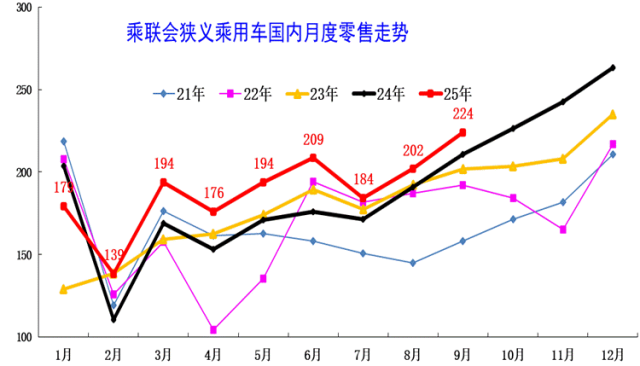
Core Insights - The implementation of the national vehicle replacement subsidy policy has significantly boosted passenger car sales in September 2024, leading to an unexpected growth in the domestic car market despite high growth pressure earlier in the month [1][5] - Buick has emerged as a key player in this growth, achieving a year-on-year sales increase, which highlights the brand's effective market strategy and adaptability in a challenging environment for traditional joint venture brands [1][7] Market Performance - In September, wholesale sales of passenger cars reached 2.8 million units, marking a historical high for the month and a 31,000 unit increase from the peak in June [4] - Buick's sales performance stands out with a year-on-year increase of 11%, contrasting with the overall decline in retail sales among mainstream joint venture brands [6][7] Sales Trends - The retail sales trend for passenger cars in China is expected to show a rise from September to December 2024, driven by the vehicle replacement policy [5] - The overall retail sales growth for mainstream joint venture brands declined by 6% in September, indicating significant challenges in the current market environment [6] Buick's Strategy - Buick's success can be attributed to its precise positioning of models and proactive marketing strategies, which have effectively attracted consumer attention and translated into sales [7] - The Envision Plus model achieved a record monthly sales figure of 11,841 units in September 2024, showcasing Buick's competitive advantages in brand image, product quality, and pricing strategy [8] Pricing Strategy - The "one-price" strategy has been successful for Buick, providing consumers with a transparent and stable pricing experience, which enhances brand trust and encourages purchases [9] - This pricing approach has contributed to the reverse growth of models like the Envision Plus and LaCrosse, as it simplifies the buying process for consumers [9] Consumer Demand Insights - The diverse consumer demand indicates that fuel vehicles remain suitable for middle-class families in urban areas, despite the rise of electric vehicles [12] - Buick's performance in the market reflects a combination of factors, including effective pricing strategies, product strengths, and the influence of the national vehicle replacement policy, providing valuable insights for other automotive brands [12]
又见“豁免”!报道称美国准备降低进口汽车零部件关税
Hua Er Jie Jian Wen· 2025-10-17 00:22
Core Viewpoint - The U.S. automotive industry is set to benefit from an extension of tariff exemptions on imported auto parts, reflecting a trend of mitigating the negative impacts of tariffs imposed under the Trump administration [1][3]. Group 1: Tariff Exemption Details - The U.S. Department of Commerce plans to announce a five-year extension of the tariff exemption for auto manufacturers, which was originally set to expire after two years [1]. - This policy allows automakers to offset a portion of the 25% tariff on imported auto parts, with a credit equivalent to 3.75% of the value of vehicles manufactured in the U.S. [4]. - The exemption was a result of months of lobbying by major automakers like Ford and General Motors, who are facing increased costs due to tariffs on imported vehicles and materials [4]. Group 2: Broader Implications of Tariff Policies - The extension of the tariff exemption is indicative of a larger trend where the actual impact of U.S. trade policies is less severe than initially claimed, with exemptions playing a crucial role [5]. - A report from Citigroup noted that the effective tariff rate in the U.S. is around 9%-10%, significantly lower than the theoretical rate of approximately 18%, largely due to policy exemptions [5]. - The report also highlighted that between 2019 and 2021, 957 companies submitted over 163,000 tariff exemption applications, with a high approval rate of 61% [5]. Group 3: Economic Impact and Market Reactions - The lower-than-expected impact of tariffs has contributed to a lack of significant inflation related to tariffs, as companies have managed to mitigate costs through various strategies [6]. - Citigroup's analysis suggests that the current trade environment, characterized by "loud thunder but little rain," is favorable for risk assets and provides the Federal Reserve with room to lower interest rates amid a weak labor market [6]. - However, there are concerns that inventory built to avoid tariffs is nearing depletion, which could lead to increased inflation in the coming months [6].
GM joint venture pauses phase 2 of Canadian battery materials plant as EV outlook dims
Yahoo Finance· 2025-10-16 20:34
General Motors and partner Posco Future M have suspended the second phase of work on their joint venture battery materials plant in Quebec amid tepid consumer demand for electric vehicles and North American policy decisions that have undercut growth in the segment. The Ultium CAM plant being commissioned in Bécancour remains on track to start producing cathode active material for EV batteries next year, but the team will not immediately proceed with an expansion project, as originally planned. “In light o ...
This 1 Unexpected Company Could be the Best Stock to Buy as Rare Earths Steal the Show
Yahoo Finance· 2025-10-16 18:07
Core Insights - Rare earth metals are essential for modern technologies, with increasing global demand and supply risks, particularly due to China's export restrictions [1] - General Motors (GM) is positioning itself as a leader in rare earth production, having invested in this area since 2021, making it the only major U.S. automaker with a domestic magnet source [2] - GM's strategic move to reduce reliance on China enhances its competitive edge as rare earth elements become critical in global trade [2] Company Overview - General Motors has a market capitalization of approximately $54 billion and operates under brands such as Chevrolet, GMC, Buick, and Cadillac [4] - The company is transitioning aggressively to electric vehicles (EVs) through its Ultium platform and advanced driver-assist technologies [4] Stock Performance - GM shares have increased by about 8% year-to-date and 17% over the past year, outperforming the broader auto sector due to strong vehicle sales and a disciplined EV investment strategy [5] - The company's robust sales in North America, particularly in pickups and SUVs, contributed to better-than-expected Q2 results [5] Valuation Metrics - GM's stock is considered attractively valued, trading at a mid-single-digit P/E of 9x and around 0.3x sales, which is significantly lower than the average for large automakers [6] - The price/book ratio of 0.8x indicates that GM's stock is undervalued in terms of both earnings and assets, suggesting limited downside if growth strategies are executed effectively [6]
General Motors expected to post solid Q3 results amid EV, tariff headwinds
Proactiveinvestors NA· 2025-10-16 16:44
Core Insights - Proactive provides fast, accessible, and actionable business and finance news content to a global investment audience [2] - The company focuses on medium and small-cap markets while also covering blue-chip companies and broader investment stories [3] - Proactive's news team delivers insights across various sectors including biotech, mining, oil and gas, and emerging technologies [3] Technology Adoption - Proactive is committed to adopting technology to enhance workflows and content production [4] - The company utilizes automation and software tools, including generative AI, while ensuring all content is edited and authored by humans [5]

X @Bloomberg
Bloomberg· 2025-10-16 15:55
General Motors and a partner have paused the second phase of a cathode factory in Quebec, resulting in the cancellation of a nickel sulfate project by Vale. https://t.co/JMojIEj7AE ...
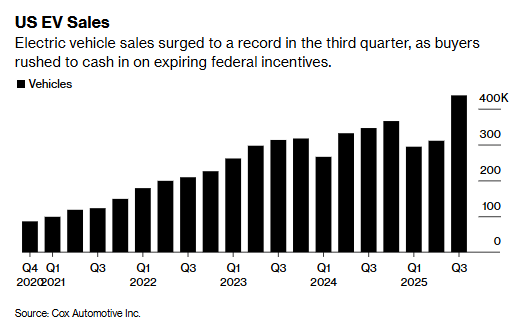
补贴退坡前迎抢购潮!美国Q3电动车销量创纪录 占比首破11%
智通财经网· 2025-10-16 12:01
Group 1 - In Q3, electric vehicle and electric truck sales in the U.S. reached 438,500 units, marking a record high for a single quarter and accounting for 11% of total new car sales, up from 8.7% previously [1][4] - Analysts predict a potential decline in electric vehicle sales in the coming months due to the cancellation of federal tax credits, despite expectations for continued growth from affordable electric models [1][6] - By 2030, electric vehicles are projected to make up 25% of new car sales in the U.S., a significant increase from current levels, although lower than previous estimates of 50% [1][6] Group 2 - Tesla remains the dominant player in the U.S. electric vehicle market, but its market share has decreased from 80% four years ago to 41% as competitors close the gap [4] - General Motors has seen rapid progress in electrification, capturing 15% of the electric vehicle market this quarter, up from 10% year-over-year, driven by the popularity of the Chevrolet Equinox [4] - Nearly half of U.S. consumers purchasing electric vehicles this year did not utilize any federal subsidies, with at least 11 electric models priced below the average new car transaction price [4] Group 3 - The path for electric vehicle development remains challenging, with forecasts indicating a drop in market share to 27% by 2030, down from previous estimates of 48% [6] - The second-hand electric vehicle market is thriving, and more affordable electric models are set to enter production, with at least nine new models expected to be priced below $40,000 in the next three years [6] - The automotive industry's shift towards electrification is deemed irreversible, with some regions taking longer to transition, but the overall direction is clear [6]