
Alphabet(GOOG)

Search documents
硅谷不相信忠诚,AI行业玩成NBA,科学家爽拿“转会费”
3 6 Ke· 2026-02-09 01:48
Core Insights - The loyalty of employees in Silicon Valley has diminished, with significant talent poaching events occurring among major tech companies, particularly in the AI sector [1][2] - The trend of "acqui-hire," where companies acquire others primarily for their talent rather than products, has become a common strategy among tech giants [24][27] Group 1: Talent Poaching Events - Major talent poaching incidents include Meta's $14.3 billion investment in Scale AI to acquire co-founder Alexandr Wang in June 2025, Google's $2.4 billion acquisition of Windsurf's technology and team in July 2025, and NVIDIA's $20 billion deal with Groq in December 2025 [1][2][11] - OpenAI has also been active in recruiting talent, bringing back researchers from Thinking Machines Lab and attracting former Google DeepMind employees [1][2] Group 2: Motivations for Job Changes - Employees are motivated to switch jobs for various reasons, including high salaries, access to cutting-edge resources, and the pursuit of more promising technologies and products [2][32] - The phenomenon of "active" and "passive" job changes is noted, with many researchers leaving for better opportunities or being relocated due to company acquisitions [2] Group 3: Acqui-hire Strategy - Acqui-hire has become a popular method for tech giants to quickly acquire skilled teams without facing antitrust scrutiny, allowing them to maintain a competitive edge in AI [24][27] - The case of Google's acquisition of Windsurf illustrates the potential fallout for remaining employees, who may feel abandoned when key talent is poached [27][28] Group 4: Employee Sentiment and Loyalty - Despite high salaries offered by companies like Meta, employee loyalty remains elusive, with some researchers returning to their previous employers shortly after being hired [18][20] - The culture in the tech industry is shifting, with employees increasingly concerned about long-term commitments to a single company, leading to a more fluid job market [32][35] Group 5: Domestic Talent Competition - The talent war is not limited to Silicon Valley, as domestic companies are also aggressively recruiting AI talent from top labs, indicating a global trend in talent mobility [37][39] - High salaries and rapid job changes are characteristic of the AI industry, where top talent is viewed as a strategic asset [40]







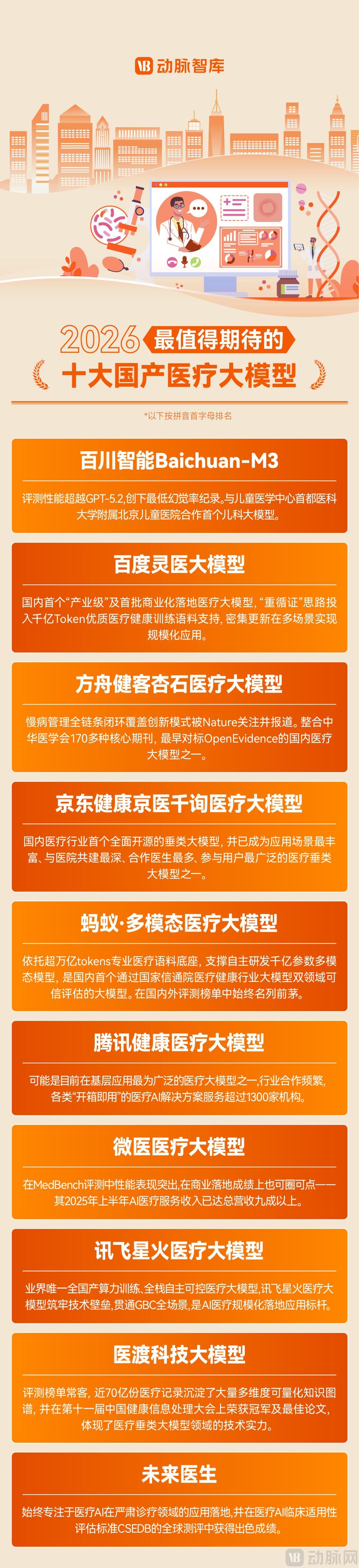
无惧OpenAI,2026年国内最值得期待的十个医疗大模型
3 6 Ke· 2026-02-09 01:31
Core Insights - The medical large model sector is experiencing significant advancements, particularly with the recent launches from OpenAI, Anthropic, and Google, indicating a competitive landscape in healthcare AI [1][3][4] - Domestic companies in China, such as Baichuan Intelligence and Ant Group, are making substantial progress, showcasing their capabilities and innovations in the medical AI field [5][6][10] Group 1: OpenAI's Developments - OpenAI launched ChatGPT Health and OpenAI for Healthcare, which comply with HIPAA regulations and aim to enhance patient care services [2] - ChatGPT Health integrates a new module based on the latest GPT-5 model, allowing users to connect personal health data while ensuring data privacy [2] - OpenAI for Healthcare targets medical institutions, offering enterprise-level solutions for clinical environments, including automated documentation [2] Group 2: Competitors' Responses - Anthropic released Claude for Healthcare, directly competing with OpenAI's offerings, highlighting its commitment to the healthcare sector [3] - Google updated its open-source medical large model, MedGemma 1.5, improving its capabilities in text, medical records, and medical imaging [3] Group 3: Domestic Innovations - Baichuan Intelligence launched Baichuan-M3, surpassing GPT-5.2 in benchmark tests, with a hallucination rate of only 3.5%, which was later improved to 2.6% [4][5] - Ant Group's medical model has gained significant traction, achieving 30 million monthly active users and doubling daily inquiries within a month [5] - JD Health and other domestic firms are also releasing new models and solutions, contributing to a vibrant competitive landscape in China's medical AI sector [5][10] Group 4: Benchmarking and Performance - HealthBench and MedBench are the primary benchmarking systems for evaluating medical large models, assessing safety, clinical applicability, and professional reasoning [7][8] - The performance of medical large models is crucial, with ongoing iterations and resource investments being necessary for advancements [8] Group 5: Industry Trends and Future Outlook - The medical large model sector is expected to grow significantly, with various domestic models emerging as strong contenders in 2026 [6][10] - The integration of local clinical guidelines and data security measures positions domestic models as more suitable for the Chinese market [6] - The increasing support from the government and the focus on localized solutions are likely to enhance the competitiveness of domestic models [6]

两大GPU买家,摆脱英伟达
半导体行业观察· 2026-02-09 01:18
Core Insights - The article discusses the competitive landscape in the AI chip market, highlighting the challenges faced by Nvidia from major tech companies like Amazon and Google, which are developing their own AI chips and reducing reliance on Nvidia [2][3]. Group 1: Market Dynamics - Nvidia currently holds a dominant market share of 92% in the AI chip sector, with projected revenues nearing $200 billion by 2025 [3]. - Amazon's AI chip, Trainium, is expected to generate "tens of billions" in revenue by 2025, while Google's Tensor Processing Units (TPUs) are projected to reach hundreds of billions in revenue [3]. - The competition from Amazon and Google represents a significant threat to Nvidia, as even small market shares can translate into billions of dollars [2]. Group 2: Strategic Partnerships - Anthropic, a key AI company, is working to reduce its dependence on Nvidia chips and has secured substantial chip orders from both Amazon and Google, amounting to $100 billion and $110 billion respectively [4][5]. - Google has begun allowing Anthropic to install its chips in data centers not owned by Google, marking a shift in its business model [4]. - Amazon's investment of $4 billion in Anthropic is aimed at fostering a competitive environment against Nvidia [5]. Group 3: Technological Developments - Amazon's chips, while not as powerful as those from Google or Nvidia, are being deployed in greater numbers, with a reported 150% quarterly revenue growth in its chip division [6]. - The collaboration between Anthropic and Amazon is seen as a potential game-changer, signaling to the market that Nvidia chips are not the only option available [6]. - Other chip manufacturers like AMD and Cerebras are also entering the market, providing alternatives to Nvidia [6][7].

从“更快”到“更省”:AI下半场,TPU重构算力版图
半导体行业观察· 2026-02-09 01:18
Core Insights - The article emphasizes the shift from "training is king" to "inference is king" in AI, highlighting the importance of specialized architectures like Google's TPU in reducing inference costs and reshaping the AI computing landscape [1][4][11]. Group 1: Evolution of AI Models - Large models undergo a growth process similar to human development, involving pre-training, fine-tuning, and reinforcement learning to align outputs with human preferences [3]. - The infrastructure for training large models requires high computing power, high memory bandwidth, and strong multi-GPU interconnects, with NVIDIA being the dominant player due to its high-performance GPUs and CUDA ecosystem [3]. Group 2: Cost Efficiency in Inference - After training, the commercial value of AI models lies in scalable inference services, where the cost of inference directly impacts profit margins [4]. - The focus has shifted to reducing inference costs while maintaining performance, with Google's TPU v7 reportedly lowering the cost per million tokens by approximately 70% compared to its predecessor [8][10]. Group 3: Competitive Landscape - The competition in AI computing is evolving, with specialized architectures like Google's TPU emerging as strong challengers to NVIDIA's dominance [10][11]. - A significant order from Anthropic for TPUs indicates a shift towards large-scale commercial deployment of ASIC chips, suggesting potential profit improvements of billions annually through reduced inference costs [10]. Group 4: Technological Innovations - Google's TPU architecture is designed for efficiency, focusing on matrix operations and minimizing unnecessary components, which enhances performance and reduces energy consumption [13]. - Innovations such as the unique pulsed array architecture and large on-chip SRAM caches contribute to TPU's advantages in inference scenarios [18]. Group 5: Software and Ecosystem Development - Google is addressing the software ecosystem by making its TPU compatible with popular frameworks like PyTorch, thereby reducing the cost of transitioning from NVIDIA's ecosystem [15][27]. - The collaboration with various tech giants to support open-source projects like OpenXLA aims to create a unified compilation path across different hardware [15][17]. Group 6: Domestic Chip Manufacturers - Domestic chip companies like Yixing Intelligent are developing architectures that align with the trends of specialized computing, focusing on efficiency and cost reduction [20][22]. - Yixing Intelligent's chips support advanced data formats and architectures that enhance performance while reducing storage costs, positioning them competitively in the market [26][27]. Group 7: Future Directions - The industry is transitioning from a focus on raw computing power to optimizing efficiency and cost-effectiveness, marking a significant shift in the competitive landscape [42]. - The emergence of technologies like ELink for high-speed interconnects indicates a broader trend towards integrated AI infrastructure that encompasses hardware, software, and system optimization [38][40].

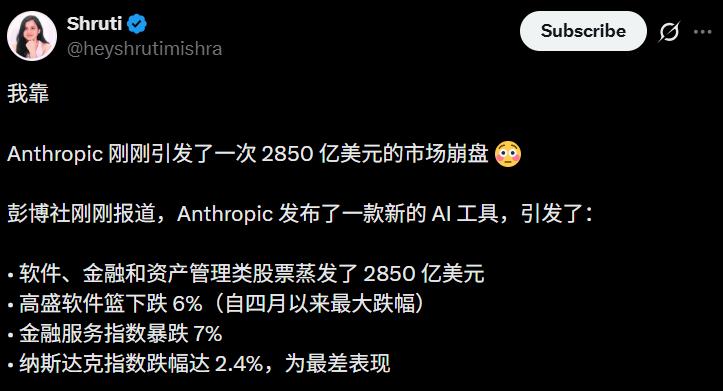
48小时万亿蒸发,高盛用Claude「杀死」人类会计,亲手埋葬软件帝国
3 6 Ke· 2026-02-09 01:08
Core Insights - The software industry is experiencing a significant downturn, with major companies facing massive sell-offs and a loss of nearly $300 billion in market value, approaching a trillion dollars when including losses in Europe and Asia [6][7][8] - The panic in the market is driven by the realization that traditional software may no longer be necessary, as AI technologies are emerging that can automate tasks previously performed by software [9][12][36] - Goldman Sachs is at the forefront of this shift, utilizing AI to automate accounting processes, which raises concerns about job losses in the finance sector [13][14] Group 1: Market Impact - Major software companies like Salesforce, Adobe, and Oracle are being heavily sold off, indicating a loss of confidence in their future profitability [6][7] - The term "SaaSpocalypse" has been coined to describe the potential collapse of the SaaS business model as AI agents can perform tasks without the need for traditional software [36][39] - The market is reacting to the fear that AI could replace many entry-level positions in accounting and compliance, leading to a significant restructuring in the workforce [14][36] Group 2: AI Integration - Goldman Sachs has developed AI systems that can handle complex tasks in accounting and compliance, which traditionally required significant human labor [13][14] - OpenAI is also rapidly advancing its AI capabilities, with tools like Codex taking over substantial coding responsibilities, indicating a shift in how software development is approached [17][20] - The integration of AI into business processes is expected to create a new paradigm where software is not just a tool but an integral part of operational workflows [39][41] Group 3: Future Outlook - Experts predict that while not all software will disappear, many superficial applications will lose their value as AI becomes capable of performing their functions [38][39] - The future of software may involve a combination of robust data systems and flexible AI agents, transforming the role of humans from operators to overseers [39][41] - The current upheaval in the software industry is seen as a necessary evolution rather than an end, with potential for new opportunities and innovations to emerge [41][45]


申万宏源证券晨会报告-20260209
Shenwan Hongyuan Securities· 2026-02-09 00:41
Group 1: Key Insights on Japanese Elections and Fiscal Policy - The upcoming Japanese general election features three main camps competing for the House of Representatives, with the ruling Liberal Democratic Party (LDP) maintaining a polling advantage [10] - Post-election macroeconomic policy is expected to remain focused on expansionary fiscal measures, but with a more cautious approach to avoid potential market instability [10] - Japan's sovereign debt risk is relatively low, but the election outcome may influence external risk factors, particularly regarding fiscal policy and market reactions [10] Group 2: Insights on Service Consumption Growth - The Chinese government is actively promoting service consumption, focusing on key areas such as travel services, home services, and online audio-visual services, marking a shift towards substantial policy implementation [9][11] - Specific measures are being developed to stimulate growth in various sectors, including travel, home services, and emotional experience services, with a focus on enhancing consumer experience and quality [11] - The service consumption sector is anticipated to play a crucial role in driving economic growth and improving consumer spending rates [11] Group 3: Chemical Industry Analysis - The chemical industry is expected to see a recovery in profitability by 2025, despite facing challenges in Q4 due to falling oil prices and rising gas prices impacting demand [12][14] - Key sub-sectors such as pesticides, compound fertilizers, and chromium chemicals are projected to experience significant profit growth, while some companies may face profitability pressures due to market conditions [14][15] - The overall chemical sector is navigating a transitional phase, with cost pressures and market dynamics influencing performance [14] Group 4: Insights on AI and Communication Industry - The communication industry is focusing on AI advancements and domestic network enhancements, with expectations for robust growth driven by increased capital expenditure from operators [19][20] - Companies in the sector are predicted to experience substantial profit growth, with specific firms projected to see year-on-year increases exceeding 50% [21] - The integration of AI technologies is expected to enhance operational efficiencies and drive demand across various segments of the communication industry [19][20] Group 5: Electric New Energy Industry Outlook - The electric new energy sector is witnessing a significant turning point, particularly in lithium battery storage, with production and pricing expected to rise in Q4 2025 [23] - The industry is experiencing a surge in production across various components, indicating strong demand and profitability potential in the battery segment [23] - Overall, the electric new energy sector is positioned for growth, with favorable market conditions anticipated to support continued expansion [23]



中国谷歌是个伪命题
虎嗅APP· 2026-02-09 00:14
Core Viewpoint - The article discusses how Google's financial performance and strategic shift towards AI infrastructure have set a benchmark that Chinese tech giants aspire to replicate, yet face significant challenges in doing so [5][6][24]. Group 1: Google's Performance and Strategy - Google's parent company, Alphabet, reported a historic revenue exceeding $400 billion in 2025, with Q4 revenue reaching $113.8 billion, showcasing its robust financial health [5]. - The growth of Google's cloud business surged by 48%, with annual revenue surpassing $70 billion, indicating a successful transition from a search-centric model to a global AI infrastructure provider [5][6]. - Google has accumulated a backlog of $240 billion in orders, reflecting strong demand for its AI capabilities and services [6]. Group 2: Chinese Tech Giants' Aspirations - Chinese tech companies like Baidu, Alibaba, and Tencent are striving to emulate Google's model, viewing it as the pinnacle of success in the tech industry [9][10]. - Baidu, heavily reliant on search and advertising, sees AI as a lifeline, investing in autonomous driving and self-developed chips to transform its search engine into a smart entity [18]. - Alibaba aims to integrate its cloud services with AI, investing $38 billion to enhance its technological capabilities and move away from mere resource selling [20]. - Tencent focuses on leveraging its social and content platforms to integrate AI, with over 900 applications utilizing AI internally [21]. Group 3: Challenges Faced by Chinese Companies - Chinese tech giants struggle to replicate Google's global operational model due to their inward-focused ecosystems, which limit their ability to scale and innovate on a global level [25][26]. - The competitive landscape in China forces companies to prioritize short-term gains over long-term innovation, hindering the development of groundbreaking technologies [34][35]. - The cultural differences between Google's engineer-driven approach and the product manager-driven culture of Chinese firms contribute to the challenges in achieving similar levels of innovation [30][32]. Group 4: Unique Opportunities for Chinese AI - Despite the challenges, Chinese companies possess unique advantages, such as a diverse and complex industrial landscape that can provide valuable data for AI applications [42]. - The rapid digitalization of various sectors in China offers opportunities for AI models to excel in practical applications, potentially surpassing Google's capabilities in specific areas [42]. - The article suggests that instead of trying to become "the Chinese Google," companies should focus on their unique narratives and strengths in the AI landscape [40][41].


加密货币交易网站创始人7000万美元收购“AI.com”,将提供个人“AI智能体”服务;英伟达为3万名工程师部署AI编码工具丨AIGC日报
创业邦· 2026-02-09 00:08
Group 1 - The founder of cryptocurrency exchange Crypto.com acquired the domain "AI.com" for $70 million, marking the highest disclosed price for a domain transaction to date. The CEO plans to launch personal "AI agents" services through this website during the Super Bowl advertisement [2] - OpenClaw has gained significant attention, with investors and entrepreneurs flocking to the project. Wang Huiwen, a veteran from Meituan, is actively recruiting teams interested in starting ventures related to OpenClaw, indicating a shift from an open-source project to a commercial direction [2] - Alphabet confirmed that its Gemini application has surpassed 750 million monthly active users, an increase of 100 million from the previous quarter. The company has raised its capital expenditure target for 2026 to $185 billion, focusing on the expansion of AI data centers and infrastructure [2] - NVIDIA has deployed AI coding tools for 30,000 engineers, resulting in a threefold increase in code output. This initiative, in collaboration with Anysphere Inc., highlights the significant impact of AI-assisted design on productivity within the company [2]

2月9日早餐 | 美股科技股大涨;千问免单活动火热
Xuan Gu Bao· 2026-02-09 00:08
Market Overview - US consumer confidence reached a six-month high, leading to a rebound in US stocks with the Dow Jones up 2.47%, Nasdaq up 2.18%, and S&P 500 up 1.97% [1] - Nvidia's CEO Jensen Huang stated that AI demand is extremely high, resulting in Nvidia's stock rising by 7% and semiconductor stocks increasing by 5.7% [1] - The Nasdaq Golden Dragon China Index rose by 3.71%, with Century Internet up over 10% and NIO up 7.23% [1] Bond and Currency Market - US Treasury yields rose across the board, with the 10-year yield up nearly 3 basis points and the 2-year yield up 5.54 basis points [2] - The US dollar fell by 0.3% on the day but gained 0.56% over the week, marking two consecutive weeks of gains [2] Cryptocurrency Market - After a significant drop, cryptocurrencies rebounded sharply, with Bitcoin soaring by 11% to regain the $70,000 mark and Ethereum also rising by 11% to surpass $2,000 [2] Semiconductor Industry - The semiconductor industry is experiencing a surge, with major companies like TSMC and ASML seeing stock increases of nearly 5% [1] - The Semiconductor Industry Association (SIA) projected global semiconductor sales to reach $1 trillion this year, with a 25.6% increase expected by 2025 [25] AI and Data Industry - The collaboration between Goldman Sachs and Anthropic aims to fully automate accounting and compliance operations, impacting 12,000 developers and thousands of operations [4] - The Chinese central bank reported a continuous increase in gold reserves, adding 40,000 ounces in January, indicating a faster accumulation pace [6] Regulatory Developments - The Chinese central bank and eight other departments issued a notice to further prevent and manage risks related to virtual currencies, stating that virtual currencies do not have the same legal status as fiat currencies [5] - The China Securities Regulatory Commission released guidelines for the regulation of asset-backed securities tokens issued overseas [7] Real Estate and Construction - The Jiangsu provincial government held a meeting to discuss policies aimed at stabilizing and boosting the real estate market [11] - The Ministry of Industry and Information Technology announced plans to enhance national computing power interconnectivity, aiming to improve overall computing capacity [9] New Product Launches - A new stock offering for Tongbao Optoelectronics is available at a subscription price of 16.17 yuan per share, focusing on automotive lighting systems and energy management systems [27] Corporate Announcements - Shahe Co. plans to acquire 70% of Jinghua Electronics for 274 million yuan, diversifying into smart display controllers and LCD devices [28] - Aisheng Co. has secured patent licensing agreements worth 1.65 billion yuan for solar battery technologies outside the US [29]


Jim Cramer Says 'I Will Defend Amazon' After $200 Billion Spending Plan Triggers Selloff, Calls Google 'The Prize'
Yahoo Finance· 2026-02-08 21:32
Group 1 - Jim Cramer defended Amazon.com Inc, acknowledging a fundamental shift in the market's relationship with mega-cap technology stocks, while major indices like the S&P 500 and Nasdaq-100 posted gains [1][2] - Amazon's fourth-quarter net sales reached $213.39 billion, surpassing Wall Street expectations of $211.30 billion, but the announcement of a $200 billion capital expenditure plan for 2026 caused investor concern [3][4] - Cramer highlighted Alphabet Inc as a top pick among technology stocks, noting its increased capital spending forecast of $175 billion to $185 billion for 2026, indicating strong demand for AI infrastructure [5]
