Alphabet(GOOG)

Search documents
千亿景林持仓曝光!与东方港湾但斌不谋而合!共识是AI应用!
私募排排网· 2026-02-09 07:00
Core Viewpoint - The article discusses the recent investment activities of Jinglin Asset Management, highlighting significant changes in their U.S. stock holdings, particularly in technology companies like Google and Nvidia [2][4]. Group 1: Investment Holdings - Jinglin Asset Management's U.S. stock holdings as of the end of 2025 are valued at approximately $4.045 billion, with eight companies having holdings exceeding $100 million [2]. - The largest increase in holdings was for Google, with a total of 2.69 million shares, representing a 52.81% increase from the previous quarter, raising its portfolio share to 20.82% [2]. - In contrast, Nvidia saw the largest reduction, with a total of 1.5409 million shares sold, marking a 64.78% decrease, resulting in a portfolio share drop to 3.86% [2]. Group 2: Future Outlook - Gao Yuncheng, a partner and fund manager at Jinglin, emphasizes the importance of companies that serve as key platforms for AI applications, naming a few such as Google, Meta, Apple, ByteDance, Tencent, and OpenAI [2]. - The year 2026 is anticipated to be a pivotal year for the widespread adoption of AI agents, suggesting a significant shift in the technology landscape [2][4]. Group 3: Comparative Analysis - Another investment firm, Dongfang Hongyuan, also significantly increased its holdings in Google, with a more than 40% increase in the fourth quarter of 2025, making it their largest position at 30.85% of their portfolio [4]. - The article notes that both firms share a similar outlook on the potential of AI technologies, indicating a broader trend among investment managers towards tech stocks, particularly those involved in AI [4].




在参与OpenAI、Google、Amazon的50个AI项目后,他们总结出了大多数AI产品失败的原因
3 6 Ke· 2026-02-09 06:57
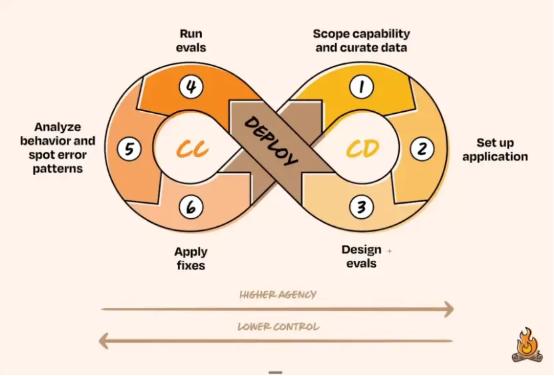
Core Insights - The cost of building AI products has significantly decreased, but the real challenge lies in product design and understanding the pain points to be addressed [1][2][3] - AI is a tool for solving problems, and leaders must engage directly to rebuild their judgment and adapt to new realities [2][3] - Retaining a degree of "foolish courage" is essential in an era where data suggests high failure rates [3] AI Product Development Challenges - Skepticism towards AI has decreased, but many leaders still view it as a potential bubble, delaying genuine investment [4] - Successful AI product development requires a thorough understanding of user experience and business processes, often necessitating a complete overhaul of existing workflows [4] - The lifecycle of AI products differs from traditional software, leading to a need for closer collaboration among PMs, engineers, and data teams [4][5] Key Differences in AI Product Construction - AI systems operate with a level of non-determinism that traditional software does not, complicating user interactions and outputs [5][6] - The balance between agency and control is crucial; higher autonomy in AI systems requires a foundation of trust built over time [6][7] - Starting with low autonomy and high control allows for gradual understanding and confidence in AI capabilities [7][8] Successful AI Product Patterns - Successful companies exhibit strong leadership, a healthy culture, and ongoing technical capabilities [14][15][16] - Leaders must acknowledge the need to relearn and adapt their intuition in the context of AI [14] - A culture that empowers employees and emphasizes AI as a tool for enhancement rather than a threat is vital for success [15] Continuous Calibration and Development Framework - The CC/CD framework emphasizes continuous improvement and understanding user behavior while maintaining user trust [25][28] - Initial stages should focus on low autonomy and high control to mitigate risks and build confidence in the system [28][29] - The framework encourages iterative processes to adapt to new user behaviors and system capabilities [32][34] Future of AI - The potential of Coding Agents remains underestimated, with significant value expected to be unlocked in the coming years [35] - The integration of AI into real workflows will enhance its contextual understanding and proactive capabilities [38] - A shift towards multi-modal experiences is anticipated, allowing for richer interactions and unlocking previously inaccessible data [39] Skills for AI Product Builders - The ability to focus on problem-solving and understanding workflows is becoming increasingly important as implementation costs decrease [40][42] - Proactive engagement and a willingness to iterate through trial and error are essential for success in AI product development [41][42]


马斯克下注光伏制造,太空光伏板块再掀涨停热潮!协鑫集成喜提四连板,光伏ETF汇添富(516290)涨超3%!太空光伏需求迎指数级增长?
Sou Hu Cai Jing· 2026-02-09 06:35
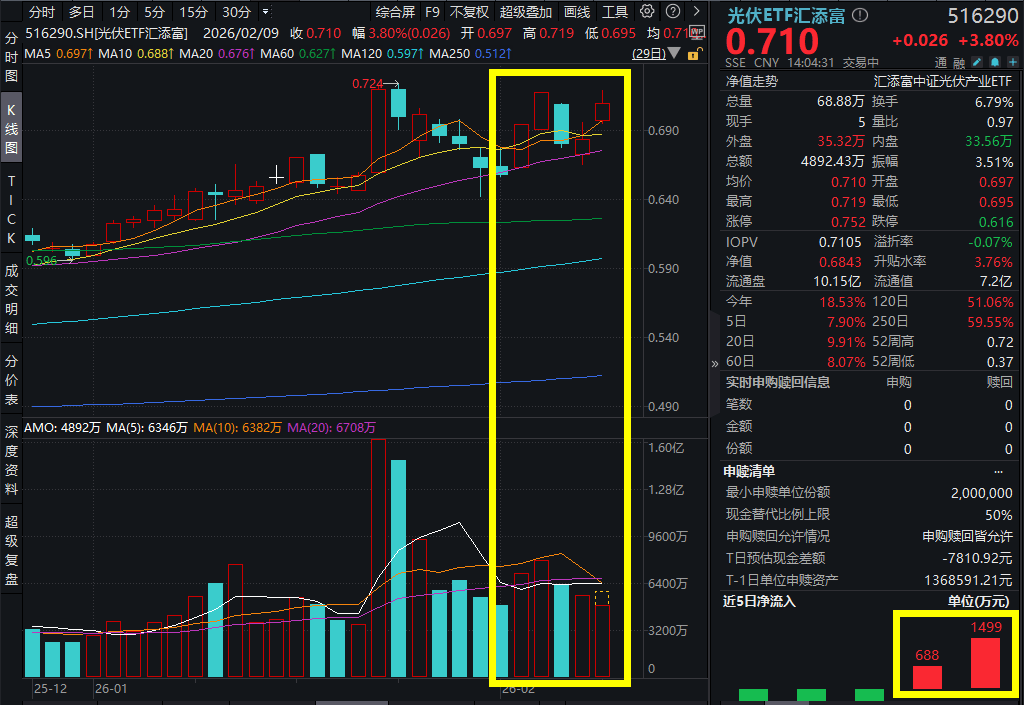
Core Viewpoint - The A-share market experienced a strong rebound, with significant gains in the photovoltaic and battery sectors driven by news related to space photovoltaic technology and Tesla's plans for solar energy production [1][4]. Group 1: Market Performance - The Shanghai Composite Index rose over 1%, with more than 4,400 stocks increasing in value [1]. - The photovoltaic ETF, Huatai-PineBridge (516290), surged nearly 4%, attracting over 20 million yuan in investment over two consecutive days [1]. - The battery ETF, Huatai-PineBridge (159796), also saw a rise of 1.78%, with a trading volume exceeding 210 million yuan [1]. Group 2: Key Stocks and Trends - Major stocks in the photovoltaic sector, such as GCL-Poly Energy and TCL Zhonghuan, experienced significant price increases, with GCL-Poly hitting the daily limit and TCL Zhonghuan rising nearly 10% [2][4]. - Market rumors indicated that Elon Musk's team visited several Chinese photovoltaic companies, focusing on those with heterojunction and perovskite technology [3]. Group 3: Space Photovoltaic Market Potential - According to CITIC Securities, the demand for space photovoltaic technology is expected to grow exponentially, with projections estimating a market size of over 800 billion yuan by 2030 under conservative scenarios [5]. - The global demand for space photovoltaic systems could reach 1 GW in a conservative scenario and 70 GW in an optimistic scenario by 2030 [5][6]. - The anticipated growth in satellite launches and advancements in solar cell technology, such as P-HJT and perovskite cells, could lead to a hundredfold or even thousandfold market expansion in the next five years [5]. Group 4: Tesla and SpaceX Developments - Tesla plans to establish 100 GW of solar capacity, which is expected to significantly boost the demand for energy storage solutions [7]. - The integration of AI in energy management is projected to drive rapid growth in storage capacity, with Tesla's initiatives potentially leading to over 300 GWh of storage demand [7]. - The competitive landscape for photovoltaic equipment suppliers is expected to favor leading Chinese companies due to their ability to meet high standards and rapid response requirements from Tesla and SpaceX [6].






AI算力的下一个战场,已经延伸到了太空?
3 6 Ke· 2026-02-09 06:26
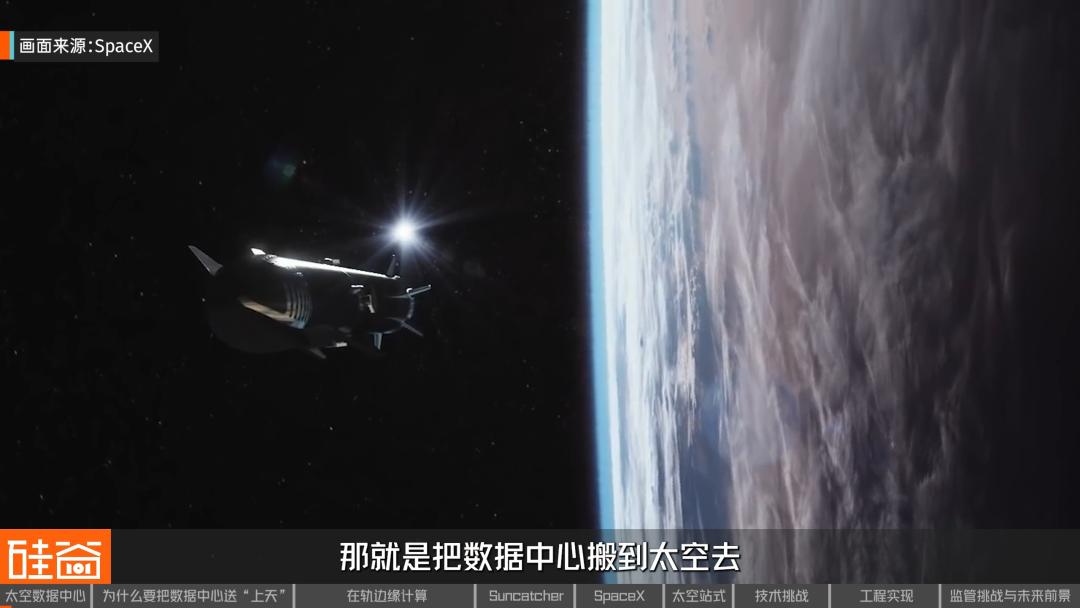
Core Insights - The concept of relocating data centers to space is gaining traction as a solution to the energy and cooling challenges faced by AI data centers on Earth [1][3] - Major tech companies like SpaceX, Amazon, and Google are actively pursuing the development of space-based data centers, indicating a shift in the industry towards this innovative approach [3][4] Group 1: Reasons for Moving Data Centers to Space - The primary bottlenecks for AI evolution are power supply and heat dissipation, which are becoming increasingly difficult to manage on Earth [4][6] - Current large-scale AI data centers consume hundreds of megawatts of power, with a single gigawatt capable of powering a medium-sized city for a year [6][8] - Space offers abundant and stable energy sources, particularly solar energy, which can be harnessed continuously without the limitations of weather or day-night cycles [9][10] Group 2: Advantages of Space Data Centers - In space, heat can be dissipated efficiently due to the extremely low background temperature, allowing for potentially infinite energy usage efficiency (PUE) [10][11] - Space data centers can achieve lower latency in data transmission, as light travels faster in a vacuum than through fiber optics, enabling rapid global data processing [13] - The combination of continuous energy supply, efficient cooling, and low-latency communication makes space an ideal environment for AI computation [13] Group 3: Current Exploration Paths - Two main approaches are being explored: "on-orbit edge computing" and "orbital cloud data centers," each addressing different levels of challenges and ambitions [28][41] - On-orbit edge computing focuses on deploying AI accelerators on existing satellites to process data in space, reducing the need for data transmission back to Earth [16][21] - Orbital cloud data centers aim to create a comprehensive cloud computing infrastructure in space, integrating multiple computing nodes for flexible resource allocation [28][30] Group 4: Challenges in Building Space Data Centers - Technical challenges include the need for larger solar panels, advanced power management systems, and specialized cooling structures to support continuous computation in space [47][48] - The complexity of engineering and high costs associated with launching and assembling space data centers pose significant barriers to their development [51][53] - Regulatory challenges arise from the potential increase in satellite numbers, which could lead to orbital congestion and collision risks [57][59] Group 5: Future Prospects - Space data centers are not expected to replace terrestrial data centers but rather serve as a complementary solution to address specific computational needs [60][62] - The long-term viability of space data centers will depend on advancements in technology, reductions in launch costs, and the establishment of effective regulatory frameworks [56][64] - The ongoing exploration of space data centers reflects a broader recognition of the need to expand computational resources beyond Earth as demand continues to grow [65][67]
美媒:谷歌公司近千名员工签署公开信,谴责ICE等机构的行动
Huan Qiu Wang· 2026-02-09 05:43
Core Viewpoint - Nearly 1,000 Google employees signed an open letter condemning the actions of U.S. Immigration and Customs Enforcement (ICE) and Customs and Border Protection (CBP), urging the company to disclose its collaborations with these agencies and to sever ties with them [1][3]. Group 1: Employee Concerns - The letter highlights that U.S. citizens have died during actions conducted by immigration enforcement, describing these violent incidents as shocking [3]. - Employees expressed strong opposition to Google's collaboration with the Department of Homeland Security, CBP, and ICE, stating that leadership has a moral and political responsibility to disclose all contracts and partnerships with these agencies [3]. - The letter calls for Google to acknowledge the dangers faced by employees due to ICE actions and to implement measures to protect them [3]. Group 2: Context and Reactions - The letter comes in the wake of a shooting incident involving immigration enforcement in Minneapolis, which has sparked domestic outrage and condemnation from various political and business figures [3]. - Apple's CEO Tim Cook expressed heartbreak over the Minneapolis incident in a verified internal memo, indicating broader industry concern regarding immigration enforcement actions [3].
Capex超预期背景下的超跌修复——海外算力大涨点评
Mei Ri Jing Ji Xin Wen· 2026-02-09 05:15
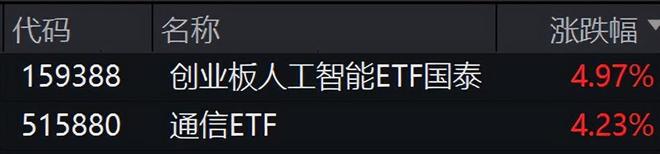
Market Performance - Overseas computing power recovery led to a rise of over 4% in the Communication ETF (515880) and the ChiNext AI ETF (159388) during trading today [1] Factors Driving the Increase - Recent US earnings reports indicate several key points: - Capital expenditures are accelerating, with Google projecting 2026 capital spending between $175 billion and $185 billion, nearly doubling year-on-year; Meta's full-year capital expenditure guidance is $115 billion to $135 billion, a 73% year-on-year increase; Amazon's guidance is $200 billion, a 53% increase year-on-year [2] - Microsoft did not provide full-year guidance but noted a seasonal quarter-on-quarter decline, likely due to factors like financing leases. The market previously expected a 42% growth in North American CSP capital expenditures for 2026, but recent earnings reports show capital expenditure growth significantly exceeding expectations [2] CPO Penetration and Market Sentiment - CPO penetration is exceeding expectations, but attention is needed on scale-up and scale-out dynamics. The consensus is that scale-up will dominate CPO, while scale-out remains led by pluggable optical modules. The domestic optical module leaders may secure some orders in the scale-up segment, indicating that CPO penetration in scale-up represents incremental growth rather than a replacement [3] - Market sentiment has rebounded from previous lows, with US markets recovering last Friday, influencing A-shares today. Both markets have faced issues related to funding and sentiment, with A-shares experiencing declining trading volumes since late January [3] Future Outlook - US earnings reports reaffirm the certainty of AI, with ongoing shortages in computing power. Google reported that Gemini 3.0 is the fastest model in its history, with over 750 million monthly active users for Gemini applications. Google also announced a partnership with Apple to develop the next-generation Apple foundational model. The management indicated that investments in AI infrastructure will gradually increase throughout the year, with a continued tight supply of computing power expected [4] - The focus remains on core segments like optical modules and servers, which are positioned at the heart of the global AI industry chain. With capital expenditures for 2026 significantly exceeding expectations, the outlook for optical modules and servers is strengthening, making Communication ETF (515880) and ChiNext AI ETF (159388) attractive for interested investors [4]


亚马逊1.39万亿、谷歌1.25万亿、微软1万亿,全球三大云厂商开启烧钱竞赛
Sou Hu Cai Jing· 2026-02-09 03:49
Core Insights - Generative AI is the main driving force behind the growth of the global cloud services market, with enterprise spending on cloud infrastructure services expected to reach $419 billion in 2025, marking the highest growth rate in three years [1] Company Summaries Microsoft - For the second fiscal quarter of 2026 ending December 31, 2025, Microsoft's total revenue reached $81.3 billion, a 17% year-on-year increase, with net profit at $38.5 billion, up 60% [4] - Microsoft's cloud revenue was $51.5 billion, growing 26% year-on-year, with the intelligent cloud segment generating $32.9 billion, a 29% increase, and Azure and other cloud services revenue rising 39% [4] - Despite strong earnings, Microsoft saw a significant stock drop of 9.99% on the earnings report day, resulting in a market value decline to $2.98 trillion, down from a peak of $4.15 trillion [5] Amazon - Amazon reported total revenue of $716.9 billion for 2025, a 12% increase year-on-year, with net profit of $77.7 billion [6] - Amazon Web Services (AWS) generated $128.7 billion in revenue, a 20% year-on-year increase, contributing significantly to the company's profits [6] - AWS backlog reached $244 billion, a 40% increase year-on-year, and Amazon plans to invest approximately $200 billion in capital expenditures for 2026 [6] Google - Google achieved total revenue of $402.8 billion in 2025, a 15% increase year-on-year, with net profit of $132.1 billion, a 32% increase [7] - Google Cloud's revenue for Q4 2025 was $17.66 billion, a 48% year-on-year increase, with total cloud revenue exceeding $70 billion [7] - Google plans to significantly increase capital expenditures to between $175 billion and $185 billion in 2026, focusing on AI infrastructure [7] Industry Overview - The overall cloud services market is experiencing robust growth driven by AI technology, with companies like Microsoft, Amazon, and Google investing heavily in capital expenditures to enhance their competitive positions [3][8] - AI is identified as the core driver of growth in the global cloud services market, which is expected to enhance revenue growth and unlock potential for cloud computing companies [8]

CSP大厂加码投资AI,原厂受益
Sou Hu Cai Jing· 2026-02-09 02:51
Group 1 - The global top four Cloud Service Providers (CSPs) will invest an additional $660 billion in AI infrastructure this year, an increase of nearly $200 billion compared to last year [1][3] - Despite concerns about an "AI bubble," major companies continue to increase their investments, with Samsung Electronics and SK Hynix expected to be significant beneficiaries [1] - Amazon's latest financial report indicates an AI investment budget of $20 billion this year, a substantial increase from the previously forecasted $14.46 billion, representing a 60% year-over-year growth [3] - Meta plans to invest up to $13.5 billion in AI devices this year, a 74% increase compared to last year [3] - Google and Microsoft have announced investment plans of $18.5 billion and $14 billion respectively, both showing significant year-over-year growth [3] - The total investment scale of the four major CSPs this year is $66 billion, a 65% increase from last year's $40 billion [3] - The accelerated investments by CSPs are expected to catalyze the performance of storage manufacturers [3]
从“更快”到“更省”:AI下半场,TPU重构算力版图
3 6 Ke· 2026-02-09 02:47
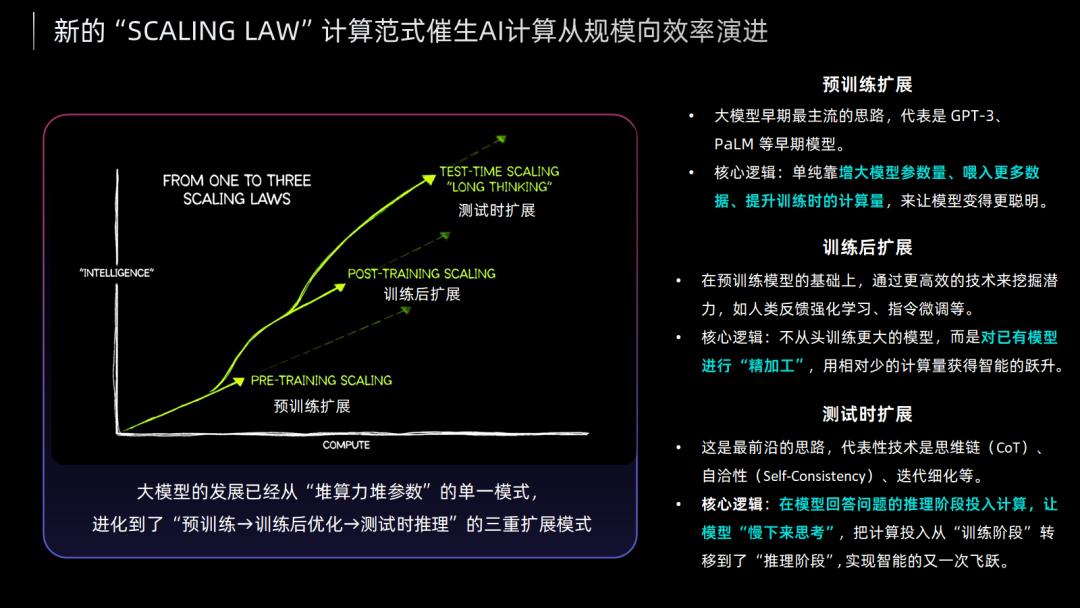
Core Insights - The rise of Google's TPU (Tensor Processing Unit) marks a significant shift in AI computing, moving from a GPU-dominated era to a new focus on specialized architectures for inference, particularly with the introduction of TPU v7, which has drastically reduced inference costs [1][4][32] Group 1: Market Dynamics - The AI landscape is evolving, with a shift from "training is king" to "inference is king," as the demand for efficient inference services grows [2][4] - Google's TPU v7 has reportedly reduced the cost per million tokens for inference by approximately 70% compared to its predecessor, indicating a competitive edge over NVIDIA's offerings [4][7] - The competition is intensifying, with companies like Anthropic placing significant orders for TPUs, highlighting the commercial viability of specialized chips [7][32] Group 2: Technological Innovations - TPU's architecture is designed for efficiency, focusing on matrix operations essential for AI, which contrasts with the general-purpose nature of GPUs [8][12] - Innovations such as the unique pulsing array architecture and large on-chip SRAM cache significantly reduce energy consumption associated with data movement [8][12] - The introduction of RISC-V architecture in AI chips allows for enhanced programmability and efficiency, aligning with industry trends towards specialized computing [15][16] Group 3: Cost Efficiency - The focus on reducing token costs is paramount, as companies aim to make AI services as affordable as utilities, driving the need for lower inference costs [4][27] - The competitive landscape is shifting towards maximizing efficiency and reducing costs rather than merely increasing computational power [27][32] - Companies like Yixing Intelligent are developing architectures that align with these trends, emphasizing energy efficiency and cost reduction in AI computations [14][20] Group 4: Ecosystem Development - The collaboration between hardware and software is crucial, with companies like Yixing Intelligent integrating open-source technologies to enhance compatibility and ease of use [20][26] - The establishment of ecosystems that support various frameworks (e.g., TensorFlow, PyTorch) is essential for broad adoption and seamless transitions between platforms [10][20] - The development of advanced interconnect technologies, such as ELink, is vital for supporting high-bandwidth, low-latency communication in AI applications [28][30]
速递|AI军备竞赛的代价:三大巨头资本财务承压,Meta现金流最为紧张
Z Potentials· 2026-02-09 02:32
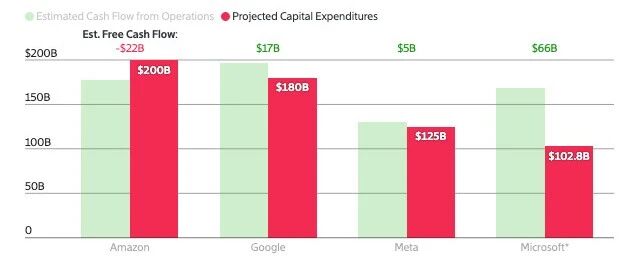
大型科技企业今年资本支出计划的大幅增长,几乎会耗尽亚马逊、谷歌和 Meta Platforms 的自由现金 流。这将迫使其中一些公司做出艰难抉择,比如是否停止股票回购或增加借款。 好消息是,这些大型科技公司都有能力比当前多借数千亿美元的资金。 近年来,大多数大型科技公司已开始通过派发股息和回购股票的方式向股东返还现金。例如,谷歌和 Meta 平台都采用这两种方式。但今年这种做法可能难以持续, 因为旨在扩大人工智能计算能力的资 本支出几乎完全耗尽了它们运营所产生的现金流。 (见上图) 谷歌和 Meta 已经开始缩减股票回购规模。然而,停止派息可能较为棘手,因为这两家公司均在 2024 年才推出股息支付计划,这使得它们的股票对投资者更具吸引力。 尽管微软可能产生大量自由现金流,却面临着其他公司没有的制约因素 ——即更庞大的股息支付承 诺。上一财年微软支付了 240 亿美元股息,且今年已将股息上调 10% 。 亚马逊不会面临同样的问题,因为它自 2022 年以来就没有回购过股票,也从未支付过股息 。但根据 标普全球市场财智的数据,其今年预计的 2000 亿美元资本支出,将超过分析师估计的 1780 亿美元运 营现金 ...