
HP(HPQ)

Search documents
惠普发布盈利预警,内存芯片波动或持续至明年
Huan Qiu Wang Zi Xun· 2026-02-25 04:43
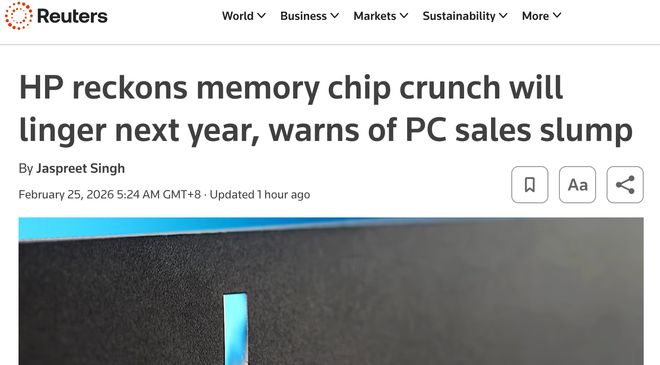
Core Viewpoint - HP has issued a profit warning, indicating that the volatility in memory chip prices will persist into next year, leading to a projected double-digit decline in PC shipments, which caused its stock to drop approximately 6% in after-hours trading [1][3]. Group 1: Financial Forecast - For the fiscal year ending October 31, 2026, HP expects adjusted earnings per share to be at the lower end of the previously forecasted range of $2.90 to $3.20 [3]. - The company acknowledged that the weakness in the PC market has exceeded prior expectations, with shipment declines aligning with overall industry trends [3]. Group 2: Profitability and Cost Pressures - HP's adjusted operating profit margin for the first fiscal quarter of 2026 was reported at 6.9%, below the market average expectation of 7.4%, indicating ongoing cost pressures affecting profitability [3]. Group 3: Strategic Responses - To mitigate the impact of rising memory chip prices, HP has implemented several self-help measures, including price increases to pass on some costs, expanding its supplier network to reduce dependency, and optimizing product designs to decrease memory chip usage [3]. - The company announced that these strategic initiatives have made progress, including the completion of the certification process for new suppliers [3].


HP (HPQ) Reports Q1 Earnings: What Key Metrics Have to Say
ZACKS· 2026-02-25 02:01
Financial Performance - For the quarter ended January 2026, HP reported revenue of $14.44 billion, a 6.9% increase year-over-year, and EPS of $0.81, up from $0.74 in the same quarter last year [1] - The reported revenue exceeded the Zacks Consensus Estimate of $14.26 billion by 1.22%, and the EPS also surpassed the consensus estimate of $0.77 by 4.65% [1] Key Metrics - Personal Systems revenue was $10.25 billion, a year-over-year increase of 11.1%, but below the average estimate of $10.39 billion [4] - Commercial Personal Systems revenue was $7.25 billion, a 9.2% increase year-over-year, but below the average estimate of $7.43 billion [4] - Consumer Personal Systems revenue reached $3 billion, exceeding the estimated $2.96 billion, with a year-over-year growth of 16.3% [4] - Printing revenue totaled $4.19 billion, slightly above the average estimate of $4.14 billion, but represented a year-over-year decline of 1.9% [4] Operational Earnings - Earnings from operations in Personal Systems were $511 million, below the average estimate of $568.76 million [4] - Corporate Investments reported a loss of $24 million, significantly better than the estimated loss of $155.43 million [4] - Earnings from operations in Printing were $765 million, slightly above the average estimate of $759.07 million [4] Stock Performance - HP shares have returned -5.7% over the past month, compared to a -1% change in the Zacks S&P 500 composite [3] - The stock currently holds a Zacks Rank 4 (Sell), indicating potential underperformance relative to the broader market in the near term [3]

HP (HPQ) Q1 Earnings and Revenues Beat Estimates
ZACKS· 2026-02-25 01:31
分组1 - HP reported quarterly earnings of $0.81 per share, exceeding the Zacks Consensus Estimate of $0.77 per share, and up from $0.74 per share a year ago, representing an earnings surprise of +4.65% [1] - The company posted revenues of $14.44 billion for the quarter ended January 2026, surpassing the Zacks Consensus Estimate by 1.22%, compared to $13.5 billion in the same quarter last year [2] - HP shares have declined approximately 17.6% since the beginning of the year, while the S&P 500 has only declined by 0.1% [3] 分组2 - The current consensus EPS estimate for the upcoming quarter is $0.72 on revenues of $13.38 billion, and for the current fiscal year, it is $2.95 on revenues of $55.01 billion [7] - The Computer - Micro Computers industry, to which HP belongs, is currently ranked in the bottom 9% of over 250 Zacks industries, indicating a challenging environment for the sector [8] - Dell Technologies, a competitor in the same industry, is expected to report quarterly earnings of $3.54 per share, reflecting a year-over-year increase of +32.1%, with revenues anticipated to be $31.91 billion, up 33.3% from the previous year [9][10]
美芯片股反弹,AMD狂飙8%,存储牛股遭空头突袭跳水
2 1 Shi Ji Jing Ji Bao Dao· 2026-02-25 01:28
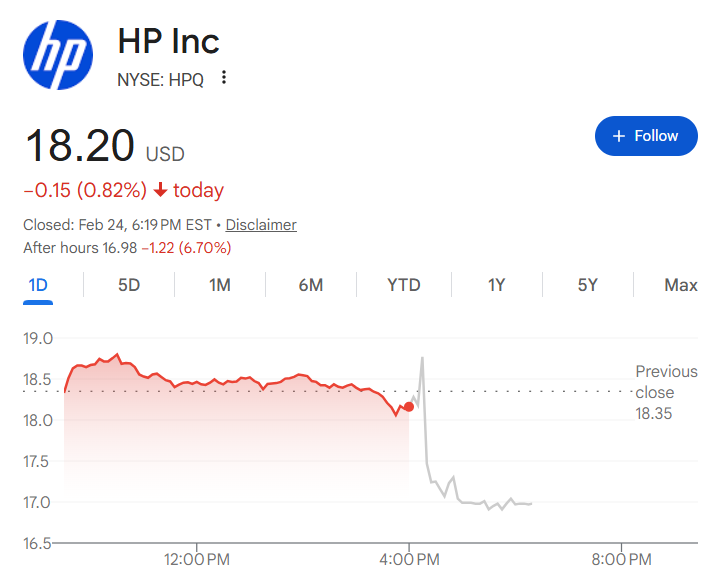
Market Performance - On February 24, US major stock indices all closed higher, with the Dow Jones and S&P 500 rising over 0.7% and the Nasdaq increasing by 1% [2] - More than 3,500 stocks in the market experienced gains [2] Semiconductor Sector - Chip stocks saw widespread gains, with AMD soaring over 8% following Meta's announcement of a multi-year agreement with the semiconductor company [2] - Intel rose by more than 5%, TSMC increased over 4%, and ARM and Qualcomm both gained over 3% [2] Company-Specific Developments - HP experienced a significant decline of nearly 7% in after-hours trading due to a negative outlook on storage chips [2] - Short-selling firm Citron Capital announced it has established a short position on storage stock SanDisk, leading to a sharp intraday drop of over 8% in SanDisk's stock price, which ultimately closed down 4.2% [2]




惠普Q1营收增长7%超预期,但存储芯片涨价拖累业绩展望,盘后股价跌近7%|财报见闻
Hua Er Jie Jian Wen· 2026-02-24 23:59
Core Insights - HP reported Q1 FY2026 earnings with net revenue of $14.44 billion, a year-over-year increase of 6.9%, exceeding analyst expectations of $13.9 billion by approximately 3.2% [1] - Non-GAAP earnings per share (EPS) were $0.81, up 9.5% from $0.74 in the same period last year, also surpassing market consensus of $0.77 by about 5.3% [1] - The personal systems segment was the main driver of the strong performance, with PC revenue growing 11% year-over-year to $10.25 billion, and consumer PCs seeing a significant growth of 16% [1][5] - However, the printing segment experienced a decline in revenue, down 2.2% to $4.19 billion, with consumer printing declining even more sharply by 8% [1][6] - Forward guidance raised concerns among investors, with the company projecting Q2 non-GAAP EPS in the range of $0.70 to $0.76, with a midpoint of $0.73, below market expectations of $0.75 [1][3] Personal Systems Segment - The personal systems business was the standout performer, achieving a revenue of $10.25 billion, a year-over-year increase of 11% (9% growth excluding currency effects), exceeding analyst expectations of $9.76 billion by about 5% [5] - Commercial PC revenue grew by 9%, while consumer PC revenue surged by 16%, with total unit shipments increasing by 12% [5] - The ongoing penetration of AI PCs was highlighted as a key driver for the personal systems segment's performance, with management emphasizing its importance for future strategies [5] - Despite the growth, the operating profit margin for the personal systems segment was only 5.0%, indicating limited profit contribution from significant revenue increases [5] Printing Segment - The printing business contributed 18.3% in operating profit margin, serving as a stabilizer for overall profitability, but revenue trends indicate ongoing challenges [6] - Quarterly printing revenue was $4.19 billion, down 2% year-over-year, with consumer printing declining by 8% and commercial printing down by 3% [6] - Over the past two years, the commercial printing business has averaged a year-over-year decline of 3.3%, reflecting structural pressures in the market [6] Cash Flow and Capital Allocation - HP generated $383 million from operating activities, with free cash flow of $175 million, resulting in a low free cash flow conversion rate of approximately 1.2% relative to revenue [7] - Despite limited cash generation capacity, HP maintained an active capital return strategy, repurchasing 13.3 million shares for $325 million and paying $0.30 per share in dividends, totaling approximately $277 million returned to shareholders [9] - The company expects full-year free cash flow to be between $2.8 billion and $3 billion, but indicated a tendency towards the lower end of this range, raising concerns about cash flow pressures in the second half of the year [9]
财报超预期股价却暴跌!惠普盘后重挫7%,关税与内存涨价成“利润杀手”
Zhi Tong Cai Jing· 2026-02-24 23:48
Core Viewpoint - HP Inc. reported its Q1 FY2026 earnings, indicating a cautious outlook for the upcoming quarters due to rising memory costs and U.S. tariff policies, projecting full-year earnings at the lower end of previous guidance [1] Financial Performance - For Q1 FY2026, HP's revenue increased by 6.9% year-over-year to $14.4 billion, with adjusted earnings per share (EPS) of $0.81, both exceeding market expectations [1] - The company anticipates Q2 adjusted EPS to be between $0.70 and $0.76, slightly below the analyst average estimate of $0.75 [1] Challenges and Cost Pressures - HP faces multiple challenges, including the impact of U.S. tariffs and rising memory chip prices, which have doubled compared to the previous quarter [2] - Memory and storage costs are projected to rise from 15%-18% of the PC material cost list to 35% in the current fiscal year [2] - The adjusted operating margin for Q1 was 6.9%, below the analyst average expectation of 7.4% [2] Strategic Initiatives - HP has initiated a multi-year cost reduction plan aimed at saving $1 billion annually by 2028, which includes restructuring-related expenses [3] Business Segment Performance - The personal systems segment, which includes consumer and commercial PCs, saw revenue growth of 11% to $10.25 billion, driven by a 16% increase in consumer PC sales attributed to the growth of AI PCs [4] - The printing segment experienced a revenue decline of 2% to $4.19 billion [4] Management Changes and Market Outlook - Following the appointment of HP's CEO Enrique Lores to PayPal, Bruce Broussard has been named interim leader while the company searches for a successor [5] - Market research indicates a projected low double-digit decline in shipments of smartphones and PCs in 2026, with demand for consumer electronics potentially impacted by the rapid construction of AI infrastructure consuming global memory chip supplies [5]
财报超预期股价却暴跌!惠普(HPQ.US)盘后重挫7% 关税与内存涨价成“利润杀手”
Zhi Tong Cai Jing· 2026-02-24 23:37
Core Viewpoint - HP Inc. reported its Q1 FY2026 earnings, indicating that profit guidance for Q2 may fall below market expectations due to U.S. tariff policies and rising storage chip prices, with full-year earnings expected at the lower end of previous forecasts [1] Financial Performance - For Q1 FY2026, HP's revenue increased by 6.9% year-over-year to $14.4 billion, with adjusted earnings per share (EPS) of $0.81, both exceeding market expectations of $13.9 billion in revenue and $0.77 EPS [1] - The adjusted operating margin for Q1 was 6.9%, below the analyst average expectation of 7.4% [2] Market Challenges - HP faces multiple challenges, including the impact of U.S. tariffs, which have led to a shift in production outside of North America, and a shortage of storage chips causing price increases [2] - The CFO noted that memory prices have approximately doubled compared to the previous quarter and are expected to continue rising, with memory and storage costs projected to account for 35% of the PC material list this fiscal year, up from 15%-18% [2] Cost Management Initiatives - HP has initiated a multi-year cost reduction plan aimed at saving $1 billion annually by 2028, which includes restructuring-related expenses [3] Business Segment Performance - The personal systems segment, which includes both consumer and commercial PCs, saw revenue growth of 11% to $10.25 billion, driven by a 16% increase in consumer PC sales attributed to the ongoing demand for AI PCs [4] - The printing segment, which includes office printers and services, experienced a revenue decline of 2% to $4.19 billion [7] Leadership Changes and Market Outlook - Following the appointment of HP's CEO Enrique Lores to PayPal, Bruce Broussard has been appointed as interim leader while the company searches for a successor [8] - Market research indicates that global shipments of smartphones and PCs are expected to decline significantly, with the demand for consumer electronics potentially impacted by the rapid construction of AI infrastructure consuming a large portion of global storage chip supply [8]
HP(HPQ) - 2026 Q1 - Quarterly Report
2026-02-24 23:31
Use these links to rapidly review the document Table of Contents Part I. Financial Information UNITED STATES SECURITIES AND EXCHANGE COMMISSION WASHINGTON, D.C. 20549 FORM 10-Q (Mark One) ☒ QUARTERLY REPORT PURSUANT TO SECTION 13 OR 15(d) OF THE SECURITIES EXCHANGE ACT OF 1934 For the quarterly period ended January 31, 2026 Or ☐ TRANSITION REPORT PURSUANT TO SECTION 13 OR 15(d) OF THE SECURITIES EXCHANGE ACT OF 1934 For the transition period from to Commission file number 1-4423 ____________________________ ...