HP(HPQ)

Search documents
存储盛宴的代价:三星利润翻倍的背后,苹果与惠普的“利润保卫战”才刚刚开始
Hua Er Jie Jian Wen· 2026-01-15 12:24
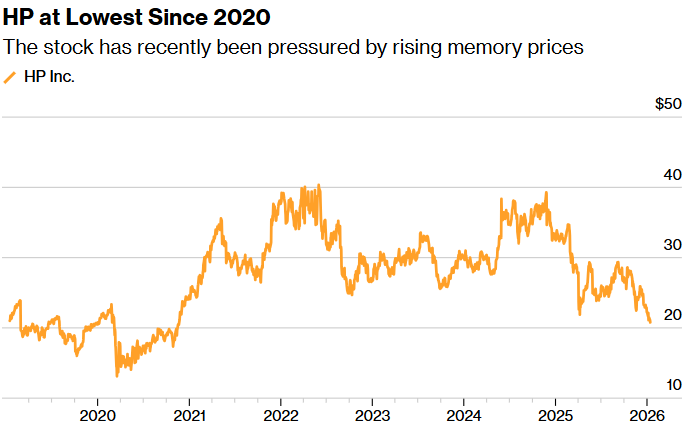
Core Viewpoint - The global technology hardware industry is facing a severe "profit defense battle" due to skyrocketing storage component prices, leading to significant differentiation within the industry. While storage chip manufacturers are experiencing explosive profit growth, downstream equipment manufacturers are forced to make difficult choices between sacrificing profit margins and raising prices to curb demand [1]. Group 1: Price Surge and Profit Impact - Samsung reported a more than 30% increase in average selling prices for DRAM and approximately 20% for NAND chips, resulting in a profit increase of over two times, with this price trend expected to continue through 2026 [1]. - The price surge is driven by AI demand, described by IDC as an "unprecedented storage chip shortage," posing a crisis for equipment manufacturers [1]. - Apple and HP stocks have reacted negatively, with Apple down 4.4% at the start of 2026, making it one of the weakest stocks in the Nasdaq 100 index, while HP's stock hit its lowest level since November 2020 [1]. Group 2: Divergent Stock Performance - The past year has seen a stark divide in stock performance, with storage companies like SanDisk, Micron Technology, and Western Digital emerging as market winners, with SanDisk leading the S&P 500 index with over 60% gains entering 2026 [2]. - In contrast, hardware giants are struggling, with Apple only rising 8.6% in 2025 and continuing to decline, while HP's market value shrank by nearly one-third in 2025 and fell another 6.8% at the start of 2026 [2]. - Dell's stock has dropped 28% since reaching a historical high in October of the previous year, indicating the tough situation for hardware companies [2]. Group 3: Profit Erosion and Cost Pressures - Storage components account for 10% to 20% of the material costs in consumer hardware products, leading to rapidly downgraded profit expectations for companies [3]. - HP is particularly affected, with estimates indicating that rising storage costs will reduce its adjusted EPS by $0.30 in 2026, and market expectations for HP's net EPS have been downgraded by 7.1% in the past month [3]. - Even Apple, with strong pricing power, is expected to be impacted by the significant rise in storage component costs over the next two years [3]. Group 4: Structural Supply Shortage - The current supply shortage is characterized as a strategic reallocation of global silicon wafer capacity, differing from typical cyclical shortages, indicating that price pressures are unlikely to dissipate quickly [5]. - The extreme scarcity of supply is expected to persist in the short term, affecting semiconductor manufacturers that supply chips for smartphones, leading to downgrades for Qualcomm and Arm by Mizuho Securities and Bank of America [5]. - Among the hardware companies, only Dell is viewed positively due to its server business growth, which can partially offset the headwinds from rising storage costs [5].


存储涨价潮下的“受害者”:消费电子产商陷入成本泥潭,苹果(AAPL.US)、惠普(HPQ.US)等面临利润冲击
智通财经网· 2026-01-15 12:15
Core Viewpoint - The surge in memory chip prices has made companies like Sandisk, Micron Technology, and Western Digital popular stocks, but it has created significant challenges for their customers, including Apple and HP, as the high costs of memory components pose investment risks that are unlikely to reverse in the short term [1] Group 1: Impact on Hardware Manufacturers - Consumer hardware manufacturers are facing pressure due to high memory component costs, leading to two choices: accept lower profit margins or raise prices, which could harm demand [1] - Apple’s stock has seen only an 8.6% increase in 2025, marking its worst performance since 2022, while HP's stock has dropped nearly one-third in 2025 and hit its lowest level since November 2020 [2] - Dell Technologies' stock has decreased by 28% since reaching a historical high in October [2] Group 2: Semiconductor Manufacturers' Risks - The rising memory prices also pose risks for semiconductor manufacturers like Qualcomm and Arm, with recent downgrades in their ratings by Mizuho Securities and Bank of America [5] - The market is expected to continue pressuring these companies as long as memory prices remain high, driven by demand from artificial intelligence [5] - Dell is viewed positively due to its server business growth, which offsets the negative impact of rising memory prices [5] Group 3: Memory Price Trends and Industry Outlook - Samsung reported a more than 30% increase in average DRAM chip prices and about a 20% increase in NAND chip prices, with expectations that this trend will continue into 2026 or longer [6] - The memory cost for consumer hardware products may account for 10% to 20% of material costs, leading to concerns about profitability for companies like Apple and HP [6] - HP's earnings forecast for 2026 has been lowered by 7.1% due to rising memory costs, while Dell's performance expectations remain relatively stable due to strong demand in its server business [7] Group 4: Long-term Industry Dynamics - Analysts suggest that the current memory chip shortage is not just a cyclical issue but may indicate a permanent strategic reconfiguration of global silicon wafer capacity [6] - The anticipated significant increase in memory component costs over the next two years could impact even large companies like Apple [7] - The cyclical nature of memory prices is acknowledged, but the current supply shortage suggests that prices are unlikely to decrease in the short term [7]

高盛重新覆盖美股IT硬件与分销板块:力捧戴尔科技、慧与科技等五股 惠普、超微电脑遭唱空
智通财经网· 2026-01-14 06:40
Group 1: Core Insights - Goldman Sachs has resumed coverage of several companies in the IT hardware and distribution sector, assigning "buy" ratings to Dell Technologies, HPE, SYNNEX, and Penguin Solutions, while giving "sell" ratings to HP and Super Micro Computer, and a "neutral" rating to Insight Enterprises [1] - The IT hardware and distribution industry experienced a modest return of only 4% in 2025, compared to a 16% increase in the S&P 500, with expectations for continued volatility in 2026 due to fluctuating AI market enthusiasm and rising input costs [1][2] Group 2: Investment Themes - Analysts believe that patient investors will be rewarded, as the industry presents stock-picking opportunities, particularly for stocks with upward consensus expectations and attractive performance in three key investor topics: sustainability of AI demand, the stage of upgrade cycles for PCs, servers, storage, and campus networks, and the impact of higher input costs on margins and demand [2] - The rationale for the "buy" ratings on Dell Technologies, HPE, SYNNEX, Penguin Solutions, and NetApp includes Dell's strong earnings growth potential related to AI, HPE's attractive business transformation, NetApp's undervalued high-margin public cloud business, SYNNEX's resilient distribution model, and Penguin Solutions' accelerated profit growth through portfolio transformation [2] Group 3: Market Outlook - In terms of AI infrastructure demand, analysts expect strong growth in new cloud (GPU-as-a-service) demand, despite potential quarterly fluctuations due to product transitions and an expanding XPU ecosystem [3] - For traditional servers and enterprise storage, there is cautious optimism for revenue growth driven by data center modernization trends in 2026, while closely monitoring demand elasticity in an inflationary pricing environment and anticipating that higher DRAM/NAND costs will largely be passed on to customers [3] - The outlook for personal computers in 2026 is expected to be weaker than current market expectations due to diminished upgrade incentives and rising prices, with the impact of rising input costs on margins and demand being a key issue for 2026 [3]



惠普取得基于电池测量结果的用户简档专利
Jin Rong Jie· 2026-01-13 10:10
Core Viewpoint - HP Development Company, Limited Liability Partnership has obtained a patent titled "User Profile Based on Battery Measurement Results," with authorization announcement number CN115136098B, and the application date was January 2020 [1] Summary by Categories - Patent Acquisition - HP Development Company has secured a patent related to user profiling based on battery measurement results [1] - The patent was officially announced under the number CN115136098B [1] - The application for this patent was filed on January 2020 [1]
2025年全球PC市场出货量达到2.795亿台 联想以25.4%份额蝉联全球第一
Ge Long Hui· 2026-01-13 08:02
Group 1 - The global PC market is expected to see a 10.1% increase in total shipments in Q4 2025, reaching 75 million units, leading to an annual total of 279.5 million units, a year-on-year growth of 9.2% [1] - In Q4 2025, notebook shipments (including mobile workstations) are projected to reach 58.6 million units, with an annual growth of 8% to 220.4 million units. Desktop shipments (including desktop workstations) are expected to be 16.2 million units, with a 14.4% annual growth to 59 million units [1] - Lenovo leads the global PC market in Q4 2025 with a shipment of 19.3 million units and a market share of 25.8%, followed by HP (20.6%), Dell (16.7%), Apple (9.4%), and Asus (7.1%). Dell has the highest year-on-year growth rate at 26%, while Apple has the lowest at 1.9% [1] Group 2 - For the entire year of 2025, Lenovo maintains its position as the top vendor with 70.9 million units shipped and a market share of 25.4%, followed by HP (20.6%), Dell (15.0%), Apple (9.9%), and Asus (7.2%) [2] - Apple leads in year-on-year growth rate for 2025 at 16.4%, while Dell has the lowest growth rate at 7.2% [2] - Omdia's chief analyst indicates that in 2026, supply-side pressures will become more significant due to unresolved device replacement demands, affecting actual shipment volumes based on suppliers' procurement capabilities and negotiation leverage [2] - A survey conducted by Omdia in November 2025 shows that 57% of B2B channel partners expect growth in their PC business in 2026 compared to 2025, indicating a healthy demand environment for suppliers who can effectively manage supply [2]

IDC:2025年第四季度全球PC出货量达7640万台 同比增长9.6%
智通财经网· 2026-01-13 05:45
Core Insights - The global PC shipments are projected to grow by 9.6% year-over-year in Q4 2025, reaching 76.4 million units, marking a strong end to a turbulent year for the PC market [1][5] - Factors influencing the PC market include the end of Windows 10 support driving upgrade demand, uncertainties around tariff policies leading to preemptive inventory stocking, and a tightening memory supply impacting pricing and availability [1][2][4] Market Overview - The PC market is expected to experience significant volatility in the coming year due to rapid changes in the memory market, with potential price increases and adjustments in average memory configurations to extend existing inventory usage [2][4] - The average selling price (ASP) of PCs is anticipated to rise in 2026 as manufacturers prioritize mid-to-high-end product supply to cope with increasing component costs, particularly memory prices [4] Company Performance - Lenovo led the market in Q4 2025 with shipments of 19.3 million units, capturing 25.3% market share, reflecting a 14.4% increase from Q4 2024 [5] - HP Inc. and Dell Technologies followed with shipments of 15.4 million (20.1% market share, up 12.1%) and 11.7 million (15.3% market share, up 18.2%) units respectively [5] - Apple and ASUS reported shipments of 7.1 million (9.3% market share, up 0.2%) and 5.4 million (7.1% market share, up 10.9%) units respectively [5] Yearly Shipment Data - Total PC shipments for 2025 reached 284.7 million units, an 8.1% increase from 263.3 million units in 2024 [6] - Lenovo maintained a leading position with 70.8 million units shipped in 2025, holding 24.9% of the market, while HP Inc. and Dell Technologies shipped 57.5 million (20.2% market share) and 41.1 million (14.4% market share) units respectively [6]
Omdia:2025年全球PC出货增长9%,内存与存储供应紧张或影响2026年表现
Jin Rong Jie· 2026-01-13 01:30
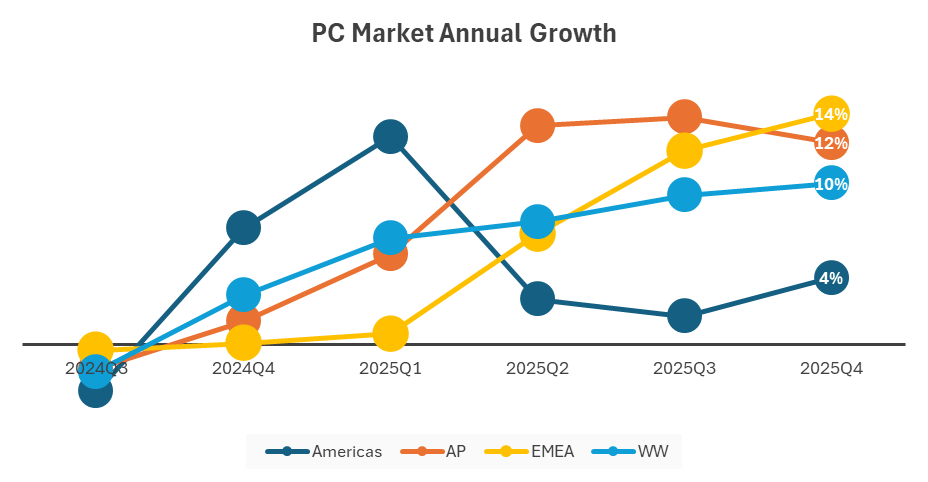
Core Insights - The global PC market is projected to see a total shipment of 75 million units in Q4 2025, marking a year-on-year growth of 10.1%, leading to an annual total of 279.5 million units, a 9.2% increase from 2024 [1][8] Group 1: Market Performance - In Q4 2025, notebook shipments (including mobile workstations) reached 58.6 million units, with an annual total of 220.4 million units, reflecting an 8% year-on-year growth [1] - Desktop shipments (including desktop workstations) in Q4 2025 totaled 16.2 million units, with an annual total of 59 million units, showing a significant year-on-year increase of 14.4% [1] - Lenovo continues to lead the PC market with a Q4 2025 shipment of 71 million units, a 14.4% increase year-on-year, and an annual total of 71 million units, up 14.6% [6] - HP ranks second with Q4 shipments of 15.4 million units, achieving growth both quarter-on-quarter and year-on-year [6] - Dell achieved a strong Q4 performance with a 26% year-on-year growth, resulting in an annual shipment of 42 million units, a 7% increase from 2024 [6] - Apple, maintaining the fourth position, became the fastest-growing vendor with an annual shipment of 28 million units, reflecting a 16.4% year-on-year growth [6] Group 2: Supply Chain and Pricing Dynamics - Despite the positive market outlook for 2025, there are concerns regarding tightening supply of memory and storage, leading to upward price pressures starting mid-2025 [3] - By December 2025, PC manufacturers began to anticipate price increases due to supply shortages, which are expected to impact 2026 shipment forecasts [3] - The cost of mainstream PC memory and storage increased by 40% to 70% from Q1 to Q4 2025, resulting in cost pressures being passed on to customers [3] - The demand for device replacements in 2026 remains strong, but supply-side pressures are expected to be more pronounced, affecting the ability to meet demand [3] - A survey indicated that 57% of B2B channel partners expect growth in PC business for 2026, suggesting a healthy market demand environment [3]
Omdia:2025年全球PC出货量达到2.795亿台 同比增长9.2%
Zhi Tong Cai Jing· 2026-01-13 01:29
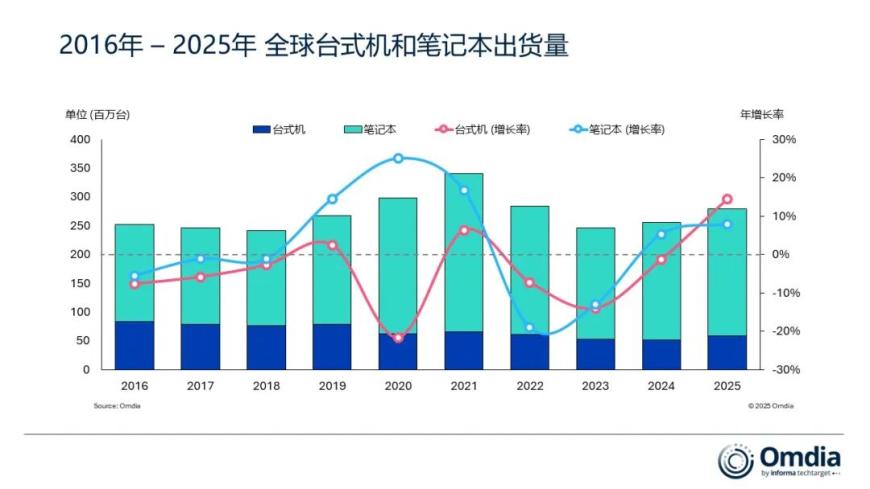
Group 1: Market Overview - Omdia's latest research indicates that total shipments of desktops, laptops, and workstations will reach 75 million units in Q4 2025, representing a year-on-year growth of 10.1% [1] - The total PC shipment for 2025 is projected to be 279.5 million units, an increase of 9.2% compared to 2024 [1][8] - In Q4 2025, laptop shipments (including mobile workstations) are expected to hit 58.6 million units, with an annual total of 220.4 million units, reflecting an 8% year-on-year growth [1] Group 2: Supply Chain and Pricing Dynamics - Despite the positive outlook for the PC market in 2025, there are concerns about tightening supply of memory and storage, leading to upward price pressures starting mid-year [3] - By December 2025, PC manufacturers began to anticipate price increases due to supply shortages, which are expected to impact 2026 shipment forecasts [3] - The cost of mainstream PC memory and storage has risen by 40% to 70% from Q1 to Q4 2025, resulting in cost pressures being passed on to customers [3] Group 3: Company Performance - Lenovo continues to lead the PC market, with Q4 2025 shipments reaching 7.1 million units, a year-on-year increase of 14.4%, and an annual total of 71 million units, up 14.6% [6] - HP ranks second, with Q4 2025 shipments of 1.54 million units, showing growth both quarter-on-quarter and year-on-year [6] - Dell achieved a strong Q4 performance with a 26% year-on-year growth, totaling 4.2 million units for the year, a 7% increase from 2024 [7]
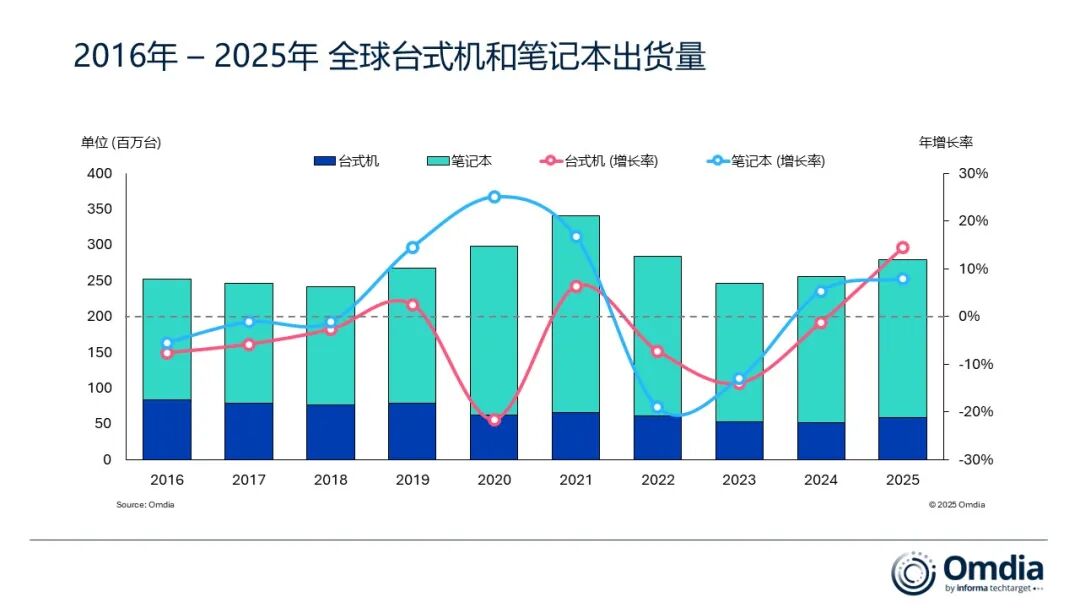
Omdia:2025年全球PC出货增长9%,内存与存储供应紧张或影响2026年表现,联想继续领跑全球市场,戴尔第四季度表现亮眼
Canalys· 2026-01-13 01:02
Core Insights - Omdia's latest research indicates that the total shipment of desktops, laptops, and workstations will reach 75 million units in Q4 2025, representing a year-on-year growth of 10.1%. This will result in an annual PC shipment of 279.5 million units in 2025, a 9.2% increase from 2024 [1][2]. Shipment Performance - In Q4 2025, laptop shipments (including mobile workstations) will total 58.6 million units, with an annual total of 220.4 million units, achieving an 8% year-on-year growth for 2025 [2]. - Desktop shipments (including desktop workstations) will reach 16.2 million units in Q4, with an annual total of 59 million units, reflecting a 14.4% year-on-year increase [2]. Market Dynamics - Despite the positive outlook for the PC market in 2025, there will be tightening supply of memory and storage starting mid-year, leading to upward price pressures. By December 2025, PC manufacturers are expected to release price increase forecasts due to supply shortages impacting 2026 shipment expectations [4]. - The cost of mainstream PC memory and storage has risen by 40% to 70% from Q1 to Q4 2025, which will ultimately affect customer pricing. The industry is shifting towards higher-end products while streamlining mid to low-end configurations to protect profit margins [4]. Vendor Performance - Lenovo continues to lead the PC market, with Q4 2025 shipments reaching 7.1 million units, a year-on-year increase of 14.4%, and an annual total of 71 million units, up 14.6% [8]. - HP ranks second, with Q4 shipments of 1.54 million units, showing growth both quarter-on-quarter and year-on-year. Dell achieved a strong Q4 performance with a 26% year-on-year growth, totaling 4.2 million units for the year, a 7% increase from 2024 [8]. - Apple remains in fourth place and is the fastest-growing vendor for the year, with annual shipments of 28 million units, reflecting a 16.4% year-on-year growth. Asus ranks fifth, maintaining its position in both quarterly and annual rankings, with Q4 shipments of 530,000 units and an annual total of 20 million units, benefiting from a 7% growth in the holiday quarter [8]. Market Share Analysis - In Q4 2025, Lenovo holds a market share of 25.8%, HP at 20.6%, Dell at 16.7%, Apple at 9.4%, and Asus at 7.1%. The total shipment for the quarter is 74.8 million units, a 10.1% increase from Q4 2024 [9]. - For the entire year of 2025, Lenovo's market share is 25.4%, HP at 20.6%, Dell at 15.0%, Apple at 9.9%, and Asus at 7.2%, with total shipments reaching 279.5 million units, a 9.2% increase from 2024 [10].

3 Dividend Stocks With High Yields and a Triple-Digit Upside Potential
247Wallst· 2026-01-12 19:19
Core Insights - The article emphasizes that investors do not need to compromise on yield and potential upside when investing in dividend stocks [1] Group 1 - Dividend stocks can offer attractive yields without sacrificing growth potential [1] - The current market conditions provide opportunities for higher returns in dividend-paying stocks [1] - Investors are encouraged to explore options beyond traditional moderate yield stocks [1]