
Intel(INTC)

Search documents
Should You Buy Intel Stock Before Earnings on January 22? UBS Analysts Say Yes.
Yahoo Finance· 2026-01-20 15:19
Analysts have been weighing in ahead of Intel's (INTC) much-awaited earnings on Jan. 22. The company has had to prove itself after an explosive rally since September 2025, sparked by successive wins with Nvidia (NVDA), SoftBank (SFTBY), and the U.S. government. Intel's CEO has been successful in courting several big-name AI companies and President Donald Trump himself, but whether he can hold the momentum is the real question. INTC stock is up 30% year-to-date (YTD) already. Its Q4 earnings are expected ...

Intel Can Claw Back Market Share, Analyst Says. The Stock Gets an Upgrade.
Barrons· 2026-01-20 15:10
Intel's Panther Lake processors, made using its new 18A manufacturing process, could be a winner, Seaport says. ...

Understanding Intel's Position In Semiconductors & Semiconductor Equipment Industry Compared To Competitors - Intel (NASDAQ:INTC)
Benzinga· 2026-01-20 15:00
Core Insights - The article provides a comprehensive analysis of Intel and its competitors in the Semiconductors & Semiconductor Equipment industry, focusing on financial metrics, market position, and growth prospects to offer insights for investors [1] Company Overview - Intel is a leading digital chipmaker specializing in microprocessors for personal computers and data centers, holding a significant market share in central processing units [2] - The company aims to revitalize its chip manufacturing business while developing advanced products [2] Financial Metrics Comparison - Intel's Price to Earnings (P/E) ratio is 782.67, significantly higher than the industry average by 10.38 times, indicating a premium valuation [3] - The Price to Book (P/B) ratio of 2.11 is below the industry average by 0.21, suggesting potential undervaluation [3] - Intel's Price to Sales (P/S) ratio is 3.87, which is 0.3 times the industry average, indicating possible undervaluation based on sales performance [3] - The Return on Equity (ROE) stands at 3.98%, which is 1.5% below the industry average, indicating inefficiency in profit generation [3] - The Earnings Before Interest, Taxes, Depreciation, and Amortization (EBITDA) is $7.85 billion, 1.17 times above the industry average, suggesting strong profitability [3] - Gross profit is $5.22 billion, which is 0.8 times below the industry average, indicating lower revenue after production costs [3] Revenue Growth - Intel's revenue growth of 2.78% is significantly lower than the industry average of 34.81%, indicating potential challenges in sales performance [4] Debt-to-Equity Ratio - Intel has a debt-to-equity (D/E) ratio of 0.44, indicating a stronger financial position compared to its top four peers, suggesting a favorable balance between debt and equity [7][8] Key Takeaways - The high P/E ratio suggests Intel may be overvalued compared to peers, while low P/B and P/S ratios indicate potential undervaluation based on book value and sales [9] - Intel's lagging ROE compared to industry peers and high EBITDA reflect strong operational earnings, but low gross profit and revenue growth highlight challenges in profit generation and business expansion [9]


The Clue Hiding in Intel's Ohio Construction Site That Investors Shouldn't Ignore
Yahoo Finance· 2026-01-20 15:00
Core Insights - Intel announced a $28 billion investment in two new chip factories in Ohio in 2022, aiming to become a world-class foundry for external customers, with initial production expected to start in 2025 [1] - The Ohio project has faced multiple delays due to challenges in securing external foundry customers, with the target date for the first fab's production now pushed to 2030 [2] Group 1 - Intel's 14A process node, set to launch in 2027, will proceed only if the company can attract significant external customers [2] - Intel's 18A process node, currently ramping in Arizona, has seen yield improvements, now exceeding 60%, which supports the launch of Panther Lake CPUs [5] - Despite initial struggles, Intel 18A is expected to be successful and profitable in the long run, but the true test will be the success of Intel 14A [6] Group 2 - Recent job postings by the construction company for Intel's Ohio fabs suggest that construction may be ramping up [7] - CEO Lip-Bu Tan's recent comments indicate a more optimistic outlook for the Intel 14A process, contrasting with earlier cautious statements [8] - Increased hiring at the Ohio fab and Tan's remarks suggest potential success in engaging customers for the Intel 14A process, which may lead to an accelerated construction timeline [9]
Analysts revise Intel stock price target ahead of earnings report
Finbold· 2026-01-20 14:42
Intel (NASDAQ: INTC) has doubled in value over the past six months, and Wall Street’s latest INTC stock price targets suggest the rally is far from over.Among the most recent analyst notes were Barclays’ $45 price target with a reiterated ‘Hold’ rating on January 16 and Jefferies matching forecast on January 15, which argued that Intel’s close ties to the artificial intelligence (AI) sector are going to be a significant tailwind.Slightly earlier, on January 13, KeyBanc upgraded Intel to ‘Overweight’ from ‘S ...
Intel upgraded, Domino's downgraded: Wall Street's top analyst calls
Yahoo Finance· 2026-01-20 14:36
Upgrades Summary - Melius Research upgraded Wingstop (WING) to Buy from Hold with a price target of $350, increased from $275, citing an attractive entry point after recent stock weakness [2] - Seaport Research upgraded Intel (INTC) to Buy from Neutral with a price target of $65, indicating that new Panther Lakes products are expected to drive near-term improvements and market share recovery in enterprise and consumer products [2] - HSBC also upgraded Intel to Hold from Reduce with a price target of $50, up from $26 [2] - Wolfe Research upgraded Allegiant Travel (ALGT) to Outperform from Peer Perform with a price target of $108, following its acquisition of Sun Country Airlines (SNCY), described as "transformational" [2] - Wells Fargo upgraded Doximity (DOCS) to Overweight from Equal Weight with a price target of $55, down from $65, suggesting that investor concerns are overblown based on survey results indicating sufficient differentiation [2] - Morgan Stanley upgraded Brinker (EAT) to Overweight from Equal Weight with a price target of $200, increased from $160, highlighting attractive long-term growth in fast casual and beverage sectors [2] - Morgan Stanley also upgraded Shake Shack (SHAK) to Overweight from Equal Weight with a price target of $125, up from $115 [2]



英特尔财报前瞻:CPU缺货或提振业绩,但这可能是把“双刃剑”
Hua Er Jie Jian Wen· 2026-01-20 13:59
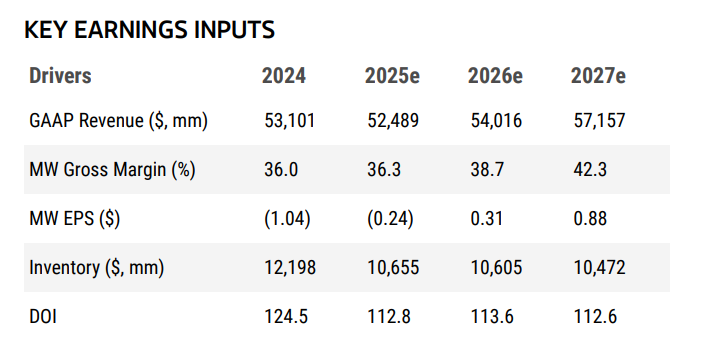
Core Viewpoint - Intel is facing a unique situation in the semiconductor cycle, where short-term supply shortages in the server CPU market may boost stock prices and quarterly performance, but underlying issues of capacity constraints and market share loss pose long-term risks to valuation [1][2]. Short-term Performance vs Long-term Concerns - Morgan Stanley predicts Intel may surprise with earnings per share (EPS) due to supply shortages, estimating non-GAAP revenue for the December quarter at $13.31 billion, a 6.7% year-over-year decline, slightly below Wall Street's expectation of $13.407 billion, but with an expected 11.5% quarter-over-quarter growth in the Data Center and AI (DCAI) segment [3][4]. - Despite the potential for short-term performance, structural issues remain, as Intel's internal capacity constraints mean it is missing out on demand rebounds, allowing competitors like AMD to capture significant market share [4][5]. Product Roadmap Challenges - Intel is in a transitional phase regarding product competitiveness, with the Panther Lake architecture showing promise in the notebook segment, but key server and high-performance desktop markets will not see competitive products until late 2026 and 2027, respectively [5][6]. - The delay in product releases means Intel's current offerings cannot fully capitalize on market demand, which will continue to suppress stock price potential [5]. Trust Issues in Foundry Business - Intel's foundry business is facing trust issues due to current supply shortages, which raise concerns among potential external customers about Intel's ability to meet their needs [6][7]. - The inability to satisfy even its own growth demands creates significant distrust, complicating efforts to attract new clients to its foundry services [6]. Financial Forecast and Valuation Outlook - For Q1 2024, Morgan Stanley forecasts Intel's revenue at $12.552 billion, slightly above Wall Street's expectation of $12.525 billion, but with a gross margin prediction of only 34.9%, below the market's 36.1% expectation [7][8]. - Intel's current stock valuation corresponds to 35 times the expected EPS for 2027, which is higher than the average for large logic semiconductor peers, reflecting market optimism about recovery potential and foundry business options [7][8]. - Analysts believe that unless Intel can demonstrate a recovery in server market share, the current profitability is insufficient to support further stock price revaluation [8].
Top Stocks With Earnings This Week: Netflix, Intel and More
Benzinga· 2026-01-20 13:45
Earnings Reports Overview - Major earnings reports are expected this week from airlines, healthcare leaders, industrial giants, streaming services, and semiconductor companies [1] - Key companies reporting include Netflix, United Airlines, Intel, and others [1][3] Netflix Earnings Expectations - Netflix is set to release its Q4 earnings report on Tuesday, with analysts predicting earnings of 55 cents per share and revenue of $11.97 billion [2] - The company’s performance during the holiday season, driven by popular content, will be closely monitored for profitability [3] Other Companies Reporting - United Airlines and Interactive Brokers will also report earnings after the market closes on Tuesday [3] - On Thursday, GE Aerospace and Freeport-McMoRan will report before the market opens, while 3M, D.R. Horton, U.S. Bancorp, Johnson & Johnson, Halliburton, Charles Schwab, Ally Financial, Procter & Gamble, Abbott Laboratories, and Mobileye will report after the market closes [4][5][6][7] Intel's Earnings Outlook - Intel is expected to report a loss of four cents per share and revenue of $13.37 billion after Thursday's market close [8] - Analysts have updated their coverage on Intel, with Citigroup upgrading the stock to Neutral and raising the price target from $29 to $50, while KeyBanc upgraded it to Overweight with a $60 price target [9]
Earnings live: 3M stock sinks, D.R. Horton rises to kick off busy week of earnings
Yahoo Finance· 2026-01-20 13:26
The fourth quarter earnings season is picking up speed. After several big banks reported last week, more financials will deliver results, with reports from Charles Schwab (SCHW) and regional banks like Fifth Third (FITB) on the schedule. But the attention will likely shift to Netflix (NFLX) and Intel (INTC), headlining the earnings calendar. An optimistic consensus is forming: As of Jan. 16, 7% of S&P 500 (^GSPC) companies have reported fourth quarter results, according to FactSet data, and Wall Street ...


机器人专用芯片是伪命题?英特尔宋继强:市场太小,目前难盈利
Feng Huang Wang· 2026-01-20 13:07
Core Insights - The core viewpoint is that for embodied intelligence to be effectively integrated into factories and homes, it must overcome the challenge of "reliability," which can be addressed by implementing a "triple system" approach in robotics [1][3]. Group 1: Current Challenges in Embodied Intelligence - Current embodied intelligence robots are likened to "genius children," performing well under ideal conditions but struggling with unexpected situations, highlighting the industry's common challenges [1]. - The accuracy of action generation in robots based on visual language models (VLA) is currently around 60-70%, with issues such as hallucinations, poor environmental adaptability, and weak long-term task planning capabilities [1][8]. Group 2: Proposed Solutions - A reliable embodied intelligence system should consist of three layers: a primary system for decision-making, a safety system for monitoring, and a fallback system for emergency handling [3]. - The primary system utilizes a "neuro-symbolic AI" approach, combining the generalization capabilities of neural networks with the reliability and interpretability of symbolic logic [3]. - The safety system continuously monitors the robot's execution status against preset safety rules, intervening when deviations occur, while the fallback system guides the robot into a safe state during emergencies [3][4]. Group 3: Industry Outlook and Hardware Considerations - The current market for robotics is small, making dedicated chips economically unfeasible; thus, the industry primarily adapts existing chips from other sectors like mobile and automotive [6]. - Intel's long-standing position in industrial automation provides it with a competitive edge, leveraging its expertise in high-precision motion control for robotics [6]. - The anticipated deployment model for future robotics involves a combination of robot terminals and edge servers to facilitate low-latency operations [7]. Group 4: Bottlenecks and Future Projections - Major bottlenecks include the limitations of VLA technology, which struggles with accuracy and understanding of physical relationships, leading to a shift towards "world models" that incorporate physical laws [8]. - Data isolation remains a critical issue, with significant variations in data requirements across different industries and robot types, complicating the establishment of unified data standards [8]. - The path to reliable embodied intelligence is projected to take two to three years, with initial deployments in semi-structured environments like logistics and manufacturing, followed by broader applications as reliability improves [10][11]. Group 5: Integration of Technologies - The development of embodied intelligence will not rely on a single technological breakthrough but rather on the integration of new AI models with established control technologies and safety engineering [12]. - The focus is on creating a reliable solution that minimizes errors in real-world applications, emphasizing the importance of a robust foundational system for robotics [12].
