J&J(JNJ)

Search documents
美股异动 | 医疗保健及医药板块走高 联合健康(UNH.US)涨超2.5%


智通财经网· 2025-08-18 14:30
Core Viewpoint - The healthcare and pharmaceutical sectors experienced gains on Monday, driven by notable stock movements following Warren Buffett's disclosure of holding shares in UnitedHealth [1] Group 1: Stock Performance - UnitedHealth (UNH.US) rose over 2.5% following the news of Buffett's investment [1] - Molina Health (MOH.US) increased by more than 2% [1] - Cigna (CI.US) saw a rise of over 1.5% [1] - Novo Nordisk (NVO.US) surged by 4.7% [1] - Johnson & Johnson (JNJ.US) experienced a slight increase of 0.22% [1] - Eli Lilly (LLY.US) rose by 0.4% [1]
电生理专家交流
2025-08-18 01:00
Summary of the Conference Call on Electrophysiology Industry Overview - The electrophysiology (EP) industry in China is experiencing continuous growth, with a 10% increase in procedures in the first half of the year, and an expected nationwide growth of 10%-15% due to the adoption of new catheter ablation technologies like pulsed field ablation (PFA) and accelerated domestic substitution [2][3][4] - The patient base for atrial fibrillation (AF) is substantial, estimated at 14-18 million, with increasing incidence due to aging, although the penetration rate of catheter ablation remains low [2][4] Key Insights - **Procedure Growth**: The EP procedures are a highlight in the cardiovascular intervention field, with a 10% growth noted in a major center, and a higher national growth rate anticipated due to the increasing adoption of independent EP teams and local anesthesia techniques [3][4] - **Technology Trends**: - Cryoablation technology is being phased out, while radiofrequency ablation remains dominant. However, PFA is rapidly gaining traction due to its lower technical difficulty and higher safety profile [2][3][7] - In a specific center, radiofrequency ablation accounts for 60%-70% of procedures, while PFA represents 30%-40%, with expectations for PFA's share to increase further [7] - **Market Share**: In the thermal ablation market, Johnson & Johnson holds over 50% market share, Abbott has 30%-40%, and domestic brands have a smaller share. In the AF thermal ablation sector, Johnson & Johnson's market share exceeds 75% [2][9] Patient Treatment Dynamics - **Patient Willingness**: Paroxysmal AF patients typically try medication first, while persistent AF patients are more inclined to opt for catheter ablation due to poor medication efficacy [5][6] - **Success Rates**: Catheter ablation for AF has a high success rate of over 90%, but the recurrence rate is significant, especially for persistent AF [4][6] Competitive Landscape - **Domestic vs. International Brands**: In the PFA era, domestic brands like Jinjiang and Huitai are gaining market share due to their ability to perform procedures under local anesthesia, contrasting with foreign brands that rely on general anesthesia [10][11] - **Emerging Technologies**: The development of nanosecond PSA technology aims to reduce pain and anesthesia needs, although it is still in preclinical stages [15] Future Outlook - **Market Dynamics**: The competitive landscape is shifting, with foreign manufacturers like Abbott lagging behind in innovation. Domestic brands with robust 3D systems are expected to emerge as key players [26] - **Price Trends**: The overall trend in medical pricing is expected to become more affordable, although specific pricing for PFA terminal products remains undisclosed [27][28] Regulatory and Guideline Changes - **Clinical Guidelines**: The U.S. has updated its guidelines to position electrophysiology as a first-line treatment, which is expected to influence domestic guidelines in China [30] Additional Considerations - **One-stop Surgery**: The concept of one-stop surgeries combining electrophysiology and left atrial appendage closure is gaining traction, although it presents challenges in terms of cost and reimbursement [21][23] This summary encapsulates the key points from the conference call regarding the electrophysiology industry, highlighting growth trends, technological advancements, patient treatment dynamics, competitive landscape, future outlook, and regulatory changes.


Massive Headwinds Are on the Horizon for Pharmaceutical Stocks, but Here Are 2 That Could Weather the Storm
The Motley Fool· 2025-08-17 23:23
Core Insights - The article discusses how Johnson & Johnson and Novartis are positioned to navigate patent expirations for key products while maintaining strong financial performance Group 1: Johnson & Johnson - Johnson & Johnson is facing biosimilar competition for its best-selling product Stelara, leading to a significant revenue drop of 42.7% year-over-year to $1.7 billion in Q2 [4] - Despite the decline in Stelara's sales, the company's overall revenue grew by 5.8% year-over-year to $23.7 billion, and it raised both top- and bottom-line guidance for the year [5] - The company has a diversified pharmaceutical portfolio with growth drivers including cancer medicines Darzalex and Erleada, and newer products like Imaavy and TAR-200 [6][7] - Johnson & Johnson is also a leader in the medical device industry, with potential growth from its robotic-assisted surgery system, Ottava [7] - The company has a strong dividend history, having raised payouts for 62 consecutive years, positioning it as a reliable long-term investment [8] Group 2: Novartis - Novartis is preparing for generic competition for its heart failure medication Entresto, which generated $4.6 billion in sales in the first half of the year, with nearly 52% from the U.S. [9] - Despite the impending patent cliff for Entresto, Novartis expects high-single-digit revenue growth for the year, indicating strong overall performance [10] - The company has a diverse portfolio with several blockbuster products, seven of which generated over $1 billion in revenue each in the first half of 2025 [11] - New products like Vanrafia, approved in April, are expected to contribute to future growth, with peak sales estimates of $1.5 billion [12] - Novartis is involved in patent litigation regarding generic versions of Entresto, which could result in financial compensation if it wins [13] - The company has a solid dividend track record, having raised payouts for 28 consecutive years, making it an attractive option for dividend-seeking investors [14]



These Are the 3 Smartest Dividend Stocks Today
The Motley Fool· 2025-08-16 14:30
Core Viewpoint - The article highlights three dividend stocks—Coca-Cola, Realty Income, and Johnson & Johnson—that provide steady income and have a proven track record of performance across various economic conditions [1][2]. Group 1: Coca-Cola - Coca-Cola is a globally recognized brand with a diverse product portfolio beyond colas, including Dasani water and Minute Maid juice [4]. - The company has raised its dividend for 63 consecutive years, making it a Dividend King, with a current yield just below 3% and a payout ratio that allows for steady increases [5]. - Despite potential headwinds from currency fluctuations and health trends affecting sugary beverage sales, Coca-Cola's adaptability keeps it in a reliable position [6]. Group 2: Realty Income - Realty Income, known as "The Monthly Dividend Company," has paid dividends for 661 consecutive months, approximately 55 years [7]. - The company operates on a business model of long-term net lease agreements with tenants in stable industries, owning over 15,600 commercial properties with a 98.5% occupancy rate [8]. - Realty Income's predictable cash flow supports a current yield of around 5.6%, and while elevated interest rates have impacted share prices, the fundamentals remain strong [9][10]. Group 3: Johnson & Johnson - Johnson & Johnson is another Dividend King, having increased its annual dividend for 63 years, with operations in pharmaceuticals and medical devices [11][12]. - The pharmaceutical segment generates the largest revenue share, while the medical devices segment benefits from consistent demand [12]. - Despite facing litigation risks, the company maintains a strong balance sheet and a payout ratio just over 50%, supporting a dividend yield of about 3% [13][14]. Group 4: Overall Investment Perspective - The three companies—Coca-Cola, Realty Income, and Johnson & Johnson—demonstrate a long history of rewarding shareholders through various market cycles, providing a stable income stream even amidst market volatility [15].



Why Is Johnson & Johnson (JNJ) Up 7.2% Since Last Earnings Report?
ZACKS· 2025-08-15 16:31
Core Viewpoint - Johnson & Johnson's recent earnings report shows a positive trend in sales and earnings, outperforming the S&P 500, but concerns remain regarding the impact of competition and market conditions on future performance [1]. Financial Performance - Q2 2025 earnings were $2.77 per share, exceeding the Zacks Consensus Estimate of $2.66, although down 1.8% year-over-year due to debt from the Intra-Cellular acquisition and gross profit erosion from Stelara [2]. - Sales reached $23.74 billion, surpassing the Zacks Consensus Estimate of $22.80 billion, with a 5.8% increase from the previous year, driven by operational growth of 4.6% and a currency impact of 1.2% [3]. - Domestic sales rose 7.8% to $13.54 billion, while international sales increased 3.2% to $10.2 billion, reflecting operational growth of 0.6% and a positive currency impact of 2.6% [4]. Segment Performance - The Innovative Medicines segment saw sales rise 4.9% to $15.2 billion, beating estimates, with key products like Darzalex and Tremfya contributing to growth despite the loss of exclusivity for Stelara impacting revenue by 710 basis points [5][6]. - The MedTech segment reported sales of $8.54 billion, up 7.3%, driven by strong performance in Cardiovascular, Surgery, and Vision, and also exceeding estimates [17][20]. Guidance and Outlook - The company raised its 2025 sales guidance by approximately $2.0 billion, now expecting a range of $93.2 billion to $93.4 billion, indicating growth of 5.1% to 5.6% [24]. - Adjusted earnings per share guidance was increased to a range of $10.80 to $10.90, reflecting strong top-line performance and favorable currency impacts [29]. - J&J anticipates operational sales growth in both the Innovative Medicine and MedTech segments to be stronger in the second half of 2025, driven by new product launches [28].
押注大盘+AI龙头!富国银行Q2增持标普500指数ETF(SPY.US)近五成,微软(MSFT.US)稳坐头号重仓
智通财经网· 2025-08-15 10:15
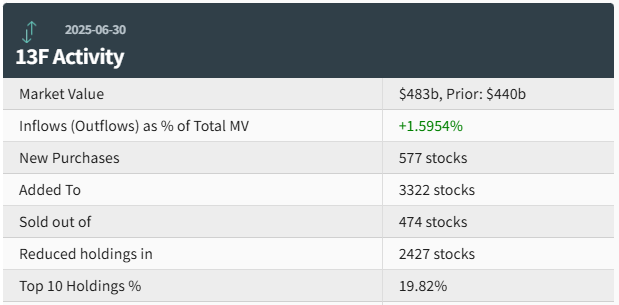
Core Insights - Wells Fargo (WFC.US) reported a total market value of $483 billion for its Q2 2025 holdings, reflecting a 9.77% increase from the previous quarter's $440 billion [1][2] - The bank added 577 new stocks to its portfolio, increased holdings in 3,322 stocks, reduced holdings in 2,427 stocks, and completely sold out of 474 stocks [1][2] - The top ten holdings accounted for 19.82% of the total market value [1][2] Holdings Overview - The largest holding is Microsoft (MSFT.US) with approximately 33.1 million shares valued at about $16.46 billion, representing 3.41% of the portfolio [2][4] - SPDR S&P 500 ETF (SPY.US) is the second-largest holding, with around 20.04 million shares valued at approximately $12.38 billion, showing a significant increase of 47.29% in shares held [2][4] - Apple (AAPL.US) ranks third with about 57.76 million shares valued at approximately $11.85 billion, a slight increase of 0.56% [2][4] Changes in Holdings - The top five purchases included SPY, Microsoft, Invesco QQQ Trust put options (QQQ.US, PUT), Google (GOOGL.US), and Meta Platforms (META.US) [6] - The top five sales included UnitedHealth (UNH.US), Invesco QQQ Trust (QQQ.US), SPY put options, Target (TGT.US), and Johnson & Johnson (JNJ.US) [5][6] - Notably, Broadcom (AVGO.US) entered the top ten holdings for the first time, indicating a strategic focus on AI chip assets [6][7] Risk Management Strategies - Wells Fargo demonstrated a defensive strategy by increasing its holdings in bond ETFs (AGG.US) and essential consumer stocks like Costco (COST.US) to enhance portfolio stability [6][7] - The bank aggressively increased its position in Nasdaq 100 put options by 92.25% while reducing its holdings in Invesco QQQ Trust by 30.66%, signaling a cautionary stance on high valuations in the tech sector [6][7]




Back To Basics: Why I Favor Amgen Over Johnson & Johnson
Seeking Alpha· 2025-08-14 19:06
Group 1 - The last coverage on Johnson & Johnson highlighted the importance of patience for investors, suggesting that recent developments could lead to positive outcomes [1] - The article emphasized the company's commitment to providing actionable investment ideas through independent research [1] Group 2 - The organization claims to have assisted its members in outperforming the S&P 500 while avoiding significant losses during periods of high volatility in both equity and bond markets [2] - A trial membership is offered to potential investors to evaluate the effectiveness of the organization's investment strategies [2]


纳瓦罗:特朗普或对医药产品推出232关税
Hua Er Jie Jian Wen· 2025-08-14 15:45
Group 1 - The core viewpoint is that U.S. President Trump's pharmaceutical tariffs may be implemented based on Section 232, as stated by White House advisor Navarro [1] - Following this announcement, Pfizer's stock dropped over 0.7%, while UnitedHealth fell more than 0.4%. Conversely, Amgen's stock increased by 0.6%, Johnson & Johnson rose by 0.1%, and AstraZeneca's ADR gained 0.4% [1]


不止药王“易主”,上半年全球药品销售TOP50解析:疫苗疲软、国产上榜、前列腺癌“王牌药”仍坚挺
Mei Ri Jing Ji Xin Wen· 2025-08-14 08:52
Core Insights - The global pharmaceutical sales ranking for the top 50 drugs has been revealed, with Novo Nordisk's semaglutide surpassing Merck's Keytruda to become the new sales champion, achieving over $16.6 billion in sales [1][3] - Eli Lilly's tirzepatide shows significant growth potential with a sales increase of 121.3%, reaching nearly $15 billion [1][2] - The entry of domestic innovative drugs into the ranking marks a notable shift in the competitive landscape [1] Group 1: Top Selling Drugs - Semaglutide, including Ozempic, Rybelsus, and Wegovy, generated sales of $16.632 billion, with a year-on-year growth of 29.8% [3][4] - Tirzepatide achieved sales of $14.734 billion, with a remarkable growth rate of 121.3% [3][8] - Dulaglutide, another Eli Lilly product, saw a decline in sales, highlighting the competitive pressures in the market [3][4] Group 2: Vaccine Sales Decline - Three vaccine products in the top 50 experienced sales declines, despite a favorable competitive landscape [4][5] - Gardasil 9, a nine-valent HPV vaccine, saw a nearly 50% drop in revenue [5][6] - The decline in vaccine sales is attributed to reduced government subsidies and market saturation [6][7] Group 3: Emerging Drugs and Growth - Over 70% of drugs in the ranking maintained positive sales growth, with only seven drugs exceeding a 30% growth rate [8] - Enzalutamide, approved for 13 years, continues to show over 30% growth, with sales projected to reach $4.6 billion in 2022 [9][10] - The competitive landscape for enzalutamide is expected to intensify as its core patent expires in 2026 [10]



桥水基金第二季度大幅增持英伟达
Zheng Quan Shi Bao Wang· 2025-08-14 00:21
Group 1 - Bridgewater Associates significantly increased its holdings in Nvidia by over 154%, making it the fund's third-largest position [2] - Microsoft saw a holding increase of over 111%, while Google and Meta increased their stakes by over 84% and nearly 90%, respectively, ranking as the sixth, fifth, and seventh largest positions in the fund [2] - Uber's holdings surged by more than five times, and Johnson & Johnson's stake increased by over 667% [2] Group 2 - Bridgewater reduced its positions in Amazon by nearly 6%, AMD by nearly 19%, and PayPal by over 12% [2] - The fund completely exited its positions in Alibaba, Baidu, and JD.com [2] - New positions include chip design company Arm, as well as Intuit, EQT, Lyft, and Ulta Beauty [2] Group 3 - The SPDR S&P 500 ETF (SPY) remains Bridgewater's largest holding, although the stake was reduced by approximately 21.9% [2] - The SPDR Gold ETF (GLD) holdings remained unchanged in the second quarter [2]