医药产品

Search documents
复星国际2025年度业绩发布会:每股NAV达18.1港元,管理层对未来充满信心
Jin Rong Jie· 2026-04-01 02:51
Core Insights - Fosun International reported a total revenue of RMB 173.43 billion for the fiscal year 2025, with an adjusted operating profit of RMB 4 billion and a net asset value (NAV) of RMB 133.5 billion, translating to a per-share NAV of HKD 18.1 [1] - The company recorded a significant non-cash impairment loss of RMB 23.4 billion, primarily due to real estate and non-core business assets, with real estate impairments accounting for approximately 55% of the total [1] - The chairman emphasized a strategic shift towards divesting underperforming assets and focusing on high-growth core sectors, indicating a commitment to sustainable and healthier growth [2] Financial Performance - The four core subsidiaries generated RMB 128.2 billion in revenue, representing 74% of the total group revenue [1] - Fosun Pharma achieved a net profit of RMB 3.371 billion, reflecting a year-on-year growth of 21.69%, while the Portuguese insurance segment reported a net profit of EUR 201 million, up 15.8% [1] - The company has successfully improved its debt structure, increasing the proportion of medium to long-term debt from 48.7% in 2024 to 53.5% [5] Strategic Focus - The company plans to concentrate on innovation and globalization, aiming for long-term value creation [4] - The insurance segment is expected to be a key driver for profit and cash flow growth, while the travel and leisure sector is also projected to achieve high efficiency through light asset operations [4] - Management is committed to optimizing the asset portfolio by divesting heavy and non-core assets, with a mid-term target of achieving a net profit of over RMB 10 billion [5] Market Outlook - The company expressed confidence in its future financing capabilities, noting improvements in the domestic and international financing environment [3] - Management believes there is no further impairment pressure anticipated, having conducted thorough assessments of asset valuations [3] - The company is exploring opportunities for non-listed assets to connect with capital markets, aiming for greater transparency and valuation recovery [5]

国泰海通证券:首予复星国际(00656)“增持”评级 核心保险赛道聚焦
智通财经网· 2026-03-10 01:51
Core Viewpoint - Cathay Securities initiates coverage on Fosun International (00656) with a "Buy" rating and a target price of HKD 7.24, indicating a significant upside potential based on the company's NAV of HKD 18.1 per share and total NAV of HKD 147.8 billion [1] Group 1: Business Structure and Performance - The company focuses on family users globally, providing services across four main sectors: health, happiness, wealth, and smart manufacturing [1] - The wealth sector, primarily through Fosun Portugal Insurance, contributes stable income with a leading market share in Portugal [1] - The happiness sector includes vacation, cultural consumption, and fashion brands, with Fosun Tourism achieving record revenue and ongoing cost reduction [1] - The health sector, centered on Fosun Pharma (02196), shows continuous improvement in innovative drug contributions and significant updates across multiple pipelines [1] - The smart manufacturing sector targets emerging industries, focusing on strategic resources and new materials to enable high-end, intelligent, and green transformations [1] Group 2: Financial Health and Strategy - Fosun International has effectively streamlined operations, focusing on debt reduction and exiting non-core assets for four consecutive years, leading to improved asset quality and reduced financial leverage [2] - The company has maintained a stable credit rating of BB- from S&P, indicating potential for recovery through strategic focus on market-leading core businesses and global operations [2] Group 3: Catalysts - The macroeconomic environment is showing signs of recovery, which could positively impact the company's performance [3] - Accelerated approval and market entry of innovative drugs may serve as a significant growth driver for the health sector [3]

华源晨会精粹20260309-20260309
Hua Yuan Zheng Quan· 2026-03-09 14:13
Public Utilities and Environmental Protection - Geopolitical conflicts have led to rising oil and gas prices, with a focus on upstream natural gas resources and coal. The closure of the Strait of Hormuz and Qatar's production halt significantly impact LNG supply and pricing in Asia and Europe. The TTF price in Europe and JKM price in Asia have increased by 64.3% and 46.5% respectively since March 2026 [2][8] - Coal prices are under short-term pressure due to seasonal demand, but the rise in overseas oil and gas prices is expected to transmit to domestic coal prices. Current coal prices are slightly down but still show a year-on-year increase of 62 yuan per ton [10][11] Transportation - The geopolitical situation has driven oil shipping rates to record highs, with VLCC rates approaching $500,000 per day. The market is experiencing a "super freight rate cycle" due to the ongoing Middle East tensions [12][13] - The express delivery sector is seeing a "de-involution" trend, with government initiatives aimed at promoting fair competition. JD Logistics reported a 22% year-on-year revenue growth in Q4 2025, driven by the expansion of real-time delivery services [18][19] Non-Banking Financial - Dongwu Securities plans to acquire control of Donghai Securities, which is expected to alleviate regional competition and enhance capital strength. The merger could elevate Dongwu's ranking among listed brokers from 18th to 14th [28][31] - Yao Cai Securities has been included in the Hong Kong Stock Connect list, which is anticipated to enhance liquidity and investor base [32] Agriculture, Forestry, Animal Husbandry, and Fishery - Pig prices have fallen below cash costs, indicating a potential reversal in the cycle. The industry is entering a phase of negative cash flow, with prices dropping to 10.23 yuan per kilogram [4][8] Media and Internet - Google has adjusted its app store policies, reducing the in-app purchase service fee to 20% for new users. This change is expected to enhance profitability for gaming companies in overseas markets [4][8] Pharmaceuticals - The rapid growth of balloon-expandable valves is noted, with a recommendation to focus on Bai Ren Medical. The pharmaceutical index has seen a decline, but innovative drugs are rebounding [4][8] Consumer Electronics - The global high-end headphone market is projected to reach $3.67 billion by 2026, with a significant shift towards wireless technology. The domestic brand HiFiMan is highlighted as a key player in this market [5][8] Power Equipment - Major tech companies in the U.S. have committed to self-sufficient power generation, which is expected to benefit the upstream power equipment supply chain. Three core power equipment companies are identified as potential beneficiaries [6][8] Home Appliances - The Open Claw phenomenon is gaining traction, indicating a shift in AI applications. The NAS market is expected to grow as it addresses privacy and data loss concerns, with Greenlink Technology positioned as a leader in this space [4][8]
法国抛出激进方案,想与中方签广场协议,常规手段对付不了中国?
Sou Hu Cai Jing· 2026-02-11 08:51
Core Viewpoint - The report from the French government advisory body highlights a perceived "survival crisis" for European industry due to competition from Chinese manufacturing, suggesting extreme measures such as imposing a 30% tariff on Chinese goods or devaluing the euro against the yuan by 20%-30% [1][2] Group 1: Proposed Measures - The proposal to impose a 30% tariff on Chinese goods is characterized as typical trade protectionism, which could lead to increased production and living costs in Europe, ultimately harming consumers and downstream businesses [1] - The suggestion to replicate the Plaza Accord by devaluing the euro is seen as more harmful than beneficial, with historical precedents indicating potential economic instability and inflation risks [2] Group 2: Underlying Issues - The report attributes the decline in European manufacturing competitiveness to internal factors such as a long-term shift away from manufacturing, insufficient labor supply, and lagging industrial innovation and transformation [2] - The notion that conventional methods cannot address competition from China is viewed as an exaggerated narrative that overlooks the importance of cooperation [4] Group 3: Current State of China-Europe Relations - China and Europe remain important trade partners, with recent disputes in the electric vehicle sector being resolved through dialogue, indicating a trend towards cooperation rather than conflict [4] - The report reflects the anxieties of hawkish factions within Europe and does not represent the official stance of the EU, suggesting that a focus on cooperation and addressing internal issues is essential for mutual development [4]

中国国际医疗设备与器械交易(集采)平台在津揭牌
Xin Lang Cai Jing· 2026-02-10 22:11
Core Insights - The China International Medical Equipment and Devices Trading (Procurement) Platform was launched on February 10, 2023, in the China-Shanghai Cooperation Organization Digital Economy Cooperation Pilot Zone, aimed at enhancing cross-border medical procurement and cooperation [1] Group 1: Platform Overview - The platform is guided by the National Healthcare Security Administration and constructed by Tianjin City, serving as a cross-border pharmaceutical trading information service platform [1] - It offers services such as online display of pharmaceutical products, procurement information, policy information collection and publication, and market operation data analysis [1] Group 2: Objectives and Functions - The platform aims to innovate cross-border procurement models, establish rules and standards for cross-border procurement, and promote international pharmaceutical procurement cooperation [1] - It seeks to connect global industry resources, facilitate cross-border industrial cooperation, and assist domestic products in entering international markets, enabling "global buying and selling" of medical equipment and devices [1] Group 3: Event Highlights - The launch event included the signing of the first batch of transactions and memorandums of cooperation between the platform and relevant institutions [1] - Attendees included government officials, representatives from financial institutions, think tanks, and pharmaceutical companies, indicating broad support and interest in the platform [2]
川渝篇:四大增长极经济与产业洞察报告(2025)
GUOTAI HAITONG SECURITIES· 2026-02-10 14:59
Group 1: Economic and Industrial Insights - The report focuses on the Chengdu-Chongqing region's industrial structure for 2025, emphasizing the need for regional collaboration to enhance supply chain capabilities[5] - The region aims to become a significant economic center and innovation hub, as outlined in the national planning documents for the 14th Five-Year Plan[5] - By 2024, the industrial output value of the Chengdu-Chongqing economic circle is projected to reach 2.42 trillion yuan, with a year-on-year growth of 6.3%[12] Group 2: Sectoral Developments - The primary industry in Sichuan and Chongqing is expected to see a gradual decline, with Sichuan's contribution to GDP dropping to 8.69% in 2024, down 1.51 percentage points from 2019[11] - The secondary industry in both regions is projected to remain below 40% of GDP, with Sichuan at 35.27% and Chongqing at 36.31% in 2024, both showing a downward trend since 2019[12] - The tertiary industry is on the rise, with Chongqing's service sector contributing 57.05% to GDP in 2024, an increase of 1.84 percentage points since 2019[21] Group 3: Key Industries and Future Directions - Sichuan's electronic information industry has become the first trillion-yuan industry in Western China, achieving revenues of 168.53 billion yuan in 2024, a 6.9% increase year-on-year[44] - Chongqing is focusing on developing a modern manufacturing cluster system, with the automotive industry identified as a key pillar, contributing significantly to local economic growth[27] - Both regions are prioritizing the development of emerging industries, with Sichuan emphasizing biomedicine and nuclear medicine as strategic sectors for growth[52]
涉嫌侵占上亿资金,上市公司百万年薪原董事长被移送起诉!
Shen Zhen Shang Bao· 2026-02-07 14:16
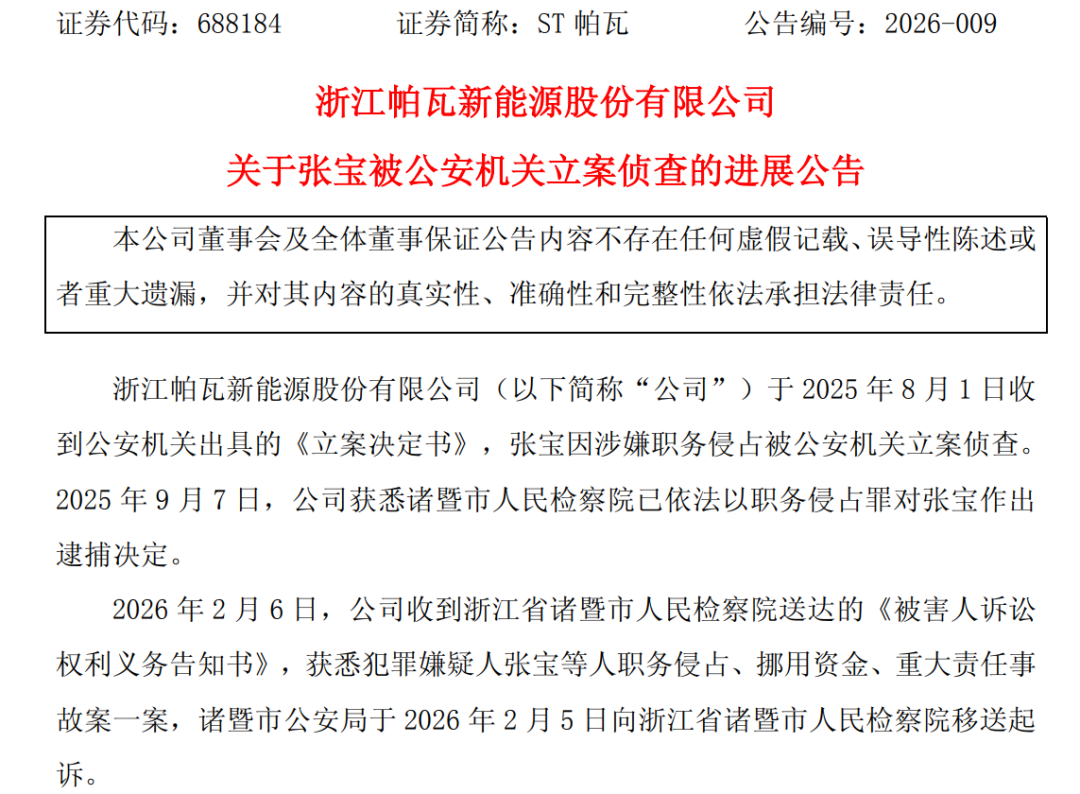
Core Viewpoint - ST Pava is currently facing legal issues involving its former chairman and general manager, Zhang Bao, who is under investigation for embezzlement and misappropriation of funds, but the company asserts that its operations remain normal and unaffected by these events [1][3]. Group 1: Legal Issues - On February 6, ST Pava received a notice from the People's Procuratorate of Zhuji City regarding the prosecution of Zhang Bao for embezzlement and misappropriation of funds [1]. - Zhang Bao was officially arrested on September 7, 2025, for the crime of embezzlement [3]. - Prior to his arrest, Zhang Bao submitted his resignation due to health reasons on May 22, 2025, and continued to hold other positions within the company [3]. Group 2: Financial Performance - As of the end of September 2025, Zhang Bao held 16.56 million shares of ST Pava, representing a 10.41% stake, making him the second-largest shareholder [4]. - ST Pava's 2025 annual profit forecast indicates a net loss of between 550 million to 700 million yuan, which is an improvement compared to the previous year, reducing losses by 26.5 million to 177 million yuan [5]. - The company has accumulated losses exceeding 1.5 billion yuan over the past three years, primarily due to high fixed costs and impairment provisions on various assets [5]. Group 3: Company Operations - ST Pava is engaged in the research, development, production, and sales of pharmaceutical products and related health services [5]. - The company has been placed under special risk warning due to a negative audit opinion on its internal controls for the 2024 financial report [5]. - As of February 6, 2025, ST Pava's stock price decreased by 0.10%, closing at 10.46 yuan, with a total market capitalization of 1.66 billion yuan [5].
欧洲对美国:既不信任 又离不开 它能承受脱钩之重吗?
Xin Lang Cai Jing· 2026-02-05 16:04
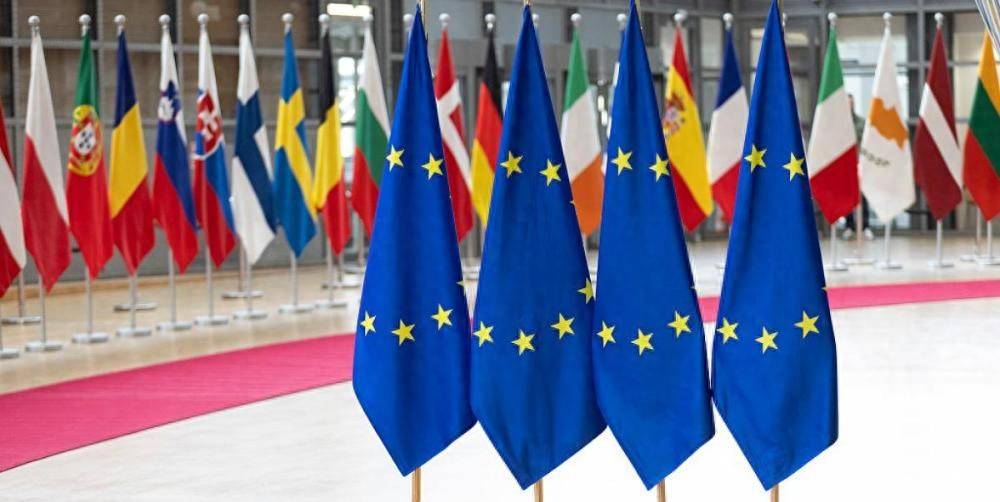
Core Viewpoint - The European Union (EU) is increasingly emphasizing the need for independence from the United States in trade, energy, and technology, particularly in light of recent geopolitical tensions and the unpredictability of U.S. policies under President Trump [2][11]. Trade - Strengthening trade ties with other countries is a crucial strategy for Europe to reduce its dependence on the U.S. The EU has recently signed trade agreements with India and the Mercosur countries after decades of negotiations [3][12]. - Despite these agreements, analysts believe that neither the Mercosur countries nor India can replace the U.S. in European trade over the next decade. The EU and the U.S. have the largest bilateral trade and investment relationship globally, with trade in goods and services projected to reach €1.68 trillion (approximately $2 trillion) in 2024, accounting for nearly 30% of global trade [3][12]. Economic Dependence - The EU relies heavily on the U.S. for exports, particularly in sectors like automobiles and pharmaceuticals. Germany, as the largest economy in the EU, views the U.S. as its primary trading partner [5][14]. - The degree of Europe's dependence on the U.S. is significantly higher than the reverse, as Europe is export-oriented and lacks sufficient domestic resources, while the U.S. economy is relatively closed and self-sufficient [5][14]. Technology - Europe lacks large tech giants comparable to those in the U.S., leading to a heavy reliance on American digital services. The most valuable tech company in Europe, ASML, has a market value only about one-third of that of the lowest-valued U.S. tech giant, Tesla [5][14]. - There is a call for Europe to invest heavily in developing its own tech giants to catch up with U.S. digital services, cloud infrastructure, and data centers [6][15]. Energy - Europe is working to reduce its long-term dependence on Russian oil and gas, which became a strategic vulnerability following Russia's invasion of Ukraine in 2022. The EU has significantly increased imports of liquefied natural gas (LNG) from the U.S. to fill the gap left by Russian energy supplies [6][15]. - Before the conflict, Russia supplied 40% of the EU's natural gas needs. In the previous year, U.S. LNG accounted for nearly one-quarter of the EU's gas demand, indicating a substantial shift in energy sourcing [8][17]. - The U.S. has used energy as a bargaining chip in trade negotiations, compelling the EU to commit to purchasing $750 billion worth of U.S. energy products [6][15].

美国商界团体反应不一,莫迪发文表示“诚挚感谢”,特朗普称美印达成贸易协议降关税
Huan Qiu Shi Bao· 2026-02-03 22:51
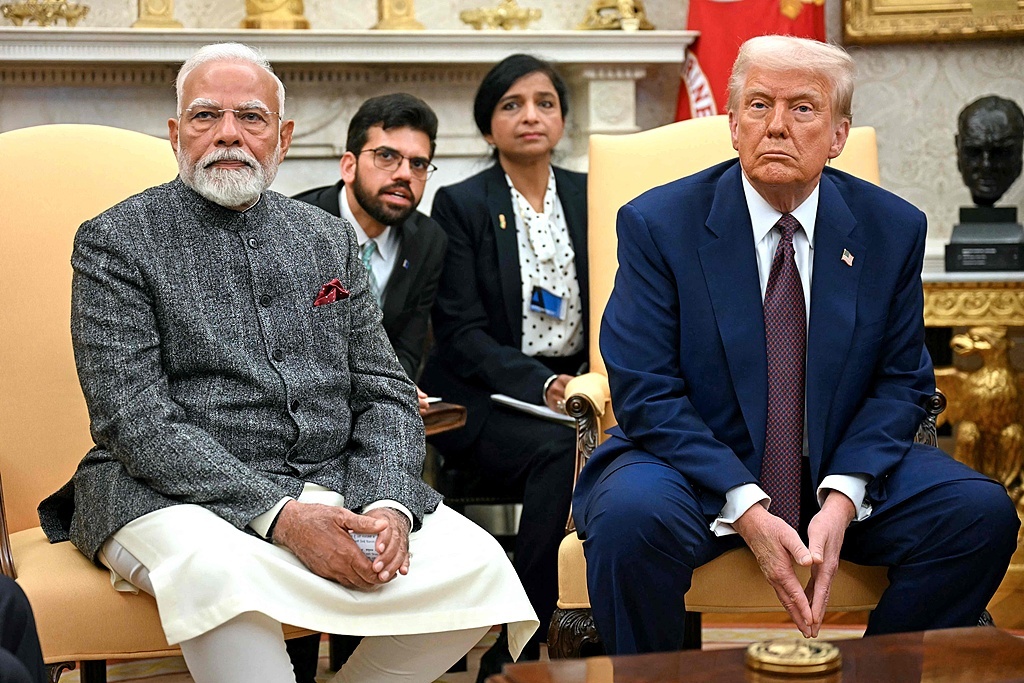
Core Viewpoint - The trade agreement between the United States and India involves a reduction of tariffs on Indian goods from 25% to 18%, effective immediately, while India will lower its tariffs and non-tariff barriers on U.S. products [1][3]. Group 1: Trade Agreement Details - The U.S. will reduce the "reciprocal tariffs" on Indian goods, and India has agreed to purchase over $500 billion worth of U.S. products, including energy, technology, and agriculture [3]. - India has committed to purchasing U.S. telecommunications and pharmaceutical products and has opened its market for certain agricultural products [3]. - The agreement includes a reduction in automobile import tariffs by India to meet U.S. demands [3]. Group 2: Economic Impact - The trade agreement is expected to strengthen economic ties between the U.S. and India, providing unprecedented opportunities for Indian farmers, small businesses, and tech workers [3][5]. - The reduction in tariffs is anticipated to enhance the price competitiveness of Indian products and help Indian exporters integrate more deeply into the U.S. supply chain [6]. - Moody's stated that the U.S. lowering tariffs on most Indian goods will inject new vitality into India's exports to the U.S. [6]. Group 3: Reactions and Concerns - The U.S. business community has mixed reactions, with some viewing the agreement as a step towards a comprehensive trade deal, while others express concerns about potential negative impacts on U.S. businesses [4]. - In India, there are concerns that the agreement may harm local farmers due to the influx of subsidized U.S. agricultural products [5]. - Indian opposition leaders have criticized the agreement, claiming it compromises the interests of Indian farmers [5].
关税降至18%后,印度停购俄油,并采购美国5000亿商品
Sou Hu Cai Jing· 2026-02-03 10:24
Group 1 - The core point of the news is the formal signing of a US-India agreement that significantly alters the global energy geopolitical landscape, with the US reducing tariffs on Indian goods from 50% to 18% in exchange for India halting oil purchases from Russia and increasing imports from the US valued at approximately $500 billion [1][3][5]. Group 2 - The agreement indicates a shift in India's energy procurement strategy, moving away from Russian oil, which had previously surged to 44% of India's imports due to discounted prices during the Russia-Ukraine conflict [5][9]. - The US aims to consolidate its influence over the oil industry in Venezuela, but American oil companies are hesitant to engage due to the deteriorated infrastructure and low profit margins in the Venezuelan oil sector [3][5]. - The agreement lacks specific investment commitments from India, contrasting with previous agreements the US made with Japan and South Korea, and it primarily serves as a transactional exchange rather than a comprehensive partnership [7][10]. Group 3 - The reduction of tariffs to 18% is still significantly higher than the previous average of 2-3% before the Trump administration's tariffs, indicating that the agreement does not provide substantial benefits to India [7][10]. - The potential for increased tensions within India is highlighted, as the agreement requires concessions in key areas like digital services tax and agricultural market access, which may face domestic opposition [7][10]. - Russia's energy exports are under pressure due to India's withdrawal and the ongoing conflict, with China stepping in to fill the gap by increasing its imports of discounted Russian oil [9][10][11].