
Merck(MRK)

Search documents
《财富》世界500强出炉!最赚钱前50公司的药企诺和诺德、默沙东新上榜
GLP1减重宝典· 2025-07-30 06:09
Core Insights - The article highlights the performance of pharmaceutical companies in the 2025 Fortune Global 500 list, with Merck, Novo Nordisk, and Johnson & Johnson being notable entries, showcasing the strength of the pharmaceutical sector [2][3]. Pharmaceutical Sector Performance - The total revenue of the 500 companies in the 2025 Fortune Global 500 list is approximately $41.7 trillion, accounting for one-third of global GDP, with a year-on-year increase of 1.8%. The total net profit is $2.98 trillion, showing a slight increase of 0.4% [2]. - The entry threshold for the list is $32.2 billion, which has slightly increased compared to the previous year [2]. - Among the top 50 most profitable companies, three are pharmaceutical firms: Merck, Novo Nordisk, and Johnson & Johnson. Notably, Merck and Novo Nordisk are making their debut on the list, while Novartis has dropped out [2]. Financial Performance of Key Companies - Merck reported a net profit of $17.117 billion, with a remarkable growth rate of 45.9% [3]. - Novo Nordisk achieved a net profit of $14.644 billion, reflecting a growth of 20.6% [3]. - Johnson & Johnson's net profit stands at $14.066 billion, indicating stable growth [3]. - Merck's revenue is significantly driven by its PD-1 cancer drug, Keytruda, which accounts for nearly one-third of its total revenue [3]. - Novo Nordisk's sales surged to $29.3 billion, a 38% increase, primarily due to its semaglutide product line, including Ozempic, Wegovy, and Rybelsus [3]. Novo Nordisk's Market Position and Challenges - Novo Nordisk's revenue for the 2024 fiscal year is reported at 290.4 billion Danish Krone (approximately $42.1 billion), with a net profit of 100.9 billion Danish Krone (approximately $14.64 billion), well above the entry threshold of $32.2 billion [5]. - The company boasts a profit margin of approximately 36%, placing it among the leaders in the global pharmaceutical industry [5]. - In terms of revenue ranking, Novo Nordisk is positioned within the top ten globally, following giants like Johnson & Johnson, Roche, Pfizer, and Merck [6]. Product Performance and Market Dynamics - The semaglutide product line is identified as the primary growth driver for Novo Nordisk, with total sales reaching $29.3 billion, contributing to over 25% growth in overall revenue [7]. - In Q1 2025, semaglutide sales hit $7.864 billion globally, surpassing Merck's Keytruda sales of $7.2 billion, temporarily making it the "king of drugs" [7]. Market Pressures and Strategic Adjustments - Novo Nordisk has revised its 2025 performance forecasts downward, with sales growth expectations adjusted from 13%-21% to 8%-14%, and operating profit expectations reduced from 16%-24% to 10%-16% [9]. - The downward revision is attributed to a slowdown in the U.S. market, increased competition from Eli Lilly's Mounjaro and Zepbound, and the widespread circulation of compounded GLP-1 drugs [9]. - Despite a 18% quarterly sales growth reported in Q2, the market reaction has been weak [10]. Leadership Changes and Strategic Focus - The company experienced a significant stock price drop of 21.8%-23% on July 29, resulting in a market value loss of over €6 billion, marking its largest single-day decline in history [11]. - In May, Novo Nordisk dismissed CEO Lars Fruergaard Jørgensen, appointing Maziar Mike Doustdar as the new CEO effective August 7, focusing on enhancing commercial execution and cost efficiency in the U.S. market [12]. - The company is also taking legal action against the proliferation of compounded drugs and is accelerating the establishment of official self-operated channels, such as NovoCare services, to address market chaos and improve the penetration of legitimate prescription channels [13]. Future Outlook - Novo Nordisk's strong performance in 2024, driven by its semaglutide product line, has positioned it among the most profitable pharmaceutical companies globally [14]. - However, the company faces significant challenges in the short term due to rising competition, declining market expectations, and regulatory issues related to compounded drugs [14]. - The new CEO Doustdar will need to navigate the pressures of reshaping the U.S. market while aiming to restore confidence through optimized execution and strengthened legitimate channels [14]. - If Novo Nordisk can successfully expand production capacity, control the circulation of counterfeit drugs, and maintain innovation in research and development, it is likely to solidify its leading position in the global pharmaceutical industry [15].


美国创新药与美元霸权:钱到底怎么来的?
2025-07-30 02:32
Summary of Key Points from the Conference Call Industry Overview - The conference call discusses the **U.S. pharmaceutical industry**, particularly focusing on the dynamics between multinational pharmaceutical companies and U.S. biotech firms in the context of innovative drug transactions [1][2]. Core Insights and Arguments - **Payment Differences**: There is a significant difference in upfront payment amounts between multinational pharmaceutical giants and U.S. biotech companies. The former tend to have higher upfront payments due to their cash reserves, while the latter rely on financing, resulting in larger total milestone amounts [1][2]. - **Funding Sources for Biotech**: U.S. biotech companies primarily depend on financing for their operations. Their cash inflow mainly comes from fundraising activities, both pre- and post-IPO, which are often supported by large pharmaceutical companies [4][5]. - **Role of Venture Capital**: The U.S. venture capital (VC) industry is highly active in the pharmaceutical sector, with 33% of first-round financing projects in 2024 being in the medical field. The average funding amount per project in pharmaceuticals is significantly higher than in other sectors [5]. - **Corporate Venture Capital (CVC)**: CVC plays a crucial role in the U.S. VC market, accounting for 20% of the number of transactions but 55% of the total amount. This indicates that while CVC transactions are fewer, they involve larger sums, reflecting the dominance of industrial capital in the VC space [6][7]. - **Acquisition Strategies**: Multinational pharmaceutical companies invest heavily in acquiring innovative assets to enhance their product lines and ensure future sales. For instance, AbbVie and Pfizer have disclosed substantial investments in externally acquired blockbuster drugs [8][9]. - **Cash Flow Management**: These companies manage their finances through operational, financing, and investment cash flows. For example, Merck reported nearly $20 billion in operational cash inflow over the past three years [9][10]. Additional Important Insights - **U.S. Healthcare Market**: The U.S. healthcare market is a vital revenue source for multinational pharmaceutical companies, with the top five companies holding a 43% market share in the prescription drug market [11][12]. - **Federal Budget and Healthcare Spending**: The U.S. federal budget has expanded significantly, with healthcare spending constituting 25% of the budget. This reliance on federal funding underscores the importance of government support in the healthcare ecosystem [13][14]. - **Impact of Foreign Investors**: Foreign investors are the primary holders of U.S. government debt, indicating global support for the U.S. federal budget and healthcare market development [15]. - **Economic Indicators**: The call discusses how economic indicators like interest rate inversions can signal potential economic issues, affecting policy decisions and market transactions [22]. - **Future of the Biotech Ecosystem**: The future of the U.S. innovative drug ecosystem will depend on the expansion of U.S. government debt and the prevailing interest rate environment, which will influence both multinational companies and biotech firms [25]. Conclusion - The conference call highlights the intricate relationships and financial dynamics within the U.S. pharmaceutical industry, emphasizing the critical roles of funding sources, market strategies, and economic conditions in shaping the future of innovative drug development and commercialization.


中国创新药:出海黄金时代,游到海水变蓝
2025-07-30 02:32
Summary of Key Points from the Conference Call Industry Overview - The Chinese innovative pharmaceutical industry is experiencing a significant enhancement in strength, with its share of global first-in-class drugs increasing to 19% [7] - Multinational corporations (MNCs) are facing a severe patent cliff, with major companies like Merck, AbbVie, and BMS having over 60%, 58%, and 69% of their 2024 revenues coming from drugs facing patent expiration within the next five years [8][9] - MNCs are actively seeking business development (BD) transactions to address these challenges, with strong cash reserves available for such activities [10] Business Development Trends - The trend of Chinese innovative drugs going global is robust, driven by the strengthening capabilities of Chinese companies and the impending patent cliffs faced by MNCs [2] - MNCs are expected to engage in more BD transactions, particularly in the second half of 2025 and into 2026, as they seek to replenish their pipelines [2] Oncology Sector Insights - The oncology field is shifting from PD-1 combined with chemotherapy to next-generation immuno-oncology (IO) and antibody-drug conjugates (ADC) [3] - Potential MNC buyers in this space include AstraZeneca, Pfizer, and Merck, all of which are looking to enhance their portfolios with next-generation IO and ADC assets [3] Metabolic Disease Developments - The metabolic field is evolving from merely focusing on weight loss to comprehensive metabolic management, including fat reduction and muscle preservation [4][5] - Companies like Novo Nordisk and AstraZeneca are exploring oral medications and multi-target approaches in this area [4] Immune and Inflammatory Disease Innovations - New directions in the immune and inflammation sector include novel targets and engineering innovations, with significant investments from companies like AbbVie and Sanofi [6] - Emerging targets such as TL1a are attracting substantial investments, indicating a strong interest in this area [20] Market Position of Chinese Innovative Drugs - Chinese innovative drug companies have made significant strides in global markets, with improved clinical data quality and increased academic recognition [7] - The presence of Chinese companies in the oncology sector is growing, with several projects in advanced stages of development [14] MNC Strategies for BD Transactions - MNCs are focusing on four main strategies for BD transactions: consolidating core areas, entering new fields, exploring opportunities, and investigating new technologies [11] - The willingness of MNCs to invest in promising assets at the preclinical stage is evident, particularly in high-potential areas like TL1a [20] ADC and TCE Technology Developments - The ADC field is characterized by a tiered approach, with MNCs diversifying their portfolios across various targets [15] - T-cell engagers (TCE) are being developed for blood cancers and autoimmune diseases, with ongoing clinical trials showing promising results [16] Conclusion - The ongoing trends in the Chinese pharmaceutical industry, coupled with the challenges faced by MNCs, are creating a fertile ground for increased collaboration and investment opportunities in the global market [29]


Merck Stock Is Almost A Classical Benjamin Graham Investment
Seeking Alpha· 2025-07-29 19:03
Core Viewpoint - The article focuses on Merck (NYSE: MRK) as a potential investment opportunity amidst a generally overheated US stock market [1]. Group 1: Company Overview - Merck is highlighted as a company of interest for value investment, particularly in the context of large companies that may be undervalued [1]. Group 2: Market Context - The current US stock market is described as overheated, suggesting that many stocks are priced high relative to their intrinsic value [1].
Merck Q2 Earnings Top, Sales Meet Estimates, 2025 View Narrowed
ZACKS· 2025-07-29 17:11
Core Insights - Merck (MRK) reported Q2 2025 adjusted EPS of $2.13, exceeding estimates, but a 7% decline year-over-year on a reported basis due to a $200 million upfront payment for a license agreement with Hengrui Pharma [2][9][17] - Revenues decreased 2% year-over-year to $15.81 billion, aligning with consensus estimates [3][9] Sales Performance of Oncology Drugs - Keytruda sales reached $7.96 billion, a 9% increase, driven by strong uptake in various cancer indications, surpassing estimates [4][9] - Alliance revenues from Lynparza and Lenvima contributed positively, with Lynparza sales up 15% to $370 million and Lenvima revenues totaling $265 million, up 5% [5] Sales Performance of Other Key Products - HPV vaccine sales (Gardasil and Gardasil 9) fell 55% to $1.13 billion due to reduced demand in China, missing estimates [7] - Sales of other vaccines showed mixed results, with Vaxneuvance increasing 20% to $229 million, while Rotateq and Pneumovax 23 saw significant declines [8][10] Animal Health Segment - The Animal Health segment generated $1.65 billion in revenues, an 11% increase year-over-year, driven by higher demand and the inclusion of Elanco aqua business sales [12] Cost and Margin Discussion - Adjusted gross margin improved to 82.2%, up 130 basis points year-over-year, attributed to a favorable product mix [13] - Adjusted R&D spending rose 15% to $3.99 billion, influenced by the upfront payment to Hengrui Pharma and increased compensation costs [14] 2025 Guidance - Merck narrowed its 2025 revenue guidance to $64.3-$65.3 billion, reflecting a less negative currency impact [15] - Adjusted EPS guidance is now between $8.87 and $8.97, accounting for a revised negative impact from foreign exchange [16] Acquisition Plans - Merck announced plans to acquire Verona Pharma for approximately $10 billion, expected to close in Q4 2025, which will enhance its portfolio in chronic obstructive pulmonary disease [19]
X @The Wall Street Journal
The Wall Street Journal· 2025-07-29 15:48
Merck & Co. said it is embarking on a multi-year cost-savings plan, which includes cuts to its workforce and real-estate footprint, as it looks to redirect resources toward new product launches https://t.co/gQWPZmFBvq ...
最新世界500强出炉:沃尔玛稳坐第一,还有这些最赚钱制药公司
第一财经· 2025-07-29 14:45
Core Insights - The total revenue of the 2025 Fortune Global 500 companies reached approximately $41.7 trillion, accounting for over one-third of the global GDP, with a year-on-year growth of about 1.8% [1] - The net profit of these companies increased by approximately 0.4% year-on-year, totaling around $2.98 trillion, marking the highest asset and net asset totals since the inception of the Fortune Global 500 list [1] Group 1: Top Companies - Walmart has maintained its position as the largest company globally for the twelfth consecutive year, followed by Amazon, State Grid Corporation of China, Saudi Aramco, and China National Petroleum [3] - Walmart's first-quarter revenue for the period ending April 30, 2025, was $165.6 billion, a 2.5% increase from $161.5 billion in the same period last year, with a net sales figure of $164 billion [4] Group 2: Energy Sector - State Grid Corporation of China ranked third in the Fortune Global 500 for the second consecutive year, recognized for its leading technology in ultra-high voltage transmission and smart grid systems [6] - China Petroleum and Chemical Corporation ranked sixth, while Shandong Gold Group was the only new Chinese company to make the list, ranking 465th, benefiting from a significant increase in gold prices [6] Group 3: Pharmaceutical Companies - Among the 50 most profitable companies, three are pharmaceutical firms: Merck, Novo Nordisk, and Johnson & Johnson, with Merck's profit increasing significantly by 45.9 times due to the sales of its PD-1 product, Keytruda [8][9] - Novo Nordisk's profit grew by 20.6%, driven by the sales of its GLP-1 receptor agonist products, which reached $29.3 billion in 2024, a 38% increase [9][10] - The total number of pharmaceutical companies in the 2025 list increased to 15, with Amgen being the new entrant, while Guangzhou Pharmaceutical Group was the only Chinese pharmaceutical company included [11]



Here's What Key Metrics Tell Us About Merck (MRK) Q2 Earnings
ZACKS· 2025-07-29 14:35
Core Insights - Merck reported $15.81 billion in revenue for Q2 2025, reflecting a year-over-year decline of 1.9% and an EPS of $2.13, down from $2.28 a year ago, with a slight revenue surprise of -0.02% against estimates [1] - The consensus EPS estimate was $2.01, resulting in an EPS surprise of +5.97% [1] Financial Performance Metrics - Merck's stock has returned +6.2% over the past month, outperforming the Zacks S&P 500 composite's +3.6% [3] - The company holds a Zacks Rank 3 (Hold), suggesting it may perform in line with the broader market in the near term [3] Sales Performance by Product - Keytruda (Oncology) U.S. sales reached $4.75 billion, exceeding the average estimate of $4.67 billion, with a year-over-year increase of +7.6% [4] - Keytruda (Oncology) International sales were $3.21 billion, surpassing the $3.16 billion estimate, marking a +12.2% year-over-year change [4] - Janumet (Diabetes) U.S. sales were $68 million, significantly above the $45.63 million estimate, reflecting a +300% year-over-year increase [4] - Lynparza (Oncology) U.S. alliance revenue was $174 million, exceeding the $140.82 million estimate, with a +13.7% year-over-year change [4] - Lynparza (Oncology) international alliance revenue reached $370 million, surpassing the $321.44 million estimate, representing a +16.7% year-over-year increase [4] - Winrevair (Cardiovascular) sales were $336 million, slightly below the $343.79 million estimate [4] - Lenvima (Oncology) alliance revenue was $265 million, exceeding the $244.01 million estimate, with a +6.4% year-over-year change [4] - Keytruda (Oncology) total sales were $7.96 billion, slightly above the $7.9 billion estimate, reflecting a +9.4% year-over-year change [4] - Animal health sales reached $1.65 billion, exceeding the $1.55 billion estimate, with an +11.1% year-over-year increase [4] - Gardasil (Vaccines) sales were $1.13 billion, below the $1.3 billion estimate, showing a -54.6% year-over-year decline [4] - Welireg (Oncology) sales were $162 million, exceeding the $154.16 million estimate [4] - Lagevrio (Virology) sales were $83 million, surpassing the $55.63 million estimate, but reflecting a -24.6% year-over-year decline [4]
默克制药:公司预计特朗普15%医药关税在2025年造成的“影响偏低”
Hua Er Jie Jian Wen· 2025-07-29 14:09
Core Viewpoint - The company expects that the impact of the 15% pharmaceutical tariff proposed by President Trump in 2025 will be "relatively low" [2] Group 1 - The company is assessing the potential effects of the proposed tariff on its operations and financial performance [2] - The anticipated low impact suggests that the company may have strategies in place to mitigate the effects of such tariffs [2]
美股异动|默沙东一度跌约8.8% Q2营收略低于预期+公布新重组计划
Ge Long Hui· 2025-07-29 14:09
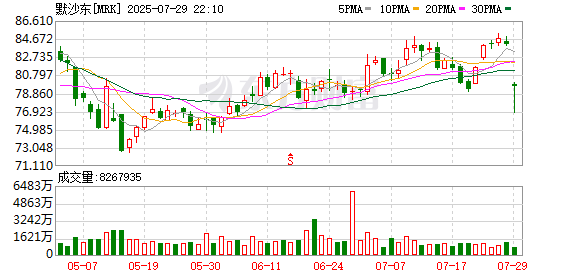
Core Viewpoint - Merck's (MRK.US) stock experienced a significant decline of approximately 8.8%, reaching a low of $76.67, following disappointing second-quarter earnings results [1] Financial Performance - Merck reported a 2% year-over-year decrease in revenue, totaling $15.81 billion, which was slightly below analyst expectations of $15.9 billion [1] - The adjusted earnings per share were $2.17, surpassing analyst forecasts of $2.02 [1] Product Sales - Sales of the HPV vaccine Gardasil plummeted by 55%, primarily due to stagnant demand in the Chinese market and weakened demand in Japan [1] - Excluding China, Gardasil sales still saw a decline of 3% [1] Supply Chain and Future Plans - The company announced an extension of the suspension of HPV vaccine supplies to China until the end of 2025, a significant delay from the earlier expectation of resuming supplies mid-year [1] - Merck plans to cut annual spending by $3 billion and will reduce positions in administrative, sales, and research departments [1]