Morgan Stanley(MS)

Search documents
外资机构谋划“加仓”中国资产
Zheng Quan Ri Bao· 2025-07-15 16:58
Group 1 - The Chinese capital market is experiencing a new pattern of deep interaction with foreign institutions, enhancing the convenience for global investors to participate in China's innovative development opportunities [1] - International capital's enthusiasm for allocating assets in China is increasing, with many foreign institutions expressing optimism about the Chinese market's prospects [1][2] - A significant shift has occurred in the priorities of sovereign wealth funds, with 59% of respondents identifying China as a high or medium priority market, indicating a separate allocation to China from broader emerging markets [2] Group 2 - The quality of listed companies in China is improving, providing a solid foundation for foreign institutions' interest, with 60% of companies reporting positive revenue growth in 2024 [3] - Foreign institutions are increasingly focusing on technology innovation, with digital technology and software being the most attractive investment areas, followed by advanced manufacturing and clean energy [5] - The bond market is also attracting international capital, with expectations that capital may flow from the US financial markets to other fixed-income markets, benefiting European, Japanese, and Chinese bonds [5] Group 3 - Foreign institutions are accelerating their investment in the Chinese market, with over 30 new funds launched by firms such as Morgan Asset Management and Fidelity [6] - Several foreign institutions are demonstrating long-term commitment to the Chinese market through capital increases, such as Morgan Stanley Fund's registered capital rising from 600 million to 950 million yuan, a growth of over 58% [6]



美股银行板块逼近高位,财报季或借预期差进一步上攻
贝塔投资智库· 2025-07-15 03:58
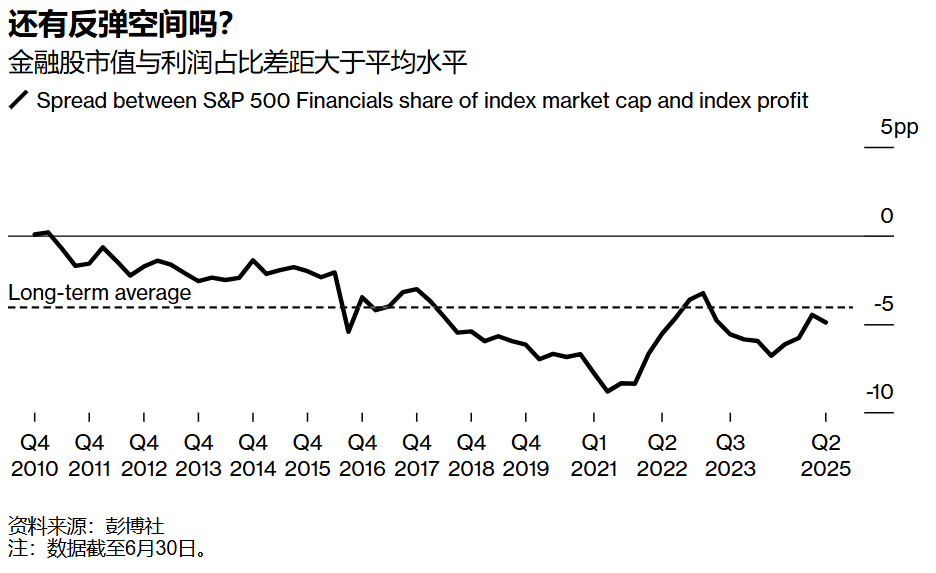
Core Viewpoint - The current conservative market expectations for Wall Street earnings may create favorable conditions for the continued strong performance of bank stocks, as evidenced by significant gains in the banking sector [1]. Group 1: Market Performance - The KBW Bank Index, which includes 24 institutions such as JPMorgan Chase and Citigroup, has risen approximately 37% since its low in April, nearing historical highs, outperforming both the S&P 500 and the Nasdaq 100 indices [1]. - Financial stocks are expected to contribute 18.6% to the overall earnings of the S&P 500, despite their current weight in the index being only 13.7%, indicating a significant expectation gap [1]. Group 2: Earnings Expectations - Analysts predict that the S&P 500 financial stock index will see a year-over-year earnings decline of about 1% in the second quarter, but cautious investor sentiment suggests potential upside if actual profits exceed expectations [1]. - Major banks, including JPMorgan Chase, Citigroup, and Wells Fargo, are set to report earnings this week, with expectations of improved performance due to a favorable regulatory environment [1]. Group 3: Regulatory Environment and Capital Management - The completion of stress tests by the Federal Reserve is expected to lead banks to update their capital management plans, potentially increasing stock buybacks, while the potential weakening of Basel III capital rules may further enhance capital flexibility [2]. - The anticipated growth in trading revenue, following the announcement of tariff policies, is also boosting market confidence [2]. Group 4: Risks and Opportunities - The banking sector faces challenges such as the high forward P/E ratio of approximately 17 for the S&P 500 financial stock index, which exceeds the 10-year average of 14 [2]. - Factors like trade wars, uncertainty in the Federal Reserve's interest rate path, and potential fluctuations in consumer credit quality pose risks to bank profitability [3]. - However, analysts believe that regulatory easing and profit growth could drive the sector higher, with some suggesting that current stock prices do not fully reflect the potential for improvement in the industry fundamentals [3].



摩根士丹利:全球宏观策略-Unsustainable Unsustainability
摩根· 2025-07-15 01:58
Investment Rating - The report does not explicitly provide an investment rating for the industry Core Insights - Debt sustainability analysis often overlooks critical contexts such as monetary system structure, non-sovereign alternatives, and investor psychology, leading to a narrow understanding of the issue [9][12][15] - Investors, rather than models, determine debt sustainability through a multi-factor equation that includes more variables than just interest rates and growth [9][37] - The report highlights that government debt does not exist in isolation but within a complex landscape of alternative investments, which influences perceptions of sustainability [15][31] Summary by Sections Debt Sustainability Analysis - The analysis of debt sustainability is often simplified to one or two dimensions, neglecting the multi-dimensional nature of the investment landscape [9][12] - Concerns about US debt sustainability have been ongoing for over a decade, with significant events like the Moody's downgrade and the One Big Beautiful Bill Act reigniting discussions [11][12] Market Reactions - Market pricing of government bond yields is influenced by various risks, making it challenging to isolate the impact of debt sustainability concerns [14][19] - The report notes that yields on 30-year government bonds in countries with high debt-to-GDP ratios do not necessarily rise with increasing debt levels, indicating a complex relationship [14][16] Global Context - The report emphasizes the importance of understanding debt sustainability within the broader context of global investments, particularly the differences between hard-currency and local-currency debt [26][28] - Emerging market local-currency bonds have proliferated since the pandemic, potentially reducing investor concerns about debt sustainability risks [28] Investor Behavior - Investors play a crucial role in assessing debt sustainability, often applying a broader perspective than traditional models, which can lead to different conclusions about risk [19][37] - The report suggests that academic approaches to linking debt levels with bond yields may miss important contextual factors, such as investor expectations and central bank responses [39][40]
摩根士丹利:关税回归 -对经济和市场的影响
摩根· 2025-07-15 01:58
Investment Rating - The report indicates a tactical escalation in tariffs, with the overall effective tariff rate expected to rise to 21-22%, which may lead to stagflationary shocks and increased recession probabilities [57]. Core Insights - Tariffs are being used as a tool for negotiation, with the US administration focused on reducing goods trade deficits while not perceiving substantial risks from tariff escalations [57]. - The weighted average tariff rate on Asia could rise to 27% and above, but it is anticipated that most large economies in Asia will reach trade agreements before August 1 [57][11]. - The implications for the copper market are significant, with a 50% tariff on copper expected to negatively impact LME copper while benefiting COMEX copper [57][27]. - The US economy may experience a stagflationary shock due to the announced tariffs, with inflation expected to remain above 2% for an extended period [57]. Summary by Sections Tariff Implications - The report highlights that the US is exploring its negotiating space through tactical tariff escalations, with current levels remaining below earlier fears [57]. - The potential for tariffs to rise on select sectors, particularly semiconductors and pharmaceuticals, remains a concern [16][57]. Trade Negotiations - Current trade negotiations involve several countries, with key issues such as agricultural access and tariff reductions on automobiles still unresolved [15][57]. - The report suggests that if agreements are not reached by the deadline, tactical tariff increases may occur, impacting trade dynamics [16][57]. Economic Outlook - The report anticipates a slowdown in capital goods imports and exports over the next 2-3 months, indicating potential economic drag [17]. - The report emphasizes the importance of monitoring Asia's export price index for signs of tariff burden sharing and its effect on corporate profit margins [19][57].
X @Bloomberg
Bloomberg· 2025-07-14 21:38
Home-building companies now commonly reduce borrowers’ mortgage rates on new homes by kicking in some of the financing, but one byproduct of those efforts is that they’ve kept home prices elevated, according to Morgan Stanley https://t.co/1iQRJsJofX ...
Tariffs are unlikely to stir another sell-off, says Morgan Stanley's Andrew Slimmon
CNBC Television· 2025-07-14 17:49
Market Analysis & Strategy - Morgan Stanley Investment Management highlights the concept of a positive but subpar year in the third year of a bull market, influencing investment strategy [2] - The firm adopted a cautious stance early in the year after a near double-digit market increase, later adding risk in April when the market declined by double digits [3] - Current market levels are perceived as inconsistent with a typical third year of a bull market, prompting a more cautious approach [3] - The firm anticipates strong second-quarter earnings, potentially leading to a few more weeks of market strength [4] - Opportunities are viewed as less favorable compared to the spring when the market was substantially lower [4] Risk Factors & Correction - Tariffs are not expected to be the primary cause of a market correction [5] - The market is not expected to react to known factors like tariffs in the same way it did previously [6] - A potential selloff later in the summer is anticipated to be triggered by unforeseen factors [6] - Potential triggers for a correction include the Federal Reserve's decisions on interest rates, higher yields, or economic concerns [7] - The market is considered vulnerable due to the magnitude and speculative nature of the rally, particularly in euphoric stocks [7]
Robust Trading, NII Growth to Aid Morgan Stanley's Q2 Earnings
ZACKS· 2025-07-14 15:50
Core Viewpoint - Morgan Stanley is expected to announce its second-quarter 2025 earnings on July 16, with analysts and investors closely monitoring the performance amid the implications of Trump's tariff plans [1] Financial Performance - The first-quarter performance was strong, driven by solid investment banking and trading results, with second-quarter revenue estimates at $15.92 billion, reflecting a 6% year-over-year growth [2] - The consensus estimate for earnings in the upcoming quarter has been revised down by 1.5% to $1.93, indicating a 6% improvement from the previous year's quarter [2][4] Earnings Surprise History - Morgan Stanley has a strong history of earnings surprises, having exceeded the Zacks Consensus Estimate in the last four quarters with an average beat of 20.3% [4] Factors Impacting Q2 Earnings - Investment Banking (IB) income is projected to decline year-over-year despite a stronger IPO market, with advisory fees estimated at $538 million, down 9.1% from the previous year [6][8] - Trading revenues are expected to surge due to market volatility, with equity trading revenues estimated at $3.46 billion, a 14.8% increase year-over-year [7][13] - Net interest income is projected to grow by 9.8% year-over-year to $2.27 billion, supported by stable rates and solid loan growth [14][15] Underwriting Fees - The consensus estimate for total underwriting fees is $884 million, indicating a decline of 13.9% year-over-year, with fixed-income underwriting fees expected to fall by 17% [10][11] Cost Management - Total non-interest expenses are anticipated to rise by 6.6% year-over-year to $11.6 billion, as the company continues to invest in its franchises [16] Price Performance - In the second quarter, Morgan Stanley's stock performance was strong, outperforming the Zacks Investment Bank industry and the S&P 500 Index, although it lagged behind Goldman Sachs [20]

美股银行板块逼近高位,财报季或借预期差进一步上攻
智通财经网· 2025-07-14 11:04
Group 1 - The current conservative market expectations for Wall Street earnings may create favorable conditions for bank stocks to continue their strong performance [1] - The KBW Bank Index, which includes 24 institutions such as JPMorgan Chase and Citigroup, has risen approximately 37% since April's low, nearing historical highs, outperforming both the S&P 500 and Nasdaq 100 indices [1] - There is a significant expectation gap in the financial sector, with the sector expected to contribute 18.6% to the S&P 500's overall earnings, while its current weight in the index is only 13.7%, exceeding the average gap over the past 15 years [1] Group 2 - Analysts predict a year-over-year decline of about 1% in the S&P 500 financial sector index for the second quarter, indicating potential upside if actual profits exceed expectations [4] - Major banks including JPMorgan, Citigroup, and Wells Fargo are set to report earnings this week, with expectations of improved regulatory environments benefiting large institutions [4] - The completion of stress tests by the Federal Reserve is expected to lead banks to update capital management plans, potentially increasing stock buyback sizes, while the potential weakening of Basel III regulations may further enhance capital flexibility [4] Group 3 - The growth expectations for trading revenue are boosting market confidence, with high trading volumes following the announcement of tariff policies [4] - Challenges remain, as the forward P/E ratio for the S&P 500 financial sector index is approximately 17 times, above the 10-year average of 14 times [4] - Factors such as the impact of trade wars on bank profitability, uncertainties regarding the Federal Reserve's interest rate path, and potential fluctuations in consumer credit quality pose downside risks [5] Group 4 - Supporters argue that regulatory easing and profit growth will drive the sector upward, with analysts noting that current stock prices do not fully reflect the potential for improvement in the industry fundamentals [5] - Multiple favorable factors are expected to contribute to upward momentum in bank stocks [5]