MUFG(MUFG)

Search documents
每日机构分析:8月11日
Xin Hua Cai Jing· 2025-08-11 13:54
Group 1 - S&P Global indicates that recent tariff measures in the U.S. may exacerbate inflation pressures, but the overall consumer price increase in Q2 remained below 3.0% [1] - Goldman Sachs reports that U.S. companies have borne most of the costs of tariffs, with 64% of the burden falling on them, while consumers and foreign exporters bear 22% and 14%, respectively [2] - If recent tariffs follow the previous cost-shifting pattern, consumer burden could rise to 67%, while corporate burden may drop below 10% [2] Group 2 - Mitsubishi UFJ forecasts that emerging Asian currencies may benefit from a weaker dollar in the second half of the year, particularly those with high domestic market-driven economies [1][2] - The potential for a ceasefire in the Russia-Ukraine conflict could positively impact the euro, especially against the dollar, yen, and Swiss franc [4] - UBS highlights increased political uncertainty in Japan due to the ruling party's election losses, which may affect the timing of monetary policy changes [4]


美元退潮+美债牛市陡峭 金融市场“叙事逻辑”迎来转变! “降息交易”晋升主线
Zhi Tong Cai Jing· 2025-08-05 05:41
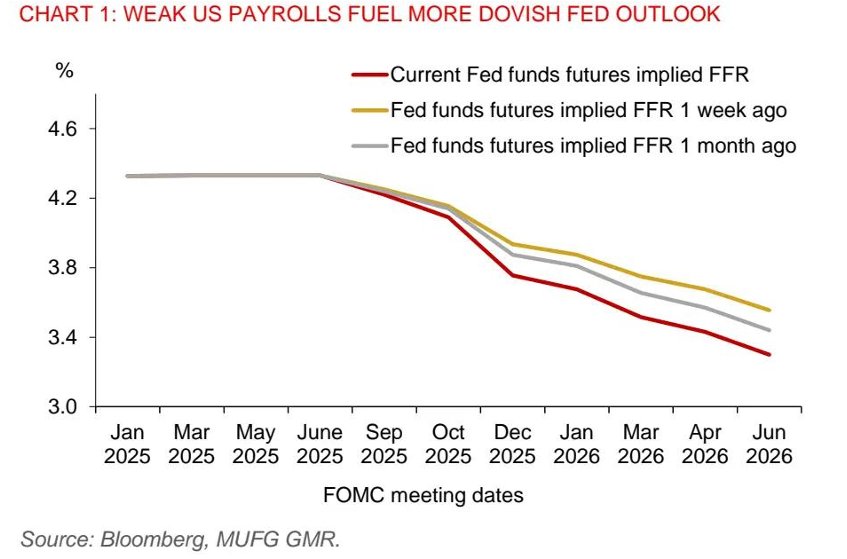
Core Viewpoint - MUFG reports that the significant underperformance of U.S. non-farm employment data in July has led to increased market expectations for interest rate cuts by the Federal Reserve within the year [1][4] Group 1: Employment Data and Economic Indicators - The July non-farm employment report showed only 73,000 jobs added, with prior months' data revised down by a total of 258,000 jobs, marking a historic downward revision of 90% [4] - The ISM manufacturing index's employment component fell to 43.4, indicating weakened labor demand, while the ISM price component dropped from 69.7 to 64.8, suggesting no significant inflationary pressure [4] Group 2: Market Reactions and Predictions - The interest rate futures market is pricing in approximately 64 basis points of easing by the end of 2025, with a 90% probability of a rate cut in September [1][5] - There is a growing expectation for at least two rate cuts by the end of the year, with traders increasingly betting on consecutive cuts in September and October [1][5] Group 3: Impact on Financial Markets - Gold prices have rebounded from around $3,270 to nearly $3,400 since the end of July, driven by rate cut expectations [5] - The U.S. dollar index fell by 0.8% on a single day, with the dollar depreciating against the yen by 2.2%, marking the largest drop since April [5] - The yield curve for U.S. Treasuries has steepened, with the 2-year Treasury yield dropping over 25 basis points, the largest decline since December 2023, indicating a bullish sentiment in the bond market [6] Group 4: Political Influences on Monetary Policy - Political dynamics in the U.S. are shifting towards supporting rate cut expectations, with President Trump exerting pressure on the Federal Reserve and calling for the dismissal of the Bureau of Labor Statistics chief [7] - The extreme weakness in the July employment report supports the argument for a rate cut, with some Federal Reserve officials advocating for immediate action [7]

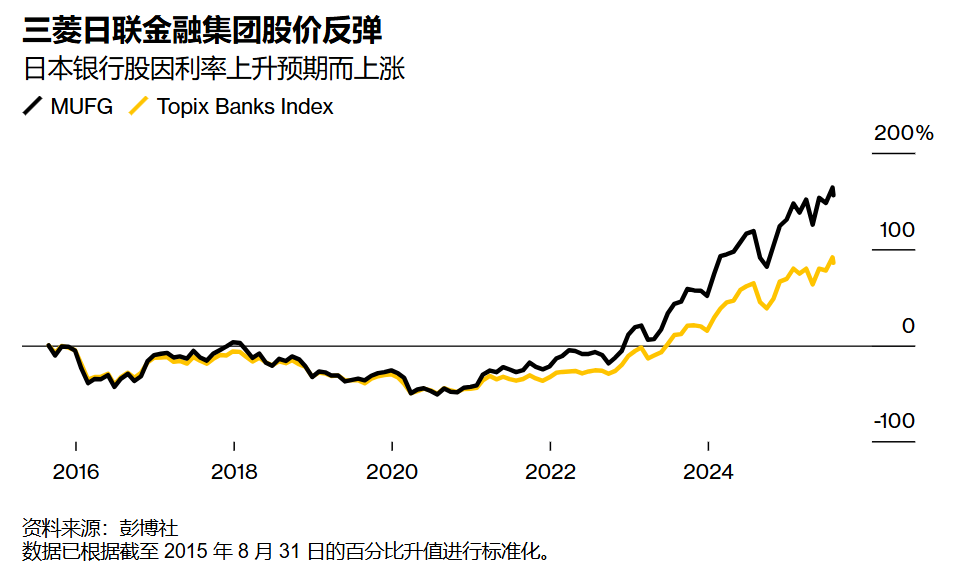
三菱日联(MUFG.US)CEO罕见呼吁日央行加息,预测最早或于9月会议启动
智通财经网· 2025-08-04 23:32
Group 1 - The CEO of Mitsubishi UFJ Financial Group (MUFG) expressed views on the Bank of Japan's interest rate hike timing, suggesting a possible adjustment in March next year, but also indicating a high likelihood of a hike in September or October this year [1] - MUFG reported a 1.8% year-on-year decline in net income for the first quarter of the fiscal year, amounting to 546.1 billion yen, while basic earnings per share remained stable at 47.55 yen, slightly exceeding analyst expectations [1] - The group aims for a record annual profit target of 2 trillion yen (approximately 135 billion USD), attributing this to rising interest rates, yen depreciation, and the sale of client company shares [1] Group 2 - The Bank of Japan maintained its policy rate at 0.5% while raising inflation forecasts for the next three years, with 42% of surveyed economists expecting a rate hike in October [2] - Continuous wage growth is a key consideration for the Bank of Japan's decisions, with expectations that companies may continue to raise salaries to address labor shortages [5] - MUFG's stock price has increased by approximately 11% this year, following a trend of over 35% annual growth in the previous four years [5] Group 3 - The group aims for a long-term return on equity target of 12%, with recent figures around 10%, and needs to generate an additional 1.2 trillion yen in net operating profit to support a 2% increase in return rates [5] - MUFG is considering expanding its securitization business and taking on more risk in project financing to drive business growth [5]
MUFG(MUFG) - 2026 Q1 - Quarterly Report
2025-08-04 10:08
[Consolidated Summary Report (Japanese GAAP)](index=4&type=section&id=Consolidated%20Summary%20Report) [Consolidated Financial Data and Earnings Target](index=4&type=section&id=1.%20Consolidated%20Financial%20Data%20for%20the%20Three%20Months%20ended%20June%2030%2C%202025) MUFG's Q1 FY2025 financial data reflects slight profit and asset declines, alongside maintained earnings targets and increased dividend forecasts [Results of Operations](index=4&type=section&id=1.%20%281%29%20Results%20of%20Operations) Q1 FY2025 saw Ordinary Income, Ordinary Profits, and Profits Attributable to Owners of Parent decline, with basic EPS stable Q1 FY2025 Results of Operations (vs. Q1 FY2024) (Millions of Yen) | Metric | Q1 FY2025 (ended Jun 30, 2025) | Q1 FY2024 (ended Jun 30, 2024) | Change (%) | | :--- | :--- | :--- | :--- | | Ordinary Income | ¥3,253,932 | ¥3,525,017 | (7.7)% | | Ordinary Profits | ¥708,535 | ¥733,359 | (3.4)% | | Profits Attributable to Owners of Parent | ¥546,068 | ¥555,894 | (1.8)% | | Comprehensive Income | ¥135,586 | ¥992,877 | (86.3)% | | Basic Earnings Per Share | ¥47.55 | ¥47.50 | +0.1% | | Diluted Earnings Per Share | ¥47.45 | ¥47.40 | +0.1% | [Financial Conditions](index=4&type=section&id=1.%20%282%29%20Financial%20Conditions) As of June 30, 2025, MUFG's total assets and net assets decreased, while the equity-to-asset ratio remained unchanged Financial Condition as of June 30, 2025 (Millions of Yen) | Metric | As of June 30, 2025 | As of March 31, 2025 | | :--- | :--- | :--- | | Total Assets | ¥401,041,048 | ¥413,113,501 | | Total Net Assets | ¥21,256,938 | ¥21,728,132 | | Equity-to-asset ratio | 5.0% | 5.0% | | Shareholders' equity | ¥20,018,546 | ¥20,520,374 | [Dividends](index=5&type=section&id=2.%20Dividends%20on%20Common%20Stock) MUFG forecasts a total annual dividend of ¥70.00 per share for FY2026, up from ¥64.00 in the previous year Dividend per Share Forecast (Yen) | Fiscal Year | Interim (2nd Qtr-end) | Year-end | Total | | :--- | :--- | :--- | :--- | | Ended Mar 31, 2025 | ¥25.00 | ¥39.00 | ¥64.00 | | Ending Mar 31, 2026 (Forecast) | ¥35.00 | ¥35.00 | ¥70.00 | [Earnings Target](index=5&type=section&id=3.%20Earnings%20Target%20for%20the%20Fiscal%20Year%20ending%20March%2031%2C%202026%20%28Consolidated%29) MUFG maintained its ¥2.0 trillion earnings target for profits attributable to owners of parent for FY2026 - MUFG's earnings target for FY2026 is **¥2.0 trillion** of profits attributable to owners of parent[13](index=13&type=chunk) - Due to various uncertainties in the financial services business, MUFG discloses an earnings target instead of a specific performance forecast[13](index=13&type=chunk) [Consolidated Financial Statements and Notes](index=9&type=section&id=2.%20Consolidated%20Financial%20Statements%20and%20Notes) Consolidated financial statements show decreased assets and comprehensive income, mixed income statement results, and varied segment performance [Consolidated Balance Sheets](index=9&type=section&id=%281%29%20Consolidated%20Balance%20Sheets) As of June 30, 2025, total assets decreased by ¥12 trillion to ¥401.0 trillion, with total liabilities also declining Key Balance Sheet Items (Millions of Yen) | Account | As of June 30, 2025 | As of March 31, 2025 | | :--- | :--- | :--- | | **Assets** | | | | Cash and due from banks | ¥105,201,744 | ¥109,095,437 | | Securities | ¥80,709,711 | ¥86,125,371 | | Loans and bills discounted | ¥122,671,835 | ¥121,436,133 | | **Total Assets** | **¥401,041,048** | **¥413,113,501** | | **Liabilities** | | | | Deposits | ¥224,705,991 | ¥228,512,749 | | Payables under repurchase agreements | ¥36,731,293 | ¥43,359,076 | | **Total Liabilities** | **¥379,784,109** | **¥391,385,368** | | **Total Net Assets** | **¥21,256,938** | **¥21,728,132** | [Consolidated Statements of Income and Comprehensive Income](index=11&type=section&id=%282%29%20Consolidated%20Statements%20of%20Income%20and%20Consolidated%20Statements%20of%20Comprehensive%20Income) Q1 FY2025 Ordinary Income fell to ¥3.3 trillion, profits stabilized by lower expenses, but Comprehensive Income plummeted to ¥135.6 billion due to FX Consolidated Income Statement Highlights (Millions of Yen) | Metric | Q1 FY2025 (ended Jun 30, 2025) | Q1 FY2024 (ended Jun 30, 2024) | | :--- | :--- | :--- | | Ordinary income | ¥3,253,932 | ¥3,525,017 | | Interest income | ¥2,022,572 | ¥2,353,006 | | Ordinary expenses | ¥2,545,396 | ¥2,791,657 | | Interest expenses | ¥1,331,819 | ¥1,529,894 | | General and administrative expenses | ¥796,719 | ¥844,873 | | Ordinary profits | ¥708,535 | ¥733,359 | | Profits attributable to owners of parent | ¥546,068 | ¥555,894 | - Comprehensive income fell sharply to **¥135.6 billion**, primarily due to a **¥279.3 billion** negative foreign currency translation adjustment, compared to a **¥471.7 billion** positive adjustment in the prior-year period[24](index=24&type=chunk) [Changes in Accounting Estimates](index=13&type=section&id=%284%29%20Changes%20in%20accounting%20estimates) A new credit rating system was adopted for credit loss allowance calculation, with an immaterial impact on Q1 FY2025 financial statements - A new credit rating system was adopted to enhance credit risk management and calculate the allowance for credit losses[27](index=27&type=chunk) - The impact of this change in accounting estimates on the financial statements for the three months ended June 30, 2025, is reported as immaterial[27](index=27&type=chunk) [Segment Information](index=14&type=section&id=%285%29%20Segment%20Information) Q1 FY2025 total operating profit was ¥542.2 billion, down from ¥685.5 billion, with varied segment performance across business groups Operating Profit (Loss) by Segment (Millions of Yen) | Reporting Segment | Q1 FY2025 (ended Jun 30, 2025) | Q1 FY2024 (ended Jun 30, 2024) | | :--- | :--- | :--- | | Retail & Digital Business Group | ¥64,219 | ¥58,146 | | Commercial Banking & Wealth Management | ¥85,611 | ¥55,394 | | Japanese Corporate & Investment Banking | ¥147,149 | ¥162,687 | | Global Commercial Banking | ¥87,106 | ¥179,573 | | Global Corporate & Investment Banking | ¥36,901 | ¥33,039 | | Global Markets Business Group | ¥83,806 | ¥127,471 | | **Total Operating Profit** | **¥542,247** | **¥685,474** | - The method for calculating operating profit for each segment was changed in the first quarter of FY2025, and the prior year's data has been restated accordingly[31](index=31&type=chunk)[32](index=32&type=chunk) [Additional Information on Allowance for Credit Losses](index=16&type=section&id=%289%29%20Additional%20Information) Allowance for credit losses calculation relies on significant estimates and forward-looking adjustments, totaling **¥39.2 billion** as of June 30, 2025 - The calculation of allowance for credit losses relies on estimates of borrower ratings, collateral values, and future cash flows, which are subject to uncertainty[40](index=40&type=chunk)[41](index=41&type=chunk) - Adjustments are made to historical loss rates to account for future projections, especially considering the uncertain business environment from geopolitical situations (Russia-Ukraine) and trade policies[44](index=44&type=chunk)[47](index=47&type=chunk) - The impact from these forward-looking adjustments was **¥39.2 billion** as of June 30, 2025, up from **¥33.6 billion** as of March 31, 2025[44](index=44&type=chunk) [Supplemental Information: Selected Financial Information](index=18&type=section&id=Selected%20Financial%20Information%20under%20Japanese%20GAAP) [Financial Results by Entity](index=20&type=section&id=1.%20Financial%20Results) MUFG's consolidated gross profits decreased to ¥1,358.4 billion, with varied financial results across its main banking entities [MUFG Consolidated](index=20&type=section&id=MUFG%20Consolidated) MUFG's Q1 FY2025 consolidated gross profits decreased to ¥1,358.4 billion, with profits attributable to owners of parent declining to ¥546.1 billion MUFG Consolidated Financial Results (Millions of Yen) | Metric | Q1 FY2025 (ended Jun 30, 2025) | Q1 FY2024 (ended Jun 30, 2024) | | :--- | :--- | :--- | | Gross profits | ¥1,358,416 | ¥1,535,602 | | Net interest income | ¥690,788 | ¥823,128 | | General and administrative expenses | ¥815,428 | ¥857,451 | | Ordinary profits | ¥708,535 | ¥733,359 | | Profits attributable to owners of parent | ¥546,068 | ¥555,894 | [BK and TB Combined](index=21&type=section&id=BK%20and%20TB%20Combined) BK and TB combined gross profits decreased to ¥767.8 billion, with net operating profits and net income also declining BK and TB Combined Financial Results (Millions of Yen) | Metric | Q1 FY2025 (ended Jun 30, 2025) | Q1 FY2024 (ended Jun 30, 2024) | | :--- | :--- | :--- | | Gross profits | ¥767,758 | ¥833,219 | | Net operating profits | ¥352,841 | ¥398,712 | | Net income | ¥351,694 | ¥361,233 | [BK Non-consolidated](index=22&type=section&id=BK%20Non-consolidated) BK non-consolidated gross profit decreased to ¥680.2 billion, but net income increased to ¥315.0 billion due to higher non-recurring gains BK Non-consolidated Financial Results (Millions of Yen) | Metric | Q1 FY2025 (ended Jun 30, 2025) | Q1 FY2024 (ended Jun 30, 2024) | | :--- | :--- | :--- | | Gross profits | ¥680,188 | ¥706,691 | | Net operating profits | ¥320,101 | ¥325,225 | | Net income | ¥314,972 | ¥282,697 | [TB Non-consolidated](index=23&type=section&id=TB%20Non-consolidated) TB non-consolidated gross profits fell to ¥87.6 billion, with net income decreasing to ¥36.7 billion due to lower interest and other operating profits TB Non-consolidated Financial Results (Millions of Yen) | Metric | Q1 FY2025 (ended Jun 30, 2025) | Q1 FY2024 (ended Jun 30, 2024) | | :--- | :--- | :--- | | Gross profits | ¥87,569 | ¥126,527 | | Net operating profits | ¥32,740 | ¥73,487 | | Net income | ¥36,721 | ¥78,536 | [Asset Quality](index=24&type=section&id=2.%20Loans%20to%20Be%20Disclosed%20under%20the%20Banking%20Act%20and%20the%20Financial%20Reconstruction%20Act%20%28the%20FRA%29) MUFG's consolidated NPLs under FRA totaled ¥1,458.3 billion as of June 30, 2025, with the NPL ratio improving to 1.05% Non-Performing Loans (NPL) under FRA (Millions of Yen) | Entity | Total NPLs (Jun 30, 2025) | NPL Ratio (Jun 30, 2025) | NPL Ratio (Mar 31, 2025) | | :--- | :--- | :--- | :--- | | MUFG Consolidated | ¥1,458,303 | 1.05% | 1.11% | | BK and TB Combined | ¥789,936 | 0.63% | 0.70% | | BK Non-consolidated | ¥788,762 | 0.65% | 0.72% | | TB Non-consolidated | ¥1,174 | 0.04% | 0.04% | [Securities Portfolio](index=25&type=section&id=3.%20Securities) MUFG's securities portfolio shows increased unrealized gains on available-for-sale securities and improved unrealized losses on held-to-maturity debt MUFG Consolidated Securities Portfolio (Millions of Yen) | Category | Balance Sheet Amount (Jun 30, 2025) | Unrealized Gains/(Losses) (Jun 30, 2025) | Unrealized Gains/(Losses) (Mar 31, 2025) | | :--- | :--- | :--- | :--- | | Debt securities held to maturity | ¥24,030,408 | (¥541,239) | (¥625,190) | | Available-for-sale securities | ¥55,146,618 | ¥2,322,186 | ¥2,203,663 | | - Domestic equity securities | ¥3,610,164 | ¥2,548,736 | ¥2,458,566 | | - Domestic bonds | ¥17,262,785 | (¥232,264) | (¥249,533) | | - Foreign bonds | ¥24,374,688 | (¥73,312) | (¥113,323) | [Key Performance Indicators](index=28&type=section&id=4.%20ROE) MUFG's Q1 FY2025 consolidated ROE slightly decreased to 10.78%, while the domestic interest rate spread for combined banking units widened [Return on Equity (ROE)](index=28&type=section&id=4.%20ROE) MUFG's Q1 FY2025 consolidated ROE (JPX basis) was 10.78%, a slight decrease from 11.18% in the prior year MUFG Consolidated ROE (JPX basis) (%) | Period | ROE (%) | | :--- | :--- | | Three months ended June 30, 2025 | 10.78 | | Three months ended June 30, 2024 | 11.18 | [Average Interest Rate Spread](index=29&type=section&id=5.%20Average%20Interest%20Rate%20Spread) The domestic interest rate spread for BK and TB combined increased to 0.89% in Q1 FY2025, driven by higher average loan rates BK and TB Combined Domestic Interest Rate Spread (%) | Metric | Q1 FY2025 (ended Jun 30, 2025) | Q1 FY2024 (ended Jun 30, 2024) | | :--- | :--- | :--- | | Avg. interest rate on loans | 1.06% | 0.82% | | Avg. interest rate on deposits | 0.17% | 0.01% | | **Interest rate spread** | **0.89%** | **0.80%** | [Loans and Deposits Breakdown](index=30&type=section&id=6.%20Loans%20and%20Deposits) For BK and TB combined, loans increased to ¥111.5 trillion, while deposits decreased to ¥212.4 trillion as of June 30, 2025 BK and TB Combined Loans and Deposits (Millions of Yen) | Metric | As of June 30, 2025 | As of March 31, 2025 | | :--- | :--- | :--- | | Deposits (ending balance) | ¥212,429,174 | ¥215,970,679 | | Loans (ending balance) | ¥111,456,580 | ¥110,082,264 | [Trust Assets and Liabilities (TB Non-consolidated)](index=31&type=section&id=7.%20Statements%20of%20Trust%20Assets%20and%20Liabilities) TB non-consolidated total trust assets increased slightly to ¥342.5 trillion, with beneficiary rights and investment trusts as key components TB Non-consolidated Trust Assets and Liabilities (Millions of Yen) | Account | As of June 30, 2025 | As of March 31, 2025 | | :--- | :--- | :--- | | **Total Assets** | **¥342,490,703** | **¥341,910,148** | | - Securities | ¥82,165,586 | ¥82,297,398 | | - Beneficiary rights to the trust | ¥171,636,024 | ¥171,790,489 | | **Total Liabilities** | **¥342,490,703** | **¥341,910,148** | | - Money trusts | ¥36,268,216 | ¥39,222,424 | | - Investment trusts | ¥170,332,783 | ¥170,479,519 |
三菱日联:黄金短期内应会获得有力支撑
news flash· 2025-08-04 08:11
Core Viewpoint - Mitsubishi UFJ Financial Group (MUFG) analysts indicate that the slowdown in U.S. employment growth has boosted expectations for interest rate cuts, which is favorable for non-yielding gold [1] Group 1 - The expectation of interest rate cuts is increasingly being factored in by traders [1] - Economic uncertainty is driving investors to seek safe-haven assets [1] - Gold is expected to receive strong support in the short term [1]
MUFG(MUFG) - 2026 Q1 - Earnings Call Presentation
2025-08-04 06:00
Financial Performance - Net Income increased by ¥12 billion YoY to ¥546 billion, a 27.3% progress towards the FY25 target of ¥2 trillion[4] - Net Operating Profits (NOP) decreased by ¥135.1 billion YoY to ¥542.9 billion, representing 24.7% progress towards the FY25 target[4,7] - Adjusted profits increased by ¥12 billion YoY from ¥534 billion to ¥546 billion[7] Business Segment Performance - R&D and CWM experienced a significant increase in Net Operating Profits, up ¥31.6 billion YoY[3,14] - JCIB experienced a decrease in Net Operating Profits, down ¥2.3 billion YoY[3,13] - Global Markets saw a decrease in Net Operating Profits, down ¥40 billion YoY[3,19] Balance Sheet - Total Loans increased by ¥1 trillion from End Mar 25 to ¥224.7 trillion[26] - Total Deposits decreased by ¥5.4 trillion from End Mar 25 to ¥401 trillion[26] Asset Quality - Non-Performing Loans (NPL) ratio decreased from 1.11% to 1.05%[40] - Total Credit Costs decreased by ¥119.8 billion YoY from negative ¥166.7 billion to negative ¥46.9 billion[7,42] Investment Securities - Available-for-sale (AFS) securities balance is ¥55.14 trillion with unrealized gains of ¥2.32 trillion[44] - Held-to-maturity securities balance is ¥24.03 trillion[44]
All You Need to Know About MUFG (MUFG) Rating Upgrade to Strong Buy
ZACKS· 2025-07-28 17:01
Core Viewpoint - Mitsubishi UFJ (MUFG) has received an upgrade to a Zacks Rank 1 (Strong Buy) due to an upward trend in earnings estimates, which is a significant factor influencing stock prices [1][3]. Earnings Estimates and Stock Price Movement - The Zacks rating system is based on changes in earnings estimates, which are closely correlated with near-term stock price movements [4][6]. - Rising earnings estimates for MUFG indicate an improvement in the company's underlying business, likely leading to an increase in stock price [5][10]. Zacks Rank System - The Zacks Rank system classifies stocks into five groups based on earnings estimates, with Zacks Rank 1 stocks historically generating an average annual return of +25% since 1988 [7][9]. - Only the top 5% of Zacks-covered stocks receive a "Strong Buy" rating, indicating superior earnings estimate revisions [9][10]. Recent Earnings Estimates for MUFG - For the fiscal year ending March 2026, MUFG is expected to earn $1.15 per share, unchanged from the previous year, but the Zacks Consensus Estimate has increased by 5.5% over the past three months [8].

Mitsubishi UFJ Financial Group (MUFG) 2025 Earnings Call Presentation
2025-07-22 04:00
Here's a summary of the key points from the provided report, formatted as requested: Retail & Digital Business Group (R&D) - The Retail & Digital Business Group aims for double-digit ROE in the mid- to long-term by improving customer base and LTV (Life Time Value)[9] - The group aims to increase its customer share from 27% by expanding the Group customer base and improving multiple transaction usage rate[12] - MUFG launched a service brand "M-tto" to provide greater convenience and value to customers across different life stages[14] - The number of annual card issuance is expected to increase from 540,000 in FY24 to 1,000,000 in FY26[25] Commercial Banking & Wealth Management Business Group (CWM) - The Commercial Banking & Wealth Management Business Group targets approximately 15.5% ROE in FY26[50] - JPY deposit income increased from ¥30 billion in FY23 to ¥110 billion in FY24[52] - The group aims to increase the number of owner approach visits to 40,000 companies[52] - The group expects an increase of ¥7 billion in fee income from business strategy proposals[59] Japanese Corporate & Investment Banking Business Group (JCIB) - The Japanese Corporate & Investment Banking Business Group achieved the highest ROE of 14.5% and net operating profits of ¥559.7 billion in FY24 among all business groups[77] - The group aims to reduce equity holdings to ¥700 billion and less than 20% of total assets by the end of March 2027[86] - The group aims to increase non-recourse loan balance in the real estate field to 100 (FY24=100) in FY26[89] Global Commercial Banking Business Group (GCB) - The Global Commercial Banking Business Group recorded an all-time high NOP in FY24[100] - Krungsri's domestic corporate loan increased by 5%[102, 105] - Bank Danamon's loan balance increased by ¥0.1 trillion[108] - The group aims to cover 1 in 4 of the ASEAN adult population with digital finance users in 10 years[131] Asset Management & Investor Services Business Group (AM/IS) - The Asset Management & Investor Services Business Group targets approximately 19% ROE in FY26[137] - The group aims to increase AuM to ¥200 trillion and AuA to ¥100 trillion by FY29[142]
MUFG(MUFG) - 2025 Q4 - Annual Report
2025-07-07 10:08
[Forward-Looking Statements](index=4&type=section&id=Forward-Looking%20Statements) This section outlines the forward-looking statements in the report, highlighting inherent risks and uncertainties that could cause actual results to differ materially - The report contains forward-looking statements regarding the company's intent, business plans, targets, and expectations, which are subject to risks and uncertainties, and actual results may vary materially[18](index=18&type=chunk)[20](index=20&type=chunk) - Key risk factors that could cause actual results to differ from forward-looking statements include economic deterioration in Japan and globally, geopolitical conflicts, climate change, competitive pressures, failure of business expansion strategies, issues with the Morgan Stanley alliance, and fluctuations in interest rates, currency exchange rates, and stock prices[21](index=21&type=chunk) [Key Information](index=6&type=section&id=Item%203.%20Key%20Information) This section provides an overview of the company's key information, including significant risk factors impacting its business and financial condition [Risk Factors](index=6&type=section&id=D.%20Risk%20Factors) The company's business and financial condition are subject to a high degree of risk, primarily related to its significant exposure to the Japanese economy, global economic conditions, climate change, competitive pressures, strategic execution, regulatory capital requirements, and various financial and operational risks [Risks Related to Our Business Environment](index=6&type=section&id=Risks%20Related%20to%20Our%20Business%20Environment) This section details risks stemming from the company's operating environment, including economic conditions in Japan and globally, climate change, and external disruptions - A significant portion of the company's assets and business operations are in Japan, making it highly susceptible to the country's economic conditions, with **64.5% of total assets** related to Japan and domestic loans accounting for **56.8% of the total loan portfolio** as of March 31, 2025[29](index=29&type=chunk) - The company is exposed to global economic risks, with significant assets in the United States (**16.4%**), Asia and Oceania excluding Japan (**9.5%**), and Europe (**5.8%**) as of March 31, 2025[33](index=33&type=chunk) - Climate change presents both physical and transition risks, which could lead to declines in the value of loans, investments, and other assets, as well as increased operational and compliance costs[40](index=40&type=chunk)[41](index=41&type=chunk) - Business operations are exposed to disruptions from external events such as natural disasters (particularly earthquakes in Tokyo), terrorism, and geopolitical conflicts, which can lead to financial and reputational losses[35](index=35&type=chunk)[36](index=36&type=chunk)[37](index=37&type=chunk) [Risks Related to Our Strategies and Our Major Investees](index=8&type=section&id=Risks%20Related%20to%20Our%20Strategies%20and%20Our%20Major%20Investees) This section addresses risks associated with the company's strategic initiatives, competitive landscape, and performance of key investments and alliances - Intensifying competition from both traditional financial institutions and non-financial entrants with new technologies could adversely affect business, financial condition, and results of operations[44](index=44&type=chunk) - The global strategic alliance with Morgan Stanley is crucial, and its failure or termination could negatively impact the company's securities business in Japan and overall growth strategy, with MUFG holding approximately **23.5% of the voting rights** in Morgan Stanley as of March 31, 2025[51](index=51&type=chunk)[52](index=52&type=chunk) - Global expansion strategies, including acquisitions and alliances with overseas subsidiaries like Krungsri (Thailand) and Bank Danamon (Indonesia), expose the company to new and complex risks, including political instability and market fluctuations[46](index=46&type=chunk)[47](index=47&type=chunk) - Goodwill from acquisitions, totaling **¥558.2 billion** as of March 31, 2025, is subject to impairment risk, which could adversely affect financial results[48](index=48&type=chunk) [Risks Related to Our Ability to Meet Regulatory Capital Requirements](index=10&type=section&id=Risks%20Related%20to%20Our%20Ability%20to%20Meet%20Regulatory%20Capital%20Requirements) This section outlines the risks related to the company's ability to meet stringent regulatory capital and Total Loss-Absorbing Capacity requirements as a Global Systemically Important Bank Capital Ratios as of March 31, 2025 | Ratio | Actual | Minimum Required | | :--- | :--- | :--- | | Total Risk-Adjusted Capital | 18.83% | 12.16% | | Tier 1 Capital | 16.65% | 10.16% | | Common Equity Tier 1 Capital | 14.18% | 8.66% | | Leverage Ratio | 5.29% | 3.95% | - As a Global Systemically Important Bank (G-SIB), MUFG is subject to stricter capital requirements, including a capital conservation buffer, a G-SIB surcharge, and a countercyclical buffer, and failure to maintain these ratios could result in regulatory actions, including restrictions on capital distributions[56](index=56&type=chunk)[57](index=57&type=chunk) - The company must also meet Total Loss-Absorbing Capacity (TLAC) requirements, with the External TLAC ratio at **24.64%** on a risk-weighted basis (vs. **18.00%** required) and **9.16%** on a total exposure basis (vs. **7.10%** required) as of March 31, 2025[59](index=59&type=chunk) [Other Financial and Operational Risks](index=11&type=section&id=Other%20Financial%20and%20Operational%20Risks) This section covers various financial and operational risks, including credit, market, funding liquidity, operational, and consumer lending risks - Credit Risk: Worsening economic conditions could increase problem loans and credit-related expenses, and the company's allowance for credit losses, based on estimates, could prove insufficient[61](index=61&type=chunk)[65](index=65&type=chunk) - Market Risk: Fluctuations in interest rates, foreign currency exchange rates, and stock prices could adversely affect the value of the company's large portfolio of financial instruments, with Japanese government bonds accounting for **9.0% of total assets** as of March 31, 2025[72](index=72&type=chunk) - Funding Liquidity Risk: A downgrade in credit ratings could require significant additional collateral postings, with a one-notch downgrade as of March 31, 2025, estimated to require **¥63.9 billion** in additional collateral[74](index=74&type=chunk)[75](index=75&type=chunk) - Operational Risk: The company faces risks from regulatory actions, legal proceedings, cyber-attacks, and failures to safeguard confidential information, with recent regulatory actions including business improvement orders from Japan's FSA in June 2024 regarding inappropriate information sharing[77](index=77&type=chunk)[80](index=80&type=chunk)[85](index=85&type=chunk) - Consumer Lending Risk: Changes in the regulatory environment for consumer finance in Japan could adversely affect subsidiaries like Mitsubishi UFJ NICOS, with the allowance for repayment of excess interest at **¥5.4 billion** as of March 31, 2025, down from **¥7.1 billion** a year earlier[90](index=90&type=chunk)[92](index=92&type=chunk) [Information on the Company](index=19&type=section&id=Item%204.%20Information%20on%20the%20Company) This section provides comprehensive information about the company, including its history, business operations, organizational structure, and property, plant and equipment [History and Development of the Company](index=19&type=section&id=A.%20History%20and%20Development%20of%20the%20Company) This section traces the company's historical evolution, key mergers, strategic alliances, and significant acquisitions and divestitures - MUFG was formed on October 1, 2005, through the merger of Mitsubishi Tokyo Financial Group, Inc. (MTFG) and UFJ Holdings, Inc[102](index=102&type=chunk) - A global strategic alliance with Morgan Stanley was formed in 2008, with MUFG holding approximately **23.5% of the voting rights** in Morgan Stanley as of March 31, 2025[103](index=103&type=chunk)[106](index=106&type=chunk) - Significant overseas expansion includes the acquisition of a majority stake in Krungsri (Thailand) in 2013 and Bank Danamon (Indonesia) in 2019[107](index=107&type=chunk)[111](index=111&type=chunk) - The company completed the sale of MUFG Union Bank to U.S. Bancorp on December 1, 2022[114](index=114&type=chunk) [Business Overview](index=21&type=section&id=B.%20Business%20Overview) MUFG is one of the world's largest financial groups with total assets of **¥405.94 trillion** as of March 31, 2025. Its operations are structured into several business groups, including Retail & Digital, Commercial Banking & Wealth Management, Corporate & Investment Banking, and Global Markets. The company's strategy focuses on global growth, digital transformation, and sustainability, while navigating a competitive landscape and a complex regulatory environment in Japan and the U.S [Medium-Term Business Plan](index=21&type=section&id=Medium-Term%20Business%20Plan) This section outlines the company's strategic pillars and key initiatives for its current medium-term business plan, focusing on growth, transformation, and sustainability - The current Medium-term Business Plan, for the three-year period ending March 31, 2027, is built on three strategic pillars: (1) expand and refine growth strategies, (2) accelerate transformation and innovation, and (3) drive social and environmental progress[120](index=120&type=chunk)[121](index=121&type=chunk) - Key growth strategies include strengthening the domestic retail customer base, evolving the Global Corporate & Investment Banking (GCIB) and Global Markets (GM) integrated model, and capturing growth opportunities in Asia through collaboration with subsidiary and partner banks[125](index=125&type=chunk)[127](index=127&type=chunk) - Transformation and innovation efforts will focus on accelerating corporate culture change, expanding human capital investment, and enhancing AI/data infrastructure[126](index=126&type=chunk)[128](index=128&type=chunk) [MUFG's Approach to Sustainability](index=24&type=section&id=MUFG's%20Approach%20to%20Sustainability) This section details the company's commitment to sustainability, including targets for sustainable finance, net zero emissions, and human capital development - MUFG has set a sustainable finance target of **¥100 trillion** in cumulative financing from fiscal year 2020 to fiscal year 2031[155](index=155&type=chunk) - The company aims to achieve net zero greenhouse gas (GHG) emissions from its financed portfolio by 2050 and from its own operations by the end of fiscal year 2031[156](index=156&type=chunk) - A key human capital target is to increase female representation in managerial positions in Japan to **27.0%** by the end of fiscal year 2027, having achieved **24.0%** as of March 31, 2025[158](index=158&type=chunk) [Business Groups](index=29&type=section&id=Business%20Groups) This section describes the company's organizational structure by business group, highlighting key operations, strategic alliances, and regional focus - The business is organized into several groups: Retail & Digital, Commercial Banking & Wealth Management, Japanese Corporate & Investment Banking, Asset Management & Investor Services, Global Corporate & Investment Banking, Global Commercial Banking, and Global Markets[161](index=161&type=chunk) - The Global Commercial Banking Business Group leverages its network of "Partner Banks" in Asia, including Krungsri in Thailand (**76.88% ownership**) and Bank Danamon in Indonesia (**92.47% ownership**), to capture growth in the region[178](index=178&type=chunk)[181](index=181&type=chunk)[185](index=185&type=chunk) - The strategic alliance with Morgan Stanley includes two joint venture securities companies in Japan and collaboration in the US corporate finance market, enhanced in July 2023 with the launch of "Alliance 2.0" for deeper collaboration[197](index=197&type=chunk)[199](index=199&type=chunk) [Supervision and Regulation](index=35&type=section&id=Supervision%20and%20Regulation) This section details the regulatory environment governing the company's operations in Japan and the United States, including capital adequacy and compliance requirements - In Japan, MUFG is supervised by the Financial Services Agency (FSA) and is subject to regulations including the Banking Act, capital adequacy guidelines based on Basel III, and Total Loss-Absorbing Capacity (TLAC) standards[210](index=210&type=chunk)[217](index=217&type=chunk)[232](index=232&type=chunk) - As a G-SIB, MUFG is subject to a capital conservation buffer (**2.5%**), a G-SIB surcharge (**1.5%**), and a countercyclical buffer (**0.16%**) as of March 31, 2025[225](index=225&type=chunk) - In the United States, MUFG is regulated by the Federal Reserve Board (FRB) as a foreign banking organization and financial holding company, with its U.S. operations subject to Enhanced Prudential Standards (EPS), though its U.S. Intermediate Holding Company (IHC) requirement ceased on November 21, 2023[283](index=283&type=chunk)[298](index=298&type=chunk)[299](index=299&type=chunk) - The company discloses limited business activities with entities in or affiliated with Iran, conducted in compliance with applicable regulations, with aggregate fee income from these activities less than **¥5 million** for FY2025[319](index=319&type=chunk)[320](index=320&type=chunk) [Organizational Structure](index=50&type=section&id=C.%20Organizational%20Structure) MUFG operates as a holding company with a wide range of domestic and overseas subsidiaries. Key wholly-owned or majority-owned subsidiaries include MUFG Bank, Mitsubishi UFJ Trust and Banking, Mitsubishi UFJ Securities Holdings, Mitsubishi UFJ NICOS, MUFG Americas Holdings, Bank of Ayudhya (Krungsri), and PT Bank Danamon Indonesia Principal Consolidated Subsidiaries and Ownership (as of March 31, 2025) | Name | Country | Ownership Interest (%) | | :--- | :--- | :--- | | MUFG Bank, Ltd. | Japan | 100.00% | | Mitsubishi UFJ Trust and Banking Corporation | Japan | 100.00% | | Mitsubishi UFJ Securities Holdings Co., Ltd. | Japan | 100.00% | | Mitsubishi UFJ NICOS Co., Ltd. | Japan | 100.00% | | MUFG Americas Holdings Corporation | USA | 100.00% | | Bank of Ayudhya Public Company Limited | Thailand | 76.88% | | PT Bank Danamon Indonesia, Tbk. | Indonesia | 92.47% | | First Sentier Investors Holdings Pty Ltd | Australia | 100.00% | [Property, Plant and Equipment](index=52&type=section&id=D.%20Property,%20Plant%20and%20Equipment) As of March 31, 2025, the net book value of premises and equipment was **¥919.9 billion**. The company is constructing a new headquarters building in Tokyo, scheduled for completion in October 2030 with a planned investment of **¥209 billion** Premises and Equipment (Net) | Date | Amount (in billions) | | :--- | :--- | | March 31, 2024 (As Adjusted) | ¥872.6 | | March 31, 2025 | ¥919.9 | - A new MUFG headquarters building is under construction, with a planned completion in October 2030 and a total planned investment of **¥209 billion**, of which **¥4.2 billion** had been invested as of March 31, 2025[327](index=327&type=chunk) [Operating and Financial Review and Prospects](index=52&type=section&id=Item%205.%20Operating%20and%20Financial%20Review%20and%20Prospects) This section provides a comprehensive review of the company's operating results, financial condition, liquidity, capital resources, and critical accounting estimates [Business Environment](index=55&type=section&id=Business%20Environment) The global economy saw moderate expansion in fiscal year 2025, with declining inflation before a late-year rise in uncertainty. Japan's economy showed modest growth, with the Bank of Japan beginning to raise its policy rate. The U.S. and Eurozone economies also grew modestly. Key market indicators showed the Japanese yen appreciating against the U.S. dollar, while the Nikkei Stock Average decreased - Japan's economy showed modest positive trends, with real GDP growing **1.7%** year-on-year in the quarter ended March 31, 2025, and the Bank of Japan began raising its policy rate, with the uncollateralized overnight call rate reaching **0.5%** by January 2025[342](index=342&type=chunk)[344](index=344&type=chunk)[350](index=350&type=chunk) - The U.S. economy grew through most of the fiscal year, with real GDP up **2.0%** year-on-year for the quarter ended March 31, 2025, and the Federal Reserve began lowering the federal funds rate in September 2024[345](index=345&type=chunk)[351](index=351&type=chunk) - The Japanese yen appreciated against the U.S. dollar, moving from **¥151.41** as of March 31, 2024, to **¥149.52** as of March 31, 2025, while the Nikkei Stock Average decreased from **¥40,369.44** to **¥35,617.56** over the same period[352](index=352&type=chunk)[355](index=355&type=chunk) [Recent Developments](index=57&type=section&id=Recent%20Developments) During fiscal year 2025, MUFG executed share repurchase programs, issued TLAC-eligible senior debt and Basel III-compliant subordinated debt to manage its capital structure. The company also pursued strategic growth through several acquisitions, including Link Administration Holdings (now MUFG Pension & Market Services), au Kabucom Securities (now Mitsubishi UFJ eSmart Securities), WealthNavi, and Zenhoren - The company conducted share repurchases, including a program from November 2024 to March 2025, buying back **158.8 million shares** for **¥300.0 billion**, and a new program was approved in May 2025 for up to **¥250.0 billion**[357](index=357&type=chunk)[358](index=358&type=chunk) - Significant amounts of TLAC eligible senior debt, including **$4.8 billion** and **€1.0 billion**, were issued during FY2025 to maintain regulatory capital levels[361](index=361&type=chunk) - Several strategic acquisitions were completed to expand business lines, including Link Administration Holdings for **¥113.5 billion** (pension services), WealthNavi for **¥98.8 billion** (online asset management), and au Kabucom Securities (online securities)[366](index=366&type=chunk)[368](index=368&type=chunk)[370](index=370&type=chunk) [Operating Results](index=60&type=section&id=A.%20Operating%20Results) For the fiscal year ended March 31, 2025, net income attributable to MUFG was **¥1,266.9 billion**, a **4.4% decrease** from the prior year. The decline was driven by lower non-interest income, primarily from net investment securities losses due to lower stock prices, and higher non-interest expenses, including goodwill impairment. This was partially offset by a **17.6% increase** in net interest income [Results of Operations](index=60&type=section&id=Results%20of%20Operations) This section provides a detailed breakdown of the company's consolidated statement of income, highlighting key revenue and expense drivers for the fiscal year Consolidated Statement of Income Summary (in billions JPY) | Fiscal Year Ended March 31, | 2024 (As Adjusted) | 2025 | % Change | | :--- | :--- | :--- | :--- | | Net Interest Income | ¥2,624.9 | ¥3,088.2 | 17.6% | | Provision for Credit Losses | ¥258.8 | ¥121.8 | (52.9)% | | Non-interest Income | ¥2,875.4 | ¥2,570.5 | (10.6)% | | Non-interest Expense | ¥3,363.3 | ¥3,741.4 | 11.2% | | **Net Income Attributable to MUFG** | **¥1,325.9** | **¥1,266.9** | **(4.4)%** | - Net interest income increased by **17.6%** to **¥3,088.2 billion** in FY2025, driven by higher average balances of domestic interest-earning assets and higher average interest rates on foreign interest-earning assets[378](index=378&type=chunk)[389](index=389&type=chunk) - Non-interest income decreased by **10.6%** to **¥2,570.5 billion**, mainly due to net investment securities losses of **¥832.5 billion** (compared to gains of **¥1,382.5 billion** in the prior year) reflecting lower stock prices[399](index=399&type=chunk)[419](index=419&type=chunk) - Non-interest expense increased by **11.2%** to **¥3,741.4 billion**, primarily due to a **¥150.1 billion** impairment of goodwill related to the First Sentier Investors and Mandala Multifinance reporting units[425](index=425&type=chunk)[432](index=432&type=chunk)[433](index=433&type=chunk) - The effective income tax rate for FY2025 was **29.4%**, slightly below the statutory rate of **30.6%**, influenced by non-taxable dividend income and offset by non-deductible goodwill impairment[437](index=437&type=chunk)[442](index=442&type=chunk)[443](index=443&type=chunk) [Business Segment Analysis](index=74&type=section&id=Business%20Segment%20Analysis) This section analyzes the operating profit performance across the company's various business segments, identifying key drivers of change Operating Profit by Business Segment (FY2025 vs FY2024, in billions JPY) | Business Group | FY2024 Operating Profit | FY2025 Operating Profit | | :--- | :--- | :--- | | Retail & Digital | ¥216.2 | ¥277.0 | | Commercial Banking & Wealth Management | ¥218.8 | ¥296.9 | | Japanese Corporate & Investment Banking | ¥606.4 | ¥639.0 | | Global Commercial Banking | ¥302.6 | ¥438.1 | | Asset Management & Investor Services | ¥121.3 | ¥135.5 | | Global Corporate & Investment Banking | ¥428.0 | ¥473.1 | | Global Markets | ¥13.6 | ¥(648.7) | - Most business groups showed increased operating profit in FY2025, driven by higher net interest income and fee income, with the Global Commercial Banking group's profit also boosted by the accounting change for Krungsri, which included 15 months of results[463](index=463&type=chunk)[465](index=465&type=chunk)[469](index=469&type=chunk) - The Global Markets Business Group reported a significant operating loss of **¥648.7 billion**, compared to a profit of **¥13.6 billion** in the prior year, mainly due to the impact of rebalancing the bond portfolio to enhance future profitability[476](index=476&type=chunk) [Liquidity and Capital Resources](index=83&type=section&id=B.%20Liquidity%20and%20Capital%20Resources) As of March 31, 2025, total assets increased to **¥405.9 trillion**, with total loans at **¥131.4 trillion**. Deposits, the primary funding source, grew to **¥249.4 trillion**. The company maintained capital ratios well above regulatory minimums, with a Common Equity Tier 1 ratio of **14.18%**. The allowance for credit losses decreased to **0.95%** of total loans, reflecting improved credit quality in the commercial segment [Financial Condition](index=83&type=section&id=Financial%20Condition) This section provides an overview of the company's balance sheet, including total assets, loans, deposits, and equity, and changes in credit loss allowances Key Balance Sheet Items (in trillions JPY) | Item | March 31, 2024 (As Adjusted) | March 31, 2025 | | :--- | :--- | :--- | | Total Assets | ¥397.8 | ¥405.9 | | Total Loans (Net) | ¥126.6 | ¥130.2 | | Total Deposits | ¥247.1 | ¥249.4 | | Total Equity | ¥18.5 | ¥19.2 | - Total loans increased by **2.8%** to **¥131.4 trillion** as of March 31, 2025, driven by growth in domestic commercial loans[514](index=514&type=chunk)[515](index=515&type=chunk) - The allowance for credit losses decreased to **¥1,243.1 billion** (**0.95%** of total loans) from **¥1,357.0 billion** (**1.06%** of total loans) a year earlier, mainly due to a reversal of credit losses in the domestic commercial segment[530](index=530&type=chunk)[532](index=532&type=chunk) - Total investment securities decreased by **6.5%** to **¥58.3 trillion**, as the company continued to reduce its strategic equity holdings to mitigate price fluctuation risk[550](index=550&type=chunk)[551](index=551&type=chunk) - Deposits remain the primary source of funding, increasing by **¥2.3 trillion** to **¥249.4 trillion** as of March 31, 2025[567](index=567&type=chunk)[573](index=573&type=chunk) [Capital Adequacy](index=95&type=section&id=Capital%20Adequacy) This section details the company's capital ratios, including Common Equity Tier 1, Tier 1, and Total Capital, demonstrating compliance with regulatory requirements MUFG Capital Ratios (Consolidated) | Ratio | March 31, 2024 | March 31, 2025 | Minimum Required (Mar 2025) | | :--- | :--- | :--- | :--- | | Common Equity Tier 1 | 13.53% | 14.18% | 8.66% | | Tier 1 Capital | 15.72% | 16.65% | 10.16% | | Total Capital | 17.82% | 18.83% | 12.16% | | Leverage Ratio | 5.19% | 5.29% | 3.95% | - The Common Equity Tier 1 capital ratio improved to **14.18%** as of March 31, 2025, from **13.53%** a year earlier, primarily due to an increase in net profits and a decrease in risk-weighted assets[594](index=594&type=chunk) - The company maintained Liquidity Coverage Ratios (LCR) and Net Stable Funding Ratios (NSFR) above the **100%** minimum requirement throughout the fiscal year[603](index=603&type=chunk)[607](index=607&type=chunk) [Critical Accounting Estimates](index=99&type=section&id=E.%20Critical%20Accounting%20Estimates) Management identifies several critical accounting estimates that require significant judgment, including the allowance for credit losses, the valuation of goodwill, and the fair value of financial instruments. The estimation of credit losses is particularly complex, involving assumptions about future economic conditions, borrower ratings, and collateral values, especially for the Commercial and Krungsri segments - Allowance for Credit Losses: This is a critical estimate involving significant judgment, especially in determining macroeconomic variables for forecast scenarios and qualitative adjustments for risks not captured by models, particularly relevant for the Commercial and Krungsri segments[615](index=615&type=chunk)[616](index=616&type=chunk)[619](index=619&type=chunk) - Goodwill: Goodwill is tested for impairment annually or more frequently if indicators exist, with the fair value of reporting units determined mainly using a discounted cash flow approach, which requires significant judgment on future operating cash flows[623](index=623&type=chunk)[624](index=624&type=chunk) - Valuation of Financial Instruments: The company uses a three-level hierarchy to determine the fair value of financial instruments, and for instruments without quoted prices (Level 2 and 3), valuation techniques like discounted cash flows and option-pricing models are used, which may require valuation adjustments for counterparty credit quality, funding costs, and liquidity risk[625](index=625&type=chunk)[627](index=627&type=chunk) [Directors, Senior Management and Employees](index=103&type=section&id=Item%206.%20Directors,%20Senior%20Management%20and%20Employees) This section provides information on the company's governance, including compensation practices, board structure, and employee demographics [Compensation](index=114&type=section&id=B.%20Compensation) Compensation for directors and corporate executives in fiscal year 2025 consisted of base salaries, performance-based stock compensation, and cash bonuses. The aggregate compensation for **5 directors** (excluding outside directors) was **¥1,135 million**, and for **17 corporate executives** was **¥2,892 million**. The company utilizes several stock-based compensation plans tied to its medium-term business plans to align executive interests with shareholder value Aggregate Compensation for FY2025 (in millions JPY) | Classification | Number of Recipients | Aggregate Compensation | | :--- | :--- | :--- | | Directors (excluding outside) | 5 | ¥1,135 | | Corporate Executives | 17 | ¥2,892 | | Outside Directors | 10 | ¥241 | - The company has performance-based stock compensation plans where shares are delivered based on points awarded for job responsibilities and the attainment of financial targets over a three-year medium-term business plan period[654](index=654&type=chunk)[655](index=655&type=chunk) - In May 2024, the company approved additional grants under its stock compensation plan tied to the current medium-term business plan ending March 31, 2027, funding the plan's trust with **¥14.1 billion** in cash[663](index=663&type=chunk) [Board Practices](index=119&type=section&id=C.%20Board%20Practices) MUFG operates under a governance structure with a Board of Directors and three statutorily mandated committees: Nominating and Governance, Audit, and Compensation. The majority of members on each committee must be outside directors. The Board currently has **16 directors**, including **9 independent outside directors**. This structure is designed to enhance transparency and facilitate swift decision-making - The company has a governance framework with a Board of Directors and three board committees: Nominating and Governance, Audit, and Compensation, where the majority of members on each committee are required to be outside directors[676](index=676&type=chunk)[678](index=678&type=chunk) - The Board of Directors consists of **16 members**, nine of whom are independent outside directors, exceeding the Tokyo Stock Exchange requirement of having one-third independent outside directors[681](index=681&type=chunk)[975](index=975&type=chunk) - In addition to the three mandated committees, the company voluntarily maintains a Risk Committee and a U.S. Risk Committee to oversee group-wide and U.S.-specific risk management functions, respectively[696](index=696&type=chunk)[698](index=698&type=chunk) [Employees](index=122&type=section&id=D.%20Employees) As of March 31, 2025, MUFG had approximately **150,800 employees**, an increase of **10,800** from the previous year, largely due to the acquisition of MUFG Pension & Market Services Holdings. The largest portion of employees (**47%**) is within the Global Commercial Banking Business Unit, reflecting the company's significant retail and commercial banking presence in Asia - As of March 31, 2025, the company had approximately **150,800 employees**, an increase of about **10,800** from the prior year, mainly due to the acquisition of MUFG Pension & Market Services Holdings[705](index=705&type=chunk) - By business unit, the Global Commercial Banking Business Unit employs the largest share of staff at **47%**, followed by Corporate Center/Corporate Staff at **11%**[706](index=706&type=chunk) - Geographically, **53%** of MUFG Bank's employees are located in Asia/Oceania excluding Japan, highlighting the scale of its operations in the region[707](index=707&type=chunk) [Quantitative and Qualitative Disclosures about Credit, Market and Other Risk](index=137&type=section&id=Item%2011.%20Quantitative%20and%20Qualitative%20Disclosures%20about%20Credit,%20Market%20and%20Other%20Risk) This section provides detailed quantitative and qualitative disclosures regarding the company's management of credit, market, and other operational risks [Risk Management](index=137&type=section&id=Risk%20Management) MUFG employs an integrated risk management system covering credit, market, funding liquidity, and operational risks. The framework is based on a "Three Lines of Defense" model. For measuring capital adequacy, the company uses the Advanced Internal Ratings-Based (AIRB) approach for credit risk and the Standardized Measurement Approach (SMA) for operational risk. Market risk is quantified daily using a Value at Risk (VaR) model [Credit Risk Management](index=140&type=section&id=Credit%20Risk%20Management) This section details the company's approach to managing credit risk, including its credit rating system and strategies for mitigating strategic equity portfolio risk - MUFG and its major banking subsidiaries use a uniform credit rating system with **15 grades** to evaluate borrower risk, which informs asset evaluation, loan pricing, and credit risk measurement[813](index=813&type=chunk)[820](index=820&type=chunk) - The company actively manages its strategic equity portfolio to reduce price fluctuation risk, and as of March 31, 2025, a one-point move in the TOPIX index would result in a variation of approximately **¥1.4 billion** in the market value of its strategically held Tokyo Stock Exchange-listed stocks[840](index=840&type=chunk)[841](index=841&type=chunk) [Market Risk Management](index=145&type=section&id=Market%20Risk%20Management) This section describes the company's methods for quantifying market risk, including the use of Value at Risk (VaR) models for trading and non-trading activities - Market risk is measured using a Value at Risk (VaR) model based on a historical simulation method, with the aggregate VaR for trading activities as of March 31, 2025, at **¥1.53 billion**[853](index=853&type=chunk)[861](index=861&type=chunk) - For non-trading activities (excluding the strategic equity portfolio), the aggregate VaR as of March 31, 2025, was **¥560.0 billion**, a decrease from **¥578.2 billion** a year earlier, primarily due to reduced Japanese yen interest rate risk[864](index=864&type=chunk)[866](index=866&type=chunk) [Operational and Other Risk Management](index=149&type=section&id=Operational%20and%20Other%20Risk%20Management) This section covers the company's management of funding liquidity, operational, and cybersecurity risks, emphasizing its "Three Lines of Defense" framework - The company manages funding liquidity risk by categorizing risk into normal, concern, and crisis stages, and maintains buffer assets like government bonds[871](index=871&type=chunk)[872](index=872&type=chunk) - Operational risk is managed through a framework that includes loss data collection, control self-assessment, and risk measurement, with the company adopting the Standardized Measurement Approach (SMA) for calculating operational risk capital as of March 31, 2024[876](index=876&type=chunk)[896](index=896&type=chunk) - Cybersecurity risk is managed as a subset of IT risk, with the company establishing a Computer Emergency Response Team (MUFG-CERT) and a Cyber Security Fusion Center (MUFG CSFC) to enhance monitoring and incident response[889](index=889&type=chunk)[990](index=990&type=chunk) - The company operates under a "Three Lines of Defense" framework for risk management, with business divisions as the 1st line, risk management and compliance as the 2nd line, and internal audit as the 3rd line[918](index=918&type=chunk)[920](index=920&type=chunk) [Controls and Procedures](index=158&type=section&id=Item%2015.%20Controls%20and%20Procedures) This section details the company's internal controls over financial reporting and disclosure procedures, including the remediation of identified material weaknesses [Management's Annual Report on Internal Control Over Financial Reporting](index=158&type=section&id=Management's%20Annual%20Report%20on%20Internal%20Control%20Over%20Financial%20Reporting) Management concluded that the company's disclosure controls and procedures were effective as of March 31, 2025. A material weakness in internal control over financial reporting related to the review of non-routine U.S. GAAP accounting treatments, which was reported as of March 31, 2024, has been successfully remediated during the fiscal year ended March 31, 2025 - Management, including the CEO and CFO, concluded that disclosure controls and procedures were effective as of March 31, 2025[937](index=937&type=chunk)[938](index=938&type=chunk) - A material weakness in internal control over financial reporting identified as of March 31, 2024, has been remediated, relating to the design of controls over the review and approval of non-routine U.S. GAAP accounting treatment considerations[943](index=943&type=chunk) - Remediation actions included enhancing the internal control design to better evaluate accounting treatments, identify needs for additional research, and escalate complex matters for further review[944](index=944&type=chunk)[945](index=945&type=chunk) - The independent registered public accounting firm, Deloitte Touche Tohmatsu LLC, issued an unqualified opinion on the effectiveness of the company's internal control over financial reporting as of March 31, 2025[942](index=942&type=chunk)[949](index=949&type=chunk) [Corporate Governance and Other Matters](index=161&type=section&id=Item%2016.%20Corporate%20Governance%20and%20Other%20Matters) This section covers various corporate governance aspects, including principal accountant fees, share repurchase programs, and cybersecurity management [16C. Principal Accountant Fees and Services](index=161&type=section&id=16C.%20Principal%20Accountant%20Fees%20and%20Services) For the fiscal year ended March 31, 2025, total fees billed by the principal accountant, Deloitte Touche Tohmatsu LLC, and its affiliates amounted to **¥9,794 million**. This includes fees for audit, audit-related, and tax services. All services were pre-approved by the audit committee in accordance with its established policies Principal Accountant Fees (in millions JPY) | Fee Type | FY2024 | FY2025 | | :--- | :--- | :--- | | Audit fees | ¥8,981 | ¥9,154 | | Audit-related fees | ¥578 | ¥572 | | Tax fees | ¥104 | ¥68 | | **Total** | **¥9,663** | **¥9,794** | - The audit committee has established pre-approval policies and procedures for all audit and permitted non-audit services provided by the principal accountant[961](index=961&type=chunk) [16E. Purchases of Equity Securities by the Issuer and Affiliated Purchasers](index=162&type=section&id=16E.%20Purchases%20of%20Equity%20Securities%20by%20the%20Issuer%20and%20Affiliated%20Purchasers) During the fiscal year ended March 31, 2025, MUFG repurchased a total of **221.4 million shares** of its common stock as part of publicly announced programs. Key repurchases included a **¥100 billion** program completed in June 2024 and a **¥300 billion** program completed in March 2025. A new **¥250 billion** program was approved in May 2025 - From May to June 2024, the company repurchased **62.7 million shares** for **¥100.0 billion**[968](index=968&type=chunk) - From November 2024 to March 2025, the company repurchased **158.8 million shares** for **¥300.0 billion**[968](index=968&type=chunk) - On November 29, 2024, the company canceled **270,000,000 shares** of its common stock held in treasury[968](index=968&type=chunk) - A new share repurchase program for up to **¥250 billion** was approved by the Board on May 15, 2025, to be executed by July 31, 2025[970](index=970&type=chunk) [16K. Cybersecurity](index=164&type=section&id=16K.%20Cybersecurity) MUFG manages cybersecurity risk as a top priority through a comprehensive, three-lines-of-defense framework integrated into its operational risk management. The program, overseen by the Board of Directors and led by the Group CIO and CISO, is based on global standards like NIST. Key components include the MUFG Cyber Security Fusion Center (CSFC) for threat analysis and Computer Security Incident Response Teams (CSIRTs) for incident handling. No material cybersecurity threats were identified in fiscal year 2025 - Cybersecurity risk is managed as a subset of IT risk within the broader operational risk category, using a three-lines-of-defense approach[989](index=989&type=chunk) - The cybersecurity program is based on global standards like those from NIST and includes centralized threat intelligence, daily monitoring, and incident response capabilities through the MUFG Cyber Security Fusion Center (CSFC) and MUFG-CERT[990](index=990&type=chunk) - The Board of Directors provides oversight, receiving regular reports from the Group CIO, with the Risk Committee and Audit Committee also assisting in overseeing cybersecurity risk management[992](index=992&type=chunk)[994](index=994&type=chunk) - During the fiscal year ended March 31, 2025, no cybersecurity threats were identified that materially affected or were reasonably likely to materially affect the company's business strategy, operations, or financial condition[987](index=987&type=chunk) [Financial Statements](index=167&type=section&id=Item%2018.%20Financial%20Statements) This section contains the company's consolidated financial statements and detailed notes, providing comprehensive financial information and accounting policies [Notes to Consolidated Financial Statements](index=195&type=section&id=Notes%20to%20Consolidated%20Financial%20Statements) The notes provide detailed information on the basis of preparation (U.S. GAAP), significant accounting policies, and specifics on financial statement line items. Key notes cover business developments including major acquisitions and divestitures, detailed breakdowns of investment securities and loans, allowance for credit losses methodology, goodwill and intangible assets, regulatory capital requirements, fair value measurements, and segment information [Note 2. Business Developments](index=214&type=section&id=Note%202.%20Business%20Developments) This note details significant business developments, including major acquisitions and divestitures, and their financial impact on the company - The sale of MUFG Union Bank to U.S. Bancorp was completed on December 1, 2022, for **¥754.0 billion** in cash and **44.4 million shares** of USB common stock, resulting in a pretax gain of **¥349.4 billion** in FY2023[1186](index=1186&type=chunk) - In FY2024, the company acquired HC Consumer Finance Philippines for **¥69.8 billion** and a majority stake in PT Home Credit Indonesia for **¥31.8 billion**[1189](index=1189&type=chunk)[1192](index=1192&type=chunk) - In FY2025, the company completed several acquisitions, including Link Administration Holdings (now MPMS) for **¥113.5 billion** and WealthNavi Inc. for **¥98.8 billion**[1208](index=1208&type=chunk)[1213](index=1213&type=chunk) [Note 4. Loans and Allowance for Credit Losses](index=224&type=section&id=Note%204.%20Loans%20and%20Allowance%20for%20Credit%20Losses) This note provides detailed information on loans and the methodology for estimating the allowance for credit losses, including key assumptions and nonaccrual loans Allowance for Credit Losses Roll-forward (in billions JPY) | Fiscal Year Ended March 31, 2025 | Commercial | Krungsri | Total | | :--- | :--- | :--- | :--- | | Balance at beginning of year | ¥745.5 | ¥405.2 | ¥1,357.0 | | Provision for (reversal of) credit losses | ¥(93.1) | ¥156.6 | ¥121.8 | | Net charge-offs | ¥42.7 | ¥159.3 | ¥266.3 | | **Balance at end of year** | **¥611.6** | **¥423.9** | **¥1,243.1** | - The allowance for credit losses is estimated using quantitative models that incorporate multiple economic forecast scenarios, including variables like unemployment rates and GDP[1123](index=1123&type=chunk) - Total nonaccrual loans increased to **¥976.7 billion** as of March 31, 2025, from **¥926.6 billion** a year prior, primarily due to an increase in the Krungsri segment[547](index=547&type=chunk)[549](index=549&type=chunk) [Note 6. Goodwill and Other Intangible Assets](index=239&type=section&id=Note%206.%20Goodwill%20and%20Other%20Intangible%20Assets) This note details the company's goodwill and other intangible assets, including balances and recognized impairment losses - Goodwill balance was **¥558.2 billion** as of March 31, 2025, up from **¥493.8 billion** a year earlier, reflecting recent acquisitions[1304](index=1304&type=chunk) - In FY2025, the company recognized goodwill impairment losses totaling **¥150.1 billion**, including **¥109.9 billion** for the First Sentier Investors reporting unit and **¥32.4 billion** for the Mandala Multifinance reporting unit[1311](index=1311&type=chunk)[1312](index=1312&type=chunk) [Note 21. Regulatory Capital Requirements](index=278&type=section&id=Note%2021.%20Regulatory%20Capital%20Requirements) This note outlines the regulatory capital requirements applicable to the company as a G-SIB, including Basel III and TLAC standards - MUFG and its banking subsidiaries are subject to capital adequacy requirements based on the Basel III framework as implemented by Japan's FSA[1478](index=1478&type=chunk)[1480](index=1480&type=chunk) - As a G-SIB, MUFG is required to maintain a capital conservation buffer of **2.5%**, a G-SIB surcharge of **1.5%**, and a countercyclical buffer, which was **0.16%** as of March 31, 2025[1489](index=1489&type=chunk) - The minimum leverage ratio required for MUFG was **3.95%** as of March 31, 2025, which the company exceeded with an actual ratio of **5.29%**[1490](index=1490&type=chunk)[1495](index=1495&type=chunk) [Note 29. Business Segments](index=302&type=section&id=Note%2029.%20Business%20Segments) This note explains the company's business segment reorganization and the accounting treatment for certain subsidiaries' results - Effective April 1, 2024, the company reorganized its business segments, creating the Retail & Digital Business Group and the Commercial Banking & Wealth Management Business Group, with prior period information recast for comparability[1631](index=1631&type=chunk)[1634](index=1634&type=chunk) - For FY2025, the fiscal year of Krungsri was changed to align with MUFG's (April-March), resulting in Krungsri's results for a 15-month period being included in the Global Commercial Banking Business Group's figures under Japanese GAAP for segment reporting[1635](index=1635&type=chunk) [Note 31. Fair Value](index=308&type=section&id=Note%2031.%20Fair%20Value) This note describes the company's fair value measurement hierarchy and provides details on assets and liabilities measured at fair value - The company uses a three-level hierarchy for fair value measurements: Level 1 (quoted prices in active markets), Level 2 (observable inputs), and Level 3 (unobservable inputs)[1653](index=1653&type=chunk) - As of March 31, 2025, total assets measured at fair value on a recurring basis were **¥96.2 trillion**, with **¥49.1 trillion** in Level 1, **¥44.0 trillion** in Level 2, and **¥3.1 trillion** in Level 3[1683](index=1683&type=chunk) - Level 3 assets, which use significant unobservable inputs, include certain asset-backed securities (CLOs), debt securities, and derivatives, and their valuation involves significant management judgment[1663](index=1663&type=chunk)[1666](index=1666&type=chunk)
MUFG forms an alliance with Peachtree Corners and Curiosity Lab
Prnewswire· 2025-07-01 23:30
Core Insights - Mitsubishi UFJ Financial Group (MUFG) has signed a Memorandum of Understanding with Curiosity Lab to enhance smart city systems through international collaboration and technology deployment [1][2] - The partnership aims to support innovative solutions in transportation and smart city technology, contributing to economic development in Peachtree Corners [2] - MUFG's global presence and regional office in Atlanta will facilitate real-world testing and access to smart infrastructure, positioning Curiosity Lab as a hub for innovation [3] Company Overview - MUFG is one of the largest global financial groups, headquartered in Tokyo, with a history spanning over 360 years and approximately 2,000 locations in more than 40 countries [3] - The group employs around 140,000 individuals and offers a wide range of financial services, including commercial banking, trust banking, and asset management [3] - MUFG aims to be "the world's most trusted financial group" by responding flexibly to customer needs and promoting sustainable growth [3] Regional Operations - MUFG's Americas operations are primarily organized under MUFG Bank, Ltd., focusing on Global Corporate and Investment Banking, Japanese Corporate Banking, and Global Markets [4] - The institution is recognized as one of the largest internationally headquartered financial entities in the Americas [4]