MUFG(MUFG)

Search documents
MUFG, HSBC bet big on India’s GIFT city in warning to Asia hubs
The Economic Times· 2025-11-14 02:05
Core Insights - GIFT City is emerging as a significant financial hub in India, attracting global banks and capturing market share from established centers like Hong Kong and Singapore [1][17] - The hub offers tax incentives, including a 10-year tax holiday on business income and the absence of withholding tax on loans, making it an attractive option for lenders [3][17] - Indian companies are increasingly preferring to borrow from GIFT City, with the hub disbursing nearly $20 billion in dollar loans in the fiscal year ended March, representing over a third of total offshore loans for local companies [1][17] Financial Growth and Investment - S&P Global Ratings anticipates that top Indian businesses will increase capital expenditure to approximately $800 billion between fiscal 2026 and 2030, and an additional $1 trillion by fiscal 2035 [5][17] - The banking assets and funds in GIFT City have grown more than twofold since June 2023, with banks managing $94 billion as of June, nearly triple the amount from three years prior [7][10] - The shift of the SGX Nifty contract to GIFT City has boosted the derivatives business, with annual equity derivatives turnover crossing $1 trillion in the fiscal year ended March, up from $255 billion in fiscal 2023 [11][17] Competitive Landscape - GIFT City is taking a larger share of the offshore borrowing market for Indian companies, posing a challenge to established financial centers [4][17] - Domestic banks like Axis Bank have consolidated their foreign business to GIFT City, shutting down branches in other global hubs [9][17] - The all-inclusive borrowing cost in GIFT City is reported to be 50 to 70 basis points lower compared to other global centers, enhancing its competitive edge [17] Challenges and Future Prospects - Despite progress, GIFT City faces challenges in attracting talent and competing with established cities in terms of infrastructure and social amenities [14][17] - The push for Indian corporates to raise foreign equity capital from GIFT City is still in early stages, with no immediate plans from large Mumbai-listed companies [12][17] - The Indian government's initiatives to spur green bond trading in the hub have not gained traction, indicating areas for improvement [13][17]



MUFG Leads Inaugural $750 Million Credit Facility for Willis Mitsui Joint Venture
Prnewswire· 2025-11-12 14:13
Core Insights - Mitsubishi UFJ Financial Group (MUFG) successfully closed a $750 million senior secured revolving credit facility for Willis Mitsui & Co. Engine Support Limited, marking a significant transaction for MUFG's aviation finance division [1][2]. Group 1: Transaction Details - The $750 million revolving credit facility will primarily support the acquisition, leasing, and trading of engines by Willis Mitsui & Co. Engine Support Limited [2]. - MUFG served multiple roles in this transaction, including Structuring Agent, Administrative Agent, Joint Lead Arranger, and Joint Bookrunner [2]. - This facility represents the inaugural revolving credit facility for Willis Mitsui & Co. Engine Support Limited, indicating a strong start for the joint venture [1][2]. Group 2: Company Statements - Aqmar Chowdhury, Director of Aviation Origination for the Americas at MUFG, expressed optimism about the growth of the joint venture following the successful establishment of the credit facility [2]. - Hagen S. Disch, Treasurer of WLFC, highlighted that the new facility enhances financial flexibility and reflects lenders' confidence in the joint venture [3]. - Akira Kaido, Chairperson and Director of WMES, noted that the credit agreement will enable the company to pursue new opportunities effectively, following their recent acquisition of Willis Mitsui & Co. Asset Management Limited [4]. Group 3: Company Background - MUFG is one of the largest global financial groups, with a history spanning over 360 years and a presence in more than 40 countries [5]. - The group offers a wide range of financial services, including commercial banking, asset management, and leasing, aiming to be the world's most trusted financial group [5]. - MUFG's Americas operations focus on Global Corporate and Investment Banking, Japanese Corporate Banking, and Global Markets, making it a significant player in the region [6].

三菱日联金融(MUFG.US)联手OpenAI 加速银行业AI推广应用
Zhi Tong Cai Jing· 2025-11-12 09:05
Core Insights - Mitsubishi UFJ Financial Group (MUFG) has partnered with OpenAI to accelerate the application of artificial intelligence (AI) in its operations, including support for a new digital bank set to launch in the next fiscal year [1] Group 1: Partnership and AI Implementation - The collaboration aims to enhance customer services through AI technologies such as intelligent dialogue for account opening and other banking services [1] - MUFG and OpenAI will jointly develop an intelligent consulting system that allows users to interact with ChatGPT for personal finance and asset allocation via a mobile application [1] Group 2: Workforce and Industry Impact - MUFG is actively recruiting experienced professionals as part of this initiative, with plans to expand its internal AI team to over 350 members by the end of the fiscal year ending March 2027 [1] - The global banking industry is exploring transformation through AI, which is not only improving operational efficiency but also reshaping the nature of jobs, leading to ongoing discussions about AI's impact on employment in Japan's financial sector [1]
Worried About US Market Volatility? Explore These Japanese ETFs
ZACKS· 2025-11-11 13:26
Core Insights - Japanese equities are becoming an attractive alternative for investors seeking to diversify from the volatility in the U.S. stock market, with Japan's stock market outperforming the U.S. recently [1][2] Market Performance - Foreign investors purchased a net 384 billion yen ($2.5 billion) of Japanese equities in late October 2025, contributing to the Nikkei 225's best monthly gain since 1990, with a 29% increase in dollar terms year to date, compared to the S&P 500's 16% gain [2] - The current enthusiasm for Japanese equities among U.S. investors is at levels not seen since the Abenomics era, indicating strong interest and potential for further investment [2][9] Investment Strategy - Pivoting to Japan's stock market is suggested as a smart move for investors looking for substantial gains and diversification, with Exchange Traded Funds (ETFs) recommended as a more accessible option compared to individual stock picking [3][4] Valuation Metrics - The Nikkei is trading at approximately 32% lower valuation compared to the S&P 500, with a trailing 12-month Price/Earnings ratio of 19.25x versus 28.41x, indicating that Japanese equities are relatively inexpensive [6] - The Japanese market is benefiting from improved corporate governance and a focus on shareholder returns, which are expected to support future growth [7] Future Growth Potential - Factors such as moderating inflation, improved trade sentiment from the US-Japan deal, AI-related growth, and steady inflow of foreign funds are anticipated to boost Japan's equity market [7] - Despite recent volatility in the U.S. market, the Japanese stock market presents a less frothy investment environment, making it an appealing option for diversification [8] ETFs to Consider - iShares MSCI Japan ETF (EWJ) has net assets of $15.92 billion, offering exposure to 180 large and mid-sized companies, with a year-to-date surge of 25.7% [11] - WisdomTree Japan Hedged Equity ETF (DXJ) has net assets of $4.64 million, focusing on 431 dividend-paying companies, with a year-to-date increase of 25.8% [12] - iShares MSCI Japan Value ETF (EWJV) has net assets of $515.75 million, targeting 115 large and mid-cap stocks with lower valuations, achieving a year-to-date rise of 28.4% [13]


金融机构纷纷下调预期,日元还要再贬?
3 6 Ke· 2025-11-10 08:59
Core Viewpoint - Japanese financial institutions are revising their forecasts for the yen's exchange rate against the US dollar, expecting it to depreciate to a range of 149 to 156 yen by the end of the year due to fading expectations of early interest rate hikes by the Bank of Japan and concerns over Prime Minister Kishida's expansionary fiscal policies [2][4]. Summary by Relevant Sections Exchange Rate Predictions - JPMorgan has significantly lowered its forecast for the yen, predicting it will depreciate to 156 yen by the end of 2025 (previously 142 yen) and to 152 yen by the end of March 2026 (previously 139 yen) [4]. - Other banks, including Mitsubishi UFJ and Sumitomo Mitsui, have also adjusted their predictions for the yen's depreciation [4][6]. Monetary Policy and Market Reactions - The Bank of Japan maintained its policy interest rate at a recent meeting, with Governor Ueda indicating no immediate plans for rate hikes, leading to increased selling pressure on the yen [5]. - Market sentiment reflects a cautious stance on potential early rate hikes, with a 57% probability of a rate increase in December as of November 7 [6]. Fiscal Policy Concerns - There is growing caution regarding Kishida's "responsible active fiscal" policies, with expectations that the supplementary budget for 2025 will exceed that of 2024, potentially increasing yen selling pressure [7]. - Analysts note that the government appears to tolerate yen depreciation, which has led to a stronger market reaction than initially anticipated [7]. Potential for Yen Appreciation - Some analysts, like Citigroup's Takashima, predict that the yen may appreciate due to stock market adjustments and a reversal of the current depreciation trend, forecasting a rate of 147 yen per dollar by the end of 2025 [8]. Effective Exchange Rate - The nominal effective exchange rate, as measured by the Nikkei Currency Index, reached a low of 71.4 on October 31, indicating a significant depreciation since the last intervention in July 2024 [10].



金融机构纷纷下调预期,日元还要再贬?
日经中文网· 2025-11-10 07:30
Core Viewpoint - Japanese financial institutions are revising their forecasts for the yen's exchange rate against the US dollar, expecting it to depreciate to a range of 149 to 156 yen by the end of the year due to fading expectations of early interest rate hikes by the Bank of Japan and concerns over Prime Minister Kishida's expansionary fiscal policies [2][6]. Group 1: Exchange Rate Predictions - Morgan Stanley has significantly lowered its forecast for the yen, predicting it will depreciate to 156 yen by the end of 2025, down from a previous estimate of 142 yen [6][7]. - Other banks, including Mitsubishi UFJ and Sumitomo Mitsui, have also adjusted their predictions, indicating a general consensus on the yen's depreciation [7]. - The yen depreciated over 4% in October, with a notable drop of more than 7 yen, reaching around 154.5 yen per dollar in early November, marking its lowest point since February [4][6]. Group 2: Monetary Policy and Market Reactions - The Bank of Japan maintained its policy interest rate during the monetary policy meeting on October 30, with Governor Ueda expressing caution regarding future rate hikes [6][8]. - Market sentiment reflects a growing awareness of potential currency intervention by the Japanese government and the Bank of Japan, as the nominal effective exchange rate index for the yen hit a low of 71.4 on October 31 [11]. - Analysts express skepticism about the immediate prospects for yen appreciation, citing a lack of clear support for early rate hikes and the potential for further yen selling pressure due to the government's fiscal policies [8][9]. Group 3: Economic and Fiscal Concerns - Concerns over Prime Minister Kishida's "responsible active fiscal" policies are prevalent, with plans for a supplementary budget expected to exceed the previous year's budget, raising fears of increased yen selling pressure [8][9]. - The market is reacting to the government's perceived tolerance for yen depreciation, with some analysts predicting a reversal in the yen's trend as stock market adjustments occur [9][10].

数据空窗期掩盖就业颓势,大行警告美元面临大跌审判
美股研究社· 2025-11-07 11:30
Core Viewpoint - The article discusses the impact of the U.S. government shutdown on the labor market and the potential downward pressure on the U.S. dollar as economic data resumes publication, highlighting structural weaknesses in the labor market [5][6][7]. Labor Market Analysis - The U.S. labor market is showing signs of structural weakness, with a lack of employment data allowing investors to overlook potential trends related to hiring slowdowns [5][6]. - A recent non-farm payroll report indicated a significant cooling in job growth, with the unemployment rate rising to its highest level since 2021 [6][7]. - Challenger, Gray & Christmas Inc. reported that U.S. companies announced the highest number of layoffs for October in over two decades, indicating weak consumer spending [7]. Dollar Performance and Predictions - The Bloomberg Dollar Spot Index experienced its largest decline since mid-October, with a year-to-date drop of 6.8% [6]. - Analysts predict a potential sell-off of the dollar once new labor market data is released, which is expected to show further weakness [6][7]. - The euro is anticipated to strengthen against the dollar, with predictions suggesting it could reach 1.20 by year-end, a level not seen in over four years [7][8]. Market Sentiment and Future Outlook - The sentiment around the dollar is shifting, with Morgan Stanley changing its stance from bearish to neutral, contingent on significant changes in U.S. interest rate outlook [8][9]. - The article notes that the end of the Fed's rate-cutting cycle and a potential discussion of rate hikes could halt the erosion of the dollar's interest rate advantage [9].


MUFG-backed climate loan fund raises initial $600 million
Reuters· 2025-11-03 06:03
Core Viewpoint - A climate finance platform co-founded by MUFG, Japan's largest financial group, has successfully raised an initial $600 million to assist developing countries in adapting to climate change impacts [1] Group 1 - The platform aims to provide financial support specifically for countries in developing markets [1] - The funding will be utilized to address the challenges posed by climate change, enhancing resilience and adaptation efforts [1] - MUFG's involvement highlights the increasing role of financial institutions in climate finance initiatives [1]

三菱日联分析师李·哈德曼:在美联储主席鲍威尔削弱了市场对进一步降息的预期后 美元的反弹不太可能持续
Xin Hua Cai Jing· 2025-10-30 13:58
Core Viewpoint - The rebound of the US dollar is unlikely to be sustained after Federal Reserve Chairman Jerome Powell weakened market expectations for further interest rate cuts [1] Group 1 - Analyst Lee Hardman from MUFG suggests that the market's anticipation for additional rate cuts has diminished [1] - The comments from Powell have led to a shift in market sentiment regarding the future of the US dollar [1]
市场押注欧洲央行本周按兵不动,明年降息前景仍存分歧
智通财经网· 2025-10-28 07:29
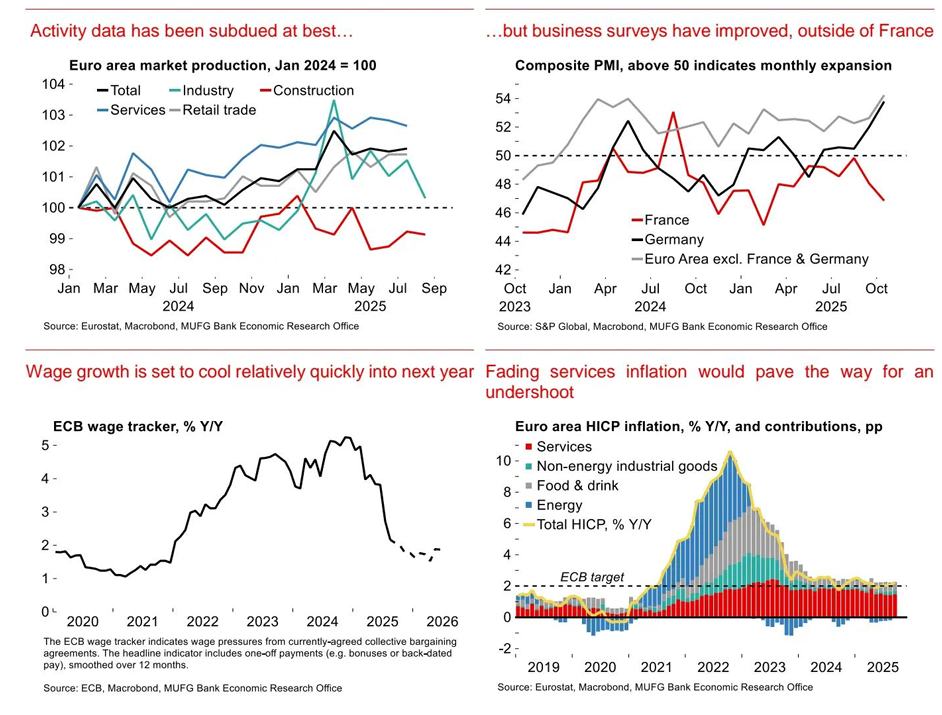
Core Viewpoint - The European Central Bank (ECB) is expected to maintain its current interest rates in the upcoming meeting, with market participants uncertain about future rate cuts, particularly in 2026, amid mixed economic signals and geopolitical factors [1][2][3]. Economic Indicators - Recent economic data indicates that the Eurozone is regaining growth momentum, with a notable improvement in the Purchasing Managers' Index (PMI) reaching a 17-month high of 52.2, despite concerns over political instability in France and weaker data from Germany [3][10]. - The inflation rate is hovering near the ECB's target, and the current interest rates are considered to be on a neutral trajectory, which has alleviated concerns regarding a downturn in Eurozone economic activity [3]. Market Expectations - The probability of the ECB restarting a rate cut cycle in 2026 has decreased to slightly below 50%, as traders reassess their positions following recent economic developments and statements from President Trump regarding trade agreements with China [2]. - MUFG's economist Cook maintains a forecast for further monetary easing by the ECB in 2026, citing potential fiscal stimulus from Germany and ongoing global trade uncertainties as factors that could keep inflation below the ECB's target [2][10]. Future Outlook - The ECB's upcoming meeting is anticipated to be a "low-key monetary policy meeting," focusing on inflation risk assessments and the implications of forthcoming economic data releases, including the preliminary GDP figures for Q3 and inflation data for Germany and the Eurozone [3]. - Cook predicts that the ECB may consider reinitiating rate cuts if inflation remains below the 2% target and the labor market shows signs of weakness, particularly in the context of a stronger Euro impacting import prices [10].