Oracle(ORCL)

Search documents
Oracle Stock Is Plunging Despite New Commitments From Nvidia and Meta. Here's Why.
Investopedia· 2025-12-11 00:50
Core Insights - Oracle has secured new agreements with AI companies Nvidia and Meta, contributing to a record backlog of $523 billion, but its fiscal second-quarter revenue of $16.06 billion fell short of analysts' expectations despite a 14% year-over-year increase [2][3] - The stock price of Oracle dropped 11% in after-hours trading following the earnings report, reflecting ongoing investor concerns about the sustainability of demand for its AI offerings and reliance on a few major customers in the AI sector [3][4] - Oracle's forecast for adjusted earnings per share for the third quarter is between $1.70 and $1.74, aligning with analysts' estimates, and it anticipates revenue growth of 19% to 21%, which exceeds projections [5] Stock Performance - As of the close on Wednesday, Oracle's shares have decreased approximately 35% from their September highs, although they remain up about 33% year-to-date, significantly lower than the 100% gain observed in September [6]


豪赌AI反噬?甲骨文Q2云收入略逊预期,天量订单难掩投资者忧虑 盘后闪崩逾10%
Jin Rong Jie· 2025-12-11 00:40
Core Viewpoint - Oracle Corporation reported a significant increase in spending on AI data centers and other equipment, but the conversion of these investments into cloud business revenue did not meet investor expectations, leading to a stock price drop of over 10% in after-hours trading [1] Financial Performance - For the second fiscal quarter ending November 30, total revenue grew by 14% to $16.1 billion, aligning closely with market expectations [1] - The adjusted earnings per share were $2.26, exceeding market average expectations [1] - Cloud software application revenue increased by 11% to $3.9 billion, marking the first time cloud infrastructure revenue surpassed application revenue [1] - Cloud computing sales rose by 34% to $7.98 billion, with infrastructure revenue growing by 68% to $4.08 billion, both slightly below analyst expectations [1] Capital Expenditure and Future Projections - The company reported capital expenditures of approximately $12 billion for the quarter, up from $8.5 billion in the previous quarter, exceeding analyst expectations of $8.25 billion [2] - Oracle expects capital expenditures to reach about $50 billion for the fiscal year ending November 2026, an increase of $15 billion from previous forecasts [3] - The company confirmed its annual revenue guidance of $67 billion, with total revenue expected to grow by 19% to 22% in the current fiscal quarter [3] Market Position and Strategic Moves - Oracle is making significant progress in the competitive cloud computing market, with major clients including TikTok and Meta Platforms [2] - The company’s "remaining performance obligations" metric surged to $523 billion, more than five times the previous figure, surpassing analyst estimates of $519 billion [2] - Concerns remain regarding the costs and timelines associated with Oracle's large-scale AI infrastructure investments, as the company has taken on substantial debt [2][3] Investor Sentiment and Market Challenges - Investor sentiment has been negatively impacted by doubts about the future of OpenAI's business and competition from companies like Google [4] - Analysts are looking for management to clarify how spending plans will adjust if demand for OpenAI changes [4]
盘后重挫超11%!甲骨文业绩不及预期,资本开支比预期多约150亿美元
美股IPO· 2025-12-11 00:34
甲骨文周三盘后公布2026财年第二财季业绩,营收与云业务收入均低于分析师预期,季度自由现金流为-100亿美元。公司同时上调全年资本开支指引, 预计将比此前预期多支出约150亿美元。受此影响,甲骨文股价盘后大跌超过11%。 甲骨文周三盘后公布第二财季业绩显示,该公司营收、云业务均不及分析师预期,季度自由现金流(FCF)为-100亿美元,预计年度资本开支将比原来 预料的多出大约150亿美元。该公司股价盘后大跌超过10%。 每股收益: 甲骨文第二财季GAAP每股收益为2.10美元,以美元计同比增长91%,以固定汇率计同比增长86%。非GAAP每股收益为2.26美元,以美元计同比增长 54%,以固定汇率计同比增长51%。 自由现金流: 甲骨文第二财季自由现金流(FCF)为-100亿美元。 云业务数据: 云业务: 甲骨文第二财季云业务营收(IaaS加SaaS)为80亿美元,以美元计同比增长34%,以固定汇率计同比增长33%,不及分析师预期80.4亿美元。 云基础设施: 第二财季云基础设施(IaaS)营收为41亿美元,以美元计同比增长68%,以固定汇率计同比增长66%,不及分析师预期。 以下是甲骨文第二财季财报要点: 主 ...

甲骨文2026财年第二季度电话会全文
美股IPO· 2025-12-11 00:34
Core Insights - Oracle Corporation reported a strong performance in Q2 of FY2026, with Remaining Performance Obligations (RPO) reaching $52.33 billion, a 433% year-over-year increase, driven by large contracts with companies like Meta and Nvidia [2][5][6] - Total cloud revenue reached $8 billion, growing by 33%, with Cloud Infrastructure (OCI) being the main growth driver, increasing by 66% to $4.1 billion, and GPU-related revenue surging by 177% [2][5][6] - The company is confident in executing its business backlog and maintaining an investment-grade debt rating, with capital expenditures expected to increase by approximately $15 billion to support accelerated business growth [2][5][9] Financial Performance Review and Outlook - The company reported a total revenue of $16.1 billion, a 13% increase year-over-year, with operating profit rising by 8% to $6.7 billion [6][8] - Non-GAAP earnings per share were $2.26, up 51%, while GAAP earnings per share were $2.10, reflecting an 86% increase [6][8] - The company anticipates that IPOs will account for 40% of revenue in the next 12 months, up from 25% in the previous year [5][6] Cloud Infrastructure (OCI) Growth - OCI's revenue growth accelerated by 66%, with significant demand for AI infrastructure, including the deployment of Nvidia GPUs [10][12] - The company operates 147 customer-facing real-time regions and plans to add 64 more, with a focus on delivering high-capacity data centers [10][12] - OCI's market consumption grew by 80%, supported by partnerships with companies like Broadcom and Palo Alto [13][15] AI Data Platform and Application Strategy - Oracle has developed the Oracle AI database and AI data platform to enable multi-step reasoning on private enterprise data while ensuring data privacy and security [16][17] - The AI data platform integrates various AI models, allowing for comprehensive data access and analysis across different databases and applications [17][18] - The company is focused on leveraging AI to enhance its applications, with significant growth in sectors like healthcare, where AI-driven solutions are being implemented [20][21] Application Business Performance and Sales Synergy - Total application revenue grew by 11%, with strong performance in core applications like Fusion ERP, SCM, and HCM, which saw growth rates of 17%, 18%, and 14% respectively [19][21] - The integration of industry application sales with core application sales teams has led to increased strategic conversations and larger transactions [21][22] - The company has successfully migrated 330 customers to the cloud, demonstrating robust demand for its application solutions [25][26]
甲骨文盘后大跌逾11% 云业务销售额不及预期、加大AI支出引发担忧
Jin Rong Jie· 2025-12-11 00:33
以数据库软件闻名的甲骨文最近在竞争激烈的云计算市场也取得了成功,该公司正在大规模建设数据中 心,以支持OpenAI的人工智能工作,Meta Platforms Inc.等公司都是其主要的云业务客户。该公司周三 公告表示,截至11月30日的季度,衡量订单量的指标——剩余履约义务增长超过四倍,达到5230亿美 元。数据显示,分析师平均估计为5190亿美元。 12月11日,甲骨文 (ORCL.US)盘后大跌逾11%,报197.77美元。甲骨文此前公布人工智能数据中心和其 他设备支出大幅增长,而这些支出转化为云收入所需的时间比投资者预期要长。该公司第二财季云业务 销售额增长34%至79.8亿美元,备受关注的基础设施业务收入增长68%至40.8亿美元。这两个数字均略 低于分析师的预期。 本文源自:格隆汇 ...
甲骨文,股价暴跌
财联社· 2025-12-11 00:24
Core Viewpoint - Oracle's stock price experienced a significant drop of over 10% following the release of mixed Q2 earnings, raising concerns among investors about the company's heavy investments in AI projects and the associated risks and returns [1][2]. Financial Performance - For the second fiscal quarter ending in November, Oracle reported an adjusted earnings per share of $2.26, a 54% increase year-over-year, surpassing analyst expectations of $1.64 [3]. - Revenue grew by 14% year-over-year to $16.1 billion, slightly below the anticipated $16.2 billion [3]. Cloud Infrastructure Growth - Oracle's cloud infrastructure revenue surged by 68% to $4.1 billion, accelerating from previous growth rates of 55% and 52% in the prior two quarters [4]. - This growth positions Oracle as a strong competitor against major players like Amazon, Microsoft, and Alphabet in the AI sector [4]. Contract Backlog - The company's remaining performance obligations (RPO) increased by 438% year-over-year to $523 billion, exceeding analyst expectations of $502 billion and growing 15% from the previous quarter [5][6]. - This substantial RPO growth is attributed to new commitments from clients such as Meta and NVIDIA [6]. Investor Concerns - Despite strong demand indicated by the earnings report, investors remain worried about the high costs associated with fulfilling these contracts and Oracle's reliance on OpenAI as a major client [6]. - The company's five-year credit default swap (CDS) rates have risen to their highest levels since 2009, reflecting declining investor confidence in Oracle's credit quality [7].

美股异动丨甲骨文盘后大跌逾11% 云业务销售额不及预期、加大AI支出引发担忧
Xin Lang Cai Jing· 2025-12-11 00:21
来源:格隆汇APP 格隆汇12月11日|甲骨文 (ORCL.US)盘后大跌逾11%,报197.77美元。甲骨文此前公布人工智能数据中 心和其他设备支出大幅增长,而这些支出转化为云收入所需的时间比投资者预期要长。该公司第二财季 云业务销售额增长34%至79.8亿美元,备受关注的基础设施业务收入增长68%至40.8亿美元。这两个数 字均略低于分析师的预期。以数据库软件闻名的甲骨文最近在竞争激烈的云计算市场也取得了成功,该 公司正在大规模建设数据中心,以支持OpenAI的人工智能工作,Meta Platforms Inc.等公司都是其主要 的云业务客户。该公司周三公告表示,截至11月30日的季度,衡量订单量的指标——剩余履约义务增长 超过四倍,达到5230亿美元。数据显示,分析师平均估计为5190亿美元。 ...
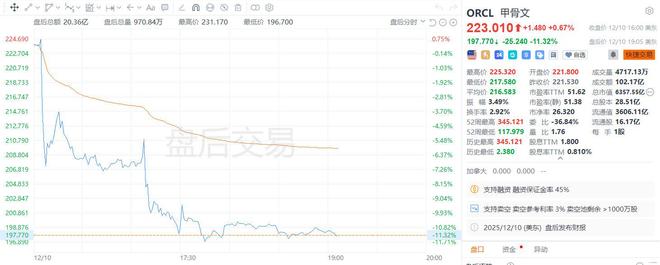
甲骨文预计第三财季营收增长19%—21%
Zheng Quan Shi Bao Wang· 2025-12-11 00:18
Core Viewpoint - Oracle's Q2 FY2026 performance fell short of analyst expectations, with total revenue of $16.1 billion and cloud revenue of $8 billion, both below forecasts [1] Financial Performance - Q2 remaining performance obligations increased by 438% year-over-year to $523 billion [1] - Q2 capital expenditures were $12 billion, with an expected total capital expenditure of approximately $50 billion for FY2026, an increase of about $15 billion from previous estimates [1] Debt Situation - Oracle has accumulated significant debt, recently issuing approximately $18 billion in new bonds, with total outstanding debt exceeding $100 billion, making it the largest in debt among investment-grade tech companies [1] Future Outlook - Oracle anticipates Q3 revenue growth of 19% to 21%, with cloud business growth projected at 40% to 44%, and reaffirms annual revenue target of $67 billion [1]
12月11日早餐 | 美联储降息;美股存储再度大涨
Xuan Gu Bao· 2025-12-11 00:12
Group 1: Federal Reserve and Market Reactions - The Federal Reserve lowered interest rates by 25 basis points and announced the purchase of short-term bonds, interpreted by the market as "not QE's QE" with a slightly dovish tone from Chairman Powell [1] - U.S. stock indices closed higher, with small-cap stocks leading the market; the S&P 500 rose by 0.67%, the Dow Jones increased by 1.05%, and the Nasdaq gained 0.33% [2] Group 2: Company Performance - Tesla, Broadcom, and Google saw stock increases of over 1%, while Oracle's post-earnings drop exceeded 10%, negatively impacting Nvidia, which fell over 1% in after-hours trading [3] - U.S. storage companies, including Micron Technology and Seagate Technology, reached new highs [4] Group 3: Chinese Market Developments - The Nasdaq Golden Dragon China Index rose by 0.64%, with notable gains from companies like Chuangzhi Global (over 47%), Junfu Capital (over 35%), and Fangduoduo (over 22%) [5] Group 4: Economic Indicators and Policies - U.S. Treasury yields fell across the board, with the two-year yield dropping over 7.6 basis points; the dollar decreased nearly 0.6%, marking its lowest level since October 29 [6] - China's satellite industry is rapidly developing, with successful launches of nine satellites, indicating a pressing need for satellite internet [7] Group 5: Sector Insights - The MLCC market is expected to grow significantly, with demand for AI servers projected to increase by 3.3 times by 2030 compared to 2025, driven by advancements in AI and automotive technologies [10] - The AI application "Qianwen" has surpassed 30 million monthly active users within 23 days of its public release, indicating strong growth potential in the AI sector [11] Group 6: Strategic Developments - Blueway Technology plans to acquire 100% of Peimeigao International, expanding into AI computing infrastructure [15] - Huasheng Co. intends to purchase 97.4% of AIDC company Yixin Technology for 6.62 billion yuan, focusing on green computing infrastructure services [15]



Oracle: Flunking On All Cylinders (NYSE:ORCL)
Seeking Alpha· 2025-12-11 00:00
Core Insights - The Conservative Income Portfolio aims to target high-value stocks with significant margins of safety while utilizing well-priced options to reduce investment volatility [1][2] - The Enhanced Equity Income Solutions Portfolio is structured to generate yields between 7-9% while minimizing volatility [1] - Trapping Value, with over 40 years of combined experience, focuses on generating options income and capital preservation through its Conservative Income Portfolio in collaboration with Preferred Stock Trader [2] Investment Strategies - The Conservative Income Portfolio includes two income-generating portfolios and a bond ladder, emphasizing lower volatility income investing [2] - The Covered Calls Portfolio is designed to provide income with a focus on capital preservation, while the fixed income portfolio targets securities with high income potential and significant undervaluation [2]