Oracle(ORCL)

Search documents
美国股票观点_人工智能资本支出的发展轨迹及企业人工智能应用的下一批受益者US Equity Views_ The trajectory of AI capex and the next beneficiaries of corporate AI adoption
2025-11-20 02:17
Summary of Key Points from the Conference Call Industry Overview - The report focuses on the AI infrastructure sector, particularly the capital expenditure (capex) trends among major AI hyperscalers including Amazon (AMZN), Google (GOOGL), Meta (META), Microsoft (MSFT), and Oracle (ORCL) [3][6][22]. Core Insights and Arguments - **Capex Growth Estimates**: Consensus estimates for 2026 capex for AI hyperscalers have increased from $467 billion (20% year-over-year growth) to $533 billion (34% year-over-year growth) during the 3Q earnings season [3][6][22]. - **Return Dispersion**: There is a notable increase in return dispersion within the AI infrastructure complex, driven by investor confidence in revenue generation from AI investments and the leverage used to fund these investments [3][6]. - **Future Capex Deceleration**: Analysts predict a significant slowdown in AI capex growth, from a current 76% year-over-year growth rate to 25% by the end of 2026. However, past estimates have been conservative, suggesting potential upside of $200 billion to current estimates [3][22][29]. - **Debt Capacity**: Large public AI hyperscalers have the capacity to increase net debt significantly without raising their net leverage above 1x. They have collectively increased net debt by $295 billion since 2021, with a current net debt/EBITDA leverage of +0.2x [3][22][42]. - **Supply Constraints**: Supply bottlenecks, particularly in power supply, may limit near-term capex growth more than cash flows or balance sheet capacity [54][55]. - **Investor Sentiment**: Investors are increasingly focused on companies that can demonstrate a clear link between capex and revenue growth. Negative reactions to capex surprises could lead management to reconsider future capex growth [55][66]. Additional Important Insights - **AI Platform Stocks**: Companies providing AI platforms are expected to benefit from increased corporate AI adoption, with a focus on those with high labor costs and exposure to AI automation [4][73]. - **Performance of AI Stocks**: The GS AI basket has outperformed the S&P 500 significantly, returning 40% year-to-date, driven by strong AI investment spending [11][15]. - **Investor Concerns**: There is growing anxiety among investors regarding the leverage and cash flow challenges faced by smaller firms in the AI ecosystem, particularly neoclouds [3][60]. - **Corporate AI Adoption**: Nearly half of S&P 500 companies discussed AI in their earnings calls, indicating a trend towards increased AI integration in business operations [68][72]. Conclusion - The AI infrastructure sector is experiencing significant capex growth, but future growth may be constrained by supply issues and investor scrutiny. Companies that can effectively link their investments to revenue generation are likely to be favored by investors. The ongoing corporate adoption of AI presents opportunities for AI platform stocks and productivity beneficiaries.





Oracle Was an AI Darling on Wall Street. Then Reality Set In.
WSJ· 2025-11-20 02:00
Core Insights - Shares have lost gains from a September AI-fueled pop, indicating a decline in investor confidence and market performance [1] - The company's debt load is growing, which may raise concerns about financial stability and future growth potential [1] Group 1: Market Performance - The company experienced a significant increase in share value due to AI-related developments in September, but this momentum has not been sustained [1] Group 2: Financial Health - The increasing debt load of the company suggests potential challenges in managing financial obligations and could impact future investment strategies [1]

Why a top strategist says the market is right to be concerned about massive borrowing among AI companies
Yahoo Finance· 2025-11-20 00:46
Concerns about an AI bubble have been rising on Wall Street in recent weeks. Julian Emanuel of Evercore said that rising debt among AI firms is a "rational" concern for markets. Despite thinking investors should be concerned, he remains mostly bullish on AI. Big Tech stocks have dipped recently on speculation that the peak is in and a correction in high-flying AI names is imminent. Front and center for investors is a relatively recent concern that heavy borrowing among AI companies could worsen th ...
AI热潮,哪些企业更受益?
Hua Er Jie Jian Wen· 2025-11-20 00:39
Core Insights - The market's investment in AI infrastructure is accelerating, with significant upward revisions in capital expenditure forecasts for major tech companies [1][2] - There is a shift in investment focus from basic infrastructure to AI platform stocks and productivity beneficiaries, indicating a more pronounced return differentiation [1][7] Capital Expenditure Forecasts - The consensus forecast for capital expenditure among the five major hyperscalers has increased from $467 billion (20% YoY growth) to $533 billion (34% YoY growth) for 2026 [2] - Analysts predict that there is still an upward potential of $200 billion in capital expenditure forecasts for 2026, suggesting current estimates may be overly conservative [3] Debt Capacity and Financial Health - Hyperscalers can increase their net debt by $700 billion without exceeding a net leverage ratio of 1x, indicating strong financial health and capacity for further investment [4] - Despite concerns about cash flow and balance sheet limitations, data shows that these companies have significant debt financing capabilities, with a net debt/EBITDA leverage ratio of only +0.2x [3] Market Dynamics and Risks - The tight relationship between large public companies and smaller AI firms creates a feedback loop, where pressures on smaller companies can impact the broader AI sector [6] - Supply chain constraints and investor appetite are more likely to limit recent capital expenditures than cash flow or balance sheet capabilities [4] Future Investment Opportunities - The focus is shifting towards AI platform stocks and productivity beneficiaries as companies increasingly adopt AI technologies [7][9] - Companies with high labor costs that are leveraging AI for automation are identified as potential beneficiaries in the evolving market landscape [9]
AI泡沫的“核心争议”:GPU真的能“用”6年吗?
华尔街见闻· 2025-11-19 23:45
Core Viewpoint - The article discusses the debate surrounding the economic lifespan of GPUs, which is crucial for understanding the profitability of major tech companies and the validity of current AI valuations. Bernstein's report suggests a depreciation period of 6 years for GPUs, arguing that this is economically reasonable, while critics like Michael Burry claim the actual lifespan is only 2-3 years, warning of potential accounting manipulation to inflate profits [1][11]. Group 1: Economic Viability of GPU Depreciation - Bernstein analysts argue that a 6-year depreciation period for GPUs is justified, as the cash costs of operating older GPUs are significantly lower than their rental prices [2][4]. - The report highlights that even 5-year-old NVIDIA A100 chips can still yield "comfortable profits," indicating that the depreciation policies of major cloud service providers are fair and not merely for financial embellishment [2][4]. - The analysis shows that the contribution profit margin for A100 chips can reach up to 70%, with operational costs being substantially lower than rental income, providing strong economic incentives for extending GPU usage [4][5]. Group 2: Market Demand and Old GPUs - The current market environment supports the value of older GPUs, as there is overwhelming demand for computing power, with AI labs willing to pay for any available capacity, even for outdated models [6][7]. - Industry analysts note that the A100's computing capacity remains nearly fully booked, suggesting that as long as demand stays strong, older hardware will continue to hold value [8]. Group 3: Depreciation Policies of Tech Giants - Google has a depreciation period of six years for its servers and network equipment, while Microsoft ranges from two to six years, and Meta plans to extend some assets to 5.5 years starting January 2025 [9][10]. - Notably, Amazon has reduced the expected lifespan of some servers and network equipment from six years to five years, reflecting differing views within the industry on hardware iteration speed [10]. Group 4: Criticism and Concerns - Michael Burry warns that tech giants are artificially inflating profits by extending the effective lifespan of assets, predicting that this accounting practice could lead to a profit inflation of $176 billion from 2026 to 2028 [11][12]. - Burry specifically points out that companies like Oracle and Meta could see their profits overstated by 26.9% and 20.8%, respectively, due to these practices [12]. - Previous warnings from Bank of America and Morgan Stanley indicate that the market may be underestimating the true scale of AI investments and the potential surge in future depreciation costs, which could reveal a lower actual profitability for tech giants than expected [14][15].


债务规模不断加大,投入回报面临失衡,美国科技巨头为AI基建“举债”引担忧
Huan Qiu Shi Bao· 2025-11-19 22:44
Core Viewpoint - The competition among U.S. tech giants for artificial intelligence (AI) dominance has intensified, leading to a surge in debt financing for data center construction, raising investor concerns about the sustainability of this trend [1][4]. Group 1: Debt Financing Trends - Amazon launched its first dollar bond issuance in three years, raising $15 billion, exceeding its initial target by $3 billion [3]. - Other tech companies are also heavily issuing bonds, with Alphabet raising approximately $17.5 billion in the U.S. and €7.5 billion in Europe, while Meta raised $30 billion in late October [3]. - Oracle plans to issue $38 billion in bonds to fund its AI infrastructure projects, contributing to a total of over $200 billion in corporate bonds issued by U.S. companies this year for AI-related infrastructure [3][4]. Group 2: Market Expectations and Concerns - Analysts estimate that global data center spending will reach nearly $3 trillion by 2028, with $1.4 trillion covered by cash flow from large U.S. tech companies, leaving a $1.5 trillion funding gap to be filled by other sources [4]. - The optimistic market outlook for AI revenue anticipates growth from $45 billion last year to $1 trillion by 2028, driven by demand from enterprises, public sectors, and individuals [4]. - Despite the robust cash flow and credit status of leading tech companies, doubts remain about the commercial viability of AI applications and the sustainability of investments in the sector [4]. Group 3: Risks and Market Reactions - If AI technologies fail to deliver expected returns in the coming years, heavily indebted companies may face significant losses, potentially impacting the broader economy [5]. - The current trend of shifting towards debt financing is reminiscent of the late 1990s internet bubble, raising concerns about the repayment of substantial debts incurred by tech companies [6]. - Recent market reactions include a sell-off in AI stocks, with Oracle's 30-year bonds dropping about 8% since their peak, indicating growing investor unease regarding the debt accumulation for AI infrastructure [6].


Oracle Commodity Holding Clarifies Terms of Amended Coal Royalty Amendments
Newsfile· 2025-11-19 22:21
Core Viewpoint - Oracle Commodity Holding Corp. has clarified its amended net smelter return (NSR) royalty agreements with Silver Elephant Mining Corp., which were initially announced on August 29, 2025, at the request of the TSX Venture Exchange [1]. Group 1: Amended Agreement Details - Under the Amended Agreement, the coal royalty from Silver Elephant's Mongolian coal projects to Oracle Commodity Holding is set at the greater of US$2 per tonne or 3% of NSR, based on the average spot sales price of coal [2]. - The previous royalty of 5% NSR under the original agreement was calculated on an actual sales-price basis, including discounts. The Amended Agreement replaces this with a 3% NSR royalty based on the average spot price, aligning with market conventions and simplifying the pricing methodology without materially altering its economic effect [3]. Group 2: Related Party Disclosure - Silver Elephant is a control person of Oracle Commodity Holding, making the amended royalty agreements "related party transactions" under Multilateral Instrument 61-101. Oracle Commodity Holding relied on available exemptions from the formal requirements under MI 61-101 for these agreements [5]. Group 3: Company Overview - Oracle Commodity Holding Corp. is a mining royalty company that holds royalties on several precious metal and critical mineral mining projects [6].

美股三大指数集体收涨,谷歌、英伟达涨超2%,中概指数跌1.53%
Ge Long Hui A P P· 2025-11-19 22:19
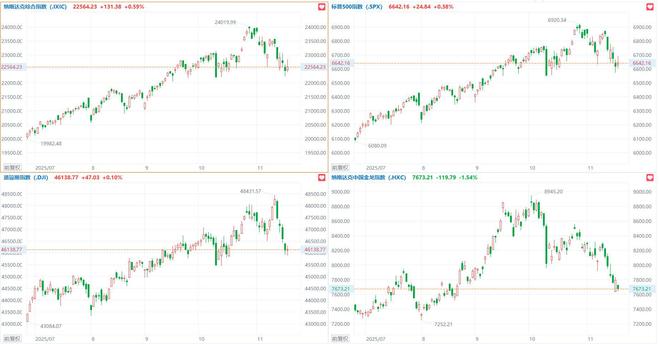
Market Performance - The three major U.S. stock indices closed higher, with the Dow Jones Industrial Average up 0.10%, the S&P 500 up 0.38%, and the Nasdaq Composite up 0.59% [1] - Large-cap tech stocks showed mixed results, with Google, Nvidia, Oracle, and Intel rising over 2%, while Netflix fell over 3%, AMD dropped over 2%, and Microsoft and Meta declined over 1% [1] Chinese Stocks - The Nasdaq Golden Dragon China Index fell by 1.53%, with most popular Chinese concept stocks declining [1] - Xpeng Motors dropped over 6%, NetEase fell over 4%, and NIO, Bilibili, and Li Auto each decreased by over 3%, while JD.com and Baidu were down over 1% [1]


美股收盘:三大指数集体收涨,谷歌、英伟达涨超2%
Xin Lang Cai Jing· 2025-11-19 21:13
Core Viewpoint - The U.S. stock market closed with all three major indices showing gains, indicating a positive market sentiment despite mixed performances among large tech stocks [1] Group 1: Market Performance - The Dow Jones Industrial Average increased by 0.1% [1] - The S&P 500 index rose by 0.38% [1] - The Nasdaq Composite gained 0.59% [1] Group 2: Large Tech Stocks - Google, Nvidia, Oracle, and Intel each saw increases of over 2% [1] - Netflix experienced a decline of over 3% [1] - AMD fell by over 2%, while Microsoft and Meta both dropped by over 1% [1]


Spotlight on Oracle: Analyzing the Surge in Options Activity - Oracle (NYSE:ORCL)
Benzinga· 2025-11-19 20:02
Deep-pocketed investors have adopted a bullish approach towards Oracle (NYSE:ORCL), and it's something market players shouldn't ignore. Our tracking of public options records at Benzinga unveiled this significant move today. The identity of these investors remains unknown, but such a substantial move in ORCL usually suggests something big is about to happen.We gleaned this information from our observations today when Benzinga's options scanner highlighted 153 extraordinary options activities for Oracle. Thi ...