
Palantir Technologies(PLTR)

Search documents
News Flash: Billionaire Michael Burry Bets Big Against AI Stocks Palantir and Nvidia
The Motley Fool· 2025-11-06 08:15
Group 1: Michael Burry's Investment Strategy - Hedge fund billionaire Michael Burry has made significant short bets against popular AI stocks Palantir and Nvidia, indicating a bearish outlook on these companies [1][2][3] - Burry's portfolio at Scion Asset Management has outperformed the S&P 500 by 20 percentage points over the last three years, showcasing his investment acumen [2] Group 2: Palantir Technologies - Palantir develops AI and data analytics platforms, recognized for its ontology-based software that enhances decision-making through machine learning [4] - The company was acknowledged as a leader in AI/ML platforms by Forrester Research, outperforming competitors like Google, AWS, and Microsoft Azure [5] - In Q3, Palantir's revenue surged 63% to $1.1 billion, marking the ninth consecutive quarter of revenue acceleration, with non-GAAP earnings more than doubling to $0.21 per diluted share [6] - Burry has allocated 66% of his portfolio to put options in Palantir, reflecting his belief that the stock is overvalued at 143 times sales, the highest in the S&P 500 [7][8] Group 3: Nvidia - Nvidia is a leader in AI infrastructure, particularly known for its GPUs, which dominate the data center market with over 90% market share [9][10] - The company is expected to maintain its market position due to its superior software development platform and integrated hardware solutions [10] - Nvidia trades at a more reasonable valuation of 30 times sales and a price-to-earnings multiple of 57, with earnings projected to grow at 36% annually over the next three years [11] - Burry has taken a smaller short position in Nvidia, indicating concerns about competition from custom AI accelerators and export restrictions affecting its business in China [12][11]


德银上调Palantir目标价至200美元
Ge Long Hui· 2025-11-06 07:54
Core Viewpoint - Deutsche Bank raised the target price for Palantir Technologies from $160 to $200 while maintaining a "Hold" rating [1] Group 1 - The target price adjustment indicates a positive outlook for Palantir Technologies [1] - The "Hold" rating suggests that the company is viewed as stable but not necessarily a strong buy at this time [1]
高盛上调Palantir目标价至188美元
Ge Long Hui· 2025-11-06 07:05
Core Viewpoint - Goldman Sachs raised the target price for Palantir Technologies from $141 to $188 while maintaining a "Neutral" rating [1] Group 1 - The target price adjustment reflects a positive outlook on Palantir Technologies' performance [1] - The new target price represents a significant increase of approximately 33.3% from the previous target [1]
Palantir(PLTR.US)“炸裂”财报获力挺 汇丰上调目标价至197美元
智通财经网· 2025-11-06 06:28
Group 1 - Palantir reported a 63% year-over-year revenue growth, reaching $1.18 billion, exceeding analysts' expectations of $1.09 billion, marking the second consecutive quarter above $1 billion [1] - Net profit surged over twofold from $143.5 million (6 cents per share) to $475.6 million (18 cents per share), with adjusted earnings per share at 21 cents, surpassing market expectations of 17 cents [1] - HSBC raised its target price for Palantir from $181 to $197, maintaining a "neutral" rating, while projecting a compound annual growth rate (CAGR) of 59.3% for the U.S. commercial sector from 2025 to 2029, with revenues expected to reach $9.3 billion by 2029 [1] Group 2 - Citigroup reiterated a "neutral/high risk" rating for Palantir, considering the potential peak in growth rates by 2026, which may lead to more challenging year-over-year comparisons [2] - Citigroup raised its estimates for Q4 guidance and increased revenue and earnings per share forecasts for 2026 by 13% and 24%, respectively, adjusting the target price from $190 to $210 [2]
大空头Michael Burry这次万一是对的,谁会输不起?
Xin Lang Cai Jing· 2025-11-06 04:49
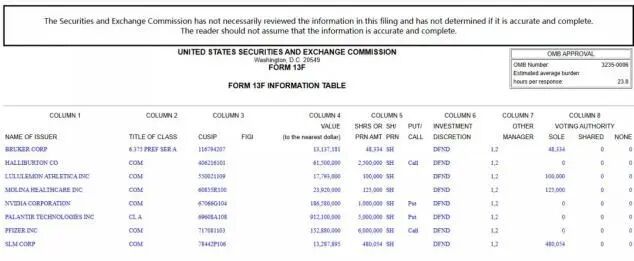
来源:估值之家 电影《大空头》的原型人物迈克尔·伯里(Michael Burry)旗下的Scion资产管理公司,在2025年11月3日提 交给美国证券交易委员会(SEC)的文件中披露,截至2025年9月30日,在其13.8亿美元的投资组合中, Palantir看跌期权的头寸达到约9.12亿美元,NVIDIA看跌期权的头寸达到约1.86亿美元,合计做空 Palantir和NVIDIA的仓位高达约80%,另外还持有少量辉瑞制药、哈利伯顿的看涨期权、以及 LULULEMON等少量股票多头头寸。 一个是AI软件(或AI应用)商业化最成功的企业,一个是AI硬件商业化最成功的企业,当"自认为"看 对大趋势后的Michael Burry,选择了重仓猛干Put(看跌期权),这与Michael Burry在2007年美国金融 危机前夕时,重仓猛干CDS(信用违约互换)时的做法,如出一辙。遗憾的是,目前尚无法得知 Michael Burry的期权到期日、行权价、期权费等重要参数。 | | | | The Securities and Exchange Commission tas not necessarly reviewed ...
历史重演还是纯属巧合?先是Burry做空,后是德银对冲,“大空头2.0”真实再现了!
美股IPO· 2025-11-06 04:26
Core Viewpoint - Michael Burry, known for his successful shorting of the housing bubble during the 2008 financial crisis, is now warning about an AI bubble, with 80% of his portfolio betting on an AI market crash [1][4][5]. Group 1: Michael Burry's Actions - Burry's Scion Asset Management has approximately 80% of its holdings focused on shorting Palantir and Nvidia, with a nominal value exceeding $1 billion [4][7]. - The put options for Palantir have a nominal value of $912 million, while those for Nvidia are valued at $186 million [7]. - Burry's strategy mirrors his previous actions before the subprime mortgage crisis, indicating a belief that many leading companies in the current AI hype will ultimately fail [7]. Group 2: Deutsche Bank's Position - Deutsche Bank is heavily invested in data center financing, primarily lending to major tech companies like Alphabet, Microsoft, and Amazon, with estimated loans reaching several billion dollars [8]. - The bank is considering shorting a basket of AI-related stocks and exploring "synthetic risk transfer" (SRT) transactions to mitigate loan default risks [9]. - The discussions within Deutsche Bank about hedging risks echo the strategies employed during the 2008 financial crisis, raising concerns about potential similarities in risk management practices [9]. Group 3: Market Sentiment and Regulatory Warnings - Global regulatory bodies are issuing warnings about the AI asset bubble, with the Monetary Authority of Singapore highlighting "relatively tight valuations" in the tech and AI sectors [4]. - Major financial institutions, including Goldman Sachs and Morgan Stanley, have cautioned that U.S. stock valuations are excessively high, predicting at least a 10% market correction [4].


历史重演还是纯属巧合?先是Burry做空,后是德银对冲,“大空头2.0”真实再现了!
Hua Er Jie Jian Wen· 2025-11-06 02:47
Core Insights - A situation reminiscent of the 2008 financial crisis is unfolding around the AI investment frenzy, with Michael Burry heavily shorting Nvidia and Palantir, echoing his previous actions during the housing bubble [1][2] - Deutsche Bank is considering shorting AI stocks to hedge against significant loan risks in the data center sector, marking a shift from real estate to AI-related loans [1][3] Group 1: Michael Burry's Actions - Michael Burry has concentrated approximately 80% of his portfolio on shorting Palantir and Nvidia, with a notional value exceeding $1 billion [1][2] - His bearish stance is supported by a belief that AI investment returns are too low and that many leading companies may ultimately collapse, similar to the internet bubble [2] Group 2: Deutsche Bank's Strategy - Deutsche Bank has made substantial bets on data center financing, primarily lending to major tech firms like Alphabet, Microsoft, and Amazon, with estimated loans reaching several billion dollars [3][4] - The bank is exploring options to hedge risks, including shorting a basket of AI-related stocks and utilizing a synthetic risk transfer (SRT) strategy to package and sell loan default risks to external investors [3][4] Group 3: Market Reactions and Concerns - Global regulatory bodies have issued warnings about the AI asset bubble, with Singapore's Monetary Authority highlighting "stretched valuations" in the tech and AI sectors [1] - Analysts have noted that Deutsche Bank's consideration of SRT structures resembles the debt collateralized obligations (CDOs) from the past, raising concerns about potential risks [4]
一夜暴涨超600%!又有中概股爆发
Zheng Quan Shi Bao· 2025-11-06 00:29
Market Overview - On November 5, major U.S. stock indices closed higher, with the Dow Jones rising by 225.76 points (0.48%) to 47,311.00 points, the Nasdaq increasing by 151.16 points (0.65%) to 23,499.80 points, and the S&P 500 gaining 24.74 points (0.37%) to 6,796.29 points [3]. AI Sector Performance - The AI sector showed signs of recovery, with AMD initially opening lower but eventually closing up by 2.51%. This rebound also positively impacted other AI stocks. AMD's Q3 earnings and revenue exceeded analyst expectations, despite initial concerns about profit margins [5]. - Other companies in the AI space, such as Broadcom and Micron Technology, also saw significant gains, with increases of 2% and 8.93% respectively [5]. Chinese Concept Stocks - The Nasdaq Golden Dragon China Index rose by 0.15%, with notable gains in several Chinese concept stocks. Haichuan Securities experienced a dramatic increase, closing up over 620%. The company, founded in 2015 and listed on Nasdaq in 2019, focuses on investment banking and asset management [7]. - Other Chinese stocks such as Futu Holdings and Tiger Brokers rose over 4% and 3% respectively, while Baidu and New Oriental saw declines of over 1% and 3% [7]. Employment Data and Economic Indicators - The ADP private employment data released on November 5 showed an increase of 42,000 jobs in October, surpassing the Dow Jones estimate of 22,000. The previous month's job loss was revised from a decrease of 29,000 to a decrease of 3,000 [4]. - ISM services sector data also exceeded expectations, indicating a robust employment market that may influence Federal Reserve interest rate policies [4].


How Jim Cramer navigates a market selloff
CNBC· 2025-11-05 23:21
Core Viewpoint - The article emphasizes using market declines as buying opportunities, highlighting that major indexes rebounded after a down session, particularly following significant losses in tech stocks like Palantir [1][2]. Market Analysis - Major indexes experienced a decline on Tuesday, primarily driven by an 8% drop in Palantir and other artificial intelligence stocks, raising concerns over inflated valuations in the tech sector [2]. - Despite Palantir's strong earnings report and positive guidance, its stock suffered due to the broader market's negative sentiment [2]. Investment Recommendations - Cramer advises investors to identify stocks that have recently reported strong quarterly results but have seen their prices drop due to market-wide declines, suggesting a gradual approach to buying rather than investing all at once [3][5]. - Two specific companies recommended for purchase during market weakness are Shopify and McDonald's. Shopify's stock decline is attributed to the overall market downturn rather than business issues, with management anticipating a robust holiday season [4]. - Cramer views McDonald's earnings miss as understandable given the challenging environment for the restaurant industry, noting the company's significant scale and efforts to reduce prices amid weakening consumer spending [4].


“AI泡沫”影响美股,日韩股市下挫
Huan Qiu Shi Bao· 2025-11-05 22:57
Group 1 - The global capital markets are experiencing concerns over high valuations of AI-related companies, leading to fears of a "bubble burst" [1] - The U.S. stock market saw a significant decline on October 4, with the Nasdaq Composite Index dropping by 2.04%, reflecting a broader negative sentiment [1] - Palantir, a representative stock in the AI sector, reported Q3 revenue of $1.18 billion and earnings per share of $0.21, both exceeding expectations, yet its stock price fell by 7.95% [1] Group 2 - Michael Burry, known for predicting the U.S. subprime mortgage crisis, has bet against Palantir and Nvidia, warning of a bubble in the AI sector [2] - OpenAI's valuation is estimated at $500 billion, but it lacks a clear profit model, raising concerns about its financial sustainability [2] - The Korean Composite Stock Price Index (KOSPI) dropped by 117.32 points, or 2.85%, on October 5, triggering a temporary trading halt due to significant sell pressure [2] Group 3 - The Japanese market also experienced a notable decline, with the Nikkei 225 index falling by 2.5% and briefly dipping below the 50,000 mark [3] - Goldman Sachs' CEO predicts a potential 10% to 20% correction in the U.S. stock market over the next 12 to 24 months, suggesting a reevaluation phase following rapid gains [3] - Analysts in the Korean securities market indicate that short-term volatility may persist as valuation disputes remain unresolved [3]