Seek .(SKLTY)

Search documents
AI-医疗-DeepSeek新一代大模型电话会
2026-01-15 01:06
Summary of Conference Call on AI in Healthcare - DeepSeek Industry Overview - The application of AI in the healthcare sector is increasingly widespread, particularly in areas such as image recognition, Clinical Decision Support Systems (CDSS), and intelligent triage [1][2] - Collaboration between Ruijin Hospital and Huawei has led to the development of an open-source large model that significantly enhances pathological recognition capabilities, which has been adopted by multiple hospitals to alleviate the shortage of pathologists [1][2] Key Insights and Arguments - AI technology has shown remarkable progress in medical imaging, especially in chest X-rays, CT scans, MRIs, and angiography, with significant efficiency in identifying lung nodules during the pandemic [2] - The integration of AI in rehabilitation robotics is a promising area, particularly in community hospitals, with companies like Fourier Intelligence making substantial advancements [2][3] - The current AI systems in hospitals are primarily provided by external vendors, while hospitals supply the necessary hardware, such as Haiguang CPUs and Huawei 910B integrated machines [5] - AI accounts for approximately 1% of total healthcare IT spending, with one-third of that allocated to AI solutions [6] Emerging Trends - Personal health applications, both domestically (e.g., Ant Financial's Aifuku) and internationally (e.g., OpenAI Health), are rapidly developing, focusing on managing patient data through apps in collaboration with healthcare professionals [7][8] - Future data integration efforts may focus on chronic diseases like diabetes, with third-party platforms facilitating data sharing and utilization [9] Data Management and Integration - Current efforts in hospital data management are being spearheaded by local health authorities, with projects in the planning stages to organize and potentially trade data assets [10][11] - Although no hospital has fully established a comprehensive data management system yet, pilot projects are underway to explore data asset trading [11] Competitive Dynamics - The relationship between public hospitals, third-party companies, and large enterprises is evolving, with commercial entities potentially addressing service limitations imposed by insurance reimbursement standards [12] - The demand for rehabilitation services is high in aging cities like Shanghai, where the shortage of rehabilitation physicians and expensive equipment presents challenges [3][14] Future Prospects - The acceptance of large models in hospitals has increased significantly, with AI technology becoming a standard component in various healthcare IT projects [4] - The integration of AI in hospital management is expected to enhance operational efficiency and improve service quality [4] - The market for rehabilitation robots is expected to diversify in terms of payment models, with potential for private institutions to adopt service fees or insurance payments [17] Conclusion - The healthcare industry is on the brink of a significant transformation driven by AI technologies, with ongoing developments in data management, rehabilitation robotics, and personalized health applications paving the way for improved patient care and operational efficiency [1][2][3][4][5][6][7][8][9][10][11][12][14][17]


财经观察:DeepSeek一周年,中美AI之路再对比
Huan Qiu Shi Bao· 2026-01-14 22:51
Core Insights - DeepSeek, a Chinese AI startup, is set to launch its next-generation AI model V4 in mid-February, which is expected to outperform competitors like Anthropic's Claude and OpenAI's GPT series [1] - The rapid development of AI in China has narrowed the gap with the US, with experts noting that the progress made in just one year is significant [1][2] Group 1: Company Developments - DeepSeek's R1 model was launched last year and completed training in just two months at a fraction of the cost incurred by US companies, achieving comparable performance to ChatGPT and Meta's Llama [2] - Chinese open-source AI models account for nearly 30% of global AI technology usage, with companies like Airbnb and Meta utilizing models developed by Alibaba [3] - Alibaba has released nearly 400 open-source models, with over 18 million derivatives and 700 million downloads, showcasing its significant role in the global AI landscape [3] Group 2: Competitive Landscape - The US AI strategy focuses on high-performance closed-source models and platform products, while China emphasizes open-source models and rapid industrial application [4] - While the US leads in cutting-edge model capabilities, China excels in engineering efficiency and speed of deployment, with no significant time lag in these areas [5] Group 3: Future Trends - The next significant advancements in AI are expected to occur in areas such as humanoid robots integrated with large models, industrial applications, and breakthroughs in low-cost inference and edge computing [10] - The AI toy industry is projected to reach a milestone of 1 million units sold, which will generate substantial interaction data, enhancing model capabilities and establishing AI toys as essential daily items [11]
摩根资产管理认为中国科技领域将迎来“更多DeepSeek时刻”
Xin Lang Cai Jing· 2026-01-14 07:58
Group 1 - Morgan Asset Management indicates that Chinese technology stocks will continue to benefit from technological breakthroughs as China intensifies efforts to create more companies similar to DeepSeek [1] - The company's global market strategist, Raisah Rasid, stated that there are still many opportunities in the technology sector in China [1] - There will be increasing advancements in robotics technology and more "DeepSeek moments" expected in the future [1]
PriceSeek提醒:雅化锂矿运回促氢氧化锂供应增
Xin Lang Cai Jing· 2026-01-14 04:09
Core Viewpoint - Yahua Group has successfully transported lithium ore from Zimbabwe back to China for the production of lithium hydroxide, indicating a stable and increased supply of raw materials, which may enhance production capacity and affect market dynamics negatively for lithium hydroxide prices [1][4]. Group 1: Company Developments - Yahua Group announced on January 13 that it has returned a bulk shipment of lithium ore from Zimbabwe for domestic production [1][4]. - The return of lithium ore is expected to stabilize and potentially increase the production of lithium hydroxide, which is crucial for battery manufacturing [1][4]. Group 2: Market Implications - The increase in raw material supply is likely to enhance market expectations for lithium hydroxide supply, potentially leading to downward pressure on spot prices due to alleviated shortages [2][5]. - The overall market sentiment is rated as slightly bearish (-1), as the substantial increase in supply is expected to negatively impact prices, despite not reaching an extreme level [2][5].

幻方量化去年收益率56.6%,为DeepSeek提供超级弹药
2 1 Shi Ji Jing Ji Bao Dao· 2026-01-14 02:16
Core Insights - The article highlights the impressive performance of Huansheng Quantitative, which achieved an average return of 56.55% in 2025, ranking second among quantitative private equity firms in China, only behind Lingjun Investment with 73.51% [2] - Huansheng Quantitative's management scale has exceeded 70 billion yuan, and its average returns over the past three years and five years are 85.15% and 114.35%, respectively [2] - The strong returns from Huansheng Quantitative provide substantial funding support for DeepSeek, a company focused on AI model development, founded by Liang Wenfeng [2][4] Company Overview - Huansheng Quantitative was established in 2015 and specializes in AI quantitative trading, consistently investing in AI algorithm research [2][4] - The company has a diverse team composed of experts in various fields, including mathematics, physics, and computer science, which enables it to tackle challenges in deep learning and big data modeling [2] - The company has experienced rapid growth, surpassing 100 billion yuan in management scale in 2019 and reaching over 700 billion yuan currently [2][4] Financial Performance - Based on industry estimates, Huansheng Quantitative's strong performance last year could generate over 700 million USD in revenue, assuming a 1% management fee and a 20% performance fee [6] - The funding for DeepSeek's research comes from Huansheng Quantitative's R&D budget, with Liang Wenfeng holding a majority stake in both companies [4][5] AI Model Development - DeepSeek, incubated by Huansheng Quantitative, aims to advance general artificial intelligence and has a budget of 5.57 million USD for its V3 model training costs [7] - DeepSeek plans to release its next-generation AI model, DeepSeek V4, around the Lunar New Year, which is expected to surpass existing top models in programming capabilities [7]


幻方量化去年收益率56.6% 为DeepSeek提供超级弹药
2 1 Shi Ji Jing Ji Bao Dao· 2026-01-14 02:15
Core Insights - The article highlights the impressive returns of Fantom Quantitative, which achieved an average return of 56.55% in 2025, ranking second among quantitative private equity firms in China, only behind Lingjun Investment with a return of 73.51% [1] - Fantom Quantitative's average return over the past three years is 85.15%, and 114.35% over the past five years, providing substantial funding support for DeepSeek's large model research [2] - Founded in 2015 by Liang Wenfeng, Fantom Quantitative focuses on AI quantitative trading and has a current management scale exceeding 70 billion yuan, maintaining a leading position in the domestic private quantitative investment sector [2][3] Company Overview - Fantom Quantitative has a team composed of award-winning mathematicians, physicists, and experts in AI, employing interdisciplinary collaboration to tackle challenges in deep learning, big data modeling, and quantitative analysis [2] - The company has been utilizing machine learning for fully automated quantitative trading since 2008 and has expanded rapidly since its inception [2] - Significant investments were made in AI training platforms, with "Firefly No. 1" established in 2019 and "Firefly No. 2" in 2021, leading to the establishment of DeepSeek in July 2023 [3] Financial Performance - Liang Wenfeng holds a majority stake in Fantom Quantitative and has ceased to introduce external funding for the fund, indicating a strong accumulation of capital for supporting large model research [4] - The strong performance of Fantom Quantitative is estimated to have generated over 700 million USD in revenue last year, assuming a 1% management fee and 20% performance fee [4] DeepSeek Developments - DeepSeek's V3 model has a total training cost budget of 5.57 million USD, while competitors like Zhizhu and MiniMax have reported significant R&D expenditures [5] - DeepSeek plans to release its next-generation AI model, DeepSeek V4, around the Lunar New Year, which is expected to surpass current leading models in programming capabilities [5]
DeepSeek论文披露全新模型机制,SSD等存储需求有望再进一步,龙头还发布炸裂业绩
Xuan Gu Bao· 2026-01-13 23:24
Group 1 - DeepSeek introduced a new paper proposing "conditional memory" as a new dimension of sparsity to optimize large language models through the Engram module [1] - The existing Transformer architecture lacks a native knowledge retrieval mechanism, leading to inefficient simulation of retrieval behavior [1] - Conditional memory complements the MoE (Mixture of Experts) approach and significantly enhances model performance in knowledge retrieval, reasoning, coding, and mathematical tasks under equal parameters and computational conditions [1] Group 2 - The Engram module is a large, scalable embedding table that acts as an external memory for Transformers, allowing for efficient retrieval of nearby content [2] - Engram caches frequently accessed embeddings in faster storage mediums while storing less frequently accessed data in larger, slower storage, maintaining low access latency [2] - The NAND industry is expected to have limited capital expenditure over the next two years, with leading manufacturers likely to focus on HBM rather than NAND, while AI applications are anticipated to drive SSD demand [2] Group 3 - Baiwei Storage forecasts a net profit of 850 million to 1 billion yuan for the year, representing a year-on-year growth of 427.19% to 520.22% [2] - Jiangbolong has launched several high-speed enterprise-level eSSD products, covering mainstream capacities from 480GB to 7.68TB [3]
DeepSeek母公司去年进账50亿,够烧2380个R1
3 6 Ke· 2026-01-13 13:02
Core Insights - DeepSeek has not engaged in new financing or significant commercialization activities despite the buzz surrounding large model players in the market [1] - DeepSeek continues to produce high-quality research papers, indicating a stable output of academic contributions [2] - The financial success of its parent company, Huanfang Quantitative, which earned approximately $7 billion last year, provides substantial funding for DeepSeek's research endeavors [6][8] Group 1: Financial Performance - Huanfang Quantitative's funds are showing impressive returns, with nearly all of its funds projected to yield over 55% in 2025 [3] - The average return for quantitative funds in China last year was 30.5%, significantly outperforming global competitors [4] - Huanfang Quantitative's asset management exceeds $70 billion, contributing to its substantial earnings [7] Group 2: Research and Development - DeepSeek's research expenditures are relatively low, with the latest V3 training costing $557,600 and R1 costing $29,400, allowing for the potential production of numerous models with available funds [6] - DeepSeek has maintained a focus on AGI research without the pressure of immediate financial returns, as it has not accepted external funding and is not tied to any major tech company [11][15] - The company has consistently released significant research outputs, including recent advancements in OCR and V3.2, while also open-sourcing components like the memory module [9][10] Group 3: Market Position and Strategy - DeepSeek operates with a unique business model that allows it to focus solely on AGI without the distractions of monetization pressures [10][12] - The company benefits from a stable and committed research team, with minimal turnover and even some returning members, indicating a strong internal culture [28][30] - DeepSeek's research outputs have become valuable to investors, as its technical papers provide insights that influence stock movements in related hardware companies [34][39] Group 4: Competitive Landscape - Compared to other major players like OpenAI, DeepSeek's approach is characterized by a lack of aggressive monetization strategies, focusing instead on pure research [26][9] - The ability to leverage a mature business model for cross-subsidization of AI research is often underestimated in the market [19][20] - DeepSeek's model integrates the strengths of both established companies and pure AI startups, positioning it uniquely in the competitive landscape [26]

梁文锋署名DeepSeek最新论文,提出新方法突破GPU内存限制
Xin Lang Cai Jing· 2026-01-13 12:33
Core Viewpoint - DeepSeek, a Chinese AI startup, has developed a new model training technique that bypasses GPU memory limitations, enhancing cost efficiency and performance in AI model training [1][3]. Group 1: Technology and Innovation - DeepSeek and researchers from Peking University introduced a "conditional memory" technique called "Engram" to address the limitations of high bandwidth memory (HBM) in scaling AI models [3][4]. - The Engram technology allows for more efficient retrieval of foundational information by decoupling computation from storage, improving the model's performance in handling long contexts [4][6]. - In a model with 27 billion parameters, the new technique improved performance on key industry benchmarks by several percentage points, preserving capacity for complex reasoning tasks [4][6]. Group 2: Competitive Landscape - The HBM gap between China and the US is significant, with Chinese storage chip manufacturers lagging behind their US and South Korean counterparts [4]. - DeepSeek's previous model, DeepSeek-R1, was trained in two months at a cost of $5.5 million, significantly lower than the expenses incurred by US companies like OpenAI, while achieving comparable performance [6][7]. - Microsoft President Brad Smith highlighted that Chinese companies like DeepSeek are rapidly gaining ground in the global AI market, particularly in emerging markets, due to their low-cost open-source models [7]. Group 3: Future Developments - Anticipation is building for DeepSeek's upcoming V4 model, expected to launch in mid-February, which is said to possess strong programming capabilities [7].
梁文锋署名DeepSeek新论文,“突破GPU内存限制”
Guan Cha Zhe Wang· 2026-01-13 12:28
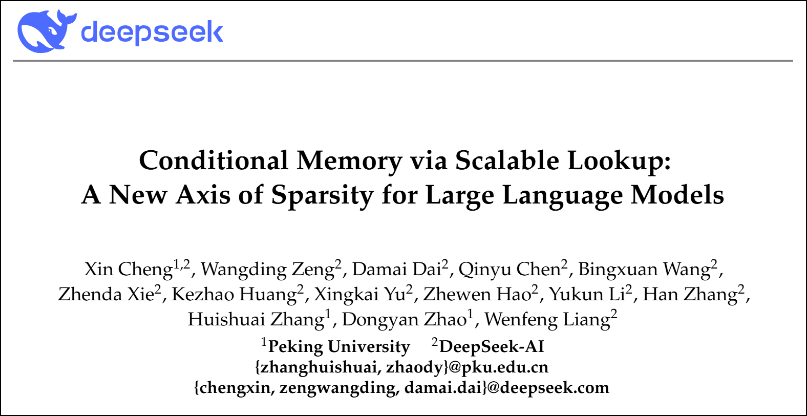
Core Insights - DeepSeek, a Chinese AI startup, has published a technical paper introducing a new model training technique that bypasses GPU memory limitations, highlighting its focus on cost efficiency despite existing gaps with leading US firms [1][2] - The new technique, termed "Engram," addresses the bottleneck of limited high-bandwidth memory (HBM) in scaling AI models, which is a significant gap between China and the US in AI hardware [3][4] - The paper has garnered attention from industry professionals in both China and the US, indicating DeepSeek's role as a leader in AI innovation over the past year [1][2] Technical Developments - The paper titled "Conditional Memory via Scalable Lookup: A New Axis of Sparsity for Large Language Models" presents the "conditional memory" technology aimed at improving the efficiency of AI models when processing long contexts, a major challenge for AI chatbots [2][3] - The Engram technique allows for the decoupling of computation and storage, enhancing the model's ability to retrieve foundational information more efficiently [3][4] - Validation of this technology was conducted on a model with 27 billion parameters, showing performance improvements in key industry benchmarks [3] Market Position and Competition - DeepSeek's previous model, DeepSeek-R1, was trained in two months at a cost of $5.5 million, significantly lower than competitors like OpenAI, while achieving comparable performance [6][7] - Microsoft President Brad Smith has noted that US AI companies are being surpassed by Chinese competitors like DeepSeek, particularly in emerging markets due to the low-cost and user-friendly nature of Chinese open-source models [7] - Anticipation is building for DeepSeek's upcoming V4 model, expected to launch in mid-February, which is said to possess strong programming capabilities [8]