Seek .(SKLTY)

Search documents
DeepSeek新模型MODEL1曝光
Jin Rong Jie· 2026-01-20 23:59
Core Insights - DeepSeek has unveiled its new model "MODEL1" on the first anniversary of DeepSeek-R1, indicating a significant development in its product line [1] - The company updated its FlashMLA code on GitHub, with 28 mentions of MODEL1 across 114 files, suggesting that MODEL1 is a distinct architecture compared to V32, which is identified as DeepSeek-V3.2 [1] - Key differences in the code include KV cache layout, sparsity handling, and FP8 decoding, highlighting various optimizations in memory usage [1] - There are reports that DeepSeek plans to release its next-generation flagship model around mid-February, coinciding with the Chinese New Year [1]

与美国关系出现裂痕,欧洲要学中国打造自主版DeepSeek
Feng Huang Wang· 2026-01-20 08:21
Core Insights - European AI companies are seeking to innovate and reduce reliance on American technology amid rising geopolitical tensions with the U.S. [4] - The success of the Chinese AI startup DeepSeek has inspired European researchers to explore alternative paths for developing competitive AI products [5] - European governments are committing hundreds of millions of dollars to decrease dependence on foreign AI suppliers [5] Group 1: Current Landscape - U.S. companies dominate the AI industry across various segments, including processor design, data center capacity, and application development [4] - The perception that innovation is solely occurring in the U.S. is considered dangerous, as it may discourage European efforts to compete [5] - European AI labs may have an advantage in open research and development, allowing for collaborative improvements on models [5] Group 2: Urgency for Autonomy - The changing geopolitical landscape has heightened the urgency for Europe to achieve self-sufficiency in AI technology [6] - Tensions between European leaders and the Trump administration have raised concerns about the future of NATO and the reliance on U.S. technology [6][7] - European dependence on U.S. AI services is viewed as a potential liability in trade negotiations [7] Group 3: Strategies for Development - European countries are attempting to localize AI development through funding initiatives, regulatory adjustments, and partnerships with academic institutions [8] - There is a focus on creating competitive large language models tailored for European languages [8] - The ongoing success of U.S. platforms like ChatGPT poses a challenge for European AI companies to catch up [9] Group 4: Policy and Market Dynamics - There is ambiguity regarding how far Europe intends to push for "digital sovereignty" and whether it requires complete self-sufficiency or just local alternatives [10] - Some European suppliers advocate for strategies that prioritize local AI products, while others warn against excluding U.S. companies [10] - The consensus on policy measures to achieve self-sufficiency in AI is still lacking within Europe [10] Group 5: Future Aspirations - Despite limited budgets, European AI labs believe they can close the performance gap with U.S. leaders, as demonstrated by DeepSeek [11] - Projects like SOOFI aim to develop competitive language models with around 100 billion parameters [11] - The future progress in AI may not solely depend on the largest GPU clusters, indicating a shift in the competitive landscape [11]





脑机接口第一股来了,「DeepSeek时刻」还没来
Xin Lang Cai Jing· 2026-01-19 13:16
Group 1 - The core idea of the article is that the brain-computer interface (BCI) sector is gaining significant attention and investment, with major developments from companies like Neuralink and Qiangnao Technology, indicating a potential commercial breakthrough in the near future [1][30][11] - Neuralink plans to begin large-scale production by 2026, while Qiangnao Technology has completed a financing round of 2 billion yuan and submitted an IPO application to the Hong Kong Stock Exchange [1][30][11] - The BCI technology is not new, having been conceptualized as early as 1973, but recent advancements have made it more viable for applications such as movement reconstruction and cognitive enhancement [1][31][36] Group 2 - Neuralink has made significant progress in invasive BCI technology, reducing the time to implant a single electrode from 17 seconds to 1.5 seconds and conducting 12 clinical studies with over 10,000 patients waiting for treatment [5][36] - Qiangnao Technology is pursuing a non-invasive approach, which allows for brain signal collection without surgery, potentially expanding its applications to entertainment and gaming [7][39][41] - The market for BCIs is projected to reach $400 billion in the U.S. medical sector by 2045, with the overall market expected to exceed $1 trillion [12][43] Group 3 - Both Neuralink and Qiangnao Technology face significant challenges, including the immaturity of the technology, high costs, and privacy concerns [15][47][56] - The technology is still developing, with current methods only able to record signals from a limited number of neurons, and invasive methods face risks of infection and device failure [49][50] - The costs associated with BCI technology, including device and surgical expenses, are currently high, which could limit accessibility and market growth [21][53][55] Group 4 - Companies are seeking capital to expand production and reduce costs, with Neuralink raising $650 million in its Series E funding and Qiangnao Technology securing 2 billion yuan in its Pre-IPO round [24][56] - Qiangnao Technology aims to assist 1 million individuals with mobility impairments and 10 million patients with cognitive disorders over the next 5 to 10 years [26][58] - Privacy issues surrounding data collection from BCIs need to be addressed, as the data could involve sensitive personal information [26][60]

没有商业模式,是DeepSeek最坚固的“护城河”
3 6 Ke· 2026-01-19 08:22
Core Insights - The article discusses the upcoming anniversary of DeepSeek and the expectations surrounding its new model release, emphasizing that the market should temper its expectations as the AI landscape has evolved significantly since last year [1][10]. Group 1: Business Model and Funding - DeepSeek's strongest competitive advantage is its unique model of zero external financing, allowing it to pursue its AGI dream without commercial pressures [2][15]. - The founder, Liang Wenfeng, prioritizes control over financial backing, making DeepSeek an outlier in a capital-driven AI industry [3][18]. - DeepSeek's funding comes from its profitable quantitative fund, Huanfang Quantitative, which generated over $700 million (approximately 5 billion RMB) in profit last year, allowing for investment in resources without external investor pressure [4][18]. Group 2: Market Position and Competition - The article warns that while DeepSeek previously led the market with its models, it is no longer the only or the most open player, as many competitors have emerged with open-source models [10][11]. - The expectation that DeepSeek will release a groundbreaking model is tempered by the reality that the market is now saturated with open-source alternatives, diminishing its unique position [10][14]. Group 3: Internal Dynamics and Research Quality - The absence of external funding allows DeepSeek to maintain a flat organizational structure, reducing internal competition and bureaucracy, which can hinder research quality [20][22]. - The article highlights that excessive funding can lead to "big company syndrome," where resources are mismanaged and research quality suffers, a situation DeepSeek avoids by self-funding [6][20]. - The focus on research quality over sheer computational power is emphasized, with insights from Ilya Sutskever suggesting that significant breakthroughs do not necessarily require vast computational resources [7][21]. Group 4: Investor Perspective - The author expresses a paradoxical desire to invest in DeepSeek while recognizing that accepting external funding would compromise its unique characteristics and mission [9][25]. - The article concludes that DeepSeek's lack of a commercial model is its enduring strength, allowing it to align its internal goals with its AGI research without external pressures [25].
没有商业模式--DeepSeek最坚固的“护城河”
Hua Er Jie Jian Wen· 2026-01-18 08:58
Core Insights - The article discusses the unique business model of DeepSeek, emphasizing its lack of external funding and commercial pressures, which allows it to focus solely on its AGI (Artificial General Intelligence) ambitions [2][10][18] - As the one-year anniversary of the "DeepSeek Moment" approaches, expectations for a new model release are high, but the author cautions against overestimating its impact due to the saturation of the AI market with open-source models [3][4][8] Group 1: Business Model and Funding - DeepSeek's strongest competitive advantage is its unique model of zero external financing, allowing it to operate without the pressures of profitability that other AI companies face [2][10] - The founder, Liang Wenfeng, has chosen to fund DeepSeek through profits from his quantitative fund, Huanfang Quantitative, which generated over $700 million (approximately 5 billion RMB) in profit last year [3][12] - The decision to avoid venture capital funding has allowed DeepSeek to maintain control over its direction and avoid the commercialization pressures that come with external investments [10][13] Group 2: Market Position and Competition - The AI landscape has become crowded with numerous players releasing open-source models, diminishing DeepSeek's previous status as a market leader [4][5][8] - Despite its initial impact, DeepSeek is no longer the most powerful, cheapest, or most open model available, as competitors like Alibaba and OpenAI have quickly followed suit with their own offerings [4][5][8] - The article highlights that the lack of a commercial model is not a flaw but rather a unique characteristic that allows DeepSeek to focus on research and innovation without external pressures [8][10][18] Group 3: Internal Dynamics and Research Culture - DeepSeek's internal structure benefits from the absence of external funding, leading to a flat organization with minimal bureaucratic competition for resources [15][16] - The article argues that having less money can reduce internal conflicts and promote a culture of collaboration and innovation, contrasting with larger labs that may suffer from "big company syndrome" [14][15][16] - The absence of external valuation pressures allows DeepSeek to prioritize research quality over superficial metrics of success, fostering a more genuine pursuit of AGI [18]
DeepSeek连发两篇论文背后,原来藏着一场学术接力
3 6 Ke· 2026-01-16 01:28
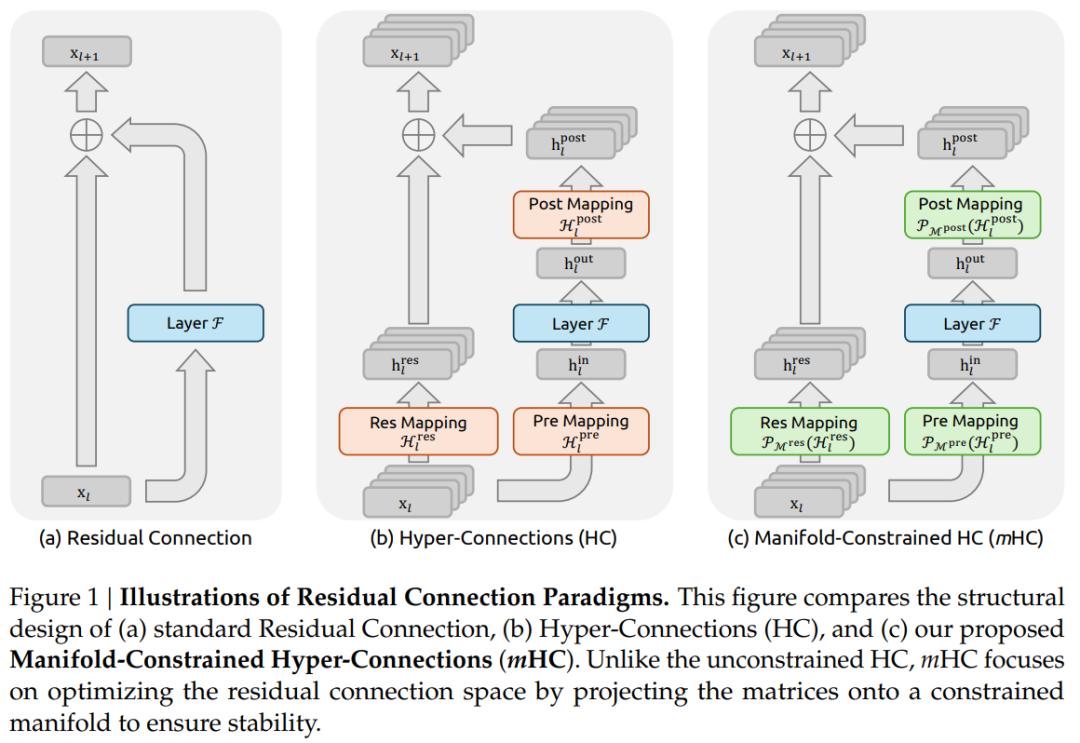
Core Insights - The article discusses the evolution of DeepSeek's research, particularly focusing on their recent papers, mHC and Conditional Memory, which build upon previous works by ByteSeed and others in the field of AI and deep learning [1][2]. Group 1: mHC and Its Innovations - mHC builds on the Hyper-Connections (HC) framework proposed by ByteSeed, significantly improving the stability and scalability of deep learning models [4][7]. - The core innovation of mHC lies in its ability to expand the width of residual flows and introduce dynamic hyper connections, which enhances model capacity without increasing computational costs [4][6]. - mHC addresses the stability issues encountered in HC during large-scale training by implementing manifold constraints and optimizing infrastructure, making it suitable for industrial applications with trillions of parameters [7][8]. Group 2: Conditional Memory and N-gram Utilization - The Conditional Memory paper introduces the concept of using an "Engram" to allow models to reference a large phrase dictionary, improving efficiency in answering straightforward questions [9][12]. - This approach contrasts with previous methods by suggesting that integrating N-gram lookups can free up computational resources for more complex reasoning tasks [10][13]. - DeepSeek's research indicates that allocating a portion of parameters to Engram can yield better performance than solely relying on Mixture of Experts (MoE) models, revealing a U-shaped scaling law [13][19]. Group 3: Collaborative Research and Community Impact - The collaboration between DeepSeek and ByteSeed exemplifies the value of open research in advancing AI technologies, showcasing how shared insights can lead to significant breakthroughs [19][20]. - The article highlights various innovative approaches from ByteSeed, such as UltraMem and Seed Diffusion Preview, which contribute to the ongoing evolution of deep learning architectures [20].
付鹏:现在大家用的ChatGPT、千问、DeepSeek等,都不是未来真正重要的东西
Xin Lang Cai Jing· 2026-01-15 12:11
Core Viewpoint - The speech by Fu Peng emphasizes the importance of early-stage investment in technology and the necessity of risk-taking capital for industrial and technological advancements, highlighting the cyclical nature of industry life cycles and the current focus on AI as a pivotal point for future growth [3][4][5]. Group 1: Historical Context and Investment Philosophy - Fu Peng referenced two significant historical events from 2015 and 2016: Elon Musk's emotional response to the failure of SpaceX and Cathie Wood's influential presentation that outlined future technological paths, contrasting her investment style with that of Warren Buffett [3][7]. - He argues that early-stage investments, even if perceived as bubbles, are essential for progress, likening the need for risk-taking capital to historical support from monarchs and nobles for exploration and innovation [3][7]. - The period from 2015 to 2022 is described as uncertain, with a growing recognition of the need for a technological revolution to address mismatched production relationships and global instability [3][5]. Group 2: Industry Lifecycle and AI Development - Fu Peng highlighted that 2022 was a crucial year in the industry lifecycle, using NVIDIA's 70% stock drop as an example of perceived bubble behavior, which later transformed into a significant player in AI computing [4][8]. - The emergence of ChatGPT in early 2023 is seen as a turning point, representing a shift from foundational AI infrastructure to practical applications, although he cautions that current AI tools may not be the most critical innovations [4][9]. - The next 15 to 18 months are deemed critical for determining whether the current technological advancements will yield substantial returns on investment, with implications for global production relationships and order [4][9]. Group 3: Future Implications and Production Relationships - Fu Peng stresses the need for a focus on improving production relationships alongside advancing productivity, advocating for human-centered policies that enhance welfare and compensation to prevent societal collapse [5][9]. - He posits that if the current technological advancements are genuine, they could positively impact humanity and stabilize global order; conversely, if they are not, countries may face significant challenges due to mismatched production relationships [5][9].

春节AI王炸突袭!DeepSeekV4硬刚海外巨头,暗藏关键破局点
Sou Hu Cai Jing· 2026-01-15 08:03
Core Viewpoint - DeepSeek, a Chinese startup, is set to launch its new generation model V4 around mid-February 2026, aiming to make a significant impact during the Chinese New Year period [1]. Group 1: Company Development - DeepSeek has shown remarkable growth over the past two years, launching its foundational model V3 on December 26, 2024, and an open-source inference model R1 on January 20, 2025, which gained significant attention for its explicit reasoning capabilities [4]. - The R1+V3 chat product has also received high domestic recognition, establishing DeepSeek as a benchmark enterprise in China's AI engineering capabilities [4]. Group 2: Model V4 Features - The V4 model is designed to significantly enhance programming capabilities, achieving a record score of 92.0 in authoritative programming benchmarks like Design2Code, surpassing products from leading overseas companies such as GPT-4.5 and Claude3.7 [6]. - A key breakthrough of V4 is its ability to handle ultra-long context processing, utilizing an NSA mechanism to achieve a 6-9 times speed increase under a 64K context window, allowing it to process millions of tokens effectively [6]. Group 3: Technical Innovations - V4 was developed under constraints of high-end GPU availability, addressing common issues in large model training such as performance degradation through innovative technical methods rather than relying solely on computational power [7]. - The introduction of the mHC architecture has significantly improved training stability, with a mere 6.7% increase in training time leading to a rise in accuracy for complex reasoning tasks from 43.8% to 51.0% [7]. Group 4: Research Contributions - On January 12, DeepSeek published a new training architecture paper co-authored by its founder and researchers from Peking University, introducing the Engram conditional memory module, which decouples computation from storage [9][10]. - This approach allows for model scaling without relying on an increase in chip quantity, providing a new technical pathway for AI companies constrained by hardware limitations [10]. Group 5: Industry Context - The large model landscape has become increasingly competitive, with open-source becoming a core trend in 2025, as both large enterprises and startups strive for dominance in the global open-source ecosystem [11]. - The launch of V4 transcends mere product iteration, serving as a "technical examination" to validate DeepSeek's technological leadership and the maturity of its architectural innovations [13]. Group 6: Market Implications - The performance of V4 will not only impact DeepSeek's standing in the global open-source ecosystem but also reflect the maturity of China's large model technology route [16]. - The ongoing competition has shifted from a focus on parameter counts to the intricacies of technical methods and operational efficiency, indicating a new phase in the industry [16].

DeepSeek一周年,中美AI之路再对比
Xin Lang Cai Jing· 2026-01-15 06:02
Core Insights - DeepSeek, a Chinese AI startup, is set to launch its next-generation AI model V4 in mid-February, which is expected to outperform competitors like Anthropic's Claude and OpenAI's GPT series [1] - The rapid development of AI models in China, particularly by DeepSeek, has significantly narrowed the gap with the US in the AI sector over the past year [2] Group 1: Company Developments - DeepSeek's R1 model was launched last year and completed training in just two months at a fraction of the cost incurred by US companies, achieving comparable performance to ChatGPT and Meta's Llama [2] - Chinese open-source AI models account for nearly 30% of global AI technology usage, with companies like Alibaba's Qwen model gaining traction among developers worldwide [3] - Alibaba has released nearly 400 open-source models, with over 18 million downloads, showcasing its significant role in the global AI landscape [3] Group 2: Competitive Landscape - The US AI strategy focuses on high-end capabilities, closed-source models, and platform products, while China's approach emphasizes open-source, engineering efficiency, and rapid industrial deployment [4][5] - While the US leads in cutting-edge model capabilities, China excels in engineering efficiency and speed of implementation, with no significant time lag in these areas [5] Group 3: Future Trends - The next significant advancements in AI are expected to occur in areas such as humanoid robots integrated with large models, industrial AI models for complex processes, and breakthroughs in low-cost inference and edge computing [10] - The AI toy industry is projected to reach a milestone of 1 million units sold, which will generate substantial interaction data, enhancing the AI models' capabilities and establishing AI toys as essential items in daily life [11]
摩根资产管理:中国科技领域将迎来“更多DeepSeek时刻”,中国科技股将继续受益于技术突破
Ge Long Hui· 2026-01-15 02:14
Group 1 - Morgan Asset Management indicates that Chinese technology stocks will continue to benefit from technological breakthroughs as China intensifies efforts to create more companies like DeepSeek [1][3] - The global market strategist Raisah Rasid stated that there are still many opportunities in China's technology sector, highlighting advancements in robotics and more "DeepSeek moments" [3] - Year-to-date, an index measuring Chinese mainland technology stocks has risen by 12%, outperforming similar indices in Hong Kong and the United States, driven by investor influx and progress in various fields such as chips, humanoid robots, and commercial rockets [3] Group 2 - Looking ahead, Rasid believes that artificial intelligence spending and more favorable policies will be key catalysts for driving Chinese technology stocks [3]