
Sandisk Corporation(SNDK)

Search documents
Will the Stock Market Rise in 2026? Investors Who Ignore This Historical Pattern Do So at Their Own Risk.
The Motley Fool· 2025-12-14 11:37
Market Overview - The S&P 500 has historically increased about 10% annually on average, with a year-to-date gain of 17% in 2025, indicating a potential for above-average returns for the third consecutive year [1][2] - Historical data suggests that the stock market tends to rise two out of three years, implying a high probability of another strong year in 2026 [5][7] Investment Strategy - Investors are encouraged to maintain a long-term investment strategy, as the average bear market lasts only 15 months and is infrequent, while market downturns of 10% to 20% are short-lived [7] - The S&P 500 is statistically likely to increase in value in 2026, and even if a market crash occurs, it is expected to be brief, leading to a new bull market [7][14] Company Focus: Sandisk - Sandisk has been the top performer in 2025 so far, with a year-to-date increase of over 500%, and is expected to outperform the S&P 500 again in 2026 [9][10] - The company reported a 10% revenue increase for fiscal 2025, with a significant surge of 23% year-over-year in the first quarter of 2026, and management anticipates over 40% growth for Q2 [12][13] - Sandisk's memory products are crucial for data centers, with demand from major hyperscalers driving revenue and profit margins, suggesting a favorable operating environment for the foreseeable future [13]


纳指跌近400点,科技巨头重挫,闪迪跌超15%,中概股普跌,亿鹏能源跌12%,金银跳水
2 1 Shi Ji Jing Ji Bao Dao· 2025-12-12 23:33
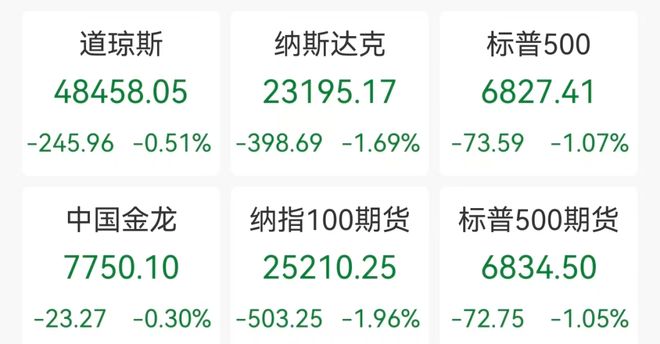
Market Overview - US technology stocks experienced a significant decline, with major indices collectively falling. The Dow Jones dropped by 246 points, the Nasdaq fell nearly 400 points, and the S&P 500 index saw a decline of over 1% [1][2] - The Nasdaq China Golden Dragon Index decreased by 0.3%, reflecting a broad downturn in Chinese concept stocks [3] Technology Sector Performance - Major tech stocks faced substantial losses, with Nvidia down over 3%, Amazon nearly 2%, and Meta, Microsoft, and Google each declining by more than 1% [2] - The semiconductor sector was particularly hard hit, with Broadcom plummeting over 11% and Oracle dropping more than 4% after a previous decline of nearly 11% [2][3] - Other semiconductor stocks like SanDisk and Oklo fell approximately 15%, while CoreWeave and Canaan Technology dropped by 10% and over 9%, respectively [2] Precious Metals Market - Gold prices surged to a peak of $4,353 per ounce before retreating to around $4,300, marking significant volatility [4] - Silver also experienced a sharp decline, with spot silver dropping by 2.5% and COMEX silver down by 3.9% [4] Cryptocurrency Market - The cryptocurrency market saw widespread declines, with Bitcoin falling over 2% and Ethereum nearly 4.5%, leading to over 110,000 liquidations [9][10]
美股存储芯片概念股全线下挫,SanDisk跌超11%
Ge Long Hui A P P· 2025-12-12 15:52
Group 1 - The US stock market saw a significant decline in storage chip stocks, with SanDisk dropping over 11% and Western Digital falling over 6% [1] - Other companies in the sector also experienced losses, including Micron Technology and Rambus, which both fell over 5%, while Seagate Technology and Pure Storage dropped over 4% [1] - The overall trend indicates a bearish sentiment in the storage chip market, impacting multiple key players [1] Group 2 - SanDisk Corp (SNDK) reported a decline of 11.43% with a total market capitalization of $31.36 billion and a year-to-date increase of 510.38% [2] - Western Digital (WDC) experienced a 6.28% drop, with a market cap of $59.98 billion and a year-to-date increase of 290.86% [2] - Micron Technology (MU) saw a decrease of 5.24%, holding a market cap of $275.62 billion and a year-to-date increase of 191.85% [2] - Rambus (RMBS) declined by 5.00%, with a market cap of $10.84 billion and a year-to-date increase of 90.51% [2] - Seagate Technology (STX) fell by 4.33%, with a market cap of $62.89 billion and a year-to-date increase of 246.92% [2] - Pure Storage (PSTG) dropped by 4.30%, with a market cap of $23.97 billion and a year-to-date increase of 18.20% [2] - Silicon Motion (SIMO) experienced a decline of 2.54%, with a market cap of $3.09 billion and a year-to-date increase of 73.46% [2]


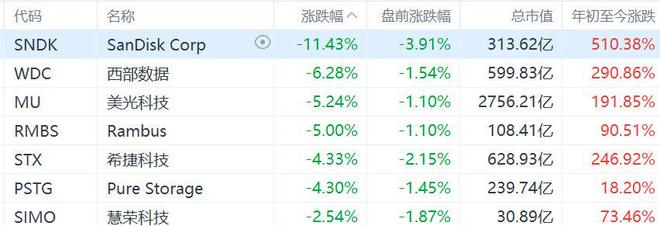
存储概念股纷纷下挫 SanDisk(SNDK.US)跌超12%
Zhi Tong Cai Jing· 2025-12-12 15:51
Core Viewpoint - Storage stocks experienced significant declines, with SanDisk dropping over 12%, Western Digital falling more than 6%, and Micron Technology and Seagate Technology both decreasing by over 4% due to concerns regarding AI investments [1] Group 1: Company Performance - SanDisk (SNDK.US) saw a decline of over 12% [1] - Western Digital (WDC.US) fell by more than 6% [1] - Micron Technology (MU.US) and Seagate Technology (STX.US) both dropped by over 4% [1] Group 2: Market Sentiment - Concerns regarding overall AI investments are deemed reasonable by Interactive Brokers' chief strategist Steve Sosnick [1] - Companies have committed trillions of dollars to AI investments, but investors find it challenging to assess how these investments will evolve [1] - The market's decision to moderately withdraw from the AI sector is considered appropriate [1]
美股异动 | 存储概念股纷纷下挫 SanDisk(SNDK.US)跌超12%
智通财经网· 2025-12-12 15:47
Core Viewpoint - The storage sector stocks experienced significant declines, with SanDisk dropping over 12%, Western Digital falling over 6%, and both Micron Technology and Seagate Technology decreasing by more than 4% due to concerns regarding AI investments [1] Group 1: Market Reactions - Storage concept stocks saw a broad downturn, indicating investor caution in the sector [1] - SanDisk (SNDK.US) fell more than 12%, while Western Digital (WDC.US) decreased over 6% [1] - Micron Technology (MU.US) and Seagate Technology (STX.US) both dropped more than 4% [1] Group 2: Expert Insights - Steve Sosnick, Chief Strategist at Interactive Brokers, expressed that market concerns regarding overall AI investments are justified [1] - Companies have committed trillions of dollars to AI, but investors find it challenging to assess how these investments will evolve [1] - The market's moderate withdrawal from the AI sector is seen as a reasonable response [1]
内存芯片价格飙涨400%! 法巴:巨头停产旧型号 美光、Sandisk直接受益全球抢货潮
Zhi Tong Cai Jing· 2025-12-11 03:12
Core Viewpoint - The memory industry is entering a historic upcycle driven by artificial intelligence (AI), with companies like Micron Technology (MU.US) and Sandisk (SNDK.US) expected to benefit significantly from this trend [1][2]. Group 1: Market Trends - DRAM and NAND spot prices have seen significant year-on-year increases of 408% and 165% respectively in November, indicating a strong upward trend in pricing [1]. - The average selling price of DRAM is projected to rise by 35% quarter-on-quarter in Q4 and by 10% in Q1 2026, driven by ongoing supply constraints [1]. - NAND prices are also expected to increase by 15% in Q4 and by 7% in the following quarter, reflecting similar supply dynamics [1]. Group 2: Historical Context - Historically, DRAM upcycles last about 8 months with an average price increase of 53%, while NAND upcycles last around 6 months with a 40% average price increase [2]. - Currently, the DRAM upcycle is in its 5th month with prices up 55% from the trough, and the NAND upcycle is in its 4th month with prices up 51% from the trough [2]. Group 3: Competitive Landscape - Major players like Samsung and SK Hynix, which control approximately 70% of the global DRAM market, are shifting focus towards high-end chips, planning to phase out DDR4 production by late 2025 to early 2026 [3]. - Tech giants such as Google, Amazon, Meta, and Microsoft are expected to invest $400 billion in AI infrastructure this year, further driving demand for memory chips [3]. Group 4: Supply Dynamics - The memory chip industry is experiencing a "super cycle," with manufacturers aggressively stockpiling chips due to surging demand [4]. - Semiconductor distributors report a significant increase in demand over the past couple of months, with customers adopting strategies of ordering double or triple the usual quantities [4].
内存芯片价格飙涨400%! 法巴:巨头停产旧型号 美光(MU.US)、Sandisk(SNDK...
Xin Lang Cai Jing· 2025-12-11 03:03
Core Viewpoint - The memory industry is entering a historic upcycle driven by artificial intelligence (AI), with companies like Micron Technology (MU.US) and Sandisk (SNDK.US) expected to benefit significantly from this trend [1][2]. Group 1: Market Trends - Consumer-grade DRAM and NAND TLC spot prices increased by 408% and 165% year-on-year in November, indicating a strong upward trend in pricing [1]. - The average selling price (ASP) of DRAM is projected to rise by 35% quarter-on-quarter in Q4 and by 10% in Q1 2026, driven by ongoing supply constraints [1]. - NAND prices are also expected to increase, with a forecasted rise of 15% in Q4 and 7% in the following quarter [1]. Group 2: Historical Context - Historically, DRAM upcycles last about 8 months with an average price increase of 53%, while NAND upcycles last around 6 months with a 40% average price increase [2]. - Currently, the DRAM upcycle is in its 5th month with prices up 55% from the trough, and the NAND upcycle is in its 4th month with prices up 51% from the trough [2]. Group 3: Competitive Landscape - Major players like Samsung and SK Hynix, which control approximately 70% of the global DRAM market, are shifting focus towards high-end chips, planning to phase out DDR4 production by late 2025 to early 2026 [3]. - The demand for AI infrastructure is expected to reach $400 billion this year from tech giants like Google, Amazon, Meta, and Microsoft, further straining supply for non-HBM memory chips [3]. Group 4: Supply Dynamics - The memory chip industry is experiencing a "super cycle," with manufacturers stockpiling chips due to surging demand [4]. - Semiconductor distributors report a significant increase in demand over the past couple of months, with customers adopting double or triple ordering strategies reminiscent of previous shortages [4].
内存芯片价格飙涨400%! 法巴:巨头停产旧型号 美光(MU.US)、Sandisk(SNDK.US)直接受益全球抢货潮
智通财经网· 2025-12-11 02:54
Core Viewpoint - The memory industry is entering a historic upcycle driven by artificial intelligence (AI), with companies like Micron Technology (MU.US) and Sandisk (SNDK.US) expected to benefit significantly from this trend [1][2]. Group 1: Market Trends - Consumer-grade DRAM and NAND TLC spot prices increased by 408% and 165% year-over-year in November, indicating a strong upward trend in pricing [1]. - The average selling price (ASP) of DRAM is projected to rise by 35% quarter-over-quarter in Q4, with a further 10% increase expected in Q1 2026 [1]. - NAND prices are also expected to rise by 15% in Q4 and 7% in the following quarter, driven by ongoing supply constraints [1]. Group 2: Historical Context - Historically, DRAM upcycles last about 8 months with an average price increase of 53%, while NAND upcycles last around 6 months with a 40% average price increase [2]. - Currently, the DRAM upcycle is in its 5th month with prices up 55% from the trough, and the NAND upcycle is in its 4th month with prices up 51% [2]. Group 3: Competitive Landscape - Major players like Samsung and SK Hynix, which control approximately 70% of the global DRAM market, are shifting focus towards high-end chips, planning to cease DDR4 production by late 2025 to early 2026 [3]. - Tech giants such as Google, Amazon, Meta, and Microsoft are expected to invest $400 billion in AI infrastructure this year, further intensifying demand for memory chips [3]. Group 4: Supply Dynamics - The memory chip industry is entering what analysts refer to as a "super cycle," with manufacturers aggressively stockpiling memory chips due to surging demand [4]. - Semiconductor distributors report a significant increase in demand over the past couple of months, with customers adopting double or triple ordering strategies reminiscent of previous shortages [4].
Sandisk Corporation (SNDK) Presents at Barclays 23rd Annual Global Technology Conference Transcript
Seeking Alpha· 2025-12-10 18:42
Core Viewpoint - The discussion at the Barclays Global Tech Conference involves forward-looking statements regarding the company's product portfolio, business plans, market trends, and future financial results [2]. Group 1 - The company is represented by David Goeckeler and Luis Visoso, indicating a focus on leadership engagement during the conference [1]. - The CFO emphasizes that the forward-looking statements are based on current assumptions and expectations, highlighting the dynamic nature of the tech industry [2]. - There is a reference to the annual report on Form 10-K and other SEC filings, which provide detailed information on risks and uncertainties that could impact actual results [3].

Sandisk (NasdaqGS:SNDK) FY Conference Transcript
2025-12-10 17:42
SanDisk FY Conference Summary Company Overview - **Company**: SanDisk (NasdaqGS: SNDK) - **Event**: Barclays Global Tech Conference - **Date**: December 10, 2025 Key Industry Insights - **Market Dynamics**: The NAND market is experiencing a significant restructuring post-2023 downturn, with a shift from a focus on price to a focus on supply. Demand is currently prioritized over pricing, indicating a dynamic market environment [6][10][11]. - **Data Center Growth**: The data center market is projected to become the largest consumer of NAND by 2026, surpassing mobile demand, which has been the largest for the past 15 years. This shift is expected to drive substantial growth in NAND consumption [12][18][19]. - **Long-Term Agreements (LTAs)**: There is an increasing interest from major customers in securing long-term agreements to ensure supply stability, reflecting the structural importance of NAND in their business models [25][27]. Financial Performance and Projections - **Gross Margin Outlook**: SanDisk aims for a through-cycle gross margin of 35%, but acknowledges the need to exceed this target to deliver returns for investors. The company has experienced three consecutive quarters below this margin [10][13]. - **Capital Investment Strategy**: The company is committed to making long-term capital investments in fabs and R&D, with a focus on sustainable growth rather than short-term gains. The industry is expected to grow at a mid-teens percentage rate, with SanDisk planning to align its capacity with this growth [17][26][29]. Technology and Product Development - **BiCS8 Transition**: SanDisk is on track with the transition to BiCS8 technology, which is expected to constitute 40-50% of its portfolio by the end of the fiscal year. This technology is crucial for maintaining competitive advantage in the NAND market [34][37]. - **HBF Technology**: The company is developing HBF technology, which aims to address the growing demand for higher bandwidth in AI applications. The first memory die is expected to be available in late 2026, with a controller following in early 2027 [38][42][43]. Market Challenges and Considerations - **Supply Constraints**: There are concerns about potential supply limitations for PCs and smartphones due to the prioritization of data center demands. SanDisk is committed to maintaining a balanced approach across its three key markets: consumer, PC, and data center [32][33]. - **Industry Evolution**: The NAND market is undergoing profound changes, with new demand drivers emerging. The company is focused on understanding these dynamics and adapting its strategies accordingly [24][44]. Conclusion - SanDisk is navigating a transformative period in the NAND industry, characterized by shifting demand dynamics, a focus on long-term supply agreements, and significant technological advancements. The company remains committed to prudent capital management while positioning itself for future growth in a rapidly evolving market landscape [44].