
中航高科

Search documents
商用大飞机及航空发动机行业深度
2026-02-25 04:13
Summary of Commercial Aircraft and Aviation Engine Industry Conference Call Industry Overview - The global commercial aircraft market is expected to exceed 48 trillion RMB over the next 20 years, with China accounting for approximately 20%, translating to about 500 billion RMB annually, significantly surpassing the military aircraft market size [1][5] - The Chinese civil aviation fleet is projected to grow to around 5,500 aircraft by 2029, with an average addition of about 400 aircraft per year, leading to a cumulative demand of over 2,000 aircraft from 2025 to 2030 [1][6] Key Insights on C919 Aircraft - The C919 has obtained its TC certificate and is gradually ramping up production, with expected deliveries of about 15 aircraft by the end of 2025 and 13 aircraft in 2024 [1][7] - Despite increasing production capacity, it still falls short of the domestic demand for 300-400 new aircraft annually, indicating a need for international market expansion [1][7] Market Dynamics and Competition - The global aviation manufacturing industry is highly monopolized, with Airbus generating over 50 billion USD in revenue and Boeing maintaining around 20 billion USD [1][8] - The market is dominated by a duopoly of Boeing and Airbus, which together hold over 90% of the market share, creating significant opportunities for domestic aircraft manufacturers to replace imports [1][8] Domestic Aviation Engine Development - The domestic commercial aviation engine sector is in its early development stage, with a projected global market demand exceeding 13 trillion RMB over the next 20 years, and the Chinese market expected to reach 2.9 trillion RMB, or about 1,450 billion RMB annually [3][12] - The demand for commercial engines in China is estimated to require around 900 engines annually by 2029, with a market size of approximately 1,000 billion RMB per year [3][12] Material Trends - The use of composite materials in civil aircraft and aviation engines is expected to increase significantly, with modern aircraft like the Boeing 787 and Airbus A350 utilizing over 50% composite materials [3][16] - The C919 aims to increase its composite material usage to over 50%, with a current usage of only 12% [3][17] Key Suppliers and Their Roles - Major suppliers in the domestic aviation supply chain include CFM International for engines and Honeywell, Safran, and Collins Aerospace for onboard equipment [1][10] - The China Aviation Industry Corporation (AVIC) is responsible for various components of the aircraft structure, with significant contributions from companies like COMAC and AVIC Xi'an Aircraft Industry [1][10] Future Prospects and Challenges - The domestic aviation industry faces challenges in achieving self-sufficiency in critical systems, as many components still rely on imports or joint ventures [1][9] - Companies like AVIC and others are making strides in domestic production capabilities, with a focus on increasing the localization of key components [1][15] Conclusion - The commercial aircraft and aviation engine industry in China is poised for significant growth, driven by increasing domestic demand and the potential for international expansion. However, challenges remain in achieving full domestic production capabilities and competing against established global players.
商业航天为哪些化工材料带来新机遇?(附128种商业航天新材料)
材料汇· 2026-01-19 15:57
Group 1: Commercial Aerospace Industry Overview - The commercial aerospace industry is entering a period of explosive growth, driven by significant advancements in low Earth orbit satellite constellations and launch capabilities [1][2] - China plans to launch 12,992 commercial satellites to create a global internet satellite constellation, with ongoing development of high-capacity rockets and completion of launch facilities in Hainan [2][4] - By 2027, the commercial aerospace industry is expected to achieve high-quality development, with enhanced innovation and resource utilization, as outlined in the National Space Administration's action plan [4] Group 2: Demand for Commercial Satellites and Rocket Technology - The demand for commercial satellites is increasing, leading to rapid development in the liquid rocket engine sector, which is the mainstream technology for reusable rockets [6][7] - The global electronic specialty gas market is projected to reach $6.023 billion by 2025, with a CAGR of 6.39% from 2022 to 2025, while China's electronic specialty gas market is expected to reach 23 billion yuan by 2024, with a CAGR of 10.31% [8][10] Group 3: Advanced Materials in Aerospace - The carbon fiber industry is experiencing structural differentiation, with high-performance carbon fibers in demand for aerospace applications, although domestic supply capabilities for high-end products remain insufficient [13][14] - Advanced structural ceramics and composites are critical materials in aerospace, with ongoing improvements in technology and innovation needed to close the gap with developed countries [15][16] - The market for quartz glass fibers and composites is expanding, driven by their essential role in aerospace and semiconductor industries [19] Group 4: Key Functional Materials for Commercial Aerospace - PI films are crucial for aerospace applications due to their excellent thermal stability and radiation resistance, with products already supplied to China's rocket technology research institute [21][22] - LCP materials are gaining traction in high-frequency communication and signal transmission industries, with significant production capabilities established by companies like Prilite [23][24] - Specialty plastics and thermal protection materials are essential for ensuring the reliability and performance of aerospace components [25][26]






中航高科:目前公司部分高性能预浸料可应用于航天领域,上年度营收占比非常低
Zheng Quan Ri Bao· 2026-01-19 14:17
(文章来源:证券日报) 证券日报网讯 1月19日,中航高科在互动平台回答投资者提问时表示,目前公司部分高性能预浸料可应 用于航天领域,上年度营收占比非常低。 ...
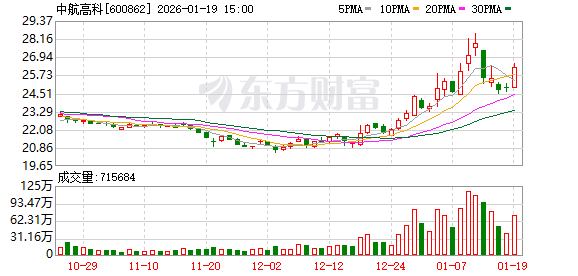
中航高科:截至三季度末公司蜂窝产品在欧盟地区累计销售收入占比小于1%
Zheng Quan Ri Bao Wang· 2026-01-19 12:13
证券日报网讯1月19日,中航高科(600862)在互动平台回答投资者提问时表示,截至三季度末,公司 蜂窝产品在欧盟地区累计销售收入占比小于1%,收入规模较低。目前公司外销有直销和代理渠道。 ...
A股超100股涨停,中航系集体飘红,黄金逼近4700美元,白银年内涨超30%
21世纪经济报道· 2026-01-19 07:49
Market Overview - Major stock indices in the Asia-Pacific region showed mixed results, with the Shanghai Composite Index surpassing 4100 points, while Hong Kong's main indices were in the red [1] - The South Korean Composite Index broke through 4900 points for the first time, with Hyundai and Kia Motors both rising over 12% [1] - A-shares experienced a contraction in trading volume, with the Shanghai Composite Index up 0.29% and the Shenzhen Component Index up 0.09%, while the ChiNext Index fell by 0.7% [1][2] Trading Volume and Stock Performance - The total trading volume in the Shanghai and Shenzhen markets was 2.73 trillion yuan, a decrease of 324.3 billion yuan from the previous trading day [1] - Over 3500 stocks in the market rose, with 103 stocks hitting the daily limit [1] Sector Performance - The electric grid equipment sector showed strong performance throughout the day, with stocks like China West Electric, Dalian Electric Porcelain, and Guangdian Electric all hitting the daily limit [3] - The AVIC index opened high and saw all constituent stocks in the green, with AVIC Aircraft, AVIC Power, AVIC Control, and AVIC Technology all hitting the daily limit, while Hongdu Aviation rose nearly 9% [4][5] Hong Kong Market - The three major indices in Hong Kong collectively declined, with the Hang Seng Index and Hang Seng Technology Index both dropping over 1%, and the Hang Seng China Enterprises Index down over 0.8% [6] - Most tech stocks in Hong Kong fell, with Bilibili down over 7%, Alibaba and Alibaba Health down over 3%, and other companies like Kuaishou and JD Health down over 2% [6] Commodity Performance - Gold and silver prices reached new highs, with spot gold nearing $4700 and silver up over 3.6%, marking a year-to-date increase of over 30% [7] - The cryptocurrency market continued to decline, with Bitcoin dropping nearly 3% and over 250,000 individuals facing liquidation, totaling approximately $871 million [7]



聚焦空天国防,航空航天ETF(159227)大涨3%,成交额同类第一
Mei Ri Jing Ji Xin Wen· 2026-01-19 07:03
Group 1 - The A-share market showed mixed performance on January 19, with strong gains in aerospace-related sectors, particularly in aviation engines and large aircraft concepts, as evidenced by the aerospace ETF (159227) rising by 3.42% and achieving a trading volume of 467 million yuan [1] - The successful landing of the Shenzhou-20 spacecraft on January 19, 2026, marks a significant achievement in China's space exploration efforts, with the spacecraft's condition being reported as normal [1] - According to Ping An Securities, the aerospace sector is experiencing accelerated growth due to government support, technological advancements, and supply chain development, with a notable decrease in rocket launch costs and improvements in recovery technology [1] Group 2 - The aerospace ETF (159227) closely tracks the Guozheng Aerospace Index, covering leading companies across the entire industry chain, including fighter jets, aviation engines, rockets, missiles, satellites, and radars, aligning perfectly with the "integrated aerospace" strategic direction [2] - The commercial aerospace concept holds a significant weight of 70% within the ETF, with top holdings including Aerospace Development, China Satellite, Aerospace Electronics, and other industry leaders [2]
商用大飞机及航空发动机行业深度:大国之翼,逐梦启航
Changjiang Securities· 2026-01-19 00:56
Investment Rating - The report maintains a "Positive" investment rating for the aerospace and defense sector [9]. Core Insights - The report indicates that during the 14th Five-Year Plan period, the production pace of domestic commercial aircraft and the self-sufficiency of commercial aviation engines are expected to accelerate, becoming significant growth drivers for the military aviation sector. This is anticipated to lead to a revaluation of related stocks in the aviation sector [3]. - Over the next 20 years, the global commercial aviation market is projected to reach approximately 48.5 trillion yuan, averaging about 2.4 trillion yuan annually. The Chinese market is expected to accumulate around 10 trillion yuan, averaging over 500 billion yuan per year [6]. - By 2029, China's civil aviation fleet is expected to require more than 400 new commercial aircraft annually, with a cumulative need for nearly 2,000 aircraft during the 14th Five-Year Plan period [6][18]. Summary by Sections Domestic Commercial Aircraft - The domestic commercial aircraft market is expected to break the oligopoly of Airbus and Boeing, which currently hold over 90% of the global market share. The C919 aircraft has various models, including the basic, extended, and plateau versions, with plans for an extended version to enhance market coverage [6][25][33]. - The structure of the C919 aircraft is primarily produced by domestic manufacturers, achieving basic localization. The body structure accounts for approximately 30%-35% of the total value, while the engine and onboard systems account for 20%-25% and 25%-30%, respectively [38][39]. Domestic Commercial Aviation Engines - The domestic commercial aviation engine market is projected to exceed 2.9 trillion yuan over the next 20 years, with an expected demand for over 900 engines annually by 2029. Currently, the market is dominated by foreign manufacturers, with no domestic engines in operation as of 2024 [7][46][49]. - The report highlights that the domestic engine manufacturer, AVIC Engine, is making strides towards self-sufficiency, with products like the CJ1000 and CJ2000 engines showing technological maturity [7][46]. Commercial Aviation Industry Chain - The commercial aviation industry chain consists of three main segments: aircraft body, onboard systems, and engines. Key players include AVIC Xi'an Aircraft Industry Group, AVIC Heavy Machinery, and others, which are positioned to benefit from the growth of the domestic aircraft market [8][9]. - The report emphasizes the importance of achieving self-sufficiency in the aviation engine sector, as it is currently a critical bottleneck for domestic aircraft production [7][46].


商业航天发动机 “心脏材料”:CMC 如何颠覆行业?13 家国产企业名单曝光
材料汇· 2026-01-18 15:29
Core Viewpoint - Ceramic matrix composites (CMC) exhibit excellent high-temperature performance and have broad applications in aerospace, nuclear power, and automotive industries, with significant market potential. China leads in brake and thermal protection for aircraft but lags in aerospace engine applications. The demand for CMC in China's aerospace industry may reach a turning point in 2024, driven by advancements in production technology and cost reductions [2][9]. Group 1: CMC Characteristics and Applications - CMCs are defined as composites that incorporate reinforcing materials into a ceramic matrix, resulting in superior properties such as high-temperature resistance, low density, and high strength [4][18]. - SiCf/SiC composites are ideal materials for the hot sections of aerospace engines, already in mass production for static components, with ongoing exploration for rotating parts [5][24]. - In the nuclear sector, SiCf/SiC composites are considered ideal candidates for reactor components due to their high melting point, thermal conductivity, and stability under neutron irradiation [42]. - Cf/SiC composites are widely used in aerospace for thermal protection and satellite mirrors, effectively addressing the thermal protection and weight reduction needs of hypersonic vehicles [46][49]. - CMCs are emerging as the preferred choice for high-performance brake materials, already in mass production for automotive and aviation applications [53][54]. Group 2: Market Growth and Trends - The global CMC market was valued at $11.9 billion in 2022 and is projected to grow at a CAGR of 10.5%, reaching $21.6 billion by 2028, with the highest market share in defense and aerospace [6]. - The demand for CMCs in the aerospace sector is expected to surge, particularly for SiCf/SiC materials, as they can withstand temperatures exceeding 2000K, significantly improving engine efficiency and reducing nitrogen oxide emissions [27][30]. Group 3: CMC Production and Industry Landscape - The production of CMC components involves complex processes with high barriers to entry, including fiber preparation, preform weaving, interface layer preparation, matrix densification, and machining [7][8]. - GE has established a vertically integrated CMC supply chain, producing 20 tons of CMC prepreg and 10 tons of SiC fibers annually, with a tenfold increase in CMC component production expected over the next decade [8][39]. - China's CMC industry has developed a relatively complete supply chain, with advancements in the production of second-generation SiC fibers and ongoing efforts to achieve industrial-scale production of third-generation fibers [9][12]. Group 4: Investment Opportunities - The anticipated turning point in demand for CMCs in China's aerospace industry in 2024 presents significant growth potential for related companies, particularly as production costs decrease and application maturity increases [13]. - The verification phase for SiCf/SiC applications will drive demand for upstream raw materials, with the potential for rapid growth in midstream CMC component manufacturing as production scales up [13].





国防军工行业投资策略周报:商业航天高景气可期,大飞机和军贸关注度提升-20260118
GF SECURITIES· 2026-01-18 08:26
Core Insights - The report highlights the promising outlook for the commercial aerospace sector and increased attention on large aircraft and military trade [2][3] - The construction of a space power is accelerating, with a focus on breakthroughs in reusable rocket technology and the development of new industries such as commercial aerospace and low-altitude economy [5][13] - Airbus has set a record for civil aircraft orders, with a total of 8,754 aircraft in backlog by the end of 2025, indicating strong market demand [5][13] - Military trade is expected to improve, with significant defense export growth reported in the UK, reaching over £20 billion in 2025 [5][14] Investment Strategy - The report recommends focusing on companies that align with the "S-curve" evolution, emphasizing supply chain reform and automation trends, with specific recommendations for companies like Aero Engine Corporation and AVIC [5][15] - It also suggests targeting companies involved in military trade, large aircraft, and low-altitude economy, highlighting firms such as Guorui Technology and China Power [5][15] - New emerging industries such as commercial aerospace, AI, and quantum computing are also identified as key areas for investment, with recommendations for companies like Ruichuang Micro-Nano and Ziguang Guowei [5][15] Company Valuation and Financial Analysis - The report provides detailed financial metrics for key companies in the defense and aerospace sector, including expected earnings per share (EPS) and price-to-earnings (PE) ratios for 2025 and 2026 [6] - For instance, Aero Engine Corporation is projected to have an EPS of 0.22 CNY in 2025, with a PE ratio of 184.41x, indicating strong growth potential [6] - Other companies like AVIC Heavy Machinery and Guorui Technology are also highlighted for their expected profitability and market positioning [6][25][27]


长征二号丙发射成功,商业航天有望成为2026年主线,回调或迎布局机会
Mei Ri Jing Ji Xin Wen· 2026-01-15 05:43
Group 1 - The A-share market experienced a collective pullback on January 15, with the commercial aerospace sector showing significant declines, particularly the Aerospace ETF (159227) which fell by 4.22% with a trading volume of 605 million yuan [1] - The commercial aerospace sector has seen a surge in investment interest due to recent catalysts, with the Aerospace ETF (159227) attracting over 1.317 billion yuan in net inflows over the last five trading days, bringing its total size to over 3.1 billion yuan, making it the top performer among similar indices [1] - China is on the brink of a large-scale satellite constellation deployment, with over 200,000 satellites planned by December 2025, marking a record number of satellite applications in the country [1] Group 2 - During the 14th Five-Year Plan period, commercial aerospace is expected to be a key driver of new productive forces and high-quality technological development in China [2] - The number of satellite launches in China is anticipated to accelerate by 2026 to secure valuable orbital and frequency resources, with private commercial rocket companies expected to play a significant role [2] - The Aerospace ETF (159227) closely tracks the National Aerospace Index, covering leading companies across the entire aerospace industry chain, including fighters, aircraft engines, rockets, missiles, satellites, and radars, with a high commercial aerospace content of 70.19% [2]