
华安基金

Search documents
银行理财到期后怎么投?一个自建多元资产配置实例
雪球· 2026-02-06 13:01
Core Viewpoint - The article discusses a customized investment strategy aimed at achieving an annualized return of 8%-12% through a diversified asset allocation model tailored to the specific financial profile and risk tolerance of an individual investor [4][9]. Group 1: Investment Strategy Overview - The investment strategy is based on a "60/30/10" model, allocating 60% to equities, 30% to bonds, and 10% to commodities [10][11]. - Historical data indicates that when the holding period exceeds three years, the probability of achieving positive returns from equity assets exceeds 85% [13]. Group 2: Asset Allocation Breakdown - The equity portion (60%) is divided into three pillars: global technology growth (30%), A-share "barbell strategy" (30%), and a defensive component (10%) in gold [14][15]. - The global technology growth pillar includes QDII funds focused on U.S. and Hong Kong tech stocks, specifically selecting two funds: Franklin Global Technology Internet Fund and GF Global Select Equity Fund [16][17]. - The A-share component employs a "dividend + quantitative" strategy, utilizing various funds to balance stability and market volatility [19][20]. Group 3: Fixed Income and Commodities - The fixed income portion (30%) serves as a "safety cushion," providing liquidity and positive returns regardless of market fluctuations [25]. - The gold allocation (10%) is justified as a hedge against currency devaluation and extreme risks, supported by ongoing central bank purchases and geopolitical tensions [29]. Group 4: Performance Management - The strategy emphasizes the importance of managing expectations, acknowledging potential drawdowns of 15%-20% in extreme market conditions [36]. - The investment approach includes regular portfolio reviews to ensure performance aligns with benchmarks and to make necessary adjustments [36]. Group 5: Conclusion - The article concludes that the key to successful investing lies not in predicting market movements but in establishing a resilient investment framework that diversifies across asset classes and geographies [38].


视频|十年激荡,谁主沉浮?中国ETF市场TOP20阵营洗牌:华夏、易方达“双雄争霸” 华宝华安融通“掉队”
Xin Lang Cai Jing· 2026-02-06 11:31
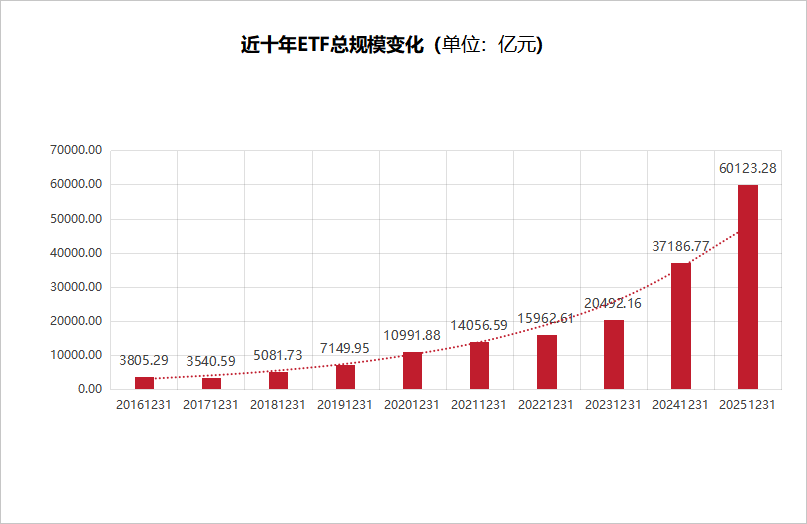
专题:新浪仓石基金研究院 过去十年,是中国公募基金行业,尤其是交易型开放式指数基金(ETF)实现跨越式发展的黄金年代。市场从一个 小众、专业的投资工具,迅速成长为容纳数万亿资金、产品种类繁多的主流资产配置选项。在此过程中,基金管 理公司的竞争格局也发生了翻天覆地的变化,头部公司的排名座次经历了显著洗牌。 市场全景:规模激增十五倍,参与主体日益丰富 根据Wind数据统计,中国ETF市场的总规模从2016年12月31日的约3805亿元,飙升至2025年12月31日的超过6.01万 亿元,实现了十年15倍的惊人增长。关键节点上,2020年10月ETF规模首次突破1万亿元,2023年底规模达到2.05 万亿元,2024年规模激增1.68万亿元,9月突破3万亿元;2025年实现历史性跨越——4月破4万亿、8月破5万亿、12 月破6万亿,年内连跨三个万亿级整数关口。 数据来源:Wind 统计区间:2016年12月31日-2025年12月31日 产品数量也从最初的146只激增至1381只,数量增长近9倍,为投资者提供了覆盖海内外、横跨股债商品的多维度 选择。 与此同时,参与ETF管理的基金公司数量从33家扩充至57家,显示 ...
两市ETF两融余额减少2.47亿元丨ETF融资融券日报
2 1 Shi Ji Jing Ji Bao Dao· 2026-02-06 04:37
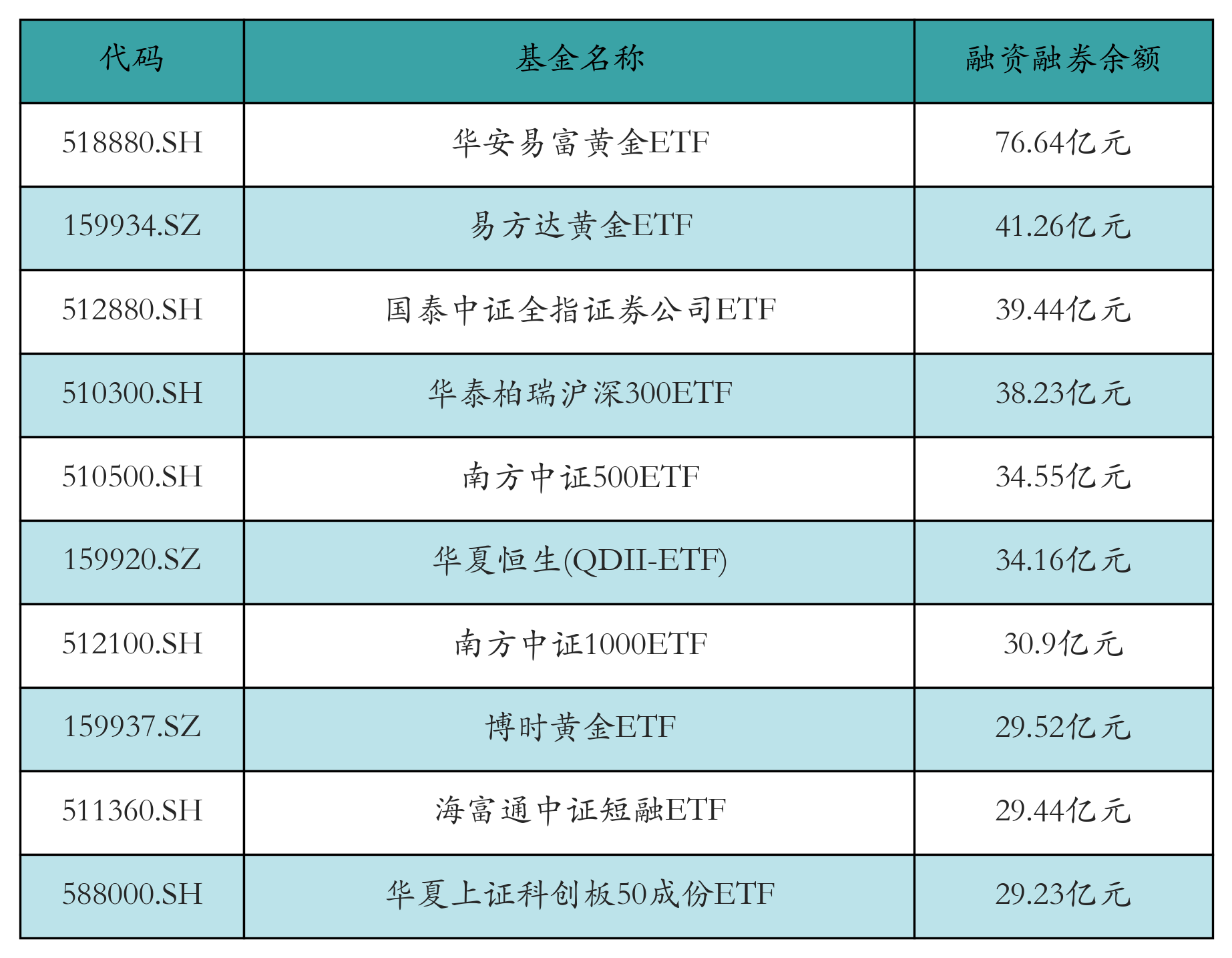
Market Overview - As of February 5, the total ETF margin balance in the two markets is 121.606 billion yuan, a decrease of 247 million yuan from the previous trading day [1] - The financing balance is 113.984 billion yuan, down by 200 million yuan, while the securities lending balance is 7.622 billion yuan, a decrease of 46.735 million yuan [1] - In the Shanghai market, the ETF margin balance is 85.489 billion yuan, a decrease of 83.627 million yuan, with a financing balance of 78.839 billion yuan, down by 36.391 million yuan [1] - In the Shenzhen market, the ETF margin balance is 36.116 billion yuan, a decrease of 1.63 billion yuan, with a financing balance of 35.144 billion yuan, also down by 1.63 billion yuan [1] ETF Margin Balances - The top three ETFs by margin balance on February 5 are: - Huaan Yifu Gold ETF (7.664 billion yuan) - E Fund Gold ETF (4.126 billion yuan) - Guotai CSI All-Share Securities Company ETF (3.944 billion yuan) [2] ETF Financing Buy Amounts - The top three ETFs by financing buy amounts on February 5 are: - Hai Futong CSI Short Bond ETF (1.78 billion yuan) - Bosera CSI Convertible Bonds and Exchangeable Bonds ETF (1.569 billion yuan) - Huaan Yifu Gold ETF (1.426 billion yuan) [4] ETF Financing Net Buy Amounts - The top three ETFs by financing net buy amounts on February 5 are: - Huaxia Shanghai Stock Exchange Sci-Tech Innovation Board 50 ETF (159 million yuan) - GF CSI Hong Kong Innovative Medicines (QDII-ETF) (151 million yuan) - Huaan Yifu Gold ETF (110 million yuan) [6] ETF Securities Lending Sell Amounts - The top three ETFs by securities lending sell amounts on February 5 are: - Southern CSI 500 ETF (92.5785 million yuan) - Southern CSI 1000 ETF (69.2863 million yuan) - Huaxia CSI 1000 ETF (20.042 million yuan) [8]
金价巨震一周:短期资金离场 黄金主题ETF规模缩水427亿
2 1 Shi Ji Jing Ji Bao Dao· 2026-02-06 00:33
Core Viewpoint - The gold market experienced significant volatility, with a historic price drop and subsequent rebound, leading to a substantial reduction in the scale of domestic gold-themed ETFs by approximately 42.7 billion yuan in one week [1][2]. Group 1: Market Performance - On January 29, the international gold price reached a historic high of nearly 5,600 USD/oz, followed by a drop of over 15% [1][2]. - The London gold price fell from 5,413.805 USD/oz to 4,964.83 USD/oz over the week, marking a decline of 8.29% [2]. - Domestic gold prices mirrored international trends, with the Shanghai Gold Exchange's SGE gold price peaking at 1,256 CNY/g, reflecting a year-to-date increase of approximately 29% [2]. Group 2: ETF Market Impact - The total scale of 20 domestic gold-themed ETFs decreased to 348.954 billion yuan, a reduction of about 42.7 billion yuan [1][2]. - Approximately 1.89% of gold-themed ETF funds opted for redemption, resulting in a net outflow of about 6.6 billion yuan, primarily due to a decline in net asset value [1][3]. - The significant drop in ETF scale was largely attributed to passive reductions from falling net values, amounting to approximately 36.1 billion yuan [3]. Group 3: Investor Behavior - Despite the ETF scale reduction, there was no panic selling among domestic investors; the adjustments were seen as short-term emotional responses [3][5]. - On January 30, the day of the gold price crash, 23.38 million yuan was still net subscribed, indicating attempts by some investors to "buy the dip" [3]. - The funds that withdrew were primarily short-term speculative funds, stable short-term allocation funds, and passive following funds [4]. Group 4: Long-term Investment Logic - Analysts believe the recent price fluctuations are a technical adjustment rather than a reversal of long-term trends, with the underlying investment logic for gold remaining intact [5][6]. - Key supporting factors for gold's long-term value include the unchanged Fed rate cut cycle, ongoing central bank gold purchases, and gold's role as a hedge against international order risks [5][7]. - Investment strategies suggest maintaining a long-term perspective on gold, with recommendations to allocate about 20% of investment portfolios to gold assets for risk hedging [6][7].
黄金主题ETF规模缩水427亿
2 1 Shi Ji Jing Ji Bao Dao· 2026-02-05 23:24
Core Viewpoint - The gold market experienced significant volatility, with international gold prices reaching a historical high before a sharp decline and subsequent rebound, leading to a substantial reduction in the scale of domestic gold-themed ETFs [1][11]. ETF Market Impact - Domestic gold-themed ETFs saw a total reduction of approximately 427 billion yuan over the week, bringing the total scale down to 3,489.54 billion yuan [4][15]. - Approximately 1.89% of gold-themed ETF funds opted for redemption, resulting in a net outflow of about 66 billion yuan, primarily due to a decline in net asset value [1][5]. - The scale reduction was largely attributed to passive shrinkage from declining net values, amounting to around 361 billion yuan [1][5]. Market Sentiment and Investor Behavior - Analysts noted that there was no panic selling among domestic investors; rather, the adjustments were seen as short-term emotional responses [1][5]. - On January 30, despite a significant drop in gold prices, there was still a net subscription of 23.38 billion yuan in some ETFs, indicating attempts by investors to "buy the dip" [5][16]. - The outflows were primarily driven by short-term speculative funds, stable short-term allocation funds, and passive following funds, with the latter showing a tendency to react to market movements [6][17]. Long-term Investment Logic - The long-term investment logic for gold remains intact, supported by three core factors: the unchanged Fed's interest rate cycle, ongoing global central bank gold purchases, and gold's role as a hedge against international order risks and sovereign credit currency risks [8][20]. - Institutions generally agree that the recent price fluctuations are a technical adjustment rather than a reversal of long-term trends, with concerns about rapid price increases being a significant factor [7][19]. Future Market Outlook - Institutions have differing views on future gold prices, with UBS predicting a target price of 7,200 USD/oz in a bullish scenario and 4,600 USD/oz in a bearish scenario [9][21]. - Analysts suggest that gold should be viewed as part of a diversified asset portfolio rather than a single heavy investment, emphasizing the importance of long-term perspectives in investment strategies [10][22].

金价巨震一周!短期资金离场 黄金主题ETF规模缩水427亿
Xin Lang Cai Jing· 2026-02-05 18:11
Core Viewpoint - The gold market experienced significant volatility, with international gold prices reaching a historical high before a sharp decline and subsequent rebound, leading to a substantial reduction in the scale of domestic gold-themed ETFs [2][5][9]. Group 1: Market Performance - On January 29, international gold prices peaked at approximately $5598.75 per ounce, marking a year-to-date increase of 30% [5]. - Following this peak, gold prices fell over 15%, with a notable drop of 9.25% on January 30, closing at $4880.034 per ounce [5][9]. - By February 4, gold prices had rebounded, but the overall decline for the week was 8.29%, with domestic gold prices reflecting a similar drop of 8.26% [5][9]. Group 2: ETF Market Impact - The total scale of 20 domestic gold-themed ETFs decreased by approximately 427 billion yuan, bringing the total to 3489.54 billion yuan [2][5]. - Approximately 1.89% of ETF funds were redeemed, resulting in a net outflow of about 66 billion yuan, primarily due to the decline in net asset value [2][6]. - The reduction in ETF scale was largely attributed to passive shrinkage from falling net values, amounting to around 361 billion yuan [2][6]. Group 3: Investor Behavior - Analysts noted that there was no panic selling among domestic investors; rather, the adjustments were seen as short-term emotional responses [2][6]. - The funds that exited the market were primarily categorized as short-term speculative funds, stable short-term allocation funds, and passive following funds [6][7][8]. - On January 30, despite the significant drop in gold prices, there was still a net subscription of 23.38 billion yuan, indicating some investors attempted to "buy the dip" [6]. Group 4: Long-term Investment Logic - Market analysts believe that the long-term investment logic for gold remains intact, supported by factors such as the ongoing Fed rate cut cycle, continued central bank gold purchases, and gold's role as a hedge against geopolitical risks [9][11]. - Institutions suggest that gold should be viewed as part of a diversified asset allocation strategy rather than a single concentrated investment [10][11]. - Recommendations include maintaining a 20% allocation to gold assets in investment portfolios to enhance risk-return profiles [10].

20只黄金基金规模7天缩水427亿
21世纪经济报道· 2026-02-05 15:01
Core Viewpoint - The gold market experienced significant volatility, with a historic price surge followed by a sharp decline, leading to a substantial reduction in the scale of domestic gold-themed ETFs, yet institutions reaffirm the long-term investment value of gold [1][3][7]. Group 1: Market Performance - On January 29, the international gold price reached a historic high of approximately $5598.75 per ounce, marking a year-to-date increase of 30% [3]. - Following this peak, the gold price plummeted over 15% on January 30, closing at $4880.034 per ounce, and continued to decline to $4659.29 per ounce by February 2, before rebounding in the following days [3][4]. - The overall decline in the London gold price over the week was approximately 8.29%, with domestic gold prices reflecting a similar trend, dropping about 8.26% [3][4]. Group 2: ETF Market Impact - The total scale of 20 domestic gold-themed ETFs decreased by approximately 427 billion yuan, bringing the total to 3489.54 billion yuan [1][3]. - Approximately 1.89% of the gold-themed ETF funds opted for redemption, resulting in a net outflow of about 66 billion yuan, primarily due to passive reductions from declining net values [1][4]. - Despite the significant drop in ETF scale, there was a notable attempt to "buy the dip," with 23.38 billion yuan in net subscriptions on the day of the gold price crash [4][5]. Group 3: Investor Behavior - Analysts suggest that the reduction in ETF scale was mainly due to passive shrinkage rather than panic selling, indicating a short-term emotional adjustment among investors [5]. - The funds that withdrew were primarily characterized as short-term speculative funds, stable short-term allocation funds, and passive following funds, each reacting to market conditions differently [5]. - The behavior of retail investors, often characterized by a lack of independent judgment, contributed to the volatility in fund flows, with rapid withdrawals during price declines and re-entries during rebounds [5]. Group 4: Long-term Investment Logic - Analysts believe the recent price fluctuations are a technical adjustment rather than a reversal of the long-term trend, with core support factors for gold remaining intact [7]. - Key supporting factors include the unchanged Fed rate cut cycle, ongoing central bank gold purchases, and gold's role as a hedge against geopolitical and currency risks [7][8]. - Institutions suggest maintaining a long-term perspective on gold investments, with recommendations to allocate around 20% of portfolios to gold assets for risk mitigation [9].

宏信证券ETF日报-20260205
Hongxin Security· 2026-02-05 09:01
Report Summary on February 5, 2026 1. Market Overview - The Shanghai Composite Index fell 0.64% to close at 4075.92 points, the Shenzhen Component Index dropped 1.44% to close at 13952.71 points, and the ChiNext Index declined 1.55% to close at 3260.28 points. The total trading volume of A - shares in the two markets was 21945 billion yuan. The top - rising sectors were beauty care (3.21%), banking (1.57%), and food and beverage (1.31%), while the top - falling sectors were non - ferrous metals (-4.57%), power equipment (-3.41%), and communication (-2.39%) [2][6] 2. Stock ETFs - The top - trading volume stock ETFs: Huaxia CSI A500ETF fell 1.37% with a discount rate of -1.23%; Huatai - Ber瑞 CSI A500ETF dropped 1.22% with a discount rate of -1.16%; Southern CSI 500ETF declined 2.04% with a discount rate of -1.90% [3][7] - The top ten stock ETFs by trading volume are presented in detail in Chart 1, including their codes, prices, price changes, tracking indices, and other information [8] 3. Bond ETFs - The top - trading volume bond ETFs: Haifutong CSI Short - Term Financing Bond ETF remained unchanged with a discount rate of 0.00%; Bosera CSI Convertible and Exchangeable Bond ETF fell 0.63% with a discount rate of -0.78%; E Fund Shanghai Stock Exchange Benchmark Market - Making Corporate Bond ETF dropped 0.04% with a discount rate of -0.16% [4][9] - The top five bond ETFs by trading volume are shown in Chart 2, including their codes, prices, price changes, and trading volumes [10] 4. Gold ETFs - Today, gold AU9999 fell 3.05% and Shanghai Gold dropped 3.15%. The top - trading volume gold ETFs: Huaan Gold ETF fell 3.17% with a discount rate of -3.35%; Bosera Gold ETF dropped 3.29% with a discount rate of -3.46%; E Fund Gold ETF declined 3.30% with a discount rate of -3.50% [12] - The top five gold ETFs by trading volume are presented in Chart 3, including their codes, prices, price changes, trading volumes, and other information [13] 5. Commodity Futures ETFs - Dacheng Non - Ferrous Metals Futures ETF fell 3.70% with a discount rate of -3.83%; Jianxin Yisheng Zhengzhou Commodity Exchange Energy and Chemical Futures ETF dropped 1.70% with a discount rate of -1.36%; Huaxia Feed Soybean Meal Futures ETF rose 0.25% with a discount rate of 5.21% [13] - Information on commodity futures ETFs, including their codes, prices, price changes, trading volumes, and tracking indices, is presented in Chart 4 [14] 6. Cross - border ETFs - The previous trading day, the Dow Jones Industrial Average rose 0.53%, the Nasdaq Composite declined 1.51%, the S&P 500 dropped 0.51%, and the German DAX fell 0.72%. Today, the Hang Seng Index rose 0.14% and the Hang Seng China Enterprises Index rose 0.50%. The top - trading volume cross - border ETFs: E Fund CSI Hong Kong Securities Investment Theme ETF fell 1.20% with a discount rate of -0.88%; Huaxia Hang Seng Tech ETF dropped 0.42% with a discount rate of 0.38%; Huatai - Ber瑞 Hang Seng Tech ETF declined 0.57% with a discount rate of 0.26% [15] - The top five cross - border ETFs by trading volume are shown in Chart 5, including their codes, trading volumes, price changes, and discount rates [16] 7. Money ETFs - The top - trading volume money ETFs are Yin Hua Ri Li ETF, Hua Bao Tian Yi ETF, and Money ETF Jian Xin [17] - The top three money ETFs by trading volume are presented in Chart 6, including their codes and trading volumes [18]
基金行业大洗牌,453名基金经理离职创纪录
Sou Hu Cai Jing· 2026-02-05 08:45
资本市场,现在是冰火两重天。 买科技股的公募,最高年盈利233%,另一方面,持有老登股的基金经理们,逐渐被基民抛弃。 基金行业正在经历一轮大洗牌。本来嘛,基民的钱亏了,基金经理却还拿着高薪和奖金,管理费一分不 少,这事被吐槽很久了。 就在上个月,新规出来,一切都要改变。 文丨金融八卦女特约作者:兴华 · · · 除了医药女神,其他明星基金经理也有翻车的。 四季度,医药女神们纷纷扑街。还有基金持仓紧握老登股的基金经理,被爆出来自己偷偷买了很多科技 股赚了大钱,成了众矢之的。 业绩轮流翻车,去年的基金经理离职人数创下新高,已经达到453人。而基金经理总人数却在持续扩 大,很多年轻的基金经理,83%连上一轮牛市都没经历过。 整个基金行业,正在经历一轮大洗牌。 知名基金经理刘彦春的四季报,普遍亏损在5.8%-7.5%之间,最近五年基本上是腰斩。 尤其是基金的四季报一披露,不少医药女神都扑街了。张韡、赵蓓等管理的医药基都在四季度陷入了亏 损,把上半年的利润吐回去不少。 赵蓓管理的工银前沿医疗A第四季度跌了13.7%,年度回报17%。 张韡管理的添富创新医药A 第四季度跌了15.5%,年度回报为36%。 金笑非的鹏华医药 ...

黄金投资全解析(QA问答版)
Sou Hu Cai Jing· 2026-02-05 08:09
Core Conclusion - As of February 5, 2026, the spot gold price in London is $4,864.01 per ounce, while the domestic gold T+D price is ¥1,092.48 per gram, and mainstream gold shop prices range from ¥1,553 to ¥1,568 per gram. The overall gold price is expected to remain strong with fluctuations, supported by anticipated Fed rate cuts of 50-75 basis points and the normalization of global central bank gold purchases, but a short-term correction risk of 5%-15% should be noted. The core value of gold lies in its role as a hedge against risk and asset preservation, with a recommended allocation not exceeding 15% of total assets [1]. Basic Understanding - Gold is primarily categorized into three types: physical gold, paper gold, and gold derivatives. Physical gold includes gold bars, coins, and jewelry, with gold bars typically having a purity of 99.99%. The investment gold bar prices from major domestic banks range from ¥1,141 to ¥1,229 per gram, while gold jewelry prices are higher due to processing fees and brand premiums, reaching ¥1,553 to ¥1,568 per gram. Paper gold is issued by banks with no physical delivery, allowing for flexible trading without fees, while gold derivatives include gold ETFs (tracking gold prices with trading costs of 0.1%-0.3%) and gold futures (with leverage of 5-10 times and higher entry barriers) [2]. Value Understanding - The core value of gold is its ability to hedge against risk, preserve assets, and combat inflation. In 2025, global central banks net purchased 863 tons of gold, driven by emerging market "de-dollarization" strategies, providing structural support for gold prices. Gold is suitable for three types of investors: those with low risk tolerance seeking stable asset preservation, those looking to hedge against inflation and diversify risks from stocks and funds, and those with short-term speculative needs who have a certain risk tolerance [5]. Influencing Factors - Key factors influencing gold price fluctuations include: 1. Federal Reserve policy: Expected rate cuts of 50-75 basis points in 2026 will lower the cost of holding gold, benefiting its price. 2. Dollar performance: The negative correlation of approximately -0.7 between the dollar index and gold prices means a stronger dollar typically leads to lower gold prices. 3. Central bank purchases: In 2025, global central banks net purchased 863 tons of gold, with an expected monthly average of 60-70 tons in 2026, supporting gold prices. 4. Geopolitical and supply-demand factors: Geopolitical conflicts increase demand for safe-haven assets, with an expected widening of the gold supply-demand gap to 320 tons in 2026, supporting prices [12]. Price Trends - The overall trend for gold prices in 2026 is expected to be strong with fluctuations. The World Gold Council predicts a baseline scenario of ±5% price fluctuations, with an optimistic scenario suggesting that if geopolitical conflicts escalate, prices could rise by 15%-30%, potentially exceeding $6,000 per ounce. In contrast, a risk scenario could see prices correct by 5%-20% if inflation rebounds. Institutions have differing views: UBS has raised its 2026 target price to $6,200 per ounce, while Goldman Sachs expects it to reach $5,400 per ounce by year-end, and JPMorgan has a long-term bullish outlook of $8,000-$8,500, but warns of short-term overbought risks [13]. Product Selection - New investors are advised to prioritize gold ETFs or bank paper gold due to their low entry barriers, controllable risks, and convenient operations. Gold ETFs typically allow investments starting at ¥100, with trading costs of only 0.1%-0.3%, and no physical storage costs. Paper gold can be traded flexibly starting from 1 gram (approximately ¥1,092 based on current T+D prices), with no leverage risk. In contrast, gold futures involve high leverage and risks, while physical gold incurs storage costs, making them less suitable for beginners [9].