vivo

Search documents
内存涨价,千元机的天塌了
3 6 Ke· 2026-02-12 08:43
Core Insights - The storage chip market has experienced a significant price surge since the second half of last year, with consumer-grade memory prices increasing by over 600%, making it a highly valuable investment product [1] - The demand for AI infrastructure has led to a depletion of production capacity among major storage chip manufacturers, including Samsung, Micron, and SK Hynix, with all their HBM production capacity booked until 2026 [1][11] - The rising prices of storage chips have disproportionately affected low-end smartphones, particularly brands like Transsion, which saw a 22.6% revenue increase but an 11% drop in net profit in Q3 last year [3][4] Market Dynamics - The high profit margins associated with HBM memory used in AI chips have prioritized its production over consumer-grade products, leading to supply constraints for low-end smartphones [3] - Various smartphone manufacturers are shifting focus from low-priced product lines to higher-margin high-end models due to the impact of rising storage costs [4][12] - Transsion's market share dropped from fourth to "others" category, indicating a significant decline in its competitive position [3][4] Pricing and Cost Structure - The cost structure of low-end smartphones is heavily impacted by the rising prices of storage chips, which are considered a rigid cost that cannot be easily adjusted [5][8] - The BOM (Bill of Materials) cost for a 12GB+256GB iPhone Pro Max indicates that storage costs account for approximately 10% of total costs, highlighting the sensitivity of low-end models to price increases [8][9] - The average selling price (ASP) of smartphones is projected to exceed $400 for the first time, reflecting a shift towards higher-priced models as low-end market segments shrink [13][16] Supply Chain Challenges - The demand for AI-related products has created a seller's market for storage chips, leading to unpredictable cost structures for smartphone manufacturers, especially in the low-end segment [12] - Major companies like Apple are facing significant supply pressures, with only partial agreements in place for NAND Flash and DRAM supplies for the upcoming quarters [11] - Samsung's internal conflicts regarding storage pricing have further complicated supply chain management, as the mobile division struggles to secure favorable terms from the semiconductor division [12]





机构:苹果成1月中国手机市场唯一增长品牌
Guan Cha Zhe Wang· 2026-02-12 07:28
Group 1 - The core viewpoint of the articles indicates that the overall smartphone market in China experienced a 23% year-on-year decline in January 2026, with Apple being the only brand to achieve positive growth of 8% [1][3] - Counterpoint Research attributes the decline in sales for domestic brands like Huawei, Xiaomi, OPPO, and vivo to reduced subsidies, consumer sentiment, and the upcoming Spring Festival [1] - Apple's market share increased to approximately 20%, placing it in a leading position alongside Huawei, driven by the success of the iPhone 17 series [1][3] Group 2 - Since the launch of the new iPhone in September last year, Apple's flagship product has seen a strong rebound in sales, achieving its highest market share in five years in January [3] - The iPhone 17 standard version has met government subsidy criteria, enhancing its cost-effectiveness and contributing to a 9% month-on-month sales increase [3] - The pricing strategy for the iPhone 17 series remains stable with minimal discounts, allowing for potential future price adjustments or profit optimization, especially with the upcoming Lunar New Year expected to drive seasonal purchasing [3]

“租手机看演出”成潮流,vivo三星大疆谁赚到了?
创业邦· 2026-02-12 03:58
以下文章来源于剁椒Spicy ,作者剁椒团队 剁椒Spicy . 专注于电商、营销、流量生态,以及消费者洞察的全新商业自媒体 来源丨剁椒Spicy(ID: ylwanjia ) 作者丨 豆芽 图源丨Midjourney 前几天,梓渝2026年巡演厦门站开唱,粉丝叶子早早地就租好了"演唱会神机",打算到现场狠狠出 片。 不仅仅是叶子,很多粉丝都提前做足了功课,不同位置该租什么设备、如何调参数、如何录开箱视频 等都研究了一遍,社交平台上有大量的攻略贴、种草贴、还有最直观的"神图"分享。 租手机看演唱会这一消费趋势,爆发于2022年底、2023年初,彼时演出市场逐步复苏,看演出的消 费者也开始从追星族、小众演出爱好者向大众破圈。一些主打长焦性能的手机,凭借远距离拍摄优 势,被捧成"演唱会神机"。代表性产品是三星s23u、三星s24u,vivo X 200u、vivo X 300。 C端的热度驱动了很多玩家入局,成熟的相机租赁方、小规模作战的个人租赁方、甚至还有黄牛纷纷 下场,成功吃到了这一波红利。 2024年就有一位在演唱会门口摆摊租赁设备的小伙,在媒体采访中 表示,"一个月跑10个城市,当天一场能赚到四五千。" ...

内存价格暴涨,手机厂商决定「复活」SD卡,但可能会让手机变卡
3 6 Ke· 2026-02-12 03:26
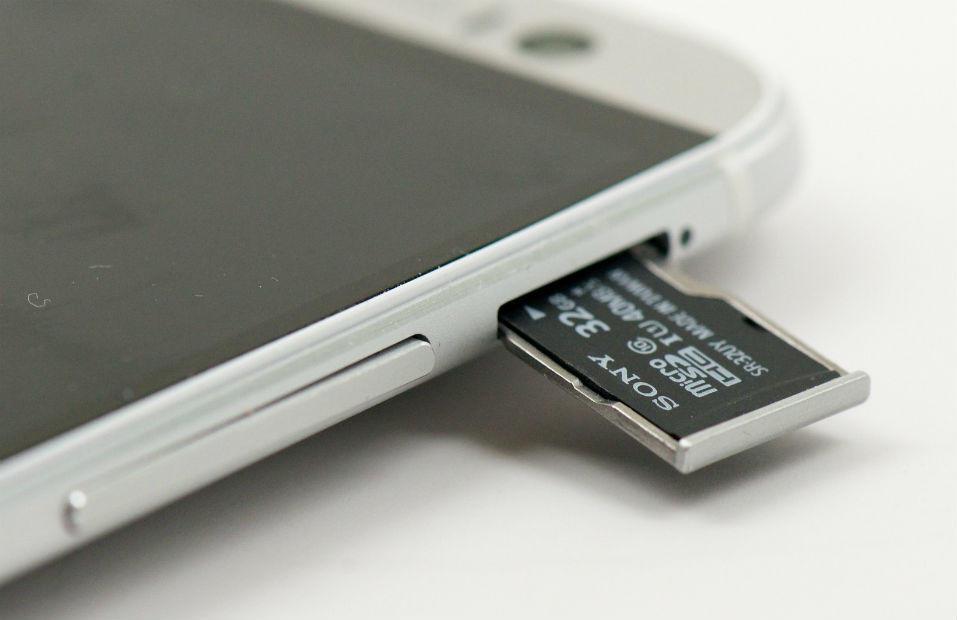
过去一段时间里,PC领域爱好者能够明显感觉到内存的价格已经飙升到难以控制的局面,但同样对内存有高使用需求的手机行业,却没有太明显的新机价 格上涨。这并不是手机厂商控价控得好,而是库存相对充足。 复活老技术,只能暂时缓解内存焦虑 通过外置存储卡的方式拓展手机存储空间,实际上是诞生在一个移动多媒体快速发展,但硬件与成本无法取得平衡的时代。早在2004年,摩托罗拉发布首款 支持MicroSD卡扩展的机型V780,这款手机内置存储空间只有10MB,但通过扩展,可以让存储空间翻数十倍,用于存放资料与音乐。 不过,消息指出手机厂商也难逃内存库存告急的窘境,有个别品牌正在考虑用其他方式降低库存消耗。而这一招就是「复活」外置存储卡的设计,允许消费 者自主扩展存储空间。 (图源:Tiger Mobile) 早年间,支持存储卡扩展几乎是每台手机必备的功能,而后续为了进一步利用内部空间,以及做防尘防水设计,渐渐取消了这一配置。没想到,一次内存危 机竟然让这个功能重新复活了。 这项设计在往后的十几年时间里,几乎成为手机的标配。但2007年,苹果发布的iPhone并没有配备这项设计,这也让市场开始对这个功能有了一些新的思 考。三星在G ...
华为小米已成新“年货”,后国补时代市场热度几何?
财联社· 2026-02-12 03:25
Core Viewpoint - The article discusses the impact of the new round of national subsidies on consumer electronics and home appliances during the upcoming Spring Festival, highlighting increased consumer demand and sales driven by these subsidies [2][15]. Group 1: National Subsidy Implementation - The Ministry of Commerce has allocated the first batch of 62.5 billion yuan in national subsidies, which will be distributed to local commerce departments to ensure consumers can claim these subsidies during the Spring Festival [1]. - Consumers can now apply for subsidies online for digital and smart products, with significant sales increases observed in various electronics stores [2][4]. - The new subsidies are expected to stimulate sales, particularly in the home appliance and 3C product sectors, with sales of air conditioners, refrigerators, washing machines, and televisions seeing over 90% month-on-month growth [2][11]. Group 2: Consumer Trends and Product Preferences - The demand for home appliances and 3C products has surged, with consumers increasingly seeking products that enhance efficiency and create a festive atmosphere [3][10]. - Popular products include smart appliances like automatic washing machines, large-capacity refrigerators, and high-end AI smartphones, reflecting a shift towards premium and technologically advanced items [3][16]. - The sales of energy-efficient appliances have risen significantly, with 92% of sales now comprising first-level energy/water efficiency products, indicating a trend towards greener and smarter home solutions [11][16]. Group 3: Market Dynamics and Manufacturer Strategies - Manufacturers are preparing for the Spring Festival by increasing inventory of energy-efficient products and optimizing supply chains to ensure product availability [12]. - Major brands like Huawei, Xiaomi, and OPPO are offering additional discounts alongside the national subsidies to enhance promotional efforts [12]. - Despite the positive impact of subsidies, rising costs of raw materials are leading to price increases for some products, which may affect overall sales volumes in the consumer electronics sector [13][14]. Group 4: Future Outlook and Challenges - The article notes that while national subsidies have boosted market confidence and consumer demand, the underlying issue of supply-demand mismatch remains a challenge [17]. - The effectiveness of subsidies may diminish as consumers become accustomed to them, necessitating a focus on product innovation and user engagement to sustain growth [17]. - Analysts express caution regarding the marginal benefits of subsidies in 2026, suggesting that manufacturers may prioritize high-margin products over volume sales, potentially impacting overall market performance [17].

巨兽出山,围堵大疆
3 6 Ke· 2026-02-12 01:52
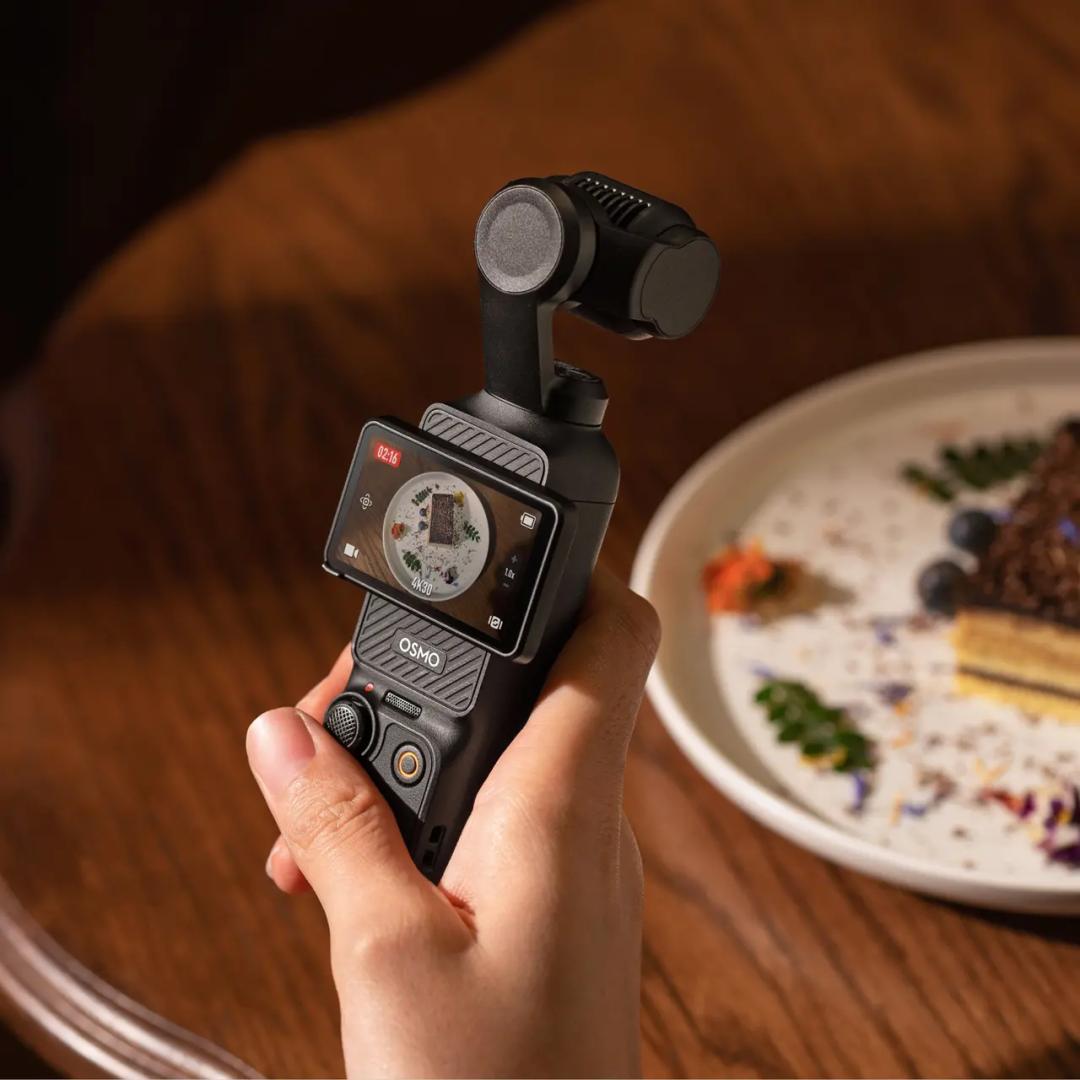
作者 | 张子怡 编辑 | 袁斯来 大疆躺着赚钱的赛道,终于被更凶悍庞大的对手纳入狙击范围。 近日,vivo官方确认正式立项独立vlog相机产品,产品形态将直接对标大疆Osmo Pocket系列。而此前,媒体曾报道OPPO的首席产品官刘作虎,正亲自带 队攻坚类似产品。 OPPO和vivo这样经历过无数血战,仍然屹立不倒的巨头,绝非大疆想要遭遇的对手。 但这场交锋,在Pocket 3爆红的那一刻已经埋下伏笔。 很少有消费电子单品能在很长一段时间中独占市场,大疆Osmo Pocket 3做到了。根据媒体报道,Pocket 3全球销量一年就超千万台,单款产品贡献营收超 200亿元。由于产能不足,过去很长一段时间里,Osmo Pocket 3被戏称为"电子茅台",二手溢价一度超过30%。直到大疆去年下半年主动降价,一货难求 的故事才宣布告终。 大疆Osmo Pocket 3(图源/官网) 更重要的是,在用户心智中,云台相机某种程度上已经等同于"大疆Pocket"——无数消费电子公司渴望拿下的品类定义者角色,大疆似乎很轻松地收入了 囊中。 如果放在5年前,手机厂商或许不会重注投入这一个品类。几家头部手机公司每年营收数千 ...
一线实探!华为小米已成新“年货” 后国补时代市场热度几何?
Xin Lang Cai Jing· 2026-02-12 01:49
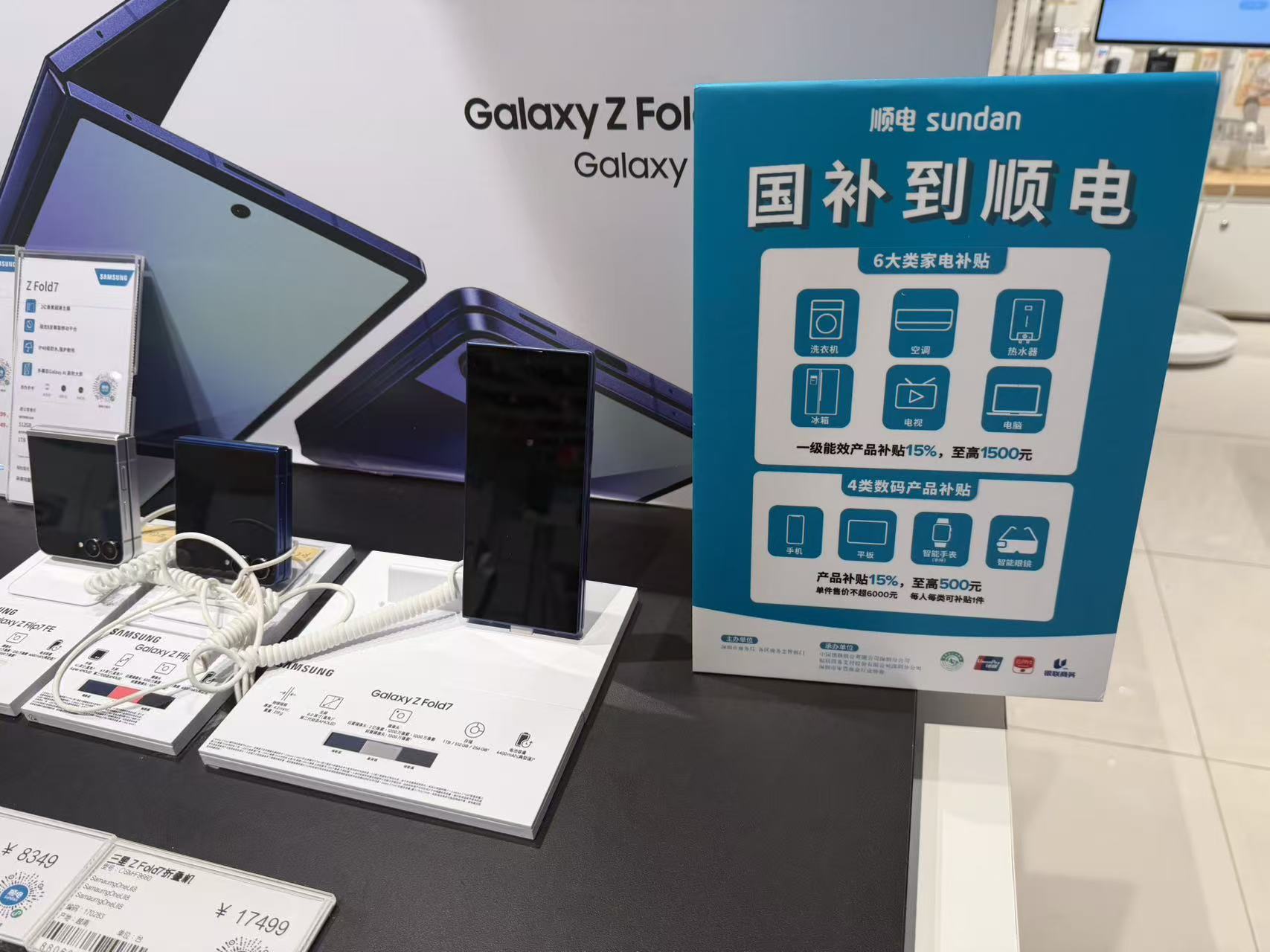
Core Viewpoint - The Chinese government has allocated 62.5 billion yuan in subsidies to stimulate consumer spending during the Spring Festival, with a focus on home appliances and 3C electronic products, leading to increased sales and market activity [1][2][6]. Group 1: Subsidy Implementation and Market Response - The Ministry of Commerce has released the first batch of 62.5 billion yuan in national subsidies, which will be distributed to local commerce departments to ensure consumers can claim these subsidies during the Spring Festival [1]. - Consumers can now apply for subsidies online for digital and smart products, with reports of increased sales activity in stores, particularly for mobile phones and home appliances [2][3]. - The combination of national subsidies, brand discounts, and platform incentives is driving consumer interest and sales, particularly in the home appliance and 3C product sectors [2][6]. Group 2: Sales Performance and Consumer Trends - Sales of major home appliances such as air conditioners, refrigerators, and washing machines have seen a month-on-month increase of over 90%, with high-end smartphones dominating the market [2][7]. - The demand for efficient and technologically advanced home appliances is rising, with products like smart air conditioners and large-screen TVs becoming popular choices for consumers during the festive season [2][7]. - The sales of energy-efficient appliances have surged, with 92% of sales being of first-level energy efficiency products, indicating a shift towards greener and smarter home solutions [7][13]. Group 3: Manufacturer Strategies and Market Dynamics - Manufacturers are preparing for the Spring Festival by increasing inventory of energy-efficient products and optimizing supply chains to ensure availability during peak demand [8][9]. - Major 3C brands are enhancing promotional efforts during the Spring Festival, with additional discounts and marketing campaigns to attract consumers [9]. - Despite the positive impact of subsidies, rising costs of raw materials are leading to price increases for some products, which may affect overall sales volumes in the future [10][11]. Group 4: Future Outlook and Industry Challenges - The effectiveness of subsidies may diminish as consumers become accustomed to them, and the market faces challenges related to supply-demand mismatches [14]. - Industry experts suggest that continuous growth will depend on product innovation and the ability to meet evolving consumer preferences, particularly in the context of AI integration in home appliances [12][14]. - The anticipated decline in smartphone sales in 2026 highlights the need for brands to adapt their strategies in response to changing market conditions and consumer behavior [11].
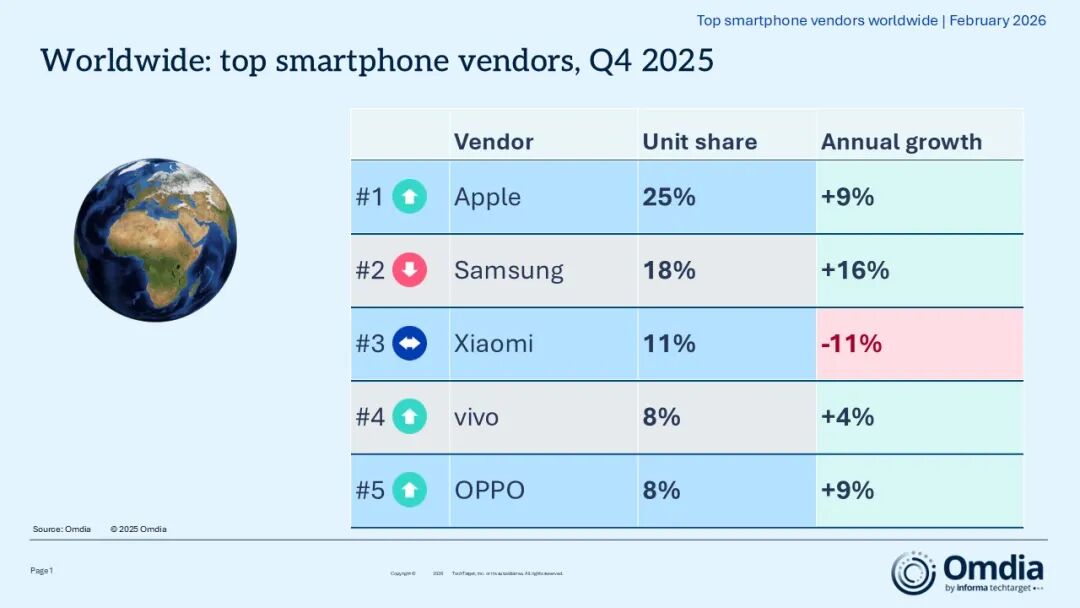
Omdia:2025年Q4全球智能手机市场同比增长4% 苹果以25%市场份额领跑
智通财经网· 2026-02-12 01:33
Core Insights - The global smartphone market is expected to grow by 4% year-on-year in Q4 2025, driven by seasonal demand recovery and improved inventory management, despite some manufacturers facing rising component costs [1] - Apple leads the market with a 25% share, benefiting from strong demand for the iPhone 17 series, achieving record quarterly shipments and maintaining its position as the largest smartphone manufacturer for three consecutive years, slightly ahead of Samsung [1] - Samsung holds the second position with an 18% market share, primarily driven by strong sales of models priced below $300, particularly the Galaxy A17 4G and 5G series [1] Global Market Rankings - In Q4 2025, the top smartphone vendors by unit share are: - Apple: 25% (+9% growth) - Samsung: 18% (+16% growth) - Xiaomi: 11% (-11% growth) - Vivo: 8% (+4% growth) - OPPO: 8% (+9% growth) [2] Regional Performance - In the APAC region (excluding Greater China), the top vendors are: - Samsung: 19% (+18% growth) - Apple: 18% (+4% growth) - Vivo: 15% (+11% growth) - OPPO: 11% (+6% growth) - Xiaomi: 10% (-23% growth) [4] - In Latin America, the rankings are: - Samsung: 33% (+21% growth) - Lenovo: 16% (+14% growth) - Xiaomi: 15% (+6% growth) - HONOR: 9% (+64% growth) - Apple: 7% (-8% growth) [4] - In India, the top vendors are: - Vivo: 25% (+16% growth) - OPPO: 16% (+4% growth) - Samsung: 14% (-11% growth) - Xiaomi: 12% (-26% growth) - Apple: 11% (-1% growth) [6] - In the United States, the rankings are: - Apple: 69% (+8% growth) - Samsung: 14% (-3% growth) - Lenovo: 9% (+13% growth) - Google: 3% (-15% growth) - TCL: 2% (-7% growth) [6] - In Brazil, the top vendors are: - Samsung: 39% (-1% growth) - Lenovo: 23% (+12% growth) - Xiaomi: 15% (+12% growth) - Apple: 11% (+10% growth) - realme: 5% (-7% growth) [7]
2025手机活跃存量增2% 苹果三星小米位列前三
Xin Lang Cai Jing· 2026-02-12 01:30
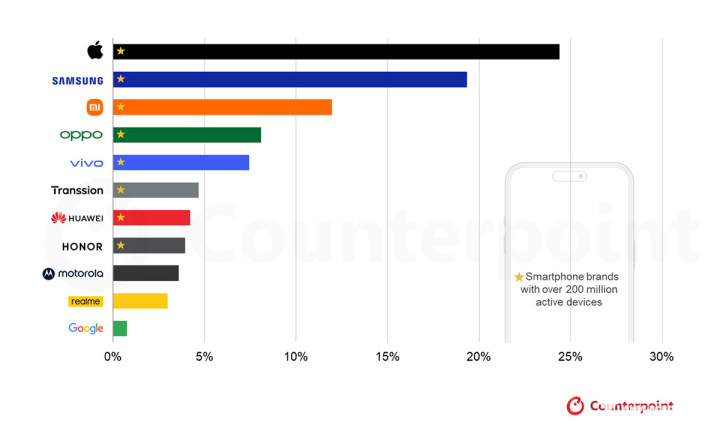
Core Insights - The report by Counterpoint Research indicates that eight smartphone manufacturers have surpassed 200 million active devices globally, collectively accounting for over 80% of the active device market share [1][6][8] - By 2025, the global active smartphone device stock is expected to grow by 2% year-on-year, with the average replacement cycle extending to nearly four years, marking a new phase of competition focused on existing users [1][5] Market Share Distribution - Apple and Samsung demonstrate a significant lead, being the only two brands with active devices exceeding 1 billion, together holding 44% of the global market share, with Apple at approximately 25% and Samsung at around 20% [5][8] - Xiaomi is the only other brand in the "200 million club" with a market share exceeding 10%, holding about 12%, while OPPO and vivo form the second tier [5][8] - The remaining brands, including Transsion, Huawei, and Honor, have closely matched market shares, with Honor making its debut in this club, while Motorola and realme are approaching the 200 million mark, indicating potential growth [5][8] Industry Challenges - The report highlights that due to soaring memory prices and extended replacement cycles, simple hardware upgrades are no longer sufficient to drive frequent device replacements among users [5][8] - The core challenge for smartphone brands moving forward will be to extract value from existing users and expand revenue through software and services [5][8]
2026年中国射频前端模块行业政策、产业链图谱、发展现状、竞争格局及未来发展趋势研判:5G与物联网双轮驱动,国产替代与多元应用开启成长空间[图]
Chan Ye Xin Xi Wang· 2026-02-12 01:08
Core Insights - The RF front-end module is a critical subsystem that directly impacts terminal communication quality, driven by the acceleration of global 5G commercialization and the increasing demand for multi-band compatibility in terminals [1][5] - The global market for RF front-end modules is projected to reach $14.881 billion by 2025, with modules accounting for nearly 70% of the market share [5] - China's RF front-end market is expected to grow from 22.9 billion yuan in 2020 to 33.6 billion yuan in 2024, and is projected to exceed 53 billion yuan by 2029, becoming the largest regional market globally [6][7] Industry Overview - RF front-end modules (RFFE) serve as the core components in wireless communication systems, integrating multiple RF devices into a single package to perform essential tasks such as signal processing [2][4] - The classification of RF front-end modules includes power amplifiers, low-noise amplifiers, filters, RF switches, and duplexers, among others, catering to various application scenarios [3] Market Dynamics - The demand for RF front-end devices is increasing due to the rapid commercialization of 5G, with a notable rise in the need for high-end products associated with key technologies like millimeter-wave communication [5] - The global RF front-end market is expected to grow at a compound annual growth rate (CAGR) of approximately 3.4% from 2025 to 2030, reaching $17.5 billion by 2030 [5] China's Market Growth - China's RF front-end market is experiencing rapid growth, driven by the acceleration of 5G commercialization, the rise of domestic smartphone brands, and the expansion of emerging applications like IoT [6][10] - The domestic market's growth is supported by policies promoting the semiconductor industry, which have created a robust support system for the RF front-end module sector [4] Industry Chain Analysis - The RF front-end module industry chain in China includes upstream suppliers of EDA design software and semiconductor materials, with domestic breakthroughs in certain areas [8] - Midstream focuses on module design, manufacturing, and testing, with local companies narrowing the technology gap with international giants [8] Competitive Landscape - The current market landscape shows a coexistence of international dominance and domestic breakthroughs, with major international companies holding about 76% of the global market share [12] - Domestic companies like Weijie Chuangxin, Huizhiwei, and Zhuoshengwei are gradually increasing their market share through continuous R&D and technological advancements [12] Future Development Trends - The RF front-end module industry in China is expected to develop along three main lines: technology, industry, and application, focusing on high integration and energy efficiency [13] - The trend of domestic substitution will deepen, with local companies aiming to penetrate high-end markets and enhance their competitiveness [14] - Application scenarios are expanding from consumer electronics to various fields, including smart vehicles and satellite internet, creating new growth opportunities [16]