中国人民银行

Search documents
人民银行开展2830亿元逆回购操作
Bei Jing Shang Bao· 2025-11-17 02:50
Wind数据显示,当日有1199亿元逆回购到期,据此计算,单日净投放1631亿元。 北京商报讯 (记者 岳品瑜 实习生 岳雯艳)11月17日,据中国人民银行官网,中国人民银行以固定利 率、数量招标方式开展了2830亿元7天期逆回购操作,操作利率1.40%,投标量2830亿元,中标量2830 亿元。 ...
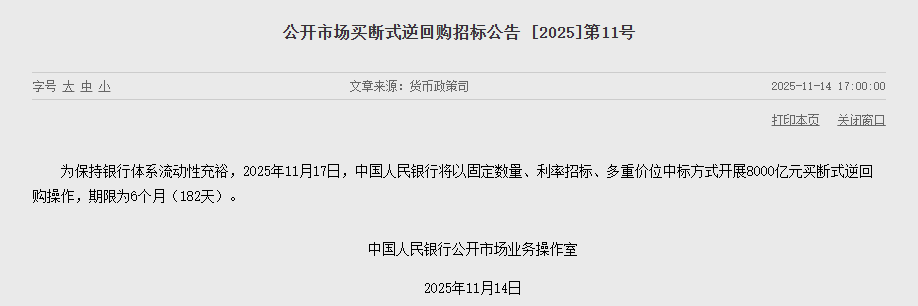
8000亿 央行加量续做6个月期买断式逆回购
Ren Min Wang· 2025-11-17 02:04
Core Viewpoint - The People's Bank of China (PBOC) is implementing a fixed amount of 800 billion yuan in a buyout reverse repurchase operation to maintain liquidity in the banking system, with a term of 6 months [1][2]. Group 1: Monetary Policy Actions - In November, the PBOC will conduct a 6-month buyout reverse repurchase operation of 800 billion yuan, with an additional 5 billion yuan in 3-month buyout reverse repurchase operations [1]. - The total amount of medium-term lending facility (MLF) maturing in November is 900 billion yuan, indicating a significant liquidity management effort by the PBOC [1][3]. - The PBOC has established a monthly pattern for liquidity operations, including 3-month and 6-month buyout reverse repurchase operations and MLF operations [1]. Group 2: Economic Implications - The PBOC's actions are aimed at ensuring that social financing conditions remain relatively loose, aligning the growth of money supply with economic growth and price expectations [2]. - Analysts believe that the increased scale of buyout reverse repurchase operations signals a continued supportive monetary policy stance, which is beneficial for stabilizing growth and expectations [2][3]. - The ongoing liquidity support is expected to facilitate government bond issuance and encourage financial institutions to increase credit supply [2][3]. Group 3: Market Dynamics - The buyout reverse repurchase mechanism differs from conventional pledged reverse repurchase, enhancing market liquidity and addressing "asset shortage" pressures [3]. - The recent buyout reverse repurchase operations are part of a coordinated policy effort to stabilize liquidity expectations and interest rates, contributing to a solid financial environment for economic stability [3].
多家银行出台方案 金融精准服务新型工业化
Xin Lang Cai Jing· 2025-11-16 04:03
为加快金融强国和制造强国建设,中国人民银行、工业和信息化部等7部门于今年8月联合印发了《关于 金融支持新型工业化的指导意见》(以下简称《意见》)。近日,中国建设银行、中国银行等发布落实 《意见》要求的相关实施方案,进一步细化与新型工业化相适应的金融机制,全面支持我国新型工业化 深入发展。(经济日报) ...
通缩之下暗藏玄机!这五类资产或将悄悄升值,内行人揭秘财富密码
Sou Hu Cai Jing· 2025-11-15 00:40
Core Viewpoint - The article discusses the hidden opportunities for asset appreciation in a deflationary environment, highlighting five asset categories that may benefit from current economic conditions and government policies [1]. Group 1: Gold - In a deflationary environment, gold is considered a "hard currency" and has seen a continuous increase in reserves, with China's gold reserves reaching 74.09 million ounces as of October, marking a 12-month consecutive increase [2]. - Global central banks are increasing gold purchases, with gold surpassing the euro as the second-largest reserve asset, indicating further potential for accumulation [2]. - The World Gold Council reported a net inflow of $8.2 billion into global gold ETFs over five months, reaching a total scale of $503 billion, reflecting a strong demand for gold as a safe asset [2]. Group 2: Long-term Pension Investment - The expansion of pension investment products nationwide is seen as a stable choice in a deflationary context, with the Financial Regulatory Authority extending the pilot program and increasing fundraising limits for financial companies [3]. - The policy encourages the issuance of long-term products with favorable fee rates, allowing investors to lock in long-term returns while investing in quality assets like the pension and health industries [3]. - The flexibility in product design and the support for pension advisory services make this an attractive option for both middle-aged individuals preparing for retirement and ordinary investors seeking stable returns [3]. Group 3: Core Housing Demand - Contrary to expectations of falling prices, policies in 2025 are focused on "core quality assets" in the housing market, with relaxed credit policies and lower down payment ratios for first-time homebuyers [5]. - Recent data shows a significant increase in new home purchases in cities like Shenzhen and Shanghai, indicating a recovery in demand for core urban properties [5]. - The combination of limited supply and supportive policies suggests that essential housing in prime locations may not only resist price declines but could also appreciate once the market stabilizes [5]. Group 4: High-Quality Bonds - The easing monetary policy signals a favorable environment for high-quality bonds, with expectations of interest rate cuts that could lead to rising bond prices [6]. - Government bonds and AAA-rated bonds are gaining popularity due to their liquidity and low credit risk, providing stable interest income for investors [6]. - Ordinary investors can consider purchasing savings bonds or investing in bond funds to mitigate market volatility while achieving better returns than regular savings accounts [6]. Group 5: Essential Consumption and New Consumer Leaders - Despite a deflationary environment, essential consumption remains robust, with government initiatives aimed at boosting demand for essential goods and services [7]. - The National Development and Reform Commission has announced support for consumer goods, indicating a commitment to enhancing the market for essential products [7]. - Companies focusing on essential goods and those benefiting from policy support in new consumption sectors are likely to see stable performance and potential asset appreciation in the current economic climate [7].

央行将开展八千亿元买断式逆回购操作
Zheng Quan Shi Bao· 2025-11-14 17:37
Group 1 - The People's Bank of China (PBOC) announced a buyout reverse repo operation of 800 billion yuan with a six-month term, indicating a net injection of 500 billion yuan for the month of November [1] - The PBOC has been consistently using buyout reverse repo operations since October last year to address long-term funding gaps, with a total of 1.5 trillion yuan in operations planned for November [1][2] - Analysts expect the PBOC to continue using various monetary policy tools, including buyout reverse repos and medium-term lending facilities (MLF), to maintain liquidity in the banking system [2] Group 2 - In October, the PBOC maintained liquidity by implementing multiple monetary policy tools, including a restart of government bond trading, despite 900 billion yuan in MLF maturing in November [2] - The PBOC's recent monetary policy report indicates a commitment to a moderately loose monetary policy to keep social financing conditions relatively relaxed [2] - Market analysts believe that the significance of the PBOC's resumption of government bond trading lies more in its signaling rather than an immediate need for liquidity injection [2]
央行将加量续做6个月期买断式逆回购
Zheng Quan Ri Bao· 2025-11-14 16:04
Core Viewpoint - The People's Bank of China (PBOC) is implementing a significant liquidity injection through a 800 billion yuan reverse repo operation to maintain ample liquidity in the banking system, with a net injection of 500 billion yuan after accounting for maturing reverse repos [1][2]. Group 1: Reverse Repo Operations - On November 17, the PBOC will conduct an 800 billion yuan reverse repo operation with a six-month term, marking a net injection of 500 billion yuan after 300 billion yuan of six-month reverse repos mature [1]. - The total net injection from reverse repos in November is expected to be 500 billion yuan, which is an increase of 100 billion yuan compared to October, indicating a continuous trend of increasing reverse repo operations for six consecutive months [1]. Group 2: Market Liquidity and Government Bonds - The increase in reverse repo operations is partly due to the issuance of 500 billion yuan in local government bonds aimed at resolving existing debt and boosting effective investment, leading to a significant rise in net financing of government bonds in November [2]. - The maturity of 9 billion yuan in Medium-term Lending Facility (MLF) in November may also necessitate additional liquidity support from the PBOC, with expectations of a slight increase in MLF renewals [2]. Group 3: Monetary Policy Framework - The PBOC has established a monthly routine for liquidity operations, including three-month reverse repos around the 5th, six-month reverse repos around the 15th, and MLF operations on the 25th, which collectively provided a net injection of 1.5 trillion yuan in the third quarter [3]. - The PBOC's monetary policy aims to maintain a moderately accommodative stance while closely monitoring changes in the global monetary policy landscape and adjusting liquidity supply accordingly [3].
【金融街发布】中国人民银行发文加强银行间市场经纪业务监管
Zhong Guo Jin Rong Xin Xi Wang· 2025-11-14 13:26
Core Viewpoint - The People's Bank of China has introduced a new regulatory framework for interbank market brokerage services, effective from January 1, 2026, aimed at enhancing oversight and promoting transparency in market transactions [1][1][1] Summary by Sections Regulatory Framework - The newly released "Management Measures for Interbank Market Brokerage Services" consists of six chapters and twenty-five articles, detailing the scope of brokerage services and prohibitive actions [1][1] - Brokerage institutions are required to strengthen internal controls and manage the entire business process, while the responsibilities of the entrusting parties are also clarified [1][1] Market Impact - The measures are designed to standardize the behavior of brokerage institutions and market participants, thereby improving the normativity and transparency of market transactions [1][1] - The People's Bank of China plans to enhance communication and collaboration with various stakeholders to ensure the effective implementation of these measures, promoting the healthy development of brokerage services [1][1]

中国人民银行发文加强银行间市场经纪业务监管
Xin Hua Wang· 2025-11-14 13:14
Core Viewpoint - The People's Bank of China has introduced the "Interbank Market Brokerage Business Management Measures" to enhance regulation of brokerage activities in the interbank market, effective from January 1, 2026 [1] Group 1: Regulatory Framework - The new measures consist of six chapters and twenty-five articles, outlining the scope of brokerage business and prohibitive actions [1] - Brokerage institutions are required to strengthen internal controls and manage the entire business process [1] - Responsibilities of the entrusting parties are clearly defined within the new regulations [1] Group 2: Market Impact - The measures aim to standardize the behavior of brokerage institutions and market participants, thereby increasing the normativity and transparency of market transactions [1] - The regulations are designed to protect the legal rights and interests of market participants [1] - The People's Bank of China plans to enhance communication and collaboration with various parties to ensure the implementation of these measures and promote the healthy development of brokerage business [1]
买断式逆回购将连续第6月加量续作 持续向市场注入中期流动性
Xin Hua Cai Jing· 2025-11-14 13:09
Core Viewpoint - The People's Bank of China (PBOC) announced a fixed quantity, interest rate tender, multi-price bidding operation for 800 billion yuan reverse repos on November 17, aimed at maintaining ample liquidity in the banking system [1] Group 1: Reverse Repo Operations - The PBOC will conduct a reverse repo operation of 800 billion yuan with a term of 6 months (182 days) [1] - There are 3 trillion yuan of 6-month and 7 trillion yuan of 3-month reverse repos maturing this month, with the latter already renewed in equal amounts on the 5th [1] - The total amount of reverse repos for both terms is expected to increase by 500 billion yuan, which is 100 billion yuan higher than the previous month [1] Group 2: Market Impact - This operation will inject medium-term liquidity into the market for six consecutive months, helping to stabilize the funding environment and support government bond issuance [1] - Financial institutions are expected to increase monetary credit investments as a result of this liquidity injection [1] - The chief macro analyst from Dongfang Jincheng noted that the PBOC's actions are aimed at maintaining a stable and ample liquidity state [1] Group 3: Future Expectations - On November 25, 900 billion yuan of Medium-term Lending Facility (MLF) will mature, and the reverse repo net injection may help alleviate the pressure of MLF renewal [1][2] - The PBOC's monetary policy execution report emphasizes the need to maintain ample liquidity and create a suitable monetary financial environment [1]
央行宣布!下周一,8000亿元
Zhong Guo Zheng Quan Bao· 2025-11-14 12:34
Core Viewpoint - The People's Bank of China (PBOC) is set to conduct a 800 billion yuan reverse repo operation on November 17, aimed at maintaining ample liquidity in the banking system, with a term of 6 months [1][4]. Group 1: Reverse Repo Operations - The upcoming operation will involve a fixed amount and interest rate bidding, with a total of 800 billion yuan for a 182-day term [1]. - This operation indicates a continuation of the 6-month reverse repo, with an additional 500 billion yuan, aligning with market expectations [4]. - The PBOC's previous operation on November 5 involved a 700 billion yuan 3-month reverse repo, effectively renewing the same amount due to the maturity of 700 billion yuan [4]. Group 2: Market Analysis - Analysts suggest that this marks the sixth consecutive month the PBOC has injected medium-term liquidity through reverse repos [5]. - Factors contributing to this liquidity support include the issuance of 500 billion yuan in local government bonds and the completion of 500 billion yuan in new policy financial instruments, which are expected to increase loan issuance [5]. - The upcoming maturity of 900 billion yuan in Medium-term Lending Facility (MLF) is anticipated to create pressure for renewal, which the reverse repo operation may alleviate [5]. Group 3: Future Expectations - There is a general expectation that the PBOC will continue to utilize various tools, including reverse repos and MLF, to ensure sufficient liquidity in the banking system [7]. - The PBOC may also consider increasing the scale of government bond purchases to smooth liquidity pressures, reflecting its intention to maintain a supportive monetary environment [6].