荣耀

Search documents
华为AI玩具开售即秒罄
财联社· 2025-11-29 08:40
Core Viewpoint - The article highlights the launch and market response of Huawei's first AI emotional companion product, "Smart Hanhai," which sold out quickly upon release, indicating strong consumer interest in AI toys [2][3]. Group 1: Product Launch and Market Performance - Huawei's "Smart Hanhai" AI toy was released at a price of 399 yuan and sold out immediately on its launch day, with multiple restocks also selling out quickly [2]. - In Huawei's JD self-operated flagship store, over 6,500 units of the "Smart Hanhai" in three color variants were sold [3]. Group 2: Collaboration and Development - The "Smart Hanhai" was co-designed by Luobo Intelligent and Huawei, marking Huawei's entry into the AI emotional companionship market [4][5]. - Luobo Intelligent, established in early 2024, focuses on developing AI companion robots, with its first product "Fuzozo" launched in June 2025 [7]. Group 3: Industry Trends and Competitors - Other companies like Honor and JD are also entering the AI toy market, with Honor collaborating with Aofei Entertainment to develop AI interactive toys [4][10]. - The AI toy market is seen as a new growth area for traditional consumer electronics companies, as they seek to diversify beyond slowing smartphone sales [12][13]. Group 4: Market Potential and Challenges - The AI toy market has significant potential, appealing to both children and adults by providing emotional value [13]. - However, the industry faces challenges such as product homogeneity, technical issues like misrecognition, and concerns over data security and privacy [13][14].


数千架空客A320飞机需紧急更换软件|首席资讯日报
首席商业评论· 2025-11-29 05:08
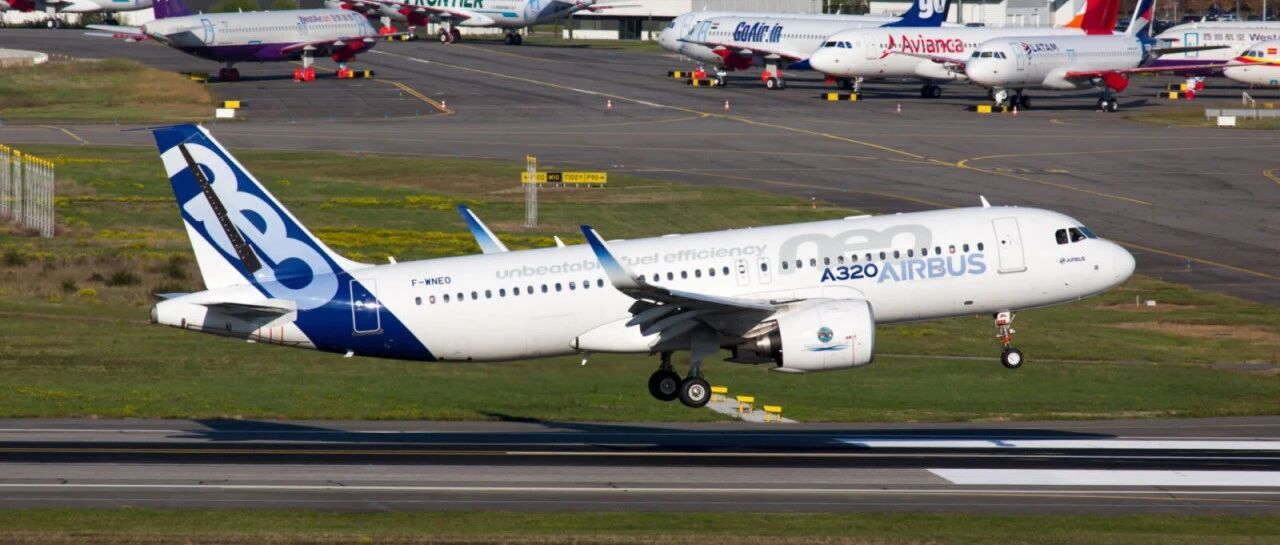
Group 1 - Airbus A320 aircraft require urgent software replacement due to vulnerability to solar radiation, affecting approximately 6,000 planes, following an incident involving JetBlue Airlines [2] - Changan Automobile's subsidiary, Avita Technology, has applied for a public listing on the Hong Kong Stock Exchange, focusing on high-end smart connected electric vehicles [3] - SolGold Plc has rejected a second acquisition offer from China Molybdenum, with the latest bid at 26 pence per share, leading to a significant increase in SolGold's stock price [4] Group 2 - Sohu Video plans to increase procurement of American TV shows and movies, aiming to provide a better experience for users seeking non-pirated content, despite current profitability challenges [5] - GSMA reports that global mobile operators' cybersecurity spending is projected to double from $15-19 billion annually to $40-42 billion by 2030, highlighting the need for better regulatory collaboration [7] - Samsung has dissolved its HBM development team, integrating it back into the DRAM division, indicating challenges in the high-bandwidth memory market [8] Group 3 - Xiahe Technology has initiated IPO counseling with CITIC Securities, aiming for a public offering [9] - DeepSeek has launched a new mathematical reasoning model, DeepSeekMath-V2, which utilizes a self-verifying training framework and has achieved high scores in competitive evaluations [10] - Xiaomi faced a legal setback in a case regarding unreturned deposits for undelivered cars, with the court ruling against the company's contract terms [11] Group 4 - Citigroup analysts suggest that Li Ning is unlikely to acquire foreign brands in the near term due to its current business strategy, maintaining a "buy" rating on several Chinese sportswear stocks [12] - JD.com announced changes to its JD Bean rules, with a maximum validity of 180 days starting in 2026 [13]






非洲智能手机市场第三季度快速增长 中国厂商加速“掘金”步伐
Zheng Quan Ri Bao Wang· 2025-11-28 12:51
Core Insights - The African smartphone market is projected to see a significant year-on-year increase of 24% in shipments by Q3 2025, reaching 22.8 million units, driven by enhanced market demand, currency stability, increased financing usage, and improved retail activities [1] - Chinese smartphone manufacturers continue to dominate the African market, with Transsion leading with a shipment of 11.6 million units and a market share of 51% in Q3, followed by Xiaomi, OPPO, and Honor, collectively holding 72% of the market share [1] Group 1: Market Growth and Dynamics - The growth of the African smartphone market in Q3 2023 outpaced the global smartphone market's moderate recovery, with South Africa leading the growth at 31% due to the acceleration of prepaid models in the low and mid-range segments [1] - The report highlights that the African smartphone market is supported by ongoing economic growth, increasing internet penetration, and favorable government policies promoting technological innovation and the internet industry [2] Group 2: Company Strategies and Opportunities - Xiaomi is accelerating its long-term strategy in Africa, planning to enter over 15 new markets and has opened its first self-operated flagship store in Morocco, focusing on models priced below $150 [2] - OPPO is consolidating its market position in North Africa with Egypt as a core hub, while Honor is maintaining steady growth in South Africa through high-cost-performance models like the Honor 200 Lite [2] - Chinese smartphone manufacturers face multiple opportunities in Africa, including deepening the cost-effective market, leveraging supply chain integration, and creating differentiated competitive advantages through targeted functional development [3]


昀冢科技:目前公司的主营业务未发生变化
Mei Ri Jing Ji Xin Wen· 2025-11-28 10:22
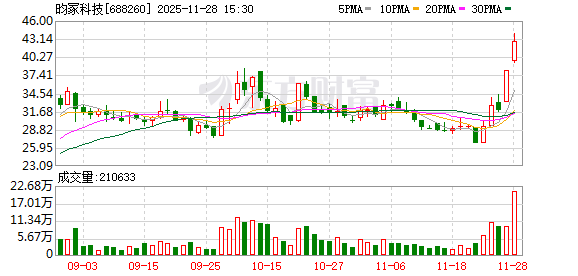
Core Viewpoint - Yunzhu Technology (688260.SH) has released a notice regarding its business operations, confirming that its main business remains unchanged, focusing on consumer electronics and electronic ceramics, as well as automotive electronics [2] Group 1: Company Overview - Yunzhu Technology specializes in the research, design, production, and sales of products in the fields of consumer electronics, electronic ceramics, and automotive electronics [2] - The company's primary business is in consumer electronics, specifically in components used in smartphone cameras, such as voice coil motors (VCM) and camera modules (CCM) [2] Group 2: Market Applications - Yunzhu Technology's consumer electronic products are primarily utilized in the smartphone camera systems of major brands including Huawei, Xiaomi, OPPO, VIVO, and Honor [2]

又一个重磅题材信号来了!
Ge Long Hui A P P· 2025-11-28 08:42
Core Viewpoint - The Mate80 series from a certain company has adopted a "quantity increase and price decrease" strategy, defying the trend of rising component prices in the smartphone industry, which has left competitors at a disadvantage [1][3][4]. Pricing Strategy - The Mate80 series has seen a price reduction of 800 yuan for the standard version, bringing it down to 4699 yuan, while the Pro and ProMax versions have decreased by 500 yuan [1]. - With additional e-commerce platform subsidies, the actual price drop could reach up to 1000 yuan [2]. Competitive Landscape - Competitors in the Android market were preparing for price increases due to rising costs of key components, such as a 30% increase in Qualcomm Snapdragon 8 chip prices and a 200% increase in DRAM memory prices over six months [2][6]. - The price reduction by the certain company has rendered similar models from competitors nearly incomparable, causing panic among rival brands [3][4]. Supply Chain Advantages - The Mate80 series boasts over 90% of its components sourced from domestic suppliers, which has allowed the company to maintain lower costs compared to competitors reliant on international supply chains [5][7]. - The self-developed Kirin 9030 chip significantly reduces external procurement costs, with internal costs potentially being half of the approximately 200 USD that competitors pay for flagship chips [5]. Market Impact - The goal for the Mate80 series is to achieve sales of over 20 million units, which would help expand the HarmonyOS ecosystem to 50 million devices, attracting more developers and enhancing the product ecosystem [5]. - The success of the Mate80 series could lead to market share loss for competitors who are heavily dependent on international supply chains [5][9]. Industry Trends - The smartphone market is currently in a phase of stock competition, with rising procurement costs leading to higher retail prices, which could hinder sales across the board [6][9]. - The certain company's ability to lower prices amidst rising costs indicates a shift in the industry, potentially forcing competitors to source components domestically to remain competitive [10][11]. Investment Opportunities - The situation presents significant investment opportunities in the domestic storage industry, which is likely to see growth due to increased demand from the certain company's success [12]. - Key players in the domestic storage supply chain, including equipment manufacturers and chip producers, are expected to benefit from this trend [12][13][14]. Conclusion - The Mate80's reverse pricing strategy signifies a shift towards "domestic substitution and ecological independence" in China's tech industry, presenting potential growth for investors focused on companies with strong technological barriers and solid performance [15].
服务品牌出海的AI Agent企业QuickCEP,拿到了近亿元融资
Sou Hu Cai Jing· 2025-11-28 08:28
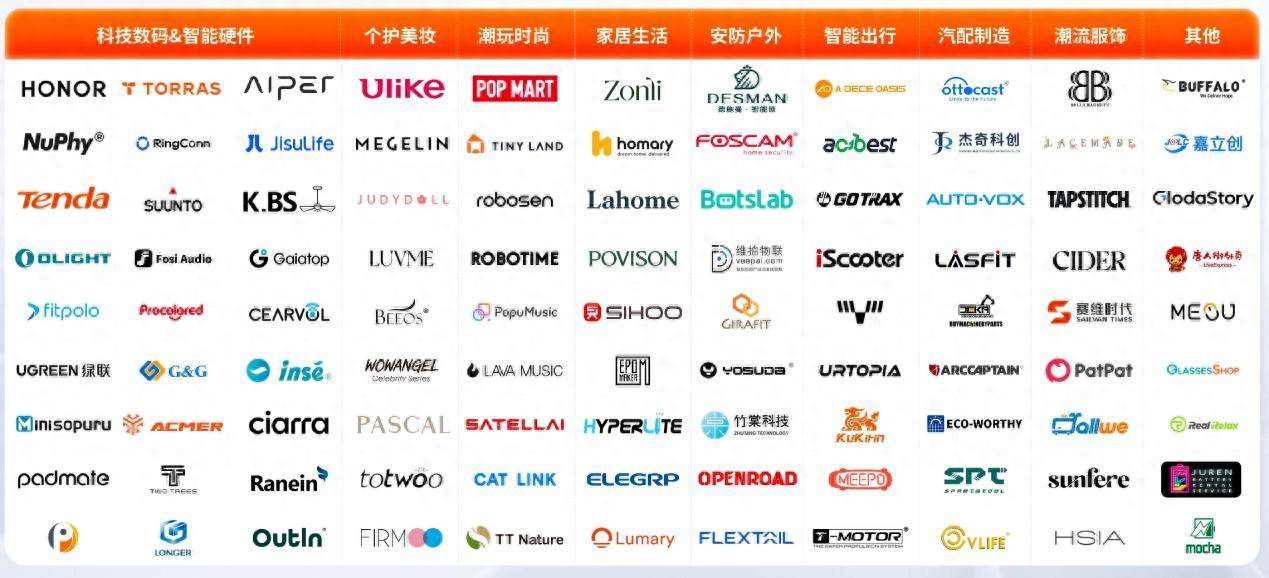
近日,中国品牌出海AI Agent解决方案企业北京快牛智营(简称:QuickCEP)完成近亿元融资,本轮融资由啟赋资本领投,老股东复星锐正超额跟投,源 合资本担任独家财务顾问。据了解,完成本轮融资后,QuickCEP将依托当前的行业领跑地位,持续通过 AI 赋能中国品牌出海企业,进一步夯实其在跨境电 商领域的业务布局,并将服务延伸至海外物流、汽车出海、金融出海、游戏出海等领域;同时,作为企业级 AI Agent 出海的先行者,QuickCEP 也将继续扩 大其在海外市场的收入规模。 在QuickCEP所服务企业中,既有泡泡玛特、TCL、荣耀手机这类中国知名品牌企业,也有原生的DTC跨境品牌像傲雷、几素、赛维时代这类企业,也包含 那些在海外提供实体服务的物流、茶饮品牌企业。近几年AI爆发后,许多出海企业就已经开始考虑如何借助AI的能力去提升海外客户的服务响应和沟通问 题,因此QuickCEP也更多地被中国出海企业所关注并建立起合作关系,从QuickCEP的角度来看,这种趋势核心点在于三个方面: 1、品牌企业在创始人思维,组织能力,人才积累上具备"思考用户需求"的基础条件,他们会清晰地知道品牌与消费者之间的互动效 ...
夸克眼镜补全AI to C硬件入口 阿里“全栈AI”战略形成闭环|聚焦
Sou Hu Cai Jing· 2025-11-28 02:15
Core Viewpoint - The launch of Alibaba's Quark AI glasses marks a significant step in the company's AI to C strategy, integrating hardware into its ecosystem and positioning itself in the growing AI glasses market [1][3][20]. Product Launch and Sales Performance - Quark AI glasses were officially released on November 27, with over 7,000 units sold on Tmall and over 500 units on JD.com by November 28, achieving top sales rankings in their respective categories [1]. - The glasses are the first smart hardware to feature the Qianwen assistant, which is part of Alibaba's broader strategy to create an AI ecosystem [6]. Supply Chain and Technology - The glasses are supported by a strong supply chain, including companies like Luxshare Precision, Qualcomm, and JBD, which contributed advanced technologies such as a compact AR light engine and high-performance chips [3][5]. - The dual-chip design, featuring Qualcomm's AR1 and Hengxuan's BES2800, allows for optimized performance and power efficiency, addressing the need for both high-load and lightweight tasks [5]. Market Outlook and Strategic Positioning - Alibaba's leadership expressed optimism about the AI glasses market, predicting that AI glasses will become essential for everyone, potentially transforming human-computer interaction [8]. - The global market for glasses exceeds 1.5 billion units annually, with a shorter replacement cycle compared to smartphones, indicating a significant opportunity for growth in the AI glasses segment [8]. Ecosystem Integration - Quark AI glasses integrate various Alibaba services such as Alipay, Gaode Map, and Taobao, enhancing their utility and user experience [9]. - Future developments will focus on expanding the glasses' capabilities in areas like identity verification, health monitoring, and online learning, aiming to create a comprehensive smart ecosystem [17]. Challenges and Industry Dynamics - The AI glasses industry faces challenges in balancing performance, weight, and battery life, with ongoing efforts to improve materials and chip technology [18][19]. - The competitive landscape is intensifying as major players like Alibaba, Baidu, and Xiaomi enter the market, driving rapid advancements in product features and applications [21].

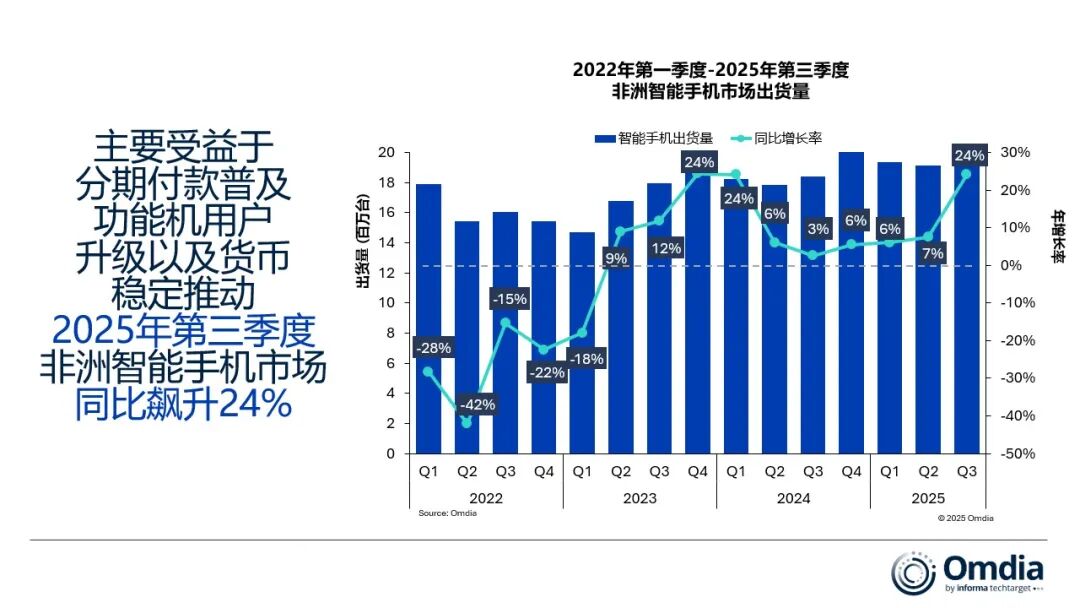
Omdia:第三季度非洲智能手机出货量同比激增24% 达到2280万台
智通财经网· 2025-11-28 01:16
Core Insights - The African smartphone market is experiencing a significant rebound, with Q3 2025 shipments expected to surge by 24% year-on-year, reaching 22.8 million units, following five consecutive quarters of decline [1][6] - Key factors driving this growth include increased market demand, currency stability, enhanced financing usage, and improved retail activities [1] - North Africa and Sub-Saharan Africa are witnessing double-digit growth in smartphone shipments, with Nigeria and Egypt each accounting for 14% of regional shipments, but with differing recovery dynamics [1][2] Market Performance - Nigeria's smartphone shipments are projected to soar by 29% year-on-year, attributed to the stabilization of the Naira and the introduction of affordable models under $150, stimulating retail upgrade demand [1] - Egypt's market is expected to grow by 19%, driven by increased demand for mid-range devices and promotional bundling strategies [1] - South Africa leads the growth with a 31% increase, benefiting from the rise of prepaid models and enhanced retail promotions [2] Product Segmentation - Smartphones priced below $100 are expected to see a remarkable 57% increase, while those above $500 are projected to grow by 52% [4] - Transsion is a key player in the entry-level market, with a 25% year-on-year increase in shipments, supported by strong demand in Algeria, Egypt, Morocco, Nigeria, Kenya, and South Africa [4] - Samsung dominates the high-end market, with strong demand for Galaxy S24 and S24 FE 5G models in South Africa, Senegal, and Algeria [4] Competitive Landscape - Xiaomi is accelerating its long-term strategy in Africa, planning to enter over 15 new markets and has opened its first flagship store in Morocco [4] - OPPO is consolidating its market position in North Africa, focusing on Egypt, while Honor is maintaining steady growth in South Africa through competitive models like Honor 200 Lite [4] Future Outlook - Despite the current growth, the African smartphone market is expected to decline by 6% in 2026 due to rising supply-side pressures, including increased BOM costs and currency depreciation [6] - The low-end 4G market, which constitutes a significant portion of demand, will be particularly affected, leading to higher average selling prices and new payment challenges for consumers [6]
Omdia: 2025年第三季度,非洲智能手机市场出货量同比增长24%,重现双位数增长,传音继续领跑,荣耀仍保持三位数最大增幅
Canalys· 2025-11-28 01:04
Core Insights - Omdia's latest research indicates that smartphone shipments in Africa will surge by 24% year-on-year in Q3 2025, reaching 22.8 million units, marking a rebound after five consecutive quarters of slowdown, driven by increased market demand, currency stability, enhanced financing usage, and improved retail activities [1] Group 1: Regional Performance - North Africa and Sub-Saharan Africa experienced double-digit growth in smartphone shipments, with Nigeria and Egypt each accounting for 14% of regional shipments; Nigeria's market surged by 29% due to stable naira exchange rates and an updated portfolio of models priced below $150, while Egypt saw a 19% increase [1] - South Africa led with a 31% growth, benefiting from the acceleration of prepaid models in the low and mid-range markets, new model launches, and increased retail promotions [2] - Kenya's market grew by 17%, driven by the rising penetration of installment payment plans, which have become a significant driver of smartphone sales [2] Group 2: Market Dynamics - The shipment of smartphones priced below $100 increased by 57%, the fastest growth rate in three quarters, while models above $500 grew by 52%; the entry-level market's rapid growth was primarily driven by Transsion, which saw a 25% year-on-year increase in shipments supported by strong demand in Algeria, Egypt, Morocco, Nigeria, Kenya, and South Africa [5] - Major brands like Samsung dominated the high-end market with strong demand for Galaxy S24 and S24 FE 5G in South Africa, Senegal, and Algeria, although overall market growth remained moderate at 5% due to consumer preference for cost-effective models [5] Group 3: Competitive Landscape - Xiaomi is accelerating its long-term strategy in Africa, planning to enter over 15 new markets in the coming months and has opened its first self-operated flagship store in Morocco; its strong sales in the sub-$150 segment account for half of its shipments [6] - OPPO is consolidating its market position in North Africa with a focus on Egypt, while Honor is maintaining steady growth in South Africa through high-cost-performance models like Honor 200 Lite [6] Group 4: Future Outlook - Omdia forecasts a 6% decline in the African smartphone market by 2026 due to rising supply-side pressures, including increased BOM costs, tight memory supply, and ongoing currency weakness, which will particularly impact the low-end 4G market that constitutes the majority of demand in Africa [8] - These pressures are expected to raise average selling prices, especially in the $80 to $150 range, presenting new payment challenges for consumers; manufacturers will need to strengthen financing partnerships, optimize channel inventory, and localize more effectively to navigate this environment [8]

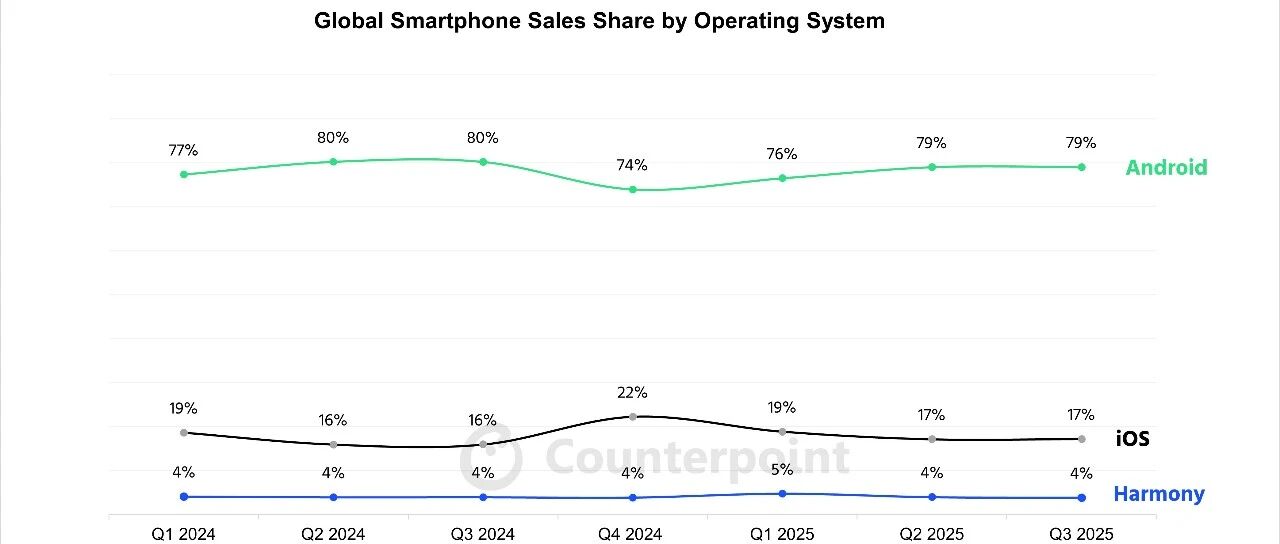
全球智能手机按操作系统划分的销售份额(2024 年 Q1 - 2025 年 Q3)
Counterpoint Research· 2025-11-28 01:03
Core Insights - The article presents quarterly insights into global smartphone operating system trends, focusing on market shares of Android, iOS, and HarmonyOS in the US, China, and India [4][6]. Global Market Overview - In Q3 2025, global smartphone sales increased by 4% year-on-year, marking the strongest performance for September since 2021. Android maintained a leading global market share of 79%, despite a 1% decline from Q3 2024. Samsung's Galaxy foldable series and early updates of certain A-series products helped mitigate this decline. HONOR's growth in various regions also supported Android's performance [9]. - iOS accounted for 17% of global sales in Q3 2025, up 1% from the previous year, driven by positive initial responses to the iPhone 17 series in key markets like the US, Japan, and India. The older iPhone 16 series also performed well during India's festive promotions [9]. - HarmonyOS captured a 14% market share in China in Q3 2025, surpassing other platforms to become the second-largest smartphone operating system in the country. The Huawei Nova 14 series was a key driver of this growth, although new models running HarmonyOS Next faced challenges due to early-stage ecosystem limitations [9]. Market Share Breakdown United States - Android's market share in the US was 45% in Q3 2025, down from 50% in Q2 2025. iOS held a 55% share in the same quarter [10]. China - In China, Android's market share was 69% in Q3 2025, a slight increase from 66% in Q2 2025. HarmonyOS maintained an 18% share, while iOS held 14% [12]. India - Android dominated the Indian market with a 92% share in Q3 2025, while iOS accounted for 8% [17].