
OpenAI

Search documents
速递|AI新贵与传统巨头对决:希尔顿CTO称三年磨一Agent,不会为概念买单
Z Potentials· 2026-02-13 02:27
Core Insights - The article discusses the competitive landscape of AI agents, highlighting how traditional software companies are racing to develop AI products that can automate tasks previously performed by human workers [1][3][8] Group 1: AI Agent Development - Companies like Microsoft, ServiceNow, and Snowflake are launching AI agent products to help clients create customized AI agents that can interact with various enterprise applications [1][3] - The emergence of AI agent management dashboards raises questions about the necessity of multiple dashboards, suggesting that each client may ultimately only need one [2] Group 2: Key Players and Products - Major players in the AI agent space include Anthropic, OpenAI, and Google, with products designed to automate tasks across different applications [3][5] - OpenAI's Frontier project aims to assist companies like Uber and Thermo Fisher Scientific in developing multiple AI collaborative assistants [9][10] Group 3: Market Dynamics and Challenges - Microsoft CEO Satya Nadella predicts that traditional software applications will collapse in the era of AI agents, as they are merely databases with business logic [8] - Despite the potential of AI agents, significant security concerns and operational challenges remain, such as the risk of credential leaks and the high operational threshold for current products [8][11] Group 4: Industry Sentiment - Executives from traditional software companies express a mix of caution and optimism regarding the integration of AI agents, with some companies already utilizing AI technologies from OpenAI and Anthropic [11][12] - The sentiment in the industry is that software leaders feel they must either achieve a trillion-dollar valuation or face extinction due to the disruptive nature of AI [12]



喝点VC|a16z最新2026大预测:下一波可观测性的浪潮将是物理的,而非数字的
Z Potentials· 2026-02-13 02:27
Core Insights - The article discusses the emergence of an AI-native industrial foundation in the U.S., focusing on sectors like energy, manufacturing, logistics, and infrastructure, which are being revitalized through AI and software innovations [3][4]. - By 2026, AI applications will evolve to eliminate visible prompts, allowing for proactive suggestions based on user behavior, enhancing personal and professional interactions [19][26]. Group 1: American Dynamism and Industrial Revival - The U.S. is rebuilding its industrial base, emphasizing AI-driven solutions in energy, manufacturing, and logistics, creating significant opportunities in advanced energy systems and autonomous operations [4][5]. - Companies are adopting a "factory mindset" to tackle complex challenges by integrating AI and automation with skilled labor, leading to efficient production processes [5][6]. - The rise of "physical observability" through interconnected sensors and cameras will enhance real-time monitoring of critical infrastructure, paving the way for advancements in robotics and autonomous systems [7]. Group 2: AI in Business and Consumer Applications - AI is transforming business models by enhancing economic outcomes rather than merely automating tasks, with companies like Eve using data to improve legal service success rates [14][15]. - The consumer AI landscape is shifting from task-oriented applications to those that foster deeper human connections, with products designed to understand users better [26][27]. - The emergence of AI voice agents is streamlining business operations, allowing companies to automate various tasks and improve efficiency [17]. Group 3: Data and Infrastructure - The future of AI will be defined by the ability to harness vast amounts of unstructured data generated in industries, with companies focusing on data collection and model training [12][13]. - The electrical industrial stack is becoming crucial for the next industrial revolution, integrating software with physical manufacturing processes [8]. Group 4: Future Trends and Opportunities - By 2026, companies will increasingly rely on collaborative AI systems that work together across business processes, necessitating a rethinking of organizational structures and workflows [24][25]. - New AI startups will emerge, focusing on serving newly established companies, leveraging the opportunity to grow alongside them [29][30].

机器人ETF鹏华(159278)红盘向上,宇树创始人称机器人未来热度或是现在的1000倍
Xin Lang Cai Jing· 2026-02-13 02:21
Group 1 - The core viewpoint is that the robotics industry, particularly embodied intelligence, is primarily driven by AI, with potential for significant growth in the coming years, possibly exceeding the hype of mobile internet by 100 to 1000 times [1] - The year 2026 is identified as a critical milestone for humanoid robots, with expectations for mass production and supply chain developments, leading to a substantial increase in output from thousands to tens of thousands of units [1] - Major companies are expected to converge in terms of supply chain and technology, indicating a global "arms race" in robotics, with advancements in electric drive technologies and new materials [1] Group 2 - As of February 13, 2026, the Guozheng Robotics Industry Index (980022) has risen by 0.52%, with notable increases in stocks such as Dingzhi Technology and Kelaimechatronics [2] - The top ten weighted stocks in the Guozheng Robotics Industry Index account for 39.43% of the index, highlighting key players in the robotics sector [2] - The Penghua Robotics ETF (159278) closely tracks the Guozheng Robotics Industry Index, reflecting the price changes of related listed companies [2]

模型对话端侧硬件-2026年如何看待端侧落地
2026-02-13 02:17
模型对话端侧硬件? 2026 年如何看待端侧落地? 20260212 2026-02-12 摘要 OpenAI 在端侧硬件方面有哪些布局? OpenAI 正在积极布局多个端侧硬件产品,包括 AI PIN、耳机、眼镜和桌面机 器人等。这些产品旨在通过各种硬件入口获取用户,并借助其庞大的用户基础 (亿级或十亿级)拉动硬件销量。OpenAI 计划每年出货量达到 1 亿级别,这 一目标值得关注。 未来几年内存市场的走势如何? AI 眼镜市场增长迅速,Meta 与陆逊梯卡合作的眼镜 2025 年销量超 700 万副,预计 2026 年达 1,500 万副,同比增长一倍,带显示功能的 AI 眼镜预计 2027 年出现,具备拍照、录像及视频图像呈现功能。 AI 手机在 2026 年发展前景广阔,多家厂商积极布局,对芯片处理能力、 NPU 处理能力及内存容量提出更高要求,有望推动消费者换机潮,AI PC 等传统终端设备也将受益。 OpenAI 积极布局端侧硬件,包括 AI PIN、耳机、眼镜和桌面机器人等, 旨在通过硬件入口获取用户,计划年出货量达 1 亿级别,其庞大用户基 础有望拉动硬件销量。 预计 2026 年上半年消费 ...
OpenAI推出首款采用Cerebras芯片的模型,AI人工智能ETF(512930)交投活跃
Xin Lang Cai Jing· 2026-02-13 02:09
Group 1 - The core viewpoint of the news highlights the performance of the AI-themed index and ETF, with notable stock movements and the introduction of OpenAI's new AI model [1][2] - As of February 12, the AI-themed index (930713) showed mixed performance among its constituent stocks, with Tuowei Information leading at a 3.29% increase, while Kunlun Wanwei experienced the largest decline [1] - The AI artificial intelligence ETF (512930) was quoted at 2.28 yuan, with a turnover rate of 1.01% and a transaction volume of 35.018 million yuan during the trading session [1] Group 2 - Wanlian Securities indicates that AI computing power construction is in a growth phase, with key hardware sectors like storage and PCB experiencing a high prosperity expansion cycle [2] - Global cloud service providers are accelerating capital expenditures, driving demand for servers and upstream components, leading to a structural shortage in high-end storage capacities [2] - The top ten weighted stocks in the AI-themed index as of January 30 include companies like Zhongji Xuchuang and Hikvision, accounting for 57.27% of the index [2]
AI“超级代理”大战打响!四大赛道全面铺开,OpenAI、Anthropic正挑战微软们的软件帝国
Hua Er Jie Jian Wen· 2026-02-13 02:01
Core Insights - Major AI companies like OpenAI and Anthropic are launching enterprise-level AI products that challenge existing enterprise software markets, prompting traditional software vendors like Microsoft and Salesforce to accelerate their own AI tools and management platforms [1][2] Group 1: Competitive Landscape - The competition involves four main product categories: browser-based agents, computer-operable agents, agent-building tools, and agent management consoles [1][2] - OpenAI and Google provide browser-based agents capable of executing multi-step tasks, while Anthropic's Cowork and Google's Gemini Computer Use are examples of computer-operable agents [2] - Agent-building tools such as Salesforce's Agentforce and Google's Gemini Enterprise allow clients to create agents that can access various enterprise applications [2] - The agent management console market features competitors like Microsoft's Agent 365 and OpenAI's Frontier, raising questions about the necessity of multiple consoles for clients [2] Group 2: Adoption Challenges - Despite the promising outlook, new agent technologies face significant challenges before widespread adoption, including security concerns and usability issues [3] - Companies like OpenAI and Anthropic indicate that their computer-operable agents are still in research preview, suggesting they are not yet ready for large-scale enterprise deployment [3] - Hilton's CTO Onkar Birk expressed caution in adopting new subscriptions, highlighting the complexity and investment required for developing customer support agents [4] Group 3: Traditional Software Companies' Response - OpenAI's strategy involves positioning its agent command technology above traditional enterprise "record systems," which are critical for storing business data [5] - Traditional enterprise application companies like Salesforce and Microsoft have not yet taken steps to block AI agents from accessing or modifying data within their systems [5] - There is a recognition that traditional companies are utilizing technologies from OpenAI and Anthropic to support their own agents, even as these AI firms promote their competitive tools [5] Group 4: Market Dynamics - Snowflake, a database company, has released a product supported by AI models from OpenAI and Anthropic, enabling clients to develop agents for searching and retrieving business metrics [6] - The competitive landscape is characterized by high stakes, with industry leaders feeling pressure to either achieve a $1 trillion valuation or face potential failure [6]



从xAI联创“转身”看行业局势,全球头部AI公司人才创业观察
3 6 Ke· 2026-02-13 01:53
Core Insights - The recent departures of xAI co-founders Yuhuai Tony Wu and Jimmy Ba have sparked significant industry discussion, signaling a potential shift towards smaller, AI-driven teams redefining innovation in the sector [1][2] - The trend of key personnel leaving established AI companies like OpenAI to pursue entrepreneurial ventures is becoming a notable pattern in the industry, indicating a movement from large organizations to startups [3][4] Group 1: xAI Developments - xAI's founding team has halved since its inception in 2023, with several core technical figures departing, which may impact the company's future capabilities and direction [3] - Wu's and Ba's statements reflect a broader trend in the AI industry, emphasizing the potential of small teams leveraging AI technology to create impactful solutions [2][3] Group 2: OpenAI Talent Exodus - A significant number of key personnel from OpenAI have left to establish their own startups, focusing on various aspects of AI, including safety, general intelligence systems, and AI search [4][5] - Notable startups emerging from this talent exodus include Safe Superintelligence, Thinking Machines Lab, and Perplexity AI, each targeting different niches within the AI landscape [7][8][10] Group 3: Investment and Valuation Trends - Safe Superintelligence has raised approximately $10 billion in funding, achieving a valuation of around $50 billion, with further funding rounds increasing its valuation to about $320 billion [7] - Thinking Machines Lab has also attracted significant investment, securing $20 billion in seed funding and reaching a valuation of approximately $120 billion [9] - Perplexity AI has gained traction as an early AI search tool, supported by investments from notable figures and firms, including Jeff Bezos and Nvidia [11] Group 4: Competitive Landscape - Anthropic, founded by former OpenAI employees, is focusing on large model development and has achieved a valuation of $615 billion following its E-round funding [14] - Character.AI, co-founded by former Google Brain researchers, has become a leader in AI virtual character interactions, boasting over 20 million monthly active users and a valuation of around $10 billion [26][27] Group 5: Future Outlook - The AI industry is evolving from a focus on foundational model breakthroughs to practical applications and long-term strategic planning, with a clear trend towards safety and system architecture [28] - The emergence of open-source ecosystems is enabling smaller teams and individual developers to redefine the execution capabilities of AI, suggesting a dynamic future for the industry [29]


这个人,两次改写中国AI叙事
3 6 Ke· 2026-02-13 01:52
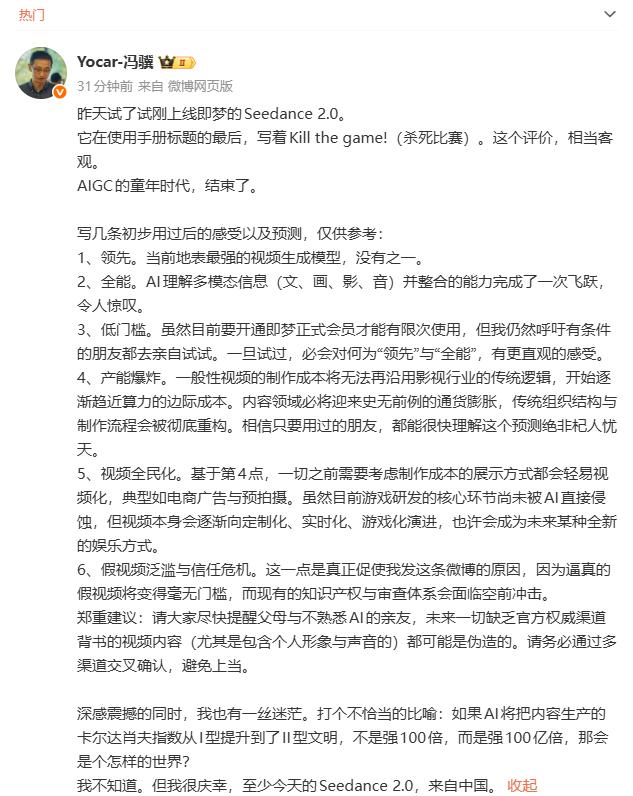
Core Insights - The article discusses the significant impact of Feng Ji, the founder of Game Science and producer of "Black Myth: Wukong," on the narrative of China's AI development through his social media posts [4][34] - Feng Ji's evaluations of DeepSeek R1 and ByteDance's Seedance 2.0 mark pivotal moments in the evolution of China's AI landscape, highlighting the transition from mere technological competition to a more mature stage of innovation and application [4][34] Group 1: Key Events and Evaluations - On January 26, 2025, Feng Ji praised DeepSeek R1 as a "national fortune-level technological achievement," emphasizing its accessibility and affordability [5][6] - He articulated the value of DeepSeek across six dimensions: powerful, cheap, open-source, free, connected, and local [5] - On February 9, 2026, he described Seedance 2.0 as "the strongest on Earth," declaring the end of the "childhood era" of AIGC, indicating a shift towards commercial viability and productivity [13][34] Group 2: Impact on AI Perception - Feng Ji's commentary helped demystify AI technologies, making them relatable to the general public by framing them as tools for everyday use [8][36] - His insights coincided with critical moments in the AI sector, where confidence in Chinese models was essential for their acceptance and integration into daily life [9][34] Group 3: Technological Advancements - DeepSeek's introduction challenged the notion that developing powerful models requires exorbitant resources, demonstrating that algorithmic innovation can significantly reduce costs [16][17] - Seedance 2.0 represents a breakthrough in video generation, showcasing China's capability to compete in this challenging domain [18][19] Group 4: Market Dynamics and Global Competition - The article highlights a shift in the AI landscape, where smaller companies can now compete alongside industry giants due to reduced barriers to entry and innovative algorithms [32][33] - The global attention on Chinese AI advancements, as evidenced by Elon Musk's comments on Seedance 2.0, indicates a growing recognition of China's role in the international tech arena [27][28] Group 5: Cultural and Societal Integration - The 2026 Spring Festival saw a surge in AI tool usage for traditional activities, indicating a cultural shift towards integrating AI into everyday life [22][24] - This trend reflects a broader democratization of technology, where AI tools are accessible to a wider demographic, including older generations in smaller cities [25][24]
国元证券晨报-20260213
Guoyuan Securities2· 2026-02-13 01:50
Core Insights - The report highlights significant changes in U.S. trade policy, particularly the rejection of tariffs on Canadian imports by the House of Representatives, which may impact market dynamics [4] - It notes a substantial inflow into China's gold ETFs, amounting to 44 billion RMB in January, marking a record high for the start of the year [4] - The report also indicates a decline in smartphone sales in China, with a year-on-year drop of 23% in January [4] Economic Data Summary - The Baltic Dry Index closed at 1958.00, reflecting a 4.04% increase [5] - The Nasdaq Index decreased by 2.03%, closing at 22597.15, while the Dow Jones Industrial Average fell by 1.34% to 49451.98 [5] - Crude oil prices (ICE Brent) dropped by 2.67% to $67.55, and gold prices (London Gold Spot) fell by 3.17% to $4921.63 [5] - The U.S. dollar index showed a slight decrease of 0.01%, closing at 96.91 [5] Market Performance - The Hang Seng Index closed at 27032.54, down by 0.86%, while the Hang Seng China Enterprises Index fell by 1.00% to 9175.18 [5] - The Shanghai Composite Index experienced a marginal increase of 0.05%, closing at 4134.02, and the Shenzhen Composite Index rose by 0.51% to 2708.93 [5]
2月13日国际晨讯 | 日韩股市低开,美股、金银遭大规模抛售,特兰普宣称希望与伊朗在“一个月左右”达成协议
Sou Hu Cai Jing· 2026-02-13 01:43
【市场回顾】 人工智能初创公司Anthropic宣布,公司在最新一轮融资中筹集了300亿美元资金,且估值达到了3800亿 美元。本轮融资中包含"部分"此前宣布的微软和英伟达投资资金。两家公司去年11月曾表示,分别计划 投入最高50亿美元和100亿美元。 谷歌母公司Alphabet周四发布升级版双子座3号(Gemini 3)"深度思考"(Deep Think)推理模式,该模 式面向谷歌AI超级用户(ultra subscribers)和部分API用户开放,旨在针对科学和工程领域的应用场 景。 【国际宏观】 据CME"美联储观察",美联储到3月降息25个基点的概率为7.8%,维持利率不变的概率为92.2%。美联 储到4月累计降息25个基点的概率25.3%,维持利率不变的概率为73.1%,累计降息50个基点的概率为 1.6%。到6月累计降息25个基点的概率为49.9%。 北京时间2月13日交易时段,金银延续跌势。伦敦现货白银盘中跌破74美元/盎司,伦敦现货黄金最低下 探至4886美元/盎司附近。而在前一交易日,金银则遭遇了大规模抛售,伦敦现货白银大跌逾10%,伦 敦现货黄金亦跌超3%。 日韩股市13日低开。日经22 ...