库卡

Search documents
“点石成金”:解码机器人数据资产的价值觉醒
3 6 Ke· 2025-06-24 06:19
Core Insights - The emergence of data as a strategic asset in the robotics industry is transforming the core value proposition, moving from traditional physical assets to data-driven financial resources [2][3] - Companies like Shanghai Chiphua and Cloud Data Technology have successfully navigated the entire process of data asset registration, evaluation, and financing, marking a significant milestone in the industry [2][3] - The shift in the robotics industry is characterized by the recognition of high-quality, contextualized interaction and operational data as essential for optimizing algorithms, enhancing performance, and securing financial resources [3][4] Data Asset Characteristics - Robotics data is undergoing a transformation from operational logs to intelligent foundations, requiring the integration of physical interaction dynamics and environmental semantic understanding [4][5] - The unique characteristics of robotics data include deep mapping of the physical world and closed-loop feedback, which drive continuous optimization of the "perception-decision-execution" cycle [5][7] Challenges in Data Acquisition - The high value potential of data assets is countered by challenges such as scarcity and high acquisition costs, particularly in industrial settings that require precise sensors and skilled operators [8][9] - The cost of data collection for humanoid robots can be significantly higher than for autonomous vehicles, with estimates showing that the cost of collecting fine manipulation data can be 3 to 7 times that of driving data [9] Data Classification Framework - A multi-dimensional classification system is necessary to manage and unlock the potential of high-value but complex data assets, categorized by source, structure, and timeliness [10][11][12][13][14][15][17][18] Industry Dependency on Data - The dependency on high-quality data assets is becoming critical for commercial viability across various sectors, as evidenced by case studies in autonomous driving, industrial robotics, and service robots [20][22][23][24] - The strategic importance of data is underscored by the fact that without high-quality data assets, companies face significant barriers to market entry and operational efficiency [20][22] Investment Focus and Trends - The strategic position of data assets is experiencing a fundamental shift, with a growing consensus that data infrastructure is becoming a focal point for investment [25] - The capital landscape is evolving, with significant investments directed towards data processing platforms and specialized data chips, indicating a shift from hardware to software and data-centric solutions [42][43] Future Paradigms and Opportunities - The robotics data landscape is expected to evolve through three stages: data melting pot, compliance framework, and ecological community, each representing a significant shift in how data is utilized and valued [26][27][28] - The market is witnessing a transition from resource accumulation to productization and capitalization, with companies increasingly recognizing the financial value of their data assets [30][35] Key Investment Opportunities - Investment opportunities are concentrated in three pivotal areas: scene hubs that monopolize high-value data, architecture hubs that control data refinement processes, and compliance hubs that facilitate data flow across geopolitical boundaries [67][70][71] - Companies that successfully navigate the challenges of data acquisition, scene adaptation, and compliance will emerge as leaders in the burgeoning trillion-dollar market for robotics data assets [73][74]


大摩闭门会:全球及中国机器人产业的现状与未来展望-纪要
2025-06-23 02:10
Summary of the Conference Call on the Global and Chinese Robotics Industry Industry Overview - The Chinese robotics market is growing at a compound annual growth rate (CAGR) of 17%, expected to reach a market size of $47 billion by 2024, with drones holding the largest share [1][2] - The market is projected to maintain a 23% annual growth rate over the next four years, reaching $110 billion by 2028 [1][2] Key Insights and Arguments - Technological advancements, particularly in AI, sensing algorithms, and mobile navigation, are crucial drivers of the robotics industry's growth [1][3] - The application of robots has significantly improved production efficiency and quality, with data from 2013 to 2017 showing an 11% increase in production efficiency and an 8% increase in total factor productivity [1][5] - China is the largest producer of robots globally, accounting for 55% of total production, with a component market estimated at $40 billion, growing at approximately 23% annually until 2028 [1][6] Market Dynamics - Service robots are benefiting from advancements in algorithms and AI, with drones and service robots expected to grow at rates exceeding 20% to 30% in the coming years [1][7][8] - The localization rate of robot components varies; for instance, the localization rate for reducers is low (around 50% or lower), while batteries are nearly 100% localized [1][9] Component Market and Demand - The demand for robot components is closely linked to the development of downstream robots, with different types of robots requiring specific components [1][10] - The evaluation of stocks in the robotics industry can be based on market space and localization rates, with key players including 汇川技术 (Inovance Technology), 美的 (Midea), and 科沃斯 (Ecovacs) [1][11][12] Company-Specific Developments - 汇川技术 has a significant advantage in the industrial sector, with plans to expand into collaborative and humanoid robots [1][13] - 美的, after acquiring KUKA, has seen its automation business generate revenue of 28.7 billion RMB in 2024, accounting for about 7% of total revenue, with expectations for high single-digit growth in 2025 [1][18][19] Future Outlook - The robotics industry is expected to continue evolving, with Midea's domestic market projected to see double-digit growth, while international markets may experience slower growth due to maturity [1][19] - Smaller solution companies like 石头科技 (Roborock) and 科沃斯 (Ecovacs) are also anticipated to play significant roles in the market's future [1][19]

淄博企业深度参与了一场事关中欧双向奔赴的大会
Qi Lu Wan Bao Wang· 2025-06-19 13:38
Core Points - The event in Qingdao focused on the cooperation between China and Europe in vocational education, highlighting the importance of high-skilled talent development [2][4] - The meeting gathered significant figures from both regions, emphasizing the successful collaboration in vocational education over the past decades [4][5] - The "Qingdao Consensus" was established, outlining key areas for future cooperation, including standard recognition and the establishment of a digital training platform [10][11] Group 1: Event Overview - The international exchange conference on vocational education was co-hosted by the China People's Association for Friendship with Foreign Countries and the China-EU Association [2] - The event featured prominent attendees, including former Spanish Prime Minister Zapatero and representatives from various European companies [4][5] - The conference addressed the challenges and opportunities in talent education and training in the context of the digital age [4][5] Group 2: Company Involvement - Shandong Rhein-Kost Intelligent Technology Co., Ltd. played a key role as the organizer of the conference, showcasing its commitment to vocational education [2][6] - Rhein-Kost has been involved in vocational education for 21 years and has established multiple Sino-German smart manufacturing demonstration bases in China [7][8] - The company has successfully implemented the German dual education system in China, collaborating with numerous educational institutions [7][8] Group 3: Key Agreements and Initiatives - The "Qingdao Consensus" includes four main aspects: standard recognition, industry-education integration, dynamic curriculum systems, and digital inclusivity [10] - Several cooperation agreements were signed, focusing on talent training frameworks and international collaboration in vocational education [11] - The conference highlighted the increasing importance of vocational education in national development strategies, particularly in Shandong province [11][12]
美的能源发布“储能+热泵+AI”战略 三维协同打造全链路能源解决方案
Zheng Quan Ri Bao Wang· 2025-06-17 13:43
Core Viewpoint - Midea Group's energy brand, Midea Energy, debuted at the 18th International Solar Photovoltaic and Smart Energy & Storage and Battery Technology and Equipment Conference, showcasing its energy strategy driven by "Storage + Heat Pump + AI" [1][2] Group 1: Energy Solutions - Midea Energy provides comprehensive energy solutions across various sectors, including commercial, residential, large-scale storage, green buildings, and intelligent manufacturing through subsidiaries like Beijing Hekang New Energy and Shenzhen Kelu Electronics [1] - Kelu Electronics presented a range of products at the conference, including the Aqua-C series all-liquid cooling storage system and integrated energy management solutions [1] - Hekang New Energy focuses on new energy solutions, offering virtual power plants and energy trading platforms, along with residential energy solutions that create smart microgrids for homes [1][2] Group 2: AI and Technology Integration - Midea Energy introduced the next-generation AI energy management system and home energy stations, optimizing energy management through advanced algorithms and dynamic pricing [2] - The company has developed core technologies in the storage sector, including AI battery management and thermal management technologies, aiming for a full-link approach to energy supply, storage, and usage [2] - KUKA showcased automation solutions for the new energy sector, with a market share exceeding 25% for its heavy-duty robots [2] Group 3: Strategic Vision - Midea Group's Vice President and CTO, Wei Chang, emphasized the importance of integrating next-generation storage, heat pump solutions, and advanced AI technologies to drive the energy sector's growth [2][3] - The energy sector is positioned as a pillar industry for Midea Group, with ongoing investments in research and development to enhance sustainable growth [3] - The current energy system is viewed as a complex network requiring real-time optimization, with Midea Energy aiming to lead an "energy efficiency revolution" through its innovative technologies [3]
工业自动化:美国工业回流对需求的边际拉动研究
Haitong Securities International· 2025-06-13 11:09
Investment Rating - The report suggests a focus on companies benefiting from the return of the US semiconductor, biopharmaceutical, and machinery manufacturing industries, highlighting leaders in industrial automation such as Siemens, Emerson, Rockwell, ABB, FANUC, Yaskawa, and Mitsubishi Electric [5][58]. Core Insights - The added value of the US manufacturing industry was $2.6 trillion in 2022, accounting for 15.1% of global manufacturing value, ranking second globally after China [1][54]. - The proportion of US manufacturing in GDP has declined from 28.4% in 2001 to 10.7% in 2022, significantly lower than the global average of 17.5% [1][54]. - The US manufacturing sector has experienced a compound annual growth rate of 1.5% from 2017 to 2022, lagging behind the global average of nearly 3% [1][54]. - The "hollowing out" of the US manufacturing sector is characterized by a shift towards capital optimization, with significant reliance on imports for key components [2][55]. - The US government aims to reverse the decline in domestic manufacturing to ensure national security, particularly in critical sectors like semiconductors and medical supplies [2][30][55]. Summary by Sections 1. Current State of US Manufacturing - The US manufacturing sector's absolute value is not low, but its contribution to the economy is overshadowed by the service sector [1][9]. - The manufacturing sector's decline is evident in its GDP contribution compared to other major economies [1][9][12]. 2. Impact of US Reshoring on Industrial Automation - Industrial automation is crucial for reducing costs and improving efficiency through the integration of manufacturing processes [3][56]. - The US industrial automation market has significant growth potential, particularly in the context of low robot density compared to other economies [3][37]. - The competitive landscape features established giants like Siemens and ABB alongside new entrants, with increasing competition driven by technological advancements and policy support [4][57]. 3. Key Companies and Market Outlook - Major players in the industrial automation sector include Siemens, ABB, Emerson, FANUC, Yaskawa, and Mitsubishi Electric, each with distinct strengths and market positions [5][58]. - The pharmaceutical and medical technology sectors are expected to drive growth in industrial automation from 2025 to 2030, while other sectors face challenges [4][57].


职业教育国际峰会在山东召开,中欧多方达成“青岛共识”
Qi Lu Wan Bao Wang· 2025-06-13 03:04
Group 1 - The conference on international exchange in vocational education and high-skilled talent development between China and Europe was held in Qingdao, China, marking the 50th anniversary of diplomatic relations between China and the EU [1] - The theme of the conference was "Empowering Vocational Education and High-Skilled Talent Development through Digital Intelligence in the New Era" [1] - Key figures such as Liu Qibao, former Vice Chairman of the National Committee of the Chinese People's Political Consultative Conference, emphasized the importance of international cooperation in vocational education for high-quality development [1][2] Group 2 - Discussions included opportunities and challenges in talent education and training in the digital age, as well as successful experiences in vocational education collaboration [2] - Chinese representatives highlighted the rapid development and unique characteristics of China's vocational education system, especially since the reform and opening-up period [3] Group 3 - The "Qingdao Consensus" was reached, focusing on mutual recognition of standards, integration of industry and education, dynamic curriculum systems, and digital training accessibility [4][5] - Four significant cooperation agreements were signed, covering areas such as talent training frameworks and international cooperation in smart manufacturing [5][6] Group 4 - The conference was supported by various organizations, including the Qingdao Municipal Government and the Shandong Provincial Department of Education, and was hosted by Shandong Rhein-Kost Intelligent Technology Co., Ltd. [7]
“美的能源”首次亮相 能源产业将成美的集团又一支柱产业
Xin Hua Cai Jing· 2025-06-11 14:23
Group 1 - Midea Group's energy-related business launched its brand "Midea Energy" at the 2025 International Solar Photovoltaic and Smart Energy Exhibition, highlighting its strategic focus on renewable energy as a pillar industry [2] - The core strategy of Midea Energy is a three-dimensional approach combining energy storage, heat pumps, and AI to achieve integrated development [2][3] - Midea Energy showcased its next-generation energy solutions, including a box-level direct cooling energy storage platform, advanced heat pump technology, and an AI-driven energy management system [2][3] Group 2 - Midea Group leverages decades of expertise in thermal management and power electronics to enhance its energy storage system development, with thermal energy accounting for over 80% of global energy usage [3] - The company has established an AI research institute to drive efficiency in its energy management systems, applicable to large-scale virtual power plants and home energy stations [3] - Midea Energy's industry footprint spans various sectors, providing customized energy solutions through brands like Midea, Hekang New Energy, Kelu Electronics, and KUKA, with KUKA's heavy-duty robots holding over 25% market share in the renewable energy sector [4] Group 3 - Midea Group aims to balance its B2B and B2C business models, with renewable energy currently accounting for about 10% of total revenue, projected to increase to nearly one-third in the future [6] - Hekang New Energy reported a total revenue of 2.24 billion yuan in Q1 2025, a year-on-year increase of 220.56%, while Kelu Electronics achieved a revenue of 1.214 billion yuan, up 16.2% [4]
美的集团发布储能、热泵和AI战略
Di Yi Cai Jing· 2025-06-11 06:15
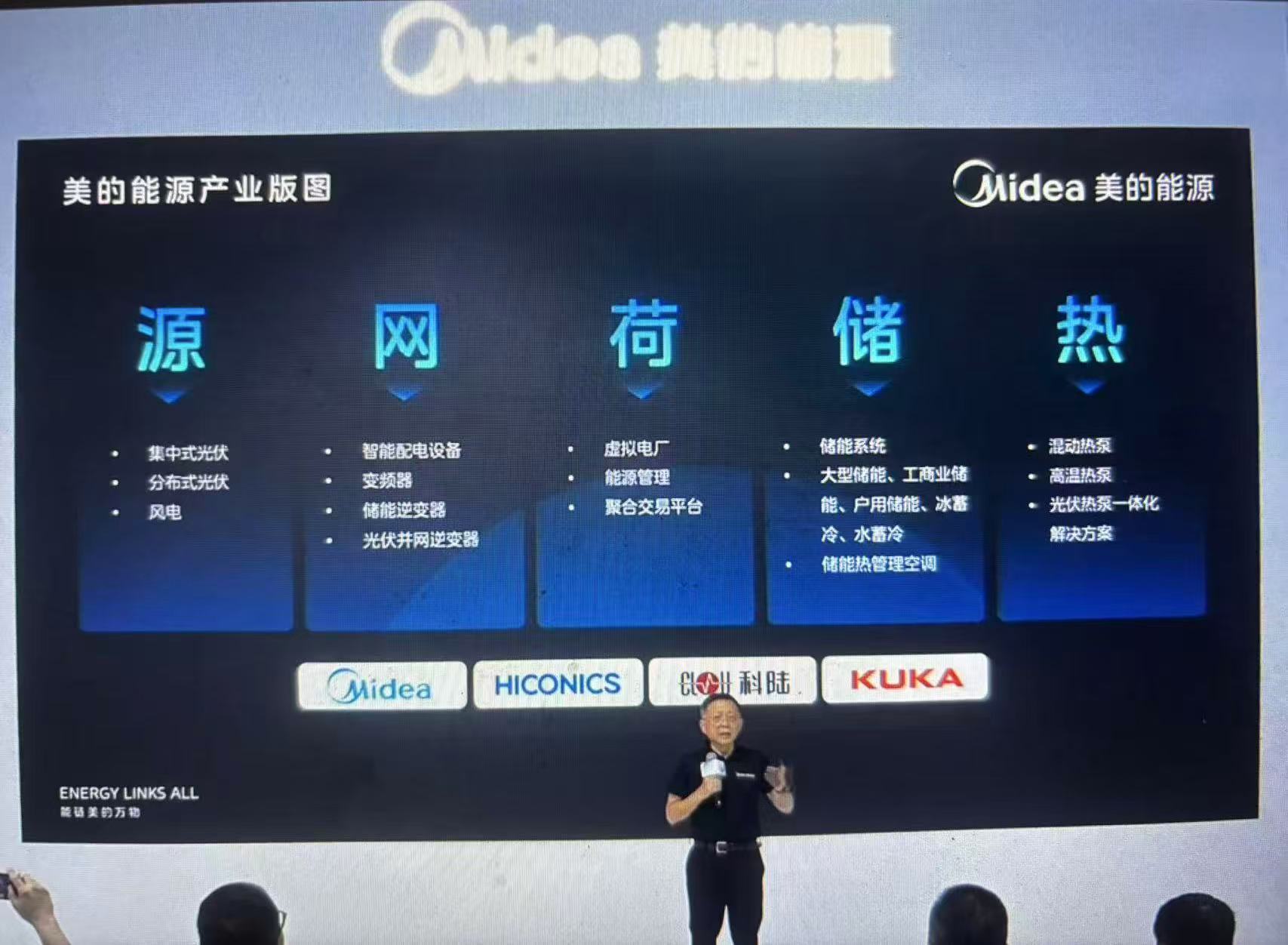
Core Viewpoint - Midea Group is positioning its energy business as a pillar industry through a three-dimensional strategy of "Energy Storage + Heat Pumps + AI" [2] Group 1: Midea Energy Strategy - Midea Energy is focusing on next-generation energy storage technology, advanced heat pump solutions, and artificial intelligence to drive business development [2] - The industrial landscape of Midea Energy includes various segments such as power generation, grid, charging, energy storage, and heat pumps [2] Group 2: Market Position and Performance - KUKA's heavy-duty robots have captured over 25% market share in the renewable energy sector [4] - Midea Group's ToB business, including Midea Energy, is a significant part of its overall strategy, with expectations for ToC and ToB revenues to each account for half of total income [5] - In Q1 2025, Midea Group reported revenue of 127.8 billion yuan and a net profit of 12.422 billion yuan, with ToB business revenue exceeding 100 billion yuan, representing over 25% of total revenue [5] Group 3: Industry Context - The scale of China's energy storage industry has reached a trillion yuan level, with increasing competition expected by 2025 [5] - The penetration rate of grid-type energy storage in the global energy storage system integration market is projected to reach 20% over the next five years [5]
解码镇域经济500强:超六成坐落苏粤浙,前十强广东占七席
2 1 Shi Ji Jing Ji Bao Dao· 2025-06-07 09:40
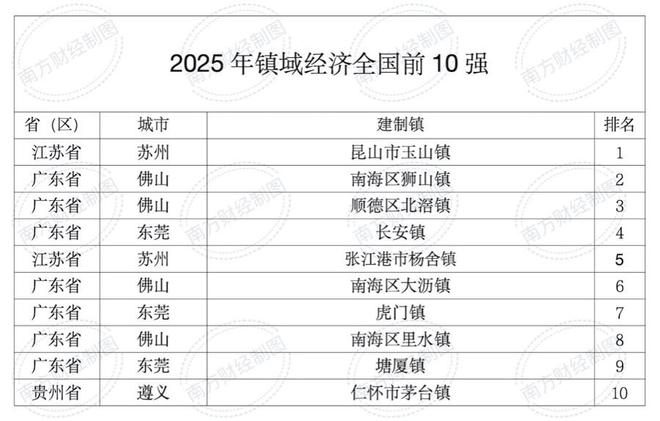
Core Insights - The report titled "2025 China Town Economic High-Quality Development Research" evaluates over 20,000 administrative towns across the country, resulting in the formation of the "2025 Town Economic Top 500" list [1][2] - The top three provinces with the most towns in the list are Jiangsu (128), Guangdong (102), and Zhejiang (82), accounting for 62.4% of the total [2][3] - Guangdong's representation has increased from 81 towns in 2023 to 102 in 2024, marking a continuous growth over three years [3][10] Group 1: Economic Performance - The top 10 towns in the list include seven from Guangdong, indicating its strong economic performance [2][6] - The towns in the top 500 are primarily from economically developed provinces, with Guangdong leading in the number of towns [2][9] - In the top 200 towns, Guangdong, Jiangsu, and Zhejiang account for 69, 59, and 29 towns respectively, representing 78.5% of the total [2] Group 2: Development Challenges - Despite the growth, Guangdong faces challenges such as regional development imbalances and a lack of mid-tier towns [1][9] - The report emphasizes the need for a networked approach to restructure the town economy, focusing resources on areas with potential and comparative advantages [1][10] Group 3: Strategic Recommendations - The "Three Integrations" strategy is proposed to enhance town economic development, focusing on integrating into urbanization, modern industrial systems, and rural revitalization [4][5] - The report suggests that towns should actively engage in provincial and municipal industrial chains and collaborate with neighboring towns for collective growth [5] Group 4: Notable Towns and Industries - Notable towns include Longan and Humen in Dongguan, which are key players in the electronic information and garment industries respectively [7][9] - The report highlights that Longan has become a "trillion-yuan town" with a GDP of 1,050.7 billion yuan in 2024, while Humen is recognized as "China's first clothing town" [7][9] Group 5: Future Goals - Dongguan aims to establish several "trillion-yuan towns" and "billion-yuan villages" by 2027, with specific GDP targets for town streets and parks [8] - The report indicates that Guangdong's town economy is transitioning from agriculture to industry, with a focus on high-end industrial upgrades [10]
四大家族格局松动?中国机器人企业谁能成为下一个“顶流”
机器人圈· 2025-06-04 10:09
前不久,ABB 正式宣布计划将其机器人业务单元进行100%分拆,并目标于2026年第二季度作为一家独立公司上市交易。 市场随后传出ABB亦在考虑出售该业务的可能性,估值在35亿至50亿美元之间。这一传闻为ABB机器人业务的未来增添了 诸多不确定性。 ABB的这一战略调整并非偶然。从ABB集团整体的财务表现来看,2024年,在电气事业部增长的驱动下,ABB在销售收 入、毛利率、运营息税摊销前利润及利润率方面均创下历史新高。其中,运营息税摊销前利润为59.68亿美元,同比增加 10%,利润率为18.1%。 相比之下,机器人业务的运营息税摊销前利润率仅为12.1%。ABB机器人业务2024年实现销售收入23亿美元,占集团总收 入的7%,运营息税摊销前利润(EBITDA)为3.29亿美元,同比下滑39%。 机器人业务订单下滑的主要原因是汽车和消费电子领域的投资减少,而物流和一般工业领域的增长势头良好。 根据ABB最新公布的财报显示,2025年一季度运营息税摊销前利润增长13%,达到15.9亿美元。但机器人与离散自动化事 业部的运营息税摊销前利润同比下降35%,虽然订单额回升了14%,但收入下降14%。 这些数据也非常 ...