成都银行

Search documents
成都市属国企2026年首轮集中招聘启动
Xin Lang Cai Jing· 2026-01-16 18:01
Group 1 - The first round of centralized recruitment for Chengdu's state-owned enterprises in 2026 has commenced, involving 10 companies and offering over 30 quality positions, with plans to recruit nearly 50 individuals [1][3] - The recruitment covers key sectors such as financial services, urban infrastructure, ecological environment, and public transportation, which are essential for urban functionality and industrial upgrading [1][2] - Technical positions dominate the recruitment, accounting for over 70% of the roles, focusing on cutting-edge fields like digital economy, artificial intelligence, and smart manufacturing [2][3] Group 2 - The recruitment aims to align with the goals of industrial development and modern service system construction, with positions in advanced manufacturing and emerging industries such as biomedicine [2][3] - The job openings cater to both industry veterans and young talents, with educational requirements ranging from associate degrees to master's degrees, and some positions are reserved for 2026 graduates [3] - The recruitment process will include qualification reviews, written tests, and interviews, with updates available through official government channels [3]
企业端发力支撑信贷
HTSC· 2026-01-16 12:01
Investment Rating - The report maintains a "Buy" rating for several banks, including Chengdu Bank, Chongqing Rural Commercial Bank, Nanjing Bank, Industrial and Commercial Bank of China, Shanghai Bank, and China Construction Bank, while recommending "Hold" for Chongqing Rural Commercial Bank [8][35]. Core Insights - The report highlights that corporate lending has become the main driver of credit growth, with December's new loans reaching 910 billion yuan, exceeding expectations, while household loans contracted significantly [2][5]. - The total social financing for 2025 is projected to be 35.6 trillion yuan, an increase of 3.34 trillion yuan year-on-year, supported mainly by government bonds [5][12]. - The report indicates a recovery in corporate bond financing, with December seeing an increase of 1.54 billion yuan, while government bond financing decreased significantly due to a high base effect from the previous year [3][5]. Summary by Sections Credit Growth - December's new loans amounted to 910 billion yuan, with corporate loans increasing by 1.07 trillion yuan, while household loans decreased by 916 billion yuan [2][5]. - The overall loan growth rate for December was 6.4%, remaining stable compared to November [2][12]. Social Financing - The total social financing in December was 2.21 trillion yuan, with a year-on-year decrease of 646.2 billion yuan, primarily due to fluctuations in government bonds [1][5]. - For the entire year of 2025, social financing is expected to grow significantly, driven by government support [5][12]. Monetary Supply - M1 and M2 growth rates for December were 3.8% and 8.5%, respectively, with M1 showing a decline due to limited demand for corporate current funds [4][12]. - New deposits in December reached 1.68 trillion yuan, with a year-on-year increase of 3.08 trillion yuan [4][12]. Investment Recommendations - The report recommends specific stocks for investment, including Chengdu Bank (target price 23.25 yuan), Nanjing Bank (target price 14.78 yuan), and Industrial and Commercial Bank of China (target price 8.31 yuan) [11][35].



城商行板块1月16日跌1.27%,江苏银行领跌,主力资金净流出2.29亿元
Zheng Xing Xing Ye Ri Bao· 2026-01-16 08:56
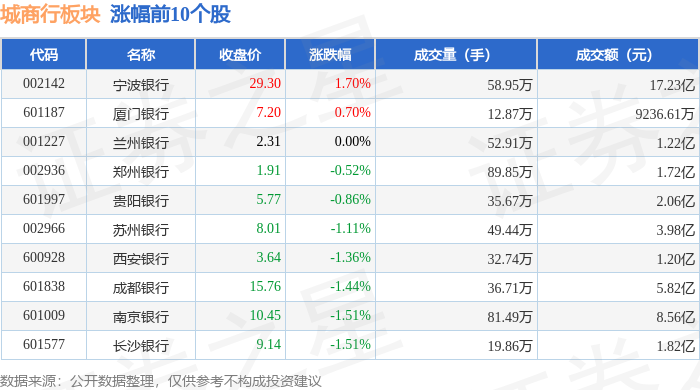
Core Viewpoint - The city commercial bank sector experienced a decline of 1.27% on January 16, with Jiangsu Bank leading the drop. The Shanghai Composite Index closed at 4101.91, down 0.26%, while the Shenzhen Component Index closed at 14281.08, down 0.18% [1]. Group 1: Stock Performance - Ningbo Bank closed at 29.30, up 1.70% with a trading volume of 589,500 shares and a transaction value of 1.723 billion [1]. - Xiamen Bank closed at 7.20, up 0.70% with a trading volume of 128,700 shares and a transaction value of 92.3661 million [1]. - Jiangsu Bank closed at 9.76, down 2.69% with a trading volume of 2,061,300 shares and a transaction value of 2.033 billion [2]. - Shanghai Bank closed at 9.64, down 2.43% with a trading volume of 961,200 shares and a transaction value of 933.3 million [2]. Group 2: Capital Flow - The city commercial bank sector saw a net outflow of 229 million from main funds, while speculative funds had a net inflow of 716 million, and retail investors experienced a net outflow of 487 million [2]. - Hangzhou Bank had a main fund net inflow of 153 million, while retail investors saw a net outflow of 113 million [3]. - Nanjing Bank recorded a main fund net inflow of 70.5 million and a retail net outflow of 131 million [3].



银行行业点评报告:政策支撑稳增长,关注Q1银行景气度修复行情
KAIYUAN SECURITIES· 2026-01-16 03:11
Investment Rating - The investment rating for the banking industry is "Positive" (maintained) [2] Core Viewpoints - The report emphasizes that policy support is crucial for stabilizing growth, with a focus on the recovery of banking sector sentiment in Q1 [4][7] - The People's Bank of China (PBOC) has indicated the feasibility of further interest rate cuts and reserve requirement ratio (RRR) reductions due to high current levels of RRR and a stable exchange rate environment [4] - Structural monetary policy tools have been introduced to lower the overall financing costs in society, with specific interest rate cuts for various loans [5] - The resumption of government bond trading operations by the PBOC is aimed at enhancing the monetary policy toolkit and ensuring smooth issuance of government bonds [6] Summary by Sections Monetary Policy and Economic Recovery - The PBOC's recent measures include a potential for 1-2 interest rate cuts within the year, with a possible reduction of 10 basis points each time, with the earliest cut expected in Q1 [4] - The report notes that the core Consumer Price Index (CPI) has shown positive growth, indicating effective policy collaboration [7] Banking Sector Performance - The banking sector is expected to benefit from improved economic conditions, with a significant increase in credit issuance anticipated in January, potentially the highest in history [7] - Banks with strong wealth management capabilities and those in active financial environments are likely to gain more from the supportive policy landscape [7] Recommendations - The report recommends focusing on banks such as CITIC Bank, Construction Bank, Agricultural Bank, and others, which are expected to benefit from the current economic recovery and policy support [7]



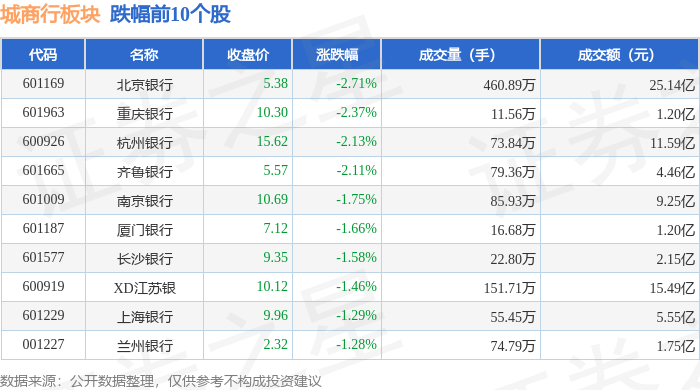
城商行板块1月14日跌2.11%,北京银行领跌,主力资金净流出7.29亿元
Zheng Xing Xing Ye Ri Bao· 2026-01-14 08:58
Core Viewpoint - The city commercial bank sector experienced a decline of 2.11% on January 14, with Beijing Bank leading the drop, while the overall market showed mixed results with the Shanghai Composite Index down 0.31% and the Shenzhen Component Index up 0.56% [1] Group 1: Market Performance - The closing price of Beijing Bank was 5.38, down 2.71%, with a trading volume of 4.6089 million shares and a transaction value of 2.514 billion [1] - Other notable declines included Chongqing Bank at 10.30 (-2.37%), Hangzhou Bank at 15.62 (-2.13%), and Qilu Bank at 5.57 (-2.11%) [1] - The city commercial bank sector saw a net outflow of 729 million in main funds, while retail investors contributed a net inflow of 53.1975 million [1] Group 2: Fund Flow Analysis - Hangzhou Bank had a main fund net inflow of 1.20 billion, but a net outflow from retail investors of 92.9469 million [2] - Suzhou Bank recorded a net inflow of 52.503 million from main funds, while retail investors had a net outflow of 54.0558 million [2] - Shanghai Bank experienced a main fund net inflow of 45.3249 million, with a retail net outflow of 46.6735 million [2]


企业商誉保护与舆情应对治理法律实务研讨会举行
Zhong Guo Xin Wen Wang· 2026-01-14 08:47
在主题发言环节,来自四川省委网信办网络综合治理与执法处、省公安厅网络安全保卫总队、省高级人 民法院民三庭、成都市中级人民法院成都知识产权法庭、金诚同达企业商誉保护与舆情应对治理法律研 究中心五位实务专家围绕企业商誉保护中的痛点难点问题,从各自的专业视角出发就企业商誉保护的法 律适用与舆情应对策略展开深度分享。 在圆桌沙龙环节,来自省公安厅、成都市检察院、郫都区法院及新华社四川分社的嘉宾们围绕"网络生 态治理视角下的企业商誉保护新格局"这一核心议题,结合各自工作实践从协同监管、司法保障、纠纷 化解、媒体监督等多维度提出了一系列建设性意见,为构建多方联动、标本兼治的企业商誉保护体系广 泛凝聚共识。 本次研讨会从网信部门、公安、法院、检察院、媒体、仲裁及律师多元视角,围绕企业商誉保护与舆情 应对的核心议题,从不同层面、不同角度进行了充分研讨交流。与会人员纷纷表示,此次研讨会内容兼 具专业性与实操性,既有权威政策解读和前沿理论支撑,又有典型案例剖析和实务经验分享,是一场干 货满满、启迪思维的思想盛宴,为明晰企业商誉保护与舆情应对的法律要点、实践路径,对进一步提升 企业商誉保护能力与舆情应对水平具有非常现实的指导意义。 ...
招行本周五“发红包” 超半数A股银行进行2025年度中期分红
Mei Ri Jing Ji Xin Wen· 2026-01-13 12:30
Core Viewpoint - The number of A-share listed banks implementing mid-term dividends is increasing, with several banks announcing their dividend plans for 2025, reflecting a commitment to shareholder returns and financial stability [1][4]. Group 1: Dividend Announcements - China Merchants Bank announced a cash dividend of approximately RMB 20.897 billion (including tax) for the first half of 2025, with a per-share dividend of RMB 1.013 (including tax) [1][2]. - As of now, over half of the 42 A-share listed banks have disclosed their mid-term dividend plans for 2025, with three banks, including China Merchants Bank, Postal Savings Bank, and Jiangsu Bank, announcing dividends this week [1][2][4]. - Postal Savings Bank distributed a cash dividend of RMB 0.123 per share (including tax) on January 12, 2026, while Jiangsu Bank announced a cash dividend of RMB 0.3309 per share (including tax) on January 14, 2026 [2]. Group 2: Regulatory Environment - The Chinese government has introduced guidelines to enhance cash dividend regulations for listed companies, encouraging multiple dividend distributions within a year and promoting higher dividend yields [3][4]. Group 3: Industry Trends - The mid-term dividend distribution among A-share listed banks has been growing, with 23 banks confirming their mid-term profit distribution plans for 2025, some of which are initiating mid-term dividends for the first time [4]. - Analysts note that the increase in the number of banks planning mid-term dividends and the stability of dividend rates indicate the banking sector's robust dividend value, which is attractive to long-term investors [5]. Group 4: Market Conditions - Despite a strong overall performance in 2025, many listed banks remain in a state of net asset value decline, primarily due to concerns over net interest margins and asset quality amid economic pressures [6]. - The average dividend yield for bank stocks is above 3%, with most banks expected to maintain a dividend yield of over 2% for their mid-term dividends in 2025 [6].

2025年超1万家银行网点关闭,净减少超2000家
新浪财经· 2026-01-13 10:24
Core Viewpoint - The article highlights a significant reduction in the number of bank branches in China by 2025, with over 1.1 million branches approved for closure and more than 840,000 new branches established, resulting in a net decrease of over 2,000 branches [4]. Group 1: Bank Branch Reductions - By 2025, the reduction in bank branches is primarily driven by rural credit cooperatives and village banks, with approximately 2,200 rural credit cooperative branches and nearly 1,000 village bank branches expected to close [4]. - In 2024, over 200 village banks exited the market, with 135 being absorbed and 85 acquired, indicating a trend of consolidation in the sector [4]. - The trend of "thinning" village banks is accelerating, with city commercial banks actively acquiring and restructuring these institutions [5]. Group 2: Transformation of Banking Services - Major banks like Minsheng Bank and Beijing Bank have initiated mergers with their village banks since 2024, reflecting a shift towards consolidation [5]. - The rise of mobile payment services has led to a reduction in the necessity for physical bank branches, prompting banks to shrink their branch networks [5]. - The China Banking Association's 2024 report emphasizes the need for banks to upgrade service channels and redirect resources to underserved areas, optimizing branch layouts [5]. Group 3: Regulatory Guidance - The National Financial Regulatory Administration aims to ensure the availability of physical bank branches in rural areas while balancing economic and social benefits, avoiding excessive competition and financial exclusion [6]. - The People's Bank of China encourages financial institutions to establish specialized branches in parks and communities to support rural revitalization and new citizen groups [6].

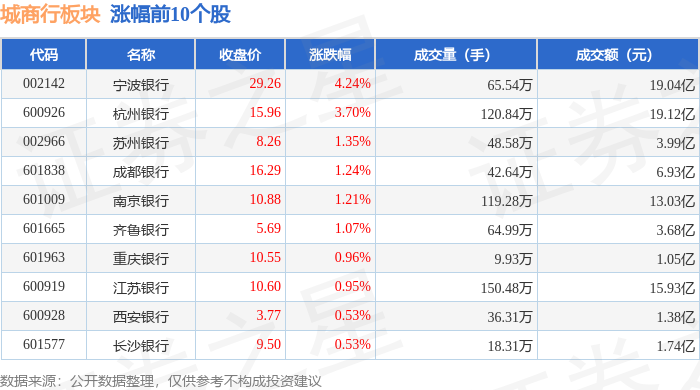
城商行板块1月13日涨1.55%,宁波银行领涨,主力资金净流入2.38亿元
Zheng Xing Xing Ye Ri Bao· 2026-01-13 09:06
Core Insights - The city commercial bank sector experienced a rise of 1.55% on January 13, with Ningbo Bank leading the gains [1] - The Shanghai Composite Index closed at 4138.76, down 0.64%, while the Shenzhen Component Index closed at 14169.4, down 1.37% [1] Stock Performance - Ningbo Bank (002142) closed at 29.26, up 4.24%, with a trading volume of 655,400 shares and a transaction value of 1.904 billion [1] - Hangzhou Bank (600926) closed at 15.96, up 3.70%, with a trading volume of 1,208,400 shares and a transaction value of 1.912 billion [1] - Suzhou Bank (002966) closed at 8.26, up 1.35%, with a trading volume of 485,800 shares [1] - Chengdu Bank (601838) closed at 16.29, up 1.24%, with a trading volume of 426,400 shares and a transaction value of 693 million [1] - Nanjing Bank (600109) closed at 10.88, up 1.21%, with a trading volume of 1,192,800 shares and a transaction value of 1.303 billion [1] - Qilu Bank (601665) closed at 5.69, up 1.07%, with a trading volume of 649,900 shares and a transaction value of 368 million [1] - Chongqing Bank (601963) closed at 10.55, up 0.96%, with a trading volume of 99,300 shares and a transaction value of 10.5 million [1] - Jiangsu Bank (616009) closed at 10.60, up 0.95%, with a trading volume of 1,504,800 shares and a transaction value of 1.593 billion [1] - Xi'an Bank (600928) closed at 3.77, up 0.53%, with a trading volume of 363,100 shares and a transaction value of 13.8 million [1] - Changsha Bank (601577) closed at 9.50, up 0.53%, with a trading volume of 183,100 shares and a transaction value of 174 million [1] Capital Flow - The city commercial bank sector saw a net inflow of 238 million from institutional investors, while retail investors contributed a net inflow of 199 million [2] - The sector experienced a net outflow of 437 million from speculative funds [2] Individual Stock Capital Flow - Hangzhou Bank (600926) had a net inflow of 70.42 million from institutional investors, while it faced a net outflow of 12.4 million from speculative funds [3] - Shanghai Bank (601229) saw a net inflow of 66.71 million from institutional investors, with a net outflow of 33.15 million from speculative funds [3] - Ningbo Bank (002142) had a net inflow of 37.18 million from institutional investors, with a net outflow of 1.4 million from speculative funds [3] - Suzhou Bank (002966) experienced a net inflow of 34.87 million from institutional investors, while facing a net outflow of 24.25 million from speculative funds [3] - Jiangsu Bank (601577) had a net inflow of 20.83 million from institutional investors, with a net outflow of 15.24 million from speculative funds [3]

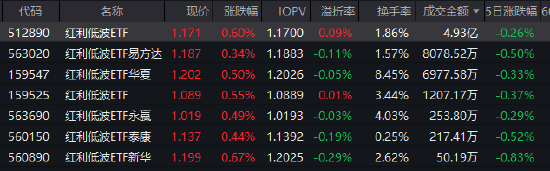
红利低波ETF(512890)近20个交易日逆势吸金15.8亿元 机构热议震荡市配置价值
Xin Lang Cai Jing· 2026-01-13 04:34
Core Viewpoint - The market experienced a broad fluctuation with all three major indices closing lower, while the Dividend Low Volatility ETF (512890) rose by 0.60% to 1.171 yuan, leading its category in trading volume [1][7]. ETF Performance - The Dividend Low Volatility ETF (512890) reported a price of 1.171 yuan, with a trading volume of 4.93 billion yuan and a turnover rate of 1.86% [2][4]. - Over the past five trading days, the ETF has seen a net outflow of 380 million yuan, but a net inflow of 1.58 billion yuan over the last 20 days and 3.67 billion yuan over the last 60 days [3][9]. Top Holdings - The top ten holdings of the Dividend Low Volatility ETF showed mixed performance, with notable movements including: - COFCO Sugar down by 1.48% - Nanjing Bank up by 2.14% - Agricultural Bank up by 1.46% [2][8]. Institutional Insights - China Galaxy Securities noted that the spring market rally continues, emphasizing the importance of annual performance forecasts and economic data to support fundamentals, while policy expectations for the "14th Five-Year Plan" may boost market confidence [4][11]. - Cinda Securities highlighted that increased trading volume reflects a recovery in risk appetite, with institutional funds entering the market, suggesting a focus on sectors with price increase expectations and performance support [5][11]. Fund Characteristics - The Dividend Low Volatility ETF (512890) was established on December 19, 2018, with a benchmark of the CSI Dividend Low Volatility Index. As of January 12, 2026, it has achieved a total return of 132.74%, outperforming its benchmark [5][11].