
迈瑞医疗

Search documents
大批医疗耗材启动调价
2 1 Shi Ji Jing Ji Bao Dao· 2026-02-04 11:56
Core Insights - The medical consumables price governance has entered a nationwide implementation phase in January 2026, with multiple provinces rapidly releasing policies for price adjustments and procurement regulations [1][3][6] Group 1: Policy Implementation - Provinces such as Liaoning, Qinghai, Guangdong, and Zhejiang have issued policies for price adjustments and procurement standards, covering both high-value and commonly used low-value consumables [1][3] - Liaoning was the first to announce the price adjustment results for the fifth batch of consumables on January 30, 2026, followed by Qinghai, which implemented price changes for 807 medical consumables immediately [3][6] - The policies are characterized by rapid implementation, strong targeting, and deep alignment with national procurement rules, focusing on stabilizing clinical supply and ensuring quality [6][10] Group 2: Industry Transformation - The price governance is reshaping the competitive landscape of the medical consumables industry, with increased compliance costs for small and medium-sized enterprises, leading to potential market exits for those lacking cost control capabilities [9][10] - The industry is transitioning from price competition to innovation and quality competition, necessitating companies to enhance supply chain management and clinical services for sustainable growth [9][10] - The governance will drive two major transformations: a shift towards high-value, innovative products and a focus on comprehensive cost management across the supply chain [9][10] Group 3: Long-term Outlook - The ongoing price governance is not merely about reducing prices but aims to balance price reduction with industry development and clinical needs [10] - The year 2026 is expected to be pivotal for deepening price governance, with more provinces likely to adopt regular price linkage and limit policies, further refining the national regulatory framework [10] - Companies must optimize product lines, improve cost structures, and increase innovation investments to thrive in the evolving landscape, moving towards a new development phase centered on clinical value and innovation [10]


大批医疗耗材启动调价
21世纪经济报道· 2026-02-04 11:49
Core Viewpoint - The article discusses the rapid implementation of medical consumables price governance across multiple provinces in China, marking a shift towards a national integrated pricing system that emphasizes cost control and innovation-driven competition in the industry [3][5][6]. Group 1: Policy Implementation - Multiple provinces, including Liaoning, Qinghai, Guangdong, and Zhejiang, have swiftly released policies for price adjustments and procurement regulations for medical consumables, indicating a significant acceleration in policy rollout [3][5]. - Liaoning was the first to announce price adjustments for the fifth batch of consumables in 2026, with Qinghai following suit by implementing price changes for 807 products immediately [3][5]. - Guangdong has set new prices for 195 selected products starting February 2, while Zhejiang focuses on limiting prices for high-value consumables, addressing inflated pricing issues [3][5]. Group 2: Characteristics of Policy - The recent provincial actions exhibit three key characteristics: rapid implementation with minimal delay between policy announcement and execution, targeted approaches focusing on specific product categories, and alignment with national procurement rules to ensure quality and clinical needs are met [5][6]. - The introduction of a "benchmark price" mechanism in the sixth batch of national high-value consumables procurement aims to prevent malicious low-price competition and serves as a model for local price governance [6]. Group 3: Industry Impact - The ongoing price governance is expected to increase compliance costs for the industry, pressuring smaller companies with limited cost control capabilities, while larger firms with economies of scale are likely to capture more market share [8]. - The shift in competition from price-based to innovation and quality-driven strategies is evident, with companies needing to enhance supply chain management and clinical services to sustain growth [8]. - The long-term transformation of the industry will involve a shift towards higher-value, innovative consumables, as procurement policies favor products with clear clinical value [8][9]. Group 4: Future Outlook - The article suggests that 2026 will be a pivotal year for the deepening of medical consumables price governance, with more provinces expected to adopt regular price linkage and limit policies, further refining the national regulatory framework [9]. - The emphasis on price transparency and standardized competition is anticipated to lead the industry away from chaotic growth towards a new phase centered on clinical value, innovation, and balanced pricing [9].

创业板50指数:龙头出海,链动全球
GF SECURITIES· 2026-02-04 09:09
Group 1 - The ChiNext 50 Index (399673.SZ) was launched on June 18, 2014, to reflect the overall performance of large-cap, liquid leading companies in the ChiNext market [3] - The index focuses on four key sectors: information technology, new energy, financial technology, and pharmaceuticals, with the top three industries being batteries (26.14%), communication equipment (23.46%), and photovoltaic equipment (7.26%), collectively accounting for 56.85% [14][24] - The index's constituent stocks are industry leaders with high representation, covering sectors such as new energy, optical modules, financial technology, PCB, and medical devices [14] Group 2 - The ChiNext 50 Index emphasizes international competitiveness and deep integration into the global industrial chain, promoting sectors with existing international competitiveness to grow stronger [18] - The index's constituent stocks have significant international operations, with overseas business income accounting for 35.17% of total revenue, higher than other major indices [25][28] - Leading companies in the index, such as CATL and Lens Technology, are key suppliers to international giants like Tesla and Apple, showcasing their strong global presence [24][26] Group 3 - The ChiNext 50 Index exhibits high elasticity and is particularly advantageous during phases of rising risk appetite, outperforming broader indices like the ChiNext Index and CSI 300 [32] - Over the past five years, the annualized return of the ChiNext 50 Index has been among the highest in its category, demonstrating its high-risk, high-reward characteristics [35] - The index is suitable for aggressive investment strategies during bull markets, aiming for higher excess returns [35] Group 4 - The valuation of the ChiNext 50 Index has returned to a reasonable range, with a current PE ratio of approximately 42, indicating a higher relative investment value [39] - The index has experienced a prolonged adjustment period, with its valuation significantly lagging behind fundamental declines, suggesting potential for future valuation and profit-driven resonance [41] - The index's constituent stocks have shown strong earnings growth, with a projected EPS compound growth rate significantly higher than other major indices [46] Group 5 - The lithium battery sector is experiencing a supply-demand resonance, driving both volume and price increases, with significant growth in demand from energy storage and new energy vehicles [55] - The communication equipment sector is benefiting from the AI data center construction, with a strong demand forecast for optical modules driven by major cloud providers [60] - The photovoltaic industry is transitioning towards high-quality development, with rising prices for raw materials like polysilicon, supported by government policies aimed at preventing "involution" in competition [67][68]






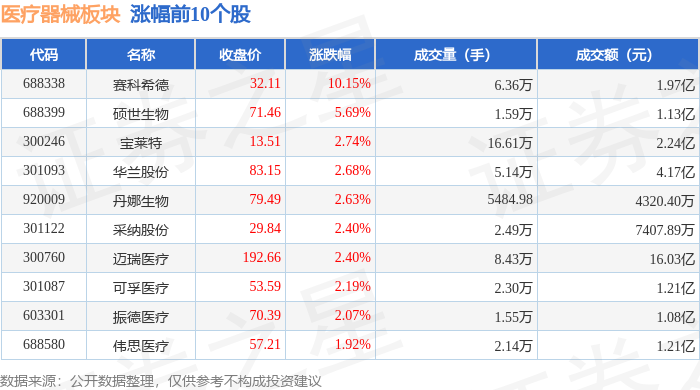
医疗器械板块2月4日涨0.9%,赛科希德领涨,主力资金净流出1.32亿元
Zheng Xing Xing Ye Ri Bao· 2026-02-04 08:56
Market Overview - The medical device sector increased by 0.9% on February 4, with SAIKOSHI leading the gains [1] - The Shanghai Composite Index closed at 4102.2, up 0.85%, while the Shenzhen Component Index closed at 14156.27, up 0.21% [1] Top Performers - SAIKOSHI (688338) closed at 32.11, up 10.15% with a trading volume of 63,600 shares and a transaction value of 197 million [1] - SHUOSHI BIO (6638889) closed at 71.46, up 5.69% with a trading volume of 15,900 shares and a transaction value of 113 million [1] - BAOLAIT (300246) closed at 13.51, up 2.74% with a trading volume of 166,100 shares and a transaction value of 224 million [1] Underperformers - KANGZHONG MEDICAL (688607) closed at 57.80, down 4.26% with a trading volume of 46,300 shares [2] - SINO MEDICAL (688108) closed at 22.70, down 3.77% with a trading volume of 170,600 shares and a transaction value of 387 million [2] - SANYOU MEDICAL (688085) closed at 21.05, down 3.08% with a trading volume of 39,800 shares and a transaction value of 84 million [2] Capital Flow - The medical device sector experienced a net outflow of 132 million from institutional investors, while retail investors saw a net outflow of 191 million [2] - Speculative funds had a net inflow of 323 million into the sector [2] Individual Stock Capital Flow - MAIRUI MEDICAL (300760) had a net inflow of 86.91 million from institutional investors, while retail investors had a net outflow of 169 million [3] - LIANSHENG MEDICAL (688271) saw a net inflow of 44.32 million from institutional investors, with a net outflow of 76.86 million from retail investors [3] - HUAKANG CLEAN (301235) had a net inflow of 31.25 million from institutional investors, while retail investors experienced a net outflow of 52.92 million [3]



从设备招投标看2026年行业投资机遇:设备拐点向上趋势明确,医疗新科技蓬勃发展
Ping An Securities· 2026-02-04 08:50
Investment Rating - The report maintains an "Outperform" rating for the pharmaceutical and biotechnology industry [1] Core Insights - The medical device bidding market is expected to maintain high prosperity in 2025, driven by policy and demand resonance, with a projected market size of CNY 193.76 billion, representing a year-on-year growth of 24% [3][11] - The upward trend for medical device companies is clear for 2026, with multiple policies expected to support the continuous development of medical innovation [4][29] - The report emphasizes the importance of high-end product localization and innovation in driving growth for leading domestic companies [33][41] Summary by Sections Bidding Review - The medical device bidding market in 2025 is projected to reach CNY 193.76 billion, with a year-on-year increase of 24%, second only to the peak in 2022 [3][11] - Monthly bidding trends show sustained high levels, with procurement amounts from July to December ranging from CNY 134 billion to CNY 285 billion [3][11] - Key segments such as medical imaging equipment and radiation therapy devices are expected to see significant growth, with year-on-year increases of 35.37% and 36.34% respectively [3][16] 2026 Outlook - The report anticipates a clear upward turning point for medical device companies in 2026, supported by policies aimed at promoting medical innovation and equipment updates [4][29] - The implementation of large-scale equipment updates and consumer replacement policies is expected to further stimulate market demand [4][29] - The report highlights the potential for domestic companies to benefit from high-end product upgrades and the commercialization of brain-computer interface technologies [4][50] Investment Recommendations - The report suggests focusing on leading domestic companies that are enhancing their high-end and intelligent medical device offerings, such as Mindray, United Imaging, and KaiLi Medical [4][33] - It also recommends monitoring companies involved in brain-computer interfaces and domestic robotics, which are expected to see significant growth in the coming years [4][50]





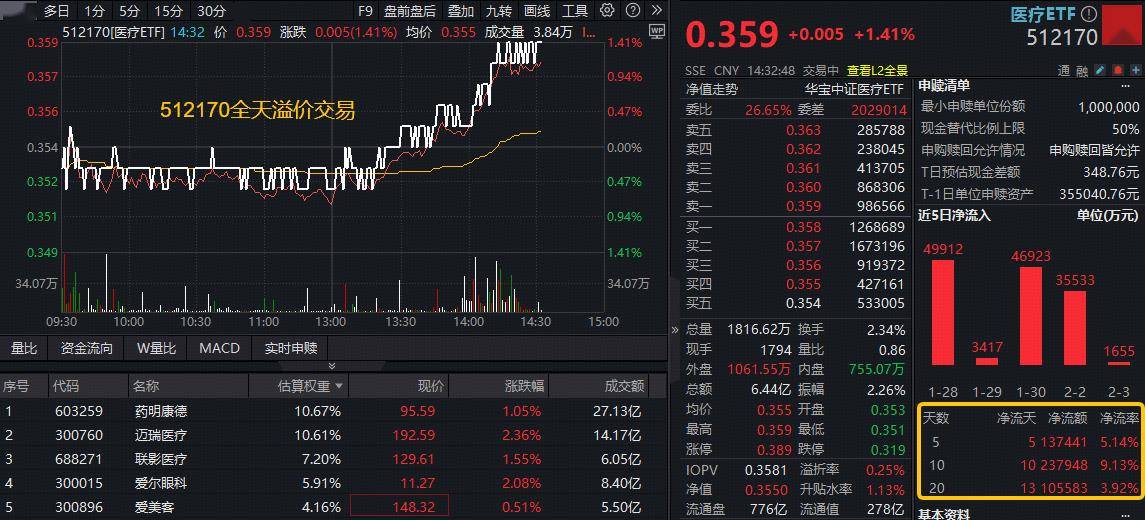
ETF盘中资讯|大权重发力,医疗快速翻红,512170溢价涨逾1.4%!资金连续12日加码,累计增仓超26亿元
Sou Hu Cai Jing· 2026-02-04 07:11
Core Viewpoint - The healthcare sector is experiencing a significant rebound, with the largest healthcare ETF (512170) showing strong performance and attracting substantial capital inflows, indicating renewed investor interest in the sector [1][3][4]. Group 1: ETF Performance - The healthcare ETF (512170) rose over 1.4% after recovering from previous lows, successfully surpassing the 5-day and 60-day moving averages [1]. - The ETF has seen a continuous premium in trading, reflecting active buying interest, with a net inflow of 2.688 billion yuan over the last 12 trading days [3]. Group 2: Earnings Forecasts - As of now, 18 constituent stocks of the healthcare ETF have disclosed their earnings forecasts for 2025, with 11 expected to report profits. Notably, 12 stocks are projected to achieve double-digit growth [4]. - Specific companies like Lepu Medical are forecasting a net profit increase of 224% to 3.86 billion yuan, while other leading CXO firms like Zhaoyan New Drug and Boteng Co. are also expected to see substantial profit growth [4][5]. Group 3: Market Trends - The recovery in the global investment landscape, ongoing domestic support for the innovative drug sector, and a revival in new drug development are contributing to a positive outlook for the CXO industry [4]. - By 2026, structural reforms and improved policy and financing environments are expected to drive the Chinese pharmaceutical industry towards high-quality development [4]. Group 4: ETF Characteristics - The healthcare ETF (512170) is the largest in the market, with a fund size of 27.5 billion yuan, covering over 50% in medical devices and nearly 25% in CXO [6]. - The ETF includes 12 stocks related to AI medical and brain-computer interface concepts, providing a diversified investment opportunity in the healthcare sector [6].
迈瑞医疗涨2.10%,成交额11.36亿元,主力资金净流入3675.05万元
Xin Lang Zheng Quan· 2026-02-04 06:17
Core Viewpoint - Mindray Medical's stock price has shown fluctuations, with a recent increase of 2.10% to 192.11 CNY per share, while the company faces a decline in revenue and profit year-on-year [1][2]. Group 1: Stock Performance - As of February 4, Mindray Medical's stock price increased by 2.10%, reaching 192.11 CNY per share, with a trading volume of 1.136 billion CNY and a turnover rate of 0.50% [1]. - Year-to-date, the stock price has risen by 0.87%, with a 5-day increase of 2.15%, but a decline of 4.36% over the past 20 days and 7.64% over the past 60 days [1]. Group 2: Financial Performance - For the period from January to September 2025, Mindray Medical reported a revenue of 25.834 billion CNY, a year-on-year decrease of 12.38%, and a net profit attributable to shareholders of 7.570 billion CNY, down 28.83% year-on-year [2]. - Since its A-share listing, Mindray Medical has distributed a total of 35.336 billion CNY in dividends, with 25.025 billion CNY distributed over the last three years [3]. Group 3: Shareholder Information - As of September 30, 2025, the number of shareholders for Mindray Medical reached 108,800, an increase of 18.86% from the previous period, while the average number of circulating shares per person decreased by 15.87% to 11,139 shares [2]. - The top ten circulating shareholders include Hong Kong Central Clearing Limited, which holds 117 million shares, a decrease of 14.736 million shares from the previous period [3].
全国首个“中医脑机接口”装备落地,医疗创新ETF(516820)持续获资金关注
Xin Lang Cai Jing· 2026-02-04 05:24
消息面上,近日,由脑机交互与人机共融海河实验室周鹏智慧中医团队牵头,天津中医药大学第一附属 医院、天津市滨海新区中医医院、天津中医药大学、天中依脉公司等多家优势单位联合研发的全国首个 脑控针灸融合神经康复装备平台"神工-华佗"落地。团队创新性研发了"脑机接口+智能穿戴式针灸"融合 技术,相关研究已获国家载人航天实验项目等多项前期项目支撑。 截至2026年2月4日 13:13,中证医药及医疗器械创新指数(931484)成分股方面涨跌互现,东阿阿胶领涨 3.35%,恩华药业上涨1.14%,康弘药业上涨1.03%;特宝生物领跌。医疗创新ETF(516820)最新报价0.36 元。 华金证券认为,政策端持续加码——国家药监局首次将"人工智能医疗器械"列为四大重点发展领域,技 术端DeepSeek-R1等开源大模型显著降低开发门槛,共同推动国内AI+医疗市场进入高速增长通道;全 球AI医疗市场规模预计2022–2030年CAGR达35.5%,至2030年将达1553亿美元。 从资金净流入方面来看,医疗创新ETF近13天获得连续资金净流入,最高单日获得4182.65万元净流 入,合计"吸金"2.46亿元,日均净流入达18 ...
东鹏饮料登陆港交所,深圳南山再添一家“A+H”上市公司
Sou Hu Cai Jing· 2026-02-04 04:15
深圳商报·读创客户端记者 张国锋 2月3日,东鹏饮料(集团)股份有限公司正式在香港主板上市(股票代码09980.HK),成为深圳市、 南山区2026年首家以"A+H"模式(即同时在内地A股和香港H股上市)登陆资本市场的企业。 作为中国功能饮料领军者,东鹏饮料精准把握行业发展趋势,稳居功能饮料赛道领跑地位,同时紧扣健 康化、细分化消费需求构建多元化产品矩阵,推行"1+6"多品类战略,在巩固能量饮料核心优势的同时 推动东鹏"补水啦"等新品类快速成长,产品结构持续优化,第二增长曲线成效显著。 目前,东鹏饮料已构建覆盖全国近100%地级市的立体化销售网络,拥有3200余家经销商及430万家有效 活跃终端网点,触达不重复终端消费者超2.5亿。通过渠道精细化管理,确保产品高效触达全国市场, 这一广覆盖、深渗透的渠道体系,既助力产品动销与市场扩张,更成为企业抵御行业波动的核心竞争优 势。 此次港股上市是东鹏饮料全球化战略的重要起点。作为企业出海的关键举措,港股上市将为其国际化拓 展提供强大助力。目前东鹏饮料的产品已出口超30个国家和地区,印尼、越南等海外子公司落地运营, 海外产能与渠道布局同步推进;本次募集资金也将投向产能 ...


阿斯利康宣布未来十年在中国投资150亿美元,医疗创新ETF(516820)连续13天净流入
Xin Lang Cai Jing· 2026-02-04 03:32
截至2026年2月4日 10:58,中证医药及医疗器械创新指数(931484)成分股方面涨跌互现,东阿阿胶领涨 3.31%,恩华药业上涨1.62%,新和成上涨1.57%;特宝生物领跌。医疗创新ETF(516820)最新报价0.36 元。 从资金净流入方面来看,医疗创新ETF近13天获得连续资金净流入,最高单日获得4182.65万元净流 入,合计"吸金"2.46亿元,日均净流入达1890.95万元。(数据来源:Wind) 消息面上,阿斯利康宣布未来十年在中国投资150亿美元,重点投向细胞治疗与放射性偶联药物 (RDC)两大前沿方向,涵盖北京、上海的战略研发中心建设,以及无锡、泰州、青岛、北京等地生 产基地扩建与新建,并计划将中国高技能员工队伍扩展至超2万人。 风险提示:基金有风险,投资需谨慎。基金管理人承诺以诚实信用、勤勉尽责的原则管理和运用基金资 产,但不保证本基金一定盈利,也不保证最低收益。基金管理人提醒投资人基金投资的"买者自负"原 则,在做出投资决策后,基金运营状况与基金净值变化引致的投资风险,由投资人自行负担。基金的过 往业绩及其净值高低并不预示其未来业绩表现,基金管理人管理的其他基金的业绩不构成对本 ...
