银河航天

Search documents
全球太空资源竞争趋于白热化
财联社· 2026-01-11 02:32
Core Viewpoint - The global competition for space resources is accelerating, with China planning to deploy over 200,000 satellites by the end of 2025 through various satellite constellation projects [2][3]. Group 1: Satellite Constellation Plans - China has submitted multiple satellite constellation plans to the International Telecommunication Union (ITU), with a total scale exceeding 200,000 satellites [3]. - The largest constellations are CTC-1 and CTC-2, each consisting of 96,714 satellites, operated by the Radio Innovation Institute [4][8]. - Other notable constellations include CHINAMOBILE-L1 with 2,520 satellites, SAILSPACE-1 with 1,296 satellites, and TIANQI-3G with 1,132 satellites [4]. Group 2: Regulatory and Competitive Landscape - The ITU is responsible for managing global radio frequency and satellite orbital resources, enforcing deployment timelines for satellite operators [9]. - The "first come, first served" principle for satellite frequency and orbital resources is intensifying global competition, as countries rush to secure limited orbital slots [11]. - As of May 2025, approximately 10,824 satellites are in low Earth orbit, with a utilization rate of about 18% of the theoretical capacity of 60,000 satellites [12]. Group 3: Market Outlook and Investment Opportunities - The U.S. leads in the number of operational spacecraft, holding 75.94% of the global share, while China accounts for approximately 9.43% [13]. - China is advancing national-level constellation projects like "GW Constellation" and "Qianfan Constellation," aiming to deploy over 10,000 satellites in the next decade [14]. - The commercial space industry is expected to experience significant growth in 2026, driven by the launch of multiple reusable and high-capacity rockets, facilitating satellite communication development [14]. - Companies to watch include Xinke Mobile, Haige Communication, Tongyu Communication, Guobo Electronics, Shaanxi Huada, Zhenyou Technology, Zhenlei Technology, Chengchang Technology, and Sanwei Communication [14].


A股:2.5亿股民!全球牛市共振+10万亿航天赛道利好,下周要冲4184点
Sou Hu Cai Jing· 2026-01-10 16:19
Market Overview - The A-share market experienced a significant surge at the beginning of 2026, with the Shanghai Composite Index reaching 4120.43 points, marking a ten-year high and a record 16 consecutive days of gains [1] - The market rally is driven by a combination of global interest rate cuts and explosive growth in the commercial aerospace industry [1][3] Financial Data - Margin trading balance exceeded 2.62 trillion yuan, with a single-day increase of 24.8 billion yuan, marking the fastest influx of new capital since October 2025 [3] - The A-share market's trading volume reached 3.15 trillion yuan in the first trading week of the year, with over 3900 stocks rising [6] Commercial Aerospace Industry - The commercial aerospace sector is experiencing rapid growth, with the industry scale approaching 2.5 trillion yuan and a significant increase in satellite applications [3] - The industry has transitioned from a nurturing phase to a strategic pillar phase, as indicated by the third Commercial Aerospace Development Conference held in December 2025 [3][4] - The market value of the commercial aerospace industry surged from 376.4 billion yuan in 2015 to an estimated 2.5 trillion yuan by 2025 [4] Technological Advancements - Reusable rockets have achieved 10 launches, reducing launch costs by 35% compared to 2023 [4] - Major satellite networking plans, such as the Tianfan constellation, are advancing rapidly [4] Investment Trends - Institutional investment strategies are becoming more aggressive, with long-term capital expected to enter the market at a scale of 2 trillion yuan [6] - The establishment of the "Leading Innovation Commercial Aerospace Alliance Science and Technology Fund" with an initial scale of 2 billion yuan aims to invest in critical components and new materials [6] Sector Performance - The market is characterized by a dual focus on consumer and technology sectors, with consumer goods prices rising and expectations for strong performance during the upcoming Spring Festival [8] - The technology sector, particularly artificial intelligence and semiconductors, is benefiting from policy support and increased demand for industrial robots and software [8]

我国新增20万颗卫星申请
21世纪经济报道· 2026-01-10 12:27
在此背景下,中国在此之前已推进"GW星座""千帆星座""鸿鹄-3"等国家级星座计划,拟在未 来十年内完成上万颗部署。 东吴证券指出,展望2026年商业航天行业将迎来多重催化,特别是多枚可回收/大载量的商业 火箭密集首飞,火箭运力将有望迎来显著提升,从而打通此前卫星通信发展的堵点。我国低轨 卫星互联网从2025年下半年已进入批量发射建设阶段,2026年有望迎来更大批量发射,产业 发展进一步加速。 (声明:文章内容仅供参考,不构成投资建议。投资者据此操作,风险自担。) SFC 来源丨上海证券报、科创板日报 编辑丨张嘉钰 江佩佩 81岁芯片大佬恢复中国籍,为交税套现近亿元,60岁归国带出2000亿元半导体巨头 2000万粉丝演员哭穷炫富,多个账号被禁言,代言产品全线停产 顶奢酒店攻入下沉市场 21君荐读 据上海证券报,记者查询国际电信联盟(ITU)官网获悉,我国2025年12月向ITU申请了超20 万颗卫星的频轨资源。其中超19万颗卫星来自近期刚刚成立的无线电创新院。 | | 2025年12月29-30日中国向ITU新增申报多个星座计划 | | | --- | --- | --- | | 星座计划名称 | 卫星数量 ...

商业航天深度:技术收敛引爆“奇点”,蓝海市场破晓已至(附62页PPT)
材料汇· 2026-01-08 16:01
Group 1 - The article emphasizes the explosive growth of the commercial space industry driven by supportive policies and technological advancements [4][19] - The transition from traditional space (government-led) to commercial space (private sector-driven) is highlighted, showcasing the shift in funding and operational models [10][12] - The U.S. and China are establishing a bipolar competitive landscape in the space industry, with the U.S. leading in commercial launches and satellite deployments [24][28] Group 2 - Key sectors in the space industry include satellites, launch vehicles, ground equipment, and terminal applications, which are experiencing increased demand [3][29] - The competitive landscape is maturing, with significant advancements in technology such as reusable rockets and cost-effective satellite manufacturing [20][23] - Investment recommendations suggest focusing on companies that are well-positioned within the rapidly evolving commercial space ecosystem [3][39] Group 3 - The article outlines the historical development of commercial space, noting critical milestones from the 1980s to the present, including the rise of companies like SpaceX and Blue Origin [11][16] - The U.S. has shifted its procurement model from cost-plus contracts to fixed-price contracts, incentivizing cost reduction and innovation in the space sector [14][15] - China's commercial space sector is rapidly developing, with government initiatives aimed at fostering innovation and investment in the industry [19][27] Group 4 - The article discusses the structure of the space industry supply chain, which includes upstream (manufacturing), midstream (launch services), and downstream (applications) segments [30][32] - The total addressable market (TAM) for the space industry is projected to grow significantly, with commercial space revenues expected to dominate [39][40] - The article highlights the high barriers to entry in the space industry, particularly in the upstream segment, which contributes to high profit margins [41]

商业航天开启黄金发展期 关注三大投资机遇
Zhong Guo Zheng Quan Bao· 2026-01-07 20:50
Core Viewpoint - The commercial aerospace sector is experiencing a significant surge, with the Wind commercial aerospace theme index showing a cumulative increase of over 60% from November 21, 2025, to January 7, 2026, indicating strong market interest and potential [1] Group 1: Industry Trends and Developments - The commercial aerospace industry is entering a concentrated "breakthrough period" for large-capacity reusable rockets, supported by a comprehensive policy framework [1][2] - The market is witnessing a structural shift towards high-quality economic development, with commercial aerospace emerging as a core representative of new productive forces [2] - The dual support of technological breakthroughs and systematic policy support is driving the current market dynamics, with significant advancements expected in 2025-2026 [3][4] Group 2: Catalysts and Events - Key catalysts for the industry include the successful launch of the Zhuque-3 rocket and upcoming launches of various models like Tianlong-3 and Zhishen-1, which will validate technological advancements [3][5] - The establishment of the National Commercial Aerospace Development Fund and the inclusion of commercial aerospace in the fifth set of listing standards on the Sci-Tech Innovation Board are expected to provide diverse financing channels for industry players [4][5] Group 3: Investment Opportunities - The investment focus should be on three core areas: rocket manufacturing and operation, satellite manufacturing and operation, and ground terminal applications [8] - Companies with strong capabilities in reusable technology and large-capacity launch capabilities are expected to lead the market [8] - The anticipated acceleration of satellite constellation networks will create significant demand for satellite production, benefiting upstream component suppliers [7][8] Group 4: Future Outlook - The commercial aerospace industry is projected to transition from concept speculation to performance realization, with companies possessing substantial technological reserves and order support expected to stand out [8] - The long-term growth logic of the commercial aerospace sector remains intact, driven by continuous technological breakthroughs and supportive policies, indicating a golden period for high-quality development across the entire industry chain [8]

中信建投任宏道: 商业航天开启黄金发展期 关注三大投资机遇
Zhong Guo Zheng Quan Bao· 2026-01-07 20:46
Core Insights - The commercial aerospace sector is a strong focus for investment, with the Wind commercial aerospace theme index showing a cumulative increase of over 60% from November 21, 2025, to January 7, 2026 [1] - Analysts believe that China's large-capacity reusable rockets are entering a critical breakthrough period, supported by a comprehensive policy framework, with significant events such as IPOs and rocket launches expected in 2026 [1][4] - The transition from speculative investment to performance realization in commercial aerospace is anticipated, with a focus on three core areas: rocket manufacturing, satellite networking, and downstream applications [1][8] Market Dynamics - The commercial aerospace sector is seen as a representation of structural market trends during a phase of high-quality economic development, with differentiated growth across various industries [2] - The sector's growth is driven by technological breakthroughs and supportive policies, including the establishment of the National Space Administration's commercial aerospace division and the launch of development funds [3][4] Technological and Policy Support - The sector is experiencing a multi-dimensional driving logic, with technological advancements since 2015, particularly in reusable rocket technology, providing solid support for market performance [3] - A series of policy measures have been implemented to support the industry, including the adjustment of listing standards for the Sci-Tech Innovation Board and the promotion of private investment [4][5] Upcoming Catalysts - Key events in 2026 include the anticipated IPO of Blue Arrow Aerospace, which is expected to set a benchmark for private rocket companies, and multiple rocket launches to validate technological advancements [6][8] - The domestic aerospace industry is rapidly closing the gap with international counterparts, particularly in areas such as rocket recovery and satellite production [6][8] Investment Opportunities - The commercial aerospace industry is transitioning from technology validation to commercial application, presenting investment opportunities across the entire value chain [7] - Key focus areas for investment include rocket manufacturing and operation, satellite production, and ground terminal applications, with an emphasis on companies that possess reusable technology and large-capacity launch capabilities [8][9] Strategic Recommendations - Investors are advised to consider companies' core positions within the industry, competitive stability, and financial health when selecting investment targets [9] - The commercial aerospace sector is expected to shift from speculative hype to tangible performance, with companies demonstrating substantial technological capabilities and order support likely to emerge as leaders [9]

电广传媒:旗下达晨财智投资蓝箭航天、星河动力等航天企业
Xin Lang Cai Jing· 2026-01-05 15:30
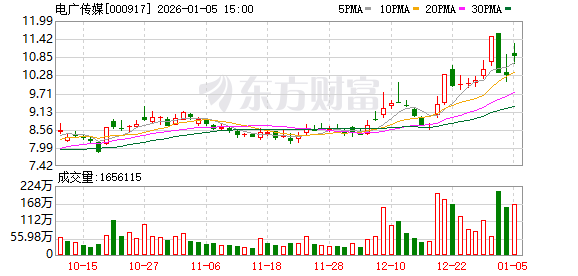
Group 1 - The core viewpoint of the article is that Dianguang Media's subsidiary, Dacheng Caizhi, is actively investing in aerospace companies, indicating a strategic focus on the aerospace sector [1] - Dacheng Caizhi currently manages a fund size of nearly 66 billion yuan, which translates to approximately 10 billion USD, showcasing significant financial capacity for investments [1] - The subsidiary has invested in over 800 companies, primarily focusing on early-stage and growth-stage investments, highlighting its commitment to fostering innovation and development in various sectors [1] Group 2 - The aerospace investments include notable companies such as Blue Arrow Aerospace, Xinghe Power, Galaxy Aerospace, and Sixiang Technology, reflecting a diverse portfolio within the aerospace industry [1] - The strategic investments in these aerospace firms suggest a growing interest and potential opportunities in the aerospace sector, which may attract further attention from investors [1]

电广传媒:公司旗下达晨财智目前管理基金规模近660亿元
Zheng Quan Ri Bao Wang· 2026-01-05 11:12
证券日报网讯1月5日,电广传媒(000917)在互动平台回答投资者提问时表示,公司旗下达晨财智目前 管理基金规模近660亿元,投资800余家企业,以早期+成长期投资为主。基金投资的项目在航天领域包 括蓝箭航天、星河动力、银河航天、四象科技等。 ...
电广传媒:公司旗下达晨财智目前管理基金规模近660亿元,投资800余家企业
Mei Ri Jing Ji Xin Wen· 2026-01-05 09:00
Group 1 - The core viewpoint of the article is that 电广传媒 has made significant investments in aerospace satellite technology companies through its subsidiary 达晨财智, which manages a fund size of nearly 66 billion yuan [2][3] - The company has invested in over 800 enterprises, focusing primarily on early-stage and growth-stage investments [2] - Notable investments in the aerospace sector include companies such as 蓝箭航天, 星河动力, 银河航天, and 四象科技 [2]
中国版“猎鹰”加速!蓝箭航天冲刺科创板,卫星产业仍将狂飙?
Jin Rong Jie· 2026-01-05 06:39
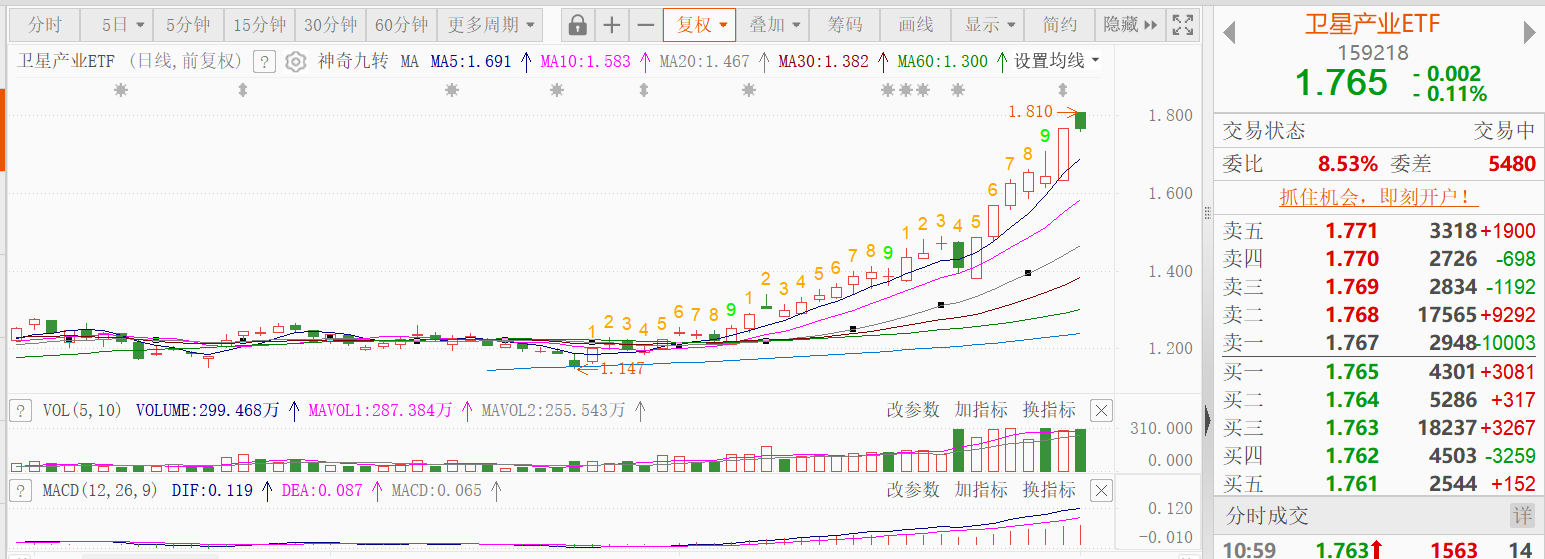
Group 1: Market Overview - On the first trading day of the year, global capital markets experienced a strong start, with the Shanghai Composite Index successfully breaking through 4000 points [1] - The satellite industry ETF showed strong performance but faced profit-taking sell-offs, leading to a decline near midday [1] - The daily trend indicates that the bullish arrangement of moving averages remains unchanged, and a pullback to the 5-day line can be seen as a good opportunity for positioning [1] Group 2: Industry Developments - Blue Arrow Aerospace, a leading player in China's commercial space sector, has had its IPO application accepted, aiming to raise 7.5 billion yuan for the production and R&D of reusable rockets, marking a key step towards commercialization [3] - The industry is driven by several factors, including policy support, with the "14th Five-Year Plan" outlining a clear roadmap for the launch of multiple new rocket types by 2026 [3] Group 3: Commercialization and Applications - Since 2025, China has completed 87 space launches, with private commercial rocket companies executing 23 of these, successfully placing 324 spacecraft into orbit [4] - The application scenarios are continuously expanding, with China Telecom reporting over 25 million units of mobile terminals supporting direct satellite connectivity sold by November 2025 [4] - The initiation of satellite IoT commercial trials and advancements in reusable rocket technology are accelerating the formation of integrated communication networks, injecting strong momentum into the digital economy [4] Group 4: Global Competition - The global competition in the commercial space sector is intensifying, with major players like SpaceX and Amazon leading low Earth orbit communication constellations, while traditional giants like Lockheed Martin and Boeing focus on high-value government markets [5] - In Europe, companies like Airbus and Thales are balancing government projects with commercial services, while OneWeb offers differentiated competitive advantages [6] - In China, major groups like Aerospace Science and Technology and Aerospace Science Industry lead significant projects, while commercial companies focus on small satellite manufacturing and launches [6] Group 5: Industry Outlook - Major countries worldwide are increasing their investments in the commercial space sector, which will enhance the overall industry climate and further promote technological development [7] Group 6: Investment Tools - The satellite industry ETF (159218) tracks the CSI Satellite Industry Index (931594.CSI), covering the entire industry chain from manufacturing and launching to operational services and terminal applications, providing investors with a streamlined way to invest in this high-growth sector [9] - The index's core advantage lies in its unique compilation rules, which adjust weights based on the proportion of revenue from satellite-related businesses, meaning companies with higher revenue contributions have greater weight in the index [9]