中国平安

Search documents
低吸时机到,南向资金连续10日买入腾讯、连续7日买入阿里!港股互联网ETF(513770)溢价翻红,14亿资金涌入
Xin Lang Cai Jing· 2026-01-21 02:10
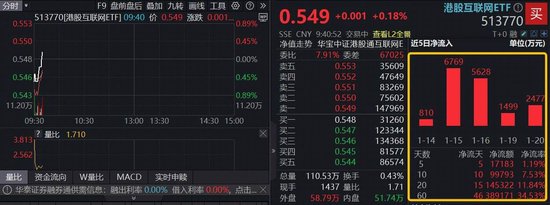
Core Viewpoint - The Hong Kong stock market is experiencing fluctuations due to tariff concerns, but there are positive movements in key stocks like Alibaba, Tencent, and Kuaishou, indicating a resilient market sentiment [1][8]. Group 1: Market Performance - The Hong Kong Internet ETF (513770) opened lower but managed to rise by 0.18%, with a real-time premium rate of nearly 0.5%, reflecting positive buying sentiment [1][8]. - Over the past 20 days, the Hong Kong Internet ETF has seen a net inflow of 1.453 billion yuan [1][8]. - Southbound funds recorded a net purchase of 3.663 billion HKD, with Tencent receiving a net buy of 663 million HKD for ten consecutive days, and Alibaba seeing net purchases for seven consecutive days [8][9]. Group 2: Strategic Insights - Goldman Sachs reports that 2026 will be a pivotal year for leading Chinese internet companies, focusing on AI investments aimed at consumers and competition around "AI super entry points" [3][9]. - Companies like Alibaba are working to solidify their leading positions in e-commerce, while Tencent is accelerating AI functionalities in WeChat [3][9]. - The competitive landscape in sectors like food delivery is becoming more rational, leading to improved unit economics [3][9]. Group 3: ETF and Fund Details - The Hong Kong Internet ETF (513770) tracks the CSI Hong Kong Internet Index, with Alibaba being the largest weight at 14.71%, and the top ten stocks accounting for nearly 77% of the ETF [3][10]. - As of January 20, the fund size reached a historical high of 14.182 billion yuan, with an average daily trading volume exceeding 600 million yuan since 2025 [10]. - The Hong Kong Large Cap 30 ETF (520560) is recommended for those looking to reduce volatility while investing in technology and dividend stocks [10].

未知机构:花旗中国保险业2026年展望寿险迎历史机遇财险乘监管东风寿险行业因财富重-20260121
未知机构· 2026-01-21 02:05
Summary of the Conference Call on the Chinese Insurance Industry Outlook for 2026 Industry Overview - The report focuses on the Chinese insurance industry, highlighting significant opportunities in both life insurance (寿险) and property insurance (财险) due to wealth reallocation and regulatory changes [1][2][3]. Key Insights and Arguments Life Insurance Sector - The life insurance industry is expected to face a historic opportunity driven by a massive reallocation of wealth, with over 70 trillion RMB in bank deposits maturing by 2026 [1][5][9]. - Retail investors, seeking higher returns in a low-interest-rate environment, are likely to shift their investments towards insurance products, particularly dividend-related products sold through bancassurance channels [1][5]. - Although the shift towards dividend products may pressure profit margins, a scheduled interest rate cut in September 2025 is anticipated to offset this impact, keeping overall profit margins stable [2][5]. - The report predicts a K-shaped growth differentiation in the market, with leading companies like China Life and Ping An benefiting from concentrated resources and growth amid tightening regulatory scrutiny [2][5][8]. Property Insurance Sector - The property insurance sector is projected to achieve a stable premium growth rate of 4% by 2026, primarily driven by auto insurance and personal property insurance [2][5]. - Regulatory improvements, such as the promotion of the "non-auto insurance report and approval integration" policy and enhanced cost management for auto insurance, are expected to provide significant room for improvement in the combined ratio (CoR) [3][6][8]. - The report identifies PICC Property and Casualty as the biggest beneficiary of these regulatory changes, potentially achieving the best performance in the industry [3][8]. Additional Important Content - The report emphasizes the structural reforms aimed at enhancing underwriting profitability, which include extending cost control from auto to non-auto insurance and gradually relaxing pricing limits for new energy vehicle insurance [6][7]. - Key data points include: - Over 70 trillion RMB in bank deposits maturing by 2026, a significant source of growth for the life insurance sector [9]. - A projected 4% growth rate for property insurance premiums in 2026 [9]. - The relaxation of the pricing coefficient for new energy vehicle insurance from 1.35 to 1.5, which will help improve profitability for property insurance companies [9]. - In 2019, cash and deposits accounted for 63.9% of Chinese households' financial assets, indicating a substantial potential for reallocating funds towards insurance products [9]. Recommended Investment Targets - China Life (2628.HK): Buy rating, target price raised to HK$38.00, favored for its market leadership and robust underwriting strategy [10][11]. - Ping An (2318.HK): Buy rating, target price raised to HK$79.00, expected to benefit from K-shaped growth differentiation [10][11]. - PICC Property and Casualty (2328.HK): Buy rating, target price of HK$21.20, anticipated to be the largest beneficiary of regulatory tailwinds [10][11]. - China Pacific Insurance (2601.HK): Buy rating, target price raised to HK$44.40 [10][11]. - People’s Insurance Group (1339.HK): Buy rating, target price of HK$7.80 [10][12].
中证粤港澳大湾区发展主题指数下跌0.89%,大湾区ETF(512970)成立以来超越基准年化收益达3.35%
Sou Hu Cai Jing· 2026-01-21 01:55
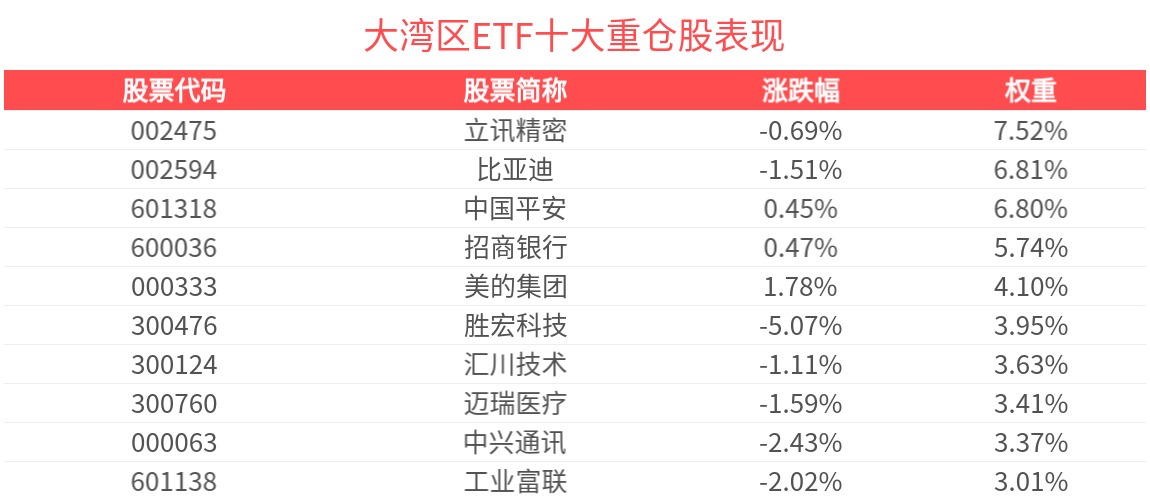
费率方面,大湾区ETF管理费率为0.15%,托管费率为0.05%。 跟踪精度方面,截至2026年1月20日,大湾区ETF近半年跟踪误差为0.026%。 大湾区ETF紧密跟踪中证粤港澳大湾区发展主题指数,中证粤港澳大湾区发展主题指数反映受益于粤港澳大湾区发展相关上市公司的整体表现。该指数系列 包含中证港股通粤港澳大湾区发展主题指数、中证沪港深粤港澳大湾区发展主题指数和中证粤港澳大湾区发展主题指数,分别从港股通合资格证券范围、沪 港深三地上市公司及内地市场中的粤港澳大湾区企业中选取符合湾区发展主题的最大50只香港市场证券、最大300家公司及最大100只内地市场证券作为指数 样本,并结合湾区经济发展特点和样本空间内科技类证券权重调整科技证券行业因子,以使指数样本中科技类证券权重与待选空间中科技类证券占比接近。 数据显示,截至2025年12月31日,中证粤港澳大湾区发展主题指数(931000)前十大权重股分别为中国平安、立讯精密、比亚迪、招商银行、美的集团、胜宏 科技、汇川技术、工业富联、中兴通讯、迈瑞医疗,前十大权重股合计占比46.96%。(以上所列股票仅为指数成份股,无特定推荐之意) 截至2026年1月20日 1 ...
上证180指数上涨0.08%,上证180ETF指数基金(530280)实现4连涨
Sou Hu Cai Jing· 2026-01-21 01:55
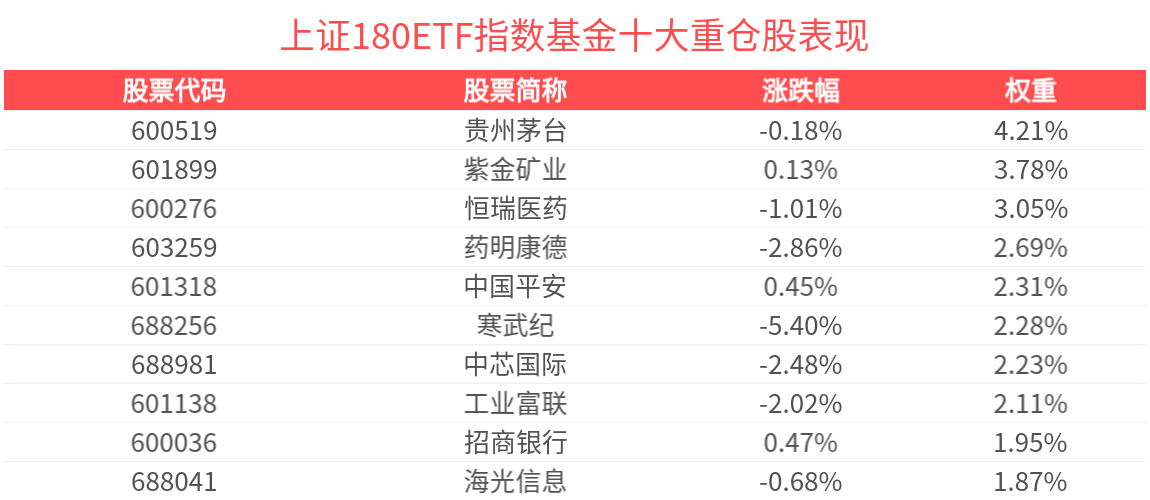
Core Viewpoint - The Shanghai 180 ETF Index Fund closely tracks the Shanghai 180 Index, which reflects the overall performance of 180 large-cap and liquid stocks in the Shanghai securities market [2] Group 1: Index Performance - As of January 20, 2026, the Shanghai 180 Index rose by 0.08%, with notable increases in constituent stocks such as China Chemical (+10.01%), China Power Construction (+7.02%), and Hengli Petrochemical (+6.62%) [1] - The Shanghai 180 ETF Index Fund achieved a four-day consecutive increase, with the latest price reported at 1.26 yuan [1] - The fund's average daily trading volume over the past year was 256.26 million yuan, with a turnover rate of 0.11% on January 20, 2026 [1] Group 2: Fund Metrics - The fund's Sharpe ratio since inception is 2.13, indicating a favorable risk-adjusted return [1] - The maximum drawdown for the fund year-to-date is 1.30%, with a relative benchmark drawdown of 0.06% [1] - The management fee for the fund is 0.15%, and the custody fee is 0.05% [1] Group 3: Top Holdings - As of December 31, 2025, the top ten weighted stocks in the Shanghai 180 Index account for 25.29% of the index, including Kweichow Moutai, Zijin Mining, and China Ping An [2] - The top ten stocks by weight are Kweichow Moutai (4.21%), Zijin Mining (3.78%), and China Ping An (2.31%), among others [3]






科技驱动理赔全面提速
Jin Rong Shi Bao· 2026-01-21 01:44
Core Insights - The insurance industry has significantly improved claims processing speed and service efficiency by 2025, with "fast and full compensation" becoming a standard service feature [1][2][3] Group 1: Claims Processing Efficiency - In the life insurance sector, Xinhua Insurance reports that claims for small medical insurance under 5,000 yuan are settled in an average of 0.5 days, with 17% of claims processed within one hour and 70% within eight hours [1] - Ping An Life achieved a record claim payment in just 8 seconds, while ICBC-AXA's medical insurance claims can be settled in as little as 8 minutes for major claims [1] - China Life Property Insurance processed a claim in just 2.5 minutes, demonstrating strong emergency service capabilities even in complex disaster scenarios [2] Group 2: Digital Transformation and Technology Integration - The rapid improvement in claims speed is attributed to the implementation of digital transformation strategies and advanced technologies in the insurance sector [3] - Ping An Life introduced the DeepSeek model for intelligent claims review, achieving 93% of automated claims processed within 60 seconds [3] - China Life Health's intelligent claims review increased by 33.2% year-on-year, with an intelligent input rate exceeding 69% [3] Group 3: Expanded Insurance Services - Insurance services are evolving beyond mere financial compensation to encompass comprehensive health management and proactive risk reduction [4] - China Pacific Insurance aims to bridge the digital divide by providing personalized services for the elderly and vulnerable groups, reaching 947,000 people through online claims services [4] - The integration of technology is reshaping every aspect of the claims value chain, from reporting to payment, creating a more efficient and customer-friendly insurance service environment [4]



未成年人关注呼吸道疾病 中青年群体警惕重大疾病
Jin Rong Shi Bao· 2026-01-21 01:44
Core Insights - The total claims amount for life insurance companies in 2025 has increased significantly, with four companies exceeding 10 billion yuan in claims [1] - The data reflects not only the payout capabilities of insurance companies but also the health risks faced by different demographics [2] Group 1: Claims Data Overview - China Life Insurance reported over 62.24 million claims totaling over 100.4 billion yuan; Ping An Life paid out 4.958 million claims amounting to 41.51 billion yuan; Taiping Life had 4.243 million claims totaling 20.1 billion yuan; and Xinhua Insurance processed 5.01 million claims totaling 14.7 billion yuan [1] - The trend indicates that commercial insurance has shifted from being a low-frequency rescue tool to a high-frequency payment method for everyday medical expenses [3] Group 2: Medical Insurance Insights - Medical insurance claims are predominantly high-frequency and low-amount, with Taiping Life's medical claims accounting for 94.4% of total claims, and 93% of Taikang Life's claims being medical [3] - The age distribution of medical claims shows that the under-17 demographic accounts for 39.4% of claims, primarily due to respiratory infections and accidental injuries [4] Group 3: Critical Illness Insurance Analysis - Critical illness insurance remains the highest payout category among life insurance companies, with Ping An Life's payouts exceeding 20.86 billion yuan, accounting for over 50% of total claims [5] - The report indicates that male policyholders should be cautious of lung cancer, thyroid cancer, and liver cancer, while female policyholders should focus on thyroid cancer, breast cancer, and lung cancer [5] - The average payout for critical illness claims is notably low, with many claims falling below 300,000 yuan, highlighting a significant gap between average payouts and actual treatment costs [6][7]

6元钱保障 守护牧民最珍贵的“家人”
Jin Rong Shi Bao· 2026-01-21 01:44
Core Viewpoint - The article highlights the efforts of the insurance company, Ping An, to promote yaks insurance in Tibet, addressing the challenges faced by herders in adopting electronic identification for their livestock while ensuring their financial protection against risks like infectious diseases and natural disasters [1][2]. Group 1: Insurance Promotion and Adoption - The government and insurance companies are actively promoting yak insurance to protect herders' interests amid increasing risks from infectious diseases and natural disasters [1]. - A significant barrier to adoption is the cultural perception of yaks as family members, making herders reluctant to accept ear tagging as it is seen as harmful [1]. - Ping An's team, led by Badu Qiuza, engages with herders to explain the benefits of ear tags as a form of protection and a key to quick claims processing [1]. Group 2: Technological Integration and Service Improvement - Since 2022, herders only need to pay 6 yuan per yak annually, supported by central government subsidies, to receive coverage for various risks [2]. - Ping An has developed a Tibetan language version of the "Ai Nong Bao" app to provide weather alerts and help herders prepare for adverse conditions, thereby reducing livestock mortality [2]. - The use of advanced technology, including "cow face recognition" and electronic ear tags, has streamlined the claims process, allowing for claims to be settled within 24 hours of reporting [2]. Group 3: Performance Metrics and Future Commitment - As of November 2025, Ping An's local branch has processed 2,891 claims, disbursing 15.095 million yuan, with a 100% claim closure rate and an average claim processing time of just 6.6 days [2]. - By August 2025, over 230,000 yaks in Tibet had been tagged, achieving a tagging rate of over 95% [2]. - Ping An is committed to its mission of serving the public through financial services, leveraging its dual strategy of comprehensive finance and technology to support rural revitalization and high-quality economic development [2].
非银金融行业周报:融资新规夯实“慢牛”根基,险企渠道深度重塑
东方财富· 2026-01-21 00:25
Investment Rating - The report maintains an "Outperform" rating for the non-bank financial sector, indicating a positive outlook for investment opportunities in this industry [2]. Core Insights - The report highlights the strengthening of the "slow bull" market foundation due to new financing regulations, which are expected to stabilize the capital market and promote long-term healthy development [12][13]. - The insurance sector is undergoing a significant transformation, with a notable trend of branch institution exits, indicating a shift from extensive expansion to a more concentrated and quality-focused approach [42][43][44]. Summary by Sections 1. Securities Business Overview and Weekly Review - The financing margin ratio has been raised to 100%, reinforcing the foundation of a "slow bull" market. This adjustment aims to lower market leverage and protect investor rights, promoting long-term stability [12]. - The China Securities Regulatory Commission (CSRC) emphasizes risk prevention, strong regulation, and high-quality development as the main themes for 2026, aiming to enhance the capital market's stability and service to the real economy [13][14]. - CITIC Securities reported a net profit of 30.05 billion CNY for 2025, marking a 38.46% year-on-year increase, reflecting a recovery in the securities industry amid a rising market [15][17]. 2. Insurance Business Overview and Weekly Review - The insurance industry has seen over 3,100 institutions exit in 2025, the highest in six years, indicating a long-term structural adjustment away from extensive physical network expansion [42]. - The exit trend is primarily driven by life insurance companies, focusing on optimizing low-efficiency branches, particularly in third and fourth-tier cities [43]. - This transformation is pushing insurance companies towards digitalization and intelligent management, redefining the role of physical branches to focus on complex business consultations and service integration [44]. 3. Market Liquidity Tracking - The central bank's net injection in the open market was 1,112.8 billion CNY, with significant reverse repos contributing to liquidity [49]. - The interbank lending rates showed mixed performance, with the weighted average rate for interbank lending at 1.33% [54].

智通港股沽空统计|1月21日
智通财经网· 2026-01-21 00:23
Group 1 - The core viewpoint of the news highlights the top short-selling ratios and amounts for various companies, indicating significant market sentiment towards these stocks [1][2]. - AIA Group (81299) and JD Group (89618) have the highest short-selling ratios at 100.00%, while Ping An Insurance (82318) follows with a ratio of 82.04% [1][2]. - The top three companies by short-selling amount are Pop Mart (09992) with 1.008 billion, Xiaomi Group (01810) with 0.825 billion, and Meituan (03690) with 0.777 billion [1][2]. Group 2 - The top short-selling ratio rankings show that AIA Group and JD Group both have a short-selling amount of 73,700 and 50,600 respectively, with Ping An Insurance at 1.6862 million [2]. - The short-selling amount rankings indicate that Pop Mart leads with 1.008 billion, followed by Xiaomi Group at 0.825 billion and Meituan at 0.777 billion [2]. - The deviation values, which reflect the difference between current short-selling ratios and the average over the past 30 days, show Ping An Insurance at 49.32%, JD Group at 43.39%, and Wanwu Cloud (02602) at 34.47% [1][2].




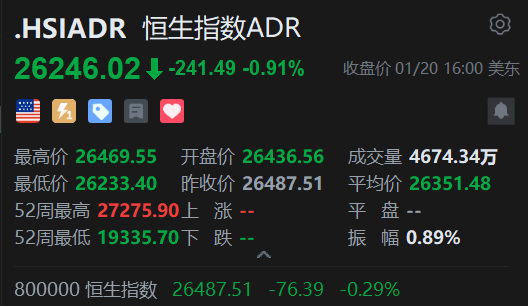
智通ADR统计 | 1月21日
智通财经网· 2026-01-20 22:29
Market Overview - The Hang Seng Index closed at 26,246.02, down by 241.49 points or 0.91% [1] - The index reached a high of 26,469.55 and a low of 26,233.40 during the trading session [1] - The average price for the day was 26,351.48, with a trading volume of 46.7434 million [1] Major Blue-Chip Stocks Performance - HSBC Holdings closed at HKD 128.682, up by 0.22% compared to the Hong Kong close [2] - Tencent Holdings closed at HKD 593.183, down by 1.30% compared to the Hong Kong close [2] - Alibaba Group (W) closed at HKD 159.700, down by 0.44% [3] - Xiaomi Group (W) closed at HKD 35.480, down by 2.74% [3] - Meituan (W) closed at HKD 97.350, down by 1.17% [3] Stock Price Changes - Tencent Holdings saw a decrease of HKD 9.000, or 1.48% [3] - HSBC Holdings increased by HKD 1.400, or 1.10% [3] - China Ping An rose by HKD 0.600, or 0.88% [3] - BYD Company experienced a decline of HKD 3.700, or 3.67% [3] - Kuaishou Technology (W) fell by HKD 0.700, or 0.91% [3]