OpenAI

Search documents
硅谷“赌”AI最狠的基金:非原生AI公司要么进化,要么消失
3 6 Ke· 2026-02-12 12:27
Core Insights - a16z is a leading venture capital firm heavily invested in the current AI wave, with a portfolio that includes major players like OpenAI and SpaceX, reflecting the commercialization path of AI over recent years [1] - The firm emphasizes not just what they invest in, but how they interpret changes in the AI industry, highlighting significant trends and signals [1] Group 1: AI Company Growth and Efficiency - AI companies are achieving faster growth with fewer resources compared to traditional SaaS companies, with revenue growth rates approximately 2.5 times higher than non-AI software companies, and some top firms experiencing year-over-year growth close to 700% [2][8][6] - A new efficiency metric, ARR per FTE (Annual Recurring Revenue per Full-Time Employee), is gaining attention, with leading AI companies achieving ARR of $500,000 to $1 million per employee, compared to $400,000 in the SaaS era, indicating a significant increase in organizational efficiency [3][10] Group 2: Transformation of Non-AI Companies - Non-AI native companies face two options: transform or be eliminated, with successful transformations often led by CEOs who actively drive change and focus on areas like customer support and operations [4][11] - Effective AI adaptation requires a fundamental rethinking of product design and organizational structure, moving beyond simply adding AI features to existing systems [12][14] Group 3: Demand and User Engagement - The demand for AI products is described as "crazy," with strong user engagement and participation, as seen in legal and medical sectors where AI tools enhance productivity without reducing workforce size [19][21] - Companies like Harvey and Abridge illustrate how AI can increase user engagement and efficiency, with lawyers reporting doubled usage time on AI products [20][21] Group 4: Financial Implications and Market Dynamics - The current capital expenditure in AI is substantial, but unlike previous bubbles, it is supported by profitable companies, with major players like Microsoft and NVIDIA maintaining controllable capital structures [25][26] - The potential for AI to generate significant revenue is highlighted, with estimates suggesting that AI could account for 1% of global GDP by 2030, necessitating a revenue target of around $1 trillion to justify the investment [31]
OpenClaw 启示录:Agent 的扩散速度取决于入口与社区 | Jinqiu Select
锦秋集· 2026-02-12 12:25
Core Insights - OpenClaw has gained significant traction since its launch in early 2026, achieving high visibility in the global developer community, including over 180,000 stars on GitHub, and leading to the emergence of social experiments like Moltbook, showcasing a new trend in interactive AI agents [3][15] - The creator, Peter Steinberger, emphasizes that the success of OpenClaw is not solely due to technology but rather its community engagement and low entry barriers, allowing users to modify the software easily [6][9] - The project has sparked discussions about the future of AI agents, the redefinition of traditional applications, and the evolution of human-agent interactions, which many entrepreneurs have yet to fully grasp [5][6] Project Origin - The inception of OpenClaw began with Peter's personal need for an AI assistant in April 2024, leading to a series of early experiments that culminated in the project's creation due to frustration over its absence [9][10] - The first working prototype was developed in just one hour, demonstrating the core functionality of interacting with a computer through a chat application [11][12] - The project experienced viral growth after an unexpected feature emerged, showcasing the agent's ability to autonomously handle tasks without prior instruction [12][13] Technical Architecture - OpenClaw's architecture includes several sophisticated components, such as a chat client gateway for decentralized access, a core decision engine, and a skills system for functionality expansion [16][17] - The agent's self-awareness allows it to read and modify its own source code, which is a significant advancement in software engineering [17][18] - The project has faced challenges related to security and brand protection, particularly after its rapid rise in popularity, highlighting the need for integrated security measures [6][27] Community and Social Impact - MoltBook, a social network for AI agents, has emerged as a phenomenon, where agents interact in a Reddit-like environment, leading to discussions that sometimes cause public concern [27][28] - The term "AI psychosis" was coined by Peter to describe the mix of genuine concern and sensationalism surrounding AI developments, reflecting societal fears about AI's role in the digital age [28][29] - OpenClaw represents a balance between freedom and responsibility, as users gain control over their data while also being accountable for its security [30][31] Business Model and Future Outlook - Despite the project's popularity, Peter has chosen to reject significant funding offers, prioritizing the open-source ethos and community engagement over commercial pressures [32][33] - The current financial status shows monthly revenues between $10,000 and $20,000, with ongoing discussions for partnerships with major tech labs, provided the project remains open-source [33][34] - Peter envisions a future where traditional applications may be replaced by AI agents, fundamentally altering the app market landscape [39][40]


年末 AI 回顾:从模型到应用,从技术到商战,拽住洪流中的意义之线(上)
Xin Lang Cai Jing· 2026-02-12 12:12
Group 1: Models - The current AI wave is still in its early stages, with technological changes being the primary driving force behind product forms and business landscapes [4][56] - The Agentic Model supports agent capabilities, which include reasoning, coding, multimodal understanding, tool usage, and memory [5][58] - The rise of reasoning models is marked by the success of DeepSeek-R1, which is the first to replicate OpenAI's o1 model at a large parameter scale [7][59] Group 2: Applications - 2025 is seen as the year of large-scale explosion for agent applications, with two main lines: General Agents centered on coding capabilities and vertical agents [29] - General Agents utilize coding as a means to execute various tasks in the digital world, with products like Claude Code and Claude Cowork leading the way [30][32] - The emergence of mobile agents is notable, with ByteDance's Doubao phone preview enabling automated tasks like replying to WeChat messages [35] Group 3: AI Giants' Competition - Major players like ByteDance, Alibaba, and Tencent are engaged in a fierce competition in the AI space, focusing on collaborative optimization and infrastructure development [13][14] - Alibaba's Qianwen team has begun recruiting its own infrastructure talent to enhance agility in development [14] - Tencent's new AI head emphasizes the importance of co-design to streamline iterations and reduce internal friction [14] Group 4: Startups - A new ecosystem of startups is emerging around agent tools, driven by the demand for automation in personal and professional tasks [29][32] - Companies like Lovart and others are focusing on multimedia content production agents, aiming to redefine creative processes [37] Group 5: AI in Science - AI is accelerating scientific discoveries, with applications in first-principles calculations and generative AI for solving complex scientific problems [49][50] - The trend of AI agents capable of automating the entire research process is gaining traction, indicating a shift towards AI-driven scientific inquiry [51]





Loblaw advances AI in Canadian retail with first-of-its-kind shopping app in ChatGPT
Globenewswire· 2026-02-12 12:00
Core Insights - Loblaw Companies Limited has launched a new shopping app integrated with ChatGPT, aimed at enhancing the shopping experience for Canadians by making it simpler and more efficient [3][7] - The partnership with OpenAI allows Loblaw to leverage advanced AI technology to provide personalized shopping experiences and improve operational productivity [9][10] Group 1: Product and Service Innovation - The PC Express app in ChatGPT enables Canadians to explore meal ideas, curate ingredients, and select products from local stores, enhancing the grocery shopping experience [7] - Loblaw is also implementing ChatGPT Enterprise for its employees to boost productivity and innovation across various business functions [8] Group 2: Strategic Positioning - Loblaw aims to position itself as a leader in AI innovation within the North American retail sector, focusing on digital customer experience and technology adaptation [9] - The collaboration with OpenAI is intended to bridge the gap between AI capabilities and the value delivered to customers, making shopping more personal and efficient [9]

X @Bloomberg
Bloomberg· 2026-02-12 11:44
Artificial intelligence has made a lot of noise in the stock market lately, but one name has been conspicuously absent from the chatter: OpenAI https://t.co/n6QvYsnWOh ...
Anthropic“花钱买路”:主动承诺承担新增电费,以换取数据中心快速扩张权
Zhi Tong Cai Jing· 2026-02-12 11:36
Group 1 - Anthropic will absorb the increased electricity costs from data center operations and will pay for grid upgrades through monthly electricity surcharges [1] - The company plans to procure additional power and protect consumers from price hikes by launching new power generation projects to meet data center electricity demands [1] - Anthropic is investing in demand-side management systems to reduce energy consumption during peak periods and is introducing grid optimization tools to lower end-user electricity costs [1] Group 2 - The company is committed to creating hundreds of permanent jobs and thousands of construction jobs through its data center projects while addressing environmental impacts with water-saving cooling technologies [1] - Anthropic is working to mitigate the impact of its workload on electricity prices when leasing existing data center capacity [1] - The AI industry in the U.S. is projected to require at least 50 gigawatts of power capacity in the coming years, with individual AI model training soon needing gigawatt-level power [1] Group 3 - The U.S. must rapidly build data centers to maintain competitiveness in AI and national security, but AI companies should not pass costs onto American consumers [2] - A draft proposal from the Trump administration aims to ensure that energy-intensive data centers do not raise residential electricity prices or affect water supply and grid reliability, with costs for new infrastructure borne by demand-side companies [2] - Anthropic's latest funding round is expected to exceed $20 billion, with projected revenues reaching up to $18 billion by 2026 [2]
甲骨文的最悲观假设:若AI数据中心合同全部终止
Hua Er Jie Jian Wen· 2026-02-12 11:20
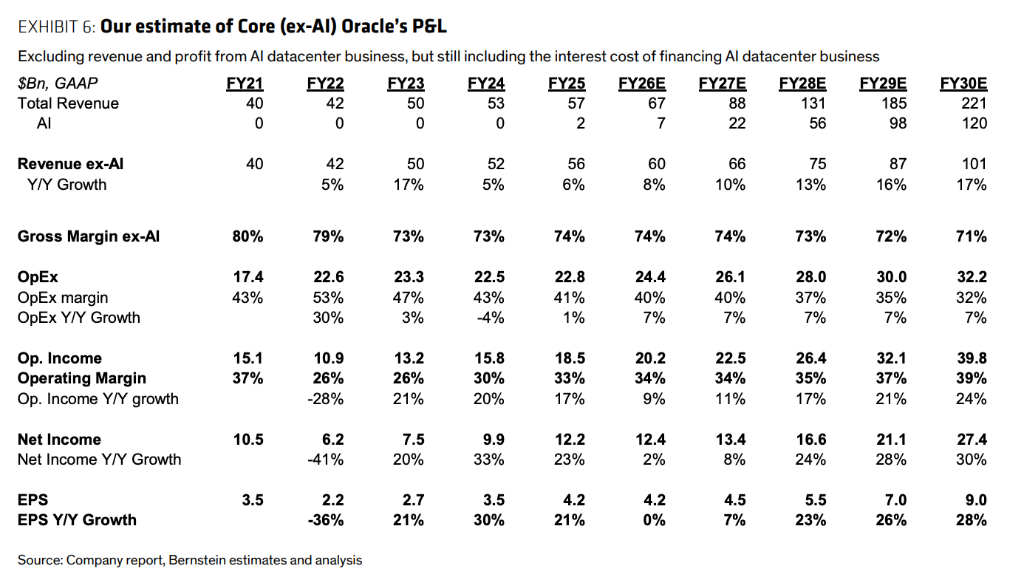
Core Insights - Bernstein conducted an extreme scenario stress test on Oracle, estimating a valuation floor of $137 per share, indicating a 15% downside from the current level of approximately $160, providing a clear margin of safety for investors [1] - In an optimistic scenario, if execution goes smoothly, the target price could rise to $313, highlighting a strong asymmetric risk-reward profile [1] Customer Concentration and Capital Expenditure Concerns - Bernstein addressed market concerns regarding customer concentration and capital expenditure, particularly related to AI clients like OpenAI, suggesting that fears are overvalued [1] - The report indicates that even if all AI contracts fail to convert into revenue, Oracle's core database, SaaS, and non-AI OCI businesses would continue to grow normally [1] Lease Liabilities Analysis - Bernstein analyzed Oracle's $248 billion lease liabilities, arguing that the risk of clients defaulting is significantly overstated [2] - The long-term nature of these leases (15 to 19 years) means that the maximum annual risk exposure is only $13 to $16.5 billion, peaking in FY2030 [2] - The global demand for data centers is expected to remain high, allowing Oracle to utilize or sublease any idle space [2] Hardware Capital Expenditure Risks - Bernstein noted that the actual exposure to hardware capital expenditure risks is limited, as Oracle can cancel or delay orders without incurring significant penalties [3] - Most computing assets are highly versatile and can be repurposed for traditional SaaS and OCI businesses, mitigating risks associated with client cancellations [3] Core Business Fundamentals - The report highlights Oracle's core business value, projecting total revenue of $101 billion by FY2030, even without AI-related income [4] - After accounting for interest costs from debt incurred for AI infrastructure, the estimated earnings per share (EPS) could still reach $9.00, suggesting a valuation of $137 per share based on industry peers' price-to-earnings ratios [4] Financial Projections - Oracle's total revenue is projected to grow from $50 billion in FY23 to $221 billion by FY30, with a notable increase in revenue from AI expected to reach $120 billion by FY30 [5] - The operating income is expected to grow from $13.2 billion in FY23 to $39.8 billion by FY30, indicating a strong upward trend in profitability [5] Valuation Comparisons - Oracle's projected EPS growth rate of 18.2% positions it favorably against peers like Microsoft and SAP, with a reasonable price-to-earnings ratio of 27.3x suggesting a stock price of $137 excluding AI revenue [6] - Bernstein believes that Oracle's current stock price reflects overly pessimistic expectations, presenting an attractive risk-reward ratio for investors [6]

理解了巴菲特“补票”谷歌,就理解了字节、阿里与腾讯的AI入口大战
创业邦· 2026-02-12 10:30
Core Insights - The article discusses the ongoing competition among Chinese tech giants for AI entry points and ecosystems, highlighting Tencent's significant investment and the strategic shift of Berkshire Hathaway in selling Apple shares to buy Google stock, indicating a re-evaluation of ecosystem competitiveness in the AI era [5][9][32]. Group 1: Investment Strategies - Warren Buffett's regret over missing early investment opportunities in Google has led to a strategic shift, where Berkshire Hathaway sold $10.6 billion worth of Apple shares and invested $4.3 billion in Google, marking a significant change in its portfolio [9][10]. - The decision to invest in Google aligns with Buffett's long-standing preference for companies with strong ecosystems, as Google has developed a comprehensive AI ecosystem that integrates hardware, software, and services [11][12]. Group 2: Google's AI Ecosystem - Google has established a full-stack AI ecosystem, integrating chips (TPU), models (Gemini), and cloud services, which has proven effective in enhancing its competitive position in the AI market [17][20]. - The TPU chip provides cost advantages and autonomy, allowing Google to meet its internal AI computing demands while reducing reliance on external suppliers [20][21]. - Google's Gemini models have shown superior performance compared to competitors, with Gemini 3 leading in various benchmarks and achieving significant user engagement [23][26]. Group 3: Market Performance and Trends - Google's cloud revenue grew by 33.5% year-over-year to $15.16 billion in Q3 2025, with operating profit reaching $3.59 billion, indicating strong market performance [27][28]. - The integration of AI into Google's advertising and cloud services has created a positive feedback loop, enhancing user experience and driving revenue growth [26][27]. - The competitive landscape is shifting, with companies like Amazon, Meta, and Microsoft facing challenges in AI capabilities and cloud services, highlighting the importance of building self-sustaining ecosystems [35][37][39]. Group 4: Competitive Landscape - Amazon's AWS is losing market share due to late entry into generative AI and challenges in model and chip development, despite its strong customer base [35][36]. - Meta struggles with model capabilities and lacks a cloud business, impacting its ability to leverage AI effectively [37]. - Microsoft's reliance on partnerships for AI capabilities, coupled with a lack of proprietary models, may hinder its competitive edge in the evolving AI landscape [39][40]. Group 5: Future Implications - The article emphasizes that only companies that can build self-reinforcing ecosystems will thrive in the AI era, as demonstrated by Google's early investments in AI technology [33][43]. - The ongoing competition among tech giants for AI dominance will shape the future landscape, with successful players likely to see significant valuation increases [34][44].


逼近2000亿!AI“王炸级”应用,来了
Zhong Guo Ji Jin Bao· 2026-02-12 10:20
Core Insights - The global AI industry is witnessing intense competition with the launch of new programming models, particularly MiniMax M2.5, which is designed for Agent scenarios and aims to set a price benchmark among high-performance AI programming models [1][6]. Group 1: Product Launches and Market Reactions - MiniMax launched its flagship programming model MiniMax M2.5 on February 12, becoming the first production-level model designed specifically for Agent scenarios [1]. - On the same day, MiniMax's stock price surged by 14.62%, closing at 588 HKD per share, with a market capitalization reaching 184.4 billion HKD [2]. - Other competitors, including Anthropic and OpenAI, also released new models, with Anthropic's Claude Opus 4.6 and OpenAI's GPT-5.3-Codex being notable mentions [1][5]. Group 2: Technical Features and Performance - MiniMax M2.5 is positioned against Claude Opus 4.6, supporting full-stack programming development across various applications, including advanced Excel processing and deep research [3]. - The model boasts a minimal activation parameter count of 10 billion, making it one of the smallest flagship models in the AI sector, which enhances its efficiency in private deployment and inference [4]. - MiniMax M2.5 achieves a transaction processing speed of 100 TPS, which is three times faster than Claude Opus 4.6, showcasing its superior performance [4]. Group 3: Competitive Landscape - The AI industry is experiencing a significant product competition, with MiniMax M2.5 aiming to provide the best cost-performance ratio in the market [5]. - The introduction of MiniMax M2.5 is expected to drive substantial advancements in Agent applications, positioning it as a key player in the evolving AI landscape [6]. - The competitive models from Anthropic and OpenAI also highlight advancements in speed and capabilities, with OpenAI's GPT-5.3-Codex showing a 25% speed improvement over its predecessor [5]. Group 4: Development and Investment - MiniMax has rapidly grown into a leading AI multimodal company within just four years, having invested approximately 500 million USD, compared to OpenAI's estimated expenditure of 40 to 55 billion USD [10].

MOSS孙天祥新公司要让AI自己写100篇论文,还要全网直播一个月
3 6 Ke· 2026-02-12 09:52
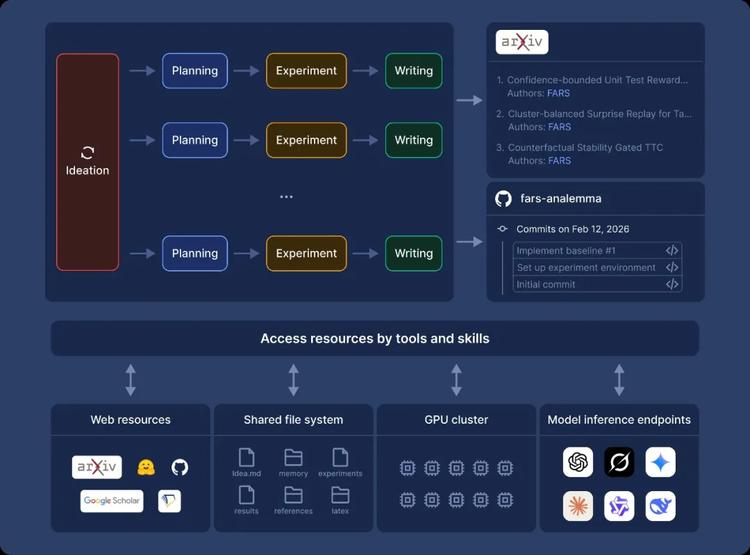
Core Insights - The article discusses a month-long live demonstration of an AI system named FARS, which aims to autonomously conduct the entire research process, producing 100 complete research papers without human intervention [1][20]. Company Overview - Analemma, the company behind FARS, was founded less than a year ago and has secured tens of millions of dollars in angel funding from notable investors such as Sequoia China and Meituan [1]. - The founder, Tianxiang Sun, was a key developer of MOSS, a significant model in the AI field, which gained attention for its capabilities [11][12]. Technology and Architecture - FARS, or Fully Automated Research System, is a multi-agent system composed of four modules: Ideation, Planning, Experiment, and Writing, which collaborate in a shared file system [2][4]. - The system utilizes APIs from various closed-source models, including Claude, GPT, and Gemini, along with self-developed models for certain tasks [5]. Research Focus and Methodology - FARS focuses on AI research itself, allowing for fully automated experiments that do not require physical laboratories [8]. - The system is designed to produce "short papers" that emphasize clear hypotheses and reliable validation, diverging from traditional academic publishing norms [7]. Quality Control and Evaluation - Each paper produced by FARS will undergo review by at least three team members with over five years of research experience before being uploaded to arXiv, ensuring a level of quality control [8]. - The team plans to invite peer reviews rather than submitting to traditional academic conferences, focusing on the practical citation and value of the results [8]. Competitive Landscape - FARS is part of a growing trend in automated research systems, competing with others like Sakana AI's AI Scientist and AI-Researcher from Hong Kong University [17][19]. - Unlike its competitors, FARS aims for real-time, large-scale, and fully transparent public deployment, which is a bold move in the field [19]. Future Directions - The live demonstration of FARS will begin on the company's website and social media platforms, marking a significant step in evaluating the system's capabilities [20]. - The results of this experiment could provide insights into the potential of AI to conduct research autonomously, a question that remains to be answered through the quality of the 100 papers produced [20][21].