
陕西煤业

Search documents
煤炭行业中报惨淡:25家上市企业利润齐降,头部四企损失超百亿
Sou Hu Cai Jing· 2025-09-04 09:46
Core Viewpoint - The coal industry is experiencing a significant decline in performance for the first half of 2025, with most listed companies reporting decreased revenues and profits compared to previous years [1][2]. Company Performance - Among 25 coal companies, 23 reported a year-on-year decline in revenue, and all 25 experienced negative growth in net profit attributable to shareholders [1]. - The total net profit of these companies for the first half of 2025 was 554.72 billion yuan, down nearly 250 billion yuan from 808.11 billion yuan in the same period last year, and down almost 500 billion yuan from 1,057.54 billion yuan in 2023 [1]. - Major companies like China Shenhua, China Coal Energy, Shaanxi Coal and Yanzhou Coal Mining collectively saw profits drop by over 10 billion yuan compared to 2024 [1]. - China Shenhua's net profit decreased by 12.03%, while China Coal Energy, Shaanxi Coal, and Yanzhou Coal reported declines of 21.28%, 31.18%, and 38.53% respectively [1][2]. Market Conditions - The overall coal price has been on a downward trend, with average prices for thermal coal dropping by over 20% in major markets, significantly impacting the revenues of coal companies [1][4]. - Nationally, the raw coal output increased by 5.4% year-on-year, while coal imports fell by 11.1%, indicating a relaxed supply-demand relationship in the domestic market [4]. - Weak downstream demand has led to a decline in coal prices, with thermal coal spot prices experiencing significant drops and even instances of price inversion between long-term contracts and spot prices [4]. Profitability and Future Outlook - The number of coal companies reporting profits over 1 billion yuan has decreased from 15 to 8, with some companies like Pingmei Shenma and Yongtai Energy seeing profit declines exceeding 80% [5]. - The number of loss-making companies increased from 1 to 5, with Anyuan Coal Industry reporting the largest loss of 290 million yuan [5]. - Despite challenges, some analysts remain optimistic about future coal prices, anticipating potential increases due to seasonal demand and supply adjustments [5]. - However, caution is advised as demand may weaken after high temperatures, and the market lacks strong supportive factors, leading to expectations of continued price fluctuations [5].

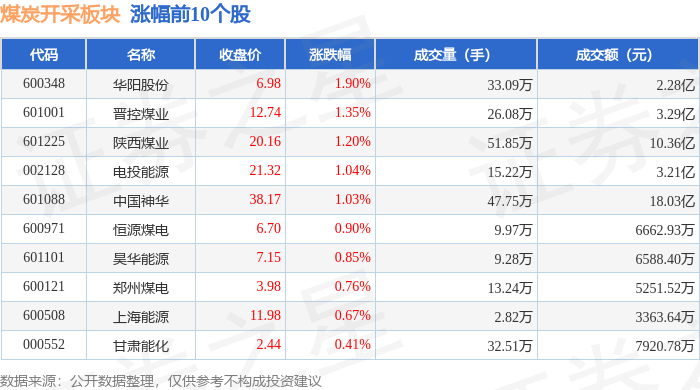
煤炭开采板块9月4日涨0.58%,华阳股份领涨,主力资金净流出2.47亿元
Zheng Xing Xing Ye Ri Bao· 2025-09-04 08:55
Group 1 - The coal mining sector increased by 0.58% on September 4, with Huayang Co. leading the gains [1] - The Shanghai Composite Index closed at 3765.88, down 1.25%, while the Shenzhen Component Index closed at 12118.7, down 2.83% [1] - Key stocks in the coal mining sector showed varied performance, with several companies experiencing positive price changes [1] Group 2 - Major coal mining stocks included: - Biaoyang Tire (600348) at 6.98, up 1.90% with a trading volume of 330,900 shares and a turnover of 228 million yuan - Jinko Coal (601001) at 12.74, up 1.35% with a trading volume of 260,800 shares and a turnover of 329 million yuan - Shaanxi Coal (601225) at 20.16, up 1.20% with a trading volume of 518,500 shares and a turnover of 1.036 billion yuan - China Shenhua (601088) at 38.17, up 1.03% with a trading volume of 477,500 shares and a turnover of 1.803 billion yuan [1] - The coal mining sector experienced a net outflow of 247 million yuan from main funds, while retail investors saw a net inflow of 187 million yuan [2]

煤炭中报“寒意浓”!25家煤企利润集体滑坡,头部四企同比少赚100多亿
Hua Xia Shi Bao· 2025-09-04 04:17
Core Viewpoint - The coal industry is experiencing significant profit declines, with 23 out of 25 listed coal companies reporting revenue drops and all showing negative net profit growth in their mid-year reports for 2025, indicating a severe contraction in industry profitability [1][2][4]. Financial Performance - In the first half of 2025, the total net profit of 25 coal companies was 554.72 billion yuan, down nearly 250 billion yuan from 808.11 billion yuan in the same period last year, and a decrease of almost 500 billion yuan compared to 2023 [1][2]. - Major coal companies, including China Shenhua, China Coal Energy, Shaanxi Coal and Electricity, and Yanzhou Coal, collectively earned over 100 billion yuan less than in the previous year, highlighting a significant profit shrinkage [1][2]. Revenue Decline - The top four coal companies reported a combined net profit of 446.36 billion yuan in the first half of 2025, down from 574.16 billion yuan last year and 669.03 billion yuan two years ago [2]. - Specific revenue figures for major companies include: - China Shenhua: Revenue of 1,381.09 billion yuan, down 18.34% [2]. - China Coal Energy: Revenue of 744.36 billion yuan, down 19.95% [2]. - Shaanxi Coal: Revenue of 779.83 billion yuan, down 14.19% [2]. - Yanzhou Coal: Revenue of 593.49 billion yuan, down 17.93% [2]. Price and Demand Factors - The decline in coal prices is attributed to oversupply and weak demand, with average sales prices for coal dropping significantly [3][4]. - For instance, Shaanxi Coal reported a coal price of 439.67 yuan/ton, down 23.81% year-on-year, while China Coal Energy's sales price fell by 114 yuan/ton [3]. - The overall coal production in China increased by 5.4% in the first half of 2025, while coal imports decreased by 11.1% [4]. Market Outlook - Despite the current downturn, there are expectations for a potential recovery in coal prices due to seasonal demand increases and supply constraints [8][10]. - Analysts suggest that the coal market may stabilize as seasonal factors and macroeconomic policies could improve demand in the latter half of 2025 [10][11].




建信期货焦炭焦煤日评-20250904
Jian Xin Qi Huo· 2025-09-04 03:42
Report Information - Report Type: Coke and Coking Coal Daily Review [1] - Date: September 4, 2025 [2] - Research Team: Black Metal Research Team [3] - Researchers: Zhai Hepan, Nie Jiayi, Feng Zeren [3] 1. Market Conditions Review 1.1 Futures Market - On September 3, the main contracts of coke and coking coal futures, J2601 and JM2601, weakened after a rebound. Their closing prices reached new lows since July 21 and August 4 respectively. The closing price of J2601 was 1,594 yuan/ton, down 0.59%, with a trading volume of 18,350 lots and an open interest of 46,404 lots, an increase of 306 lots. The closing price of JM2601 was 1,106 yuan/ton, down 1.25%, with a trading volume of 1,068,419 lots and an open interest of 745,765 lots, an increase of 10,853 lots [5]. 1.2 Spot Market - On September 3, the daily KDJ indicators of coke 2601 and coking coal 2601 contracts continued to decline, and the daily MACD green bars slightly expanded. The ex - warehouse price index of quasi - first - grade metallurgical coke in Rizhao Port, Qingdao Port, and Tianjin Port was 1,520 yuan/ton, with no change. The ex - warehouse price index in Tangshan was 1,450 yuan/ton, also unchanged. The aggregated price of low - sulfur main coking coal in Tangshan was 1,445 yuan/ton, unchanged; in Luliang it was 1,404 yuan/ton, unchanged; in Linfen it was 1,470 yuan/ton, unchanged; in Handan it was 1,350 yuan/ton, unchanged; in Heze it was 1,320 yuan/ton, up 30 yuan/ton; in Pingdingshan it was 1,460 yuan/ton, unchanged [8]. 2. Future Outlook 2.1 Fundamental Analysis - **Coke**: Since mid - June, the coke output of independent coking plants has significantly declined from its high, and the coke output of steel mills has dropped to a new low since late January. Port coke inventories have declined for three consecutive weeks from their high since the end of May. Steel mills are still destocking, but last week's inventory slightly rebounded from its low since mid - December last year. Coking plant inventories have slightly increased for two consecutive weeks from their low since late October last year. Tonnage coke profit has been profitable for three consecutive weeks. After the 8th round of spot price increase for coke, it was reported that some northern steel mills plan to conduct the first round of coke price cuts on September 5 [10]. - **Coking Coal**: From January to July, China's imports of coal and lignite decreased by 1.9 percentage points year - on - year to - 13.0%, and imports of coking coal still had a large year - on - year decline of - 8.0%. After a significant decline in the inventories of refined coal and raw coal in mines in the past 9 weeks, there has been a rebound. The overall declines reached 43.2% and 32.6% respectively. However, the refined coal inventory in mines has increased for three consecutive weeks, with an increase of 15.5%, while the raw coal inventory in mines has only increased by 0.5% in the past 2 weeks. The inventory of independent coking plants has declined for four consecutive weeks from its high since early February, the steel mill inventory has slightly declined after rising to a new high since early February, and the port inventory has increased for two consecutive weeks from its low since early July last year. With high inventories in steel mills and coking plants, the spot price of coking coal is likely to decline slowly [11]. 2.2 Comprehensive Outlook - The proposed price cut in the coke spot market and the expected increase in Mongolian coal imports are negative for the double - coke industry chain. The decline in steel mills' immediate profits will further suppress the prices of double - coke from the demand side. It is recommended to expect a continued decline or weak performance in the near term. The stabilization and rebound of coal and coke futures, especially after mid - to - late September, depend on the recovery of terminal demand in the steel market [11]. 3. Industry News - On September 3, the Ministry of Finance plans to re - issue the 2025 ultra - long - term special treasury bonds (Phase III) for the second time. The re - issued bonds are 50 - year fixed - rate coupon - bearing bonds, with a competitive tender face value of 35 billion yuan [12]. - As of the end of 2024, China's installed capacity of new energy storage reached 73.76 million kilowatts/168 million kilowatt - hours, accounting for more than 40% of the global total, ranking first in the world [12]. - On August 29, the dredging project of the fifth - phase project of Huanghua Port Coal Terminal passed the pre - acceptance. The designed dredging volume was 2.7748 million cubic meters [13]. - On August 31, the 60 - megawatt Chang'an Shimenzi Wind Power Project, the first wind power project of Shaanxi Coal Group in Hunan, was fully connected to the grid [13]. - Shanxi Coking Coal responded to the impact of over - production verification, stating that its approved production capacity is 48.9 million tons/year, and it has never reached full - load production, so the over - production verification policy will not affect production and sales [13]. - In the first half of 2025, Inner Mongolia added 11.91 million kilowatts of power generation capacity, with a total installed capacity of 270 million kilowatts, and new energy installed capacity of 145 million kilowatts, an increase of 10.28 million kilowatts. Its power generation reached 416.7 billion kilowatt - hours, a year - on - year increase of 4.7% [13]. - On September 1, the autumn centralized maintenance of the Shitai Railway under the jurisdiction of China Railway Taiyuan Bureau Group Co., Ltd. began, which will last for 15 days [13]. - As of the end of August, the commercial coal output of Wuhai Energy Company reached 9.3175 million tons, a record high for the same period in the past 5 years [13]. - On September 1, the head of the National Energy Administration met with the Minister of Energy of Kazakhstan to discuss cooperation in oil and gas, renewable energy, and electricity [13]. - On September 2, the China - Shanghai Cooperation Organization Energy Cooperation Platform was inaugurated in Beijing [13]. - On September 2, the chairman of PetroChina met with the President of Kazakhstan to discuss cooperation in oil and gas, refining, and new energy [14]. - Since September, the import steam coal market has remained weak. The price advantage of imported coal has continued to narrow, and the bid price of Indonesian 3800 - kcal coal has fallen below 400 yuan/ton [14]. - Elga, a global leading high - quality coking coal producer, expects the situation of Russian coking coal producers to stabilize by the end of this year [14]. - In June 2025, Canada's coal production was 3.444 million tons, a year - on - year decrease of 3.5% and a month - on - month decrease of 8.9% [14]. 4. Data Overview The report provides multiple data charts, including the spot price index of metallurgical coke in major markets, the aggregated spot price of main coking coal, the production and capacity utilization rate of coking plants and steel mills, the national average daily hot metal output, the coke and coking coal inventories of ports, steel mills, and coking plants, the tonnage coke profit of independent coking plants, the production and operating rate of sample mines, the refined coal and raw coal inventories of sample mines, and the basis of Rizhao Port's quasi - first - grade coke and Linfen's low - sulfur main coking coal against the January contracts [16][19][22][33][35][36].
煤炭中报“寒意浓”!25家上市煤企利润集体滑坡
Hua Xia Shi Bao· 2025-09-04 01:54
Core Viewpoint - The coal industry is experiencing significant profit declines, with 23 out of 25 listed coal companies reporting revenue drops and all 25 showing negative net profit growth in the first half of 2025, indicating a severe contraction in industry profitability [1][2]. Financial Performance - In the first half of 2025, the total net profit of 25 coal companies was 554.72 billion yuan, down nearly 250 billion yuan from 808.11 billion yuan in the same period last year, and a decrease of almost 500 billion yuan compared to 1,057.54 billion yuan in 2023 [1][2]. - The top four coal companies, including China Shenhua, China Coal Energy, Shaanxi Coal and Electricity, and Yanzhou Coal Mining, collectively earned over 100 billion yuan less than in the first half of 2024 [1]. - China Shenhua maintained the highest revenue at 1,381.09 billion yuan, down 18.34% year-on-year, with a net profit of 246.41 billion yuan, a decrease of 12.03% [2]. Price Decline Factors - The decline in coal prices is attributed to a combination of factors, including a 10.9% drop in sales volume and a 12.9% decrease in average selling prices for coal, leading to a significant reduction in sales revenue [3]. - The average selling price of coal for Shaanxi Coal was 439.67 yuan/ton, down 23.81% year-on-year, while China Coal Energy reported a drop of 114 yuan/ton in its comprehensive sales price [3]. Supply and Demand Dynamics - The coal supply remains high, with a production increase of 5.4% year-on-year, while demand is weak, leading to a surplus in the market [4]. - The price of thermal coal has seen significant declines, with the NCEI index showing a 24 yuan/ton decrease in long-term contract prices compared to the end of the previous year [4]. Profitability Trends - The number of coal companies with profits exceeding 10 billion yuan has halved, dropping from 15 to 8, with several companies experiencing profit declines exceeding 80% [5]. - The number of loss-making companies increased from 1 to 5, with the most significant loss reported by Anyuan Coal at 290 million yuan [5]. Market Outlook - Despite short-term pressures, there are optimistic forecasts for coal prices in the latter half of the year, with expectations of improved demand during seasonal peaks [7][8]. - Analysts suggest that while the supply side may see marginal contractions, the demand side remains resilient, potentially alleviating downward pressure on coal prices [8].
发挥长钱长投优势 险资系私募偏好大蓝筹
Zhong Guo Zheng Quan Bao· 2025-09-03 22:44
Group 1 - A new insurance-funded private equity firm, Hengyi Chiying, has registered with a fund size of 30 billion yuan, bringing the total number of insurance-funded private equity firms to seven, with a combined trial amount of 222 billion yuan [1][2] - The insurance capital long-term investment reform pilot was approved in October 2023, with China Life and Xinhua Insurance each contributing 25 billion yuan to establish a 50 billion yuan company fund [2] - The investment strategy of these funds focuses on long-term and value investments, particularly in leading companies in the energy and infrastructure sectors, such as China Petroleum and China Shenhua [1][2] Group 2 - Six insurance-funded private equity funds are currently operational, with significant holdings in major companies like China Petroleum and China Shenhua, indicating a strategic shift towards stable, blue-chip stocks [3][4] - The Honghu Zhiyuan Fund has reported substantial holdings, becoming a major shareholder in companies like Sinopec and Daqin Railway, with corresponding market values exceeding 17 billion yuan and 19 billion yuan respectively [3][4] - The funds emphasize a long-term investment approach, aiming to reduce short-term market volatility impacts on financial statements and promote sustainable investment returns [5][6] Group 3 - The total assets of the Honghu Zhiyuan Fund reached 57.11 billion yuan, with a net profit of 9.68 billion yuan in the first half of the year, showcasing the effectiveness of their investment strategy [5] - The insurance companies are committed to establishing private equity funds to leverage their long-term capital advantages, supporting the capital market and aligning with national strategies [6]



发挥长钱长投优势险资系私募偏好大蓝筹
Zhong Guo Zheng Quan Bao· 2025-09-03 22:42
Group 1 - A new insurance-funded private equity firm, Hengyi Chiying (Shenzhen) Private Fund Management Co., Ltd., has completed registration with an initial fund size of 30 billion yuan [1] - The total number of insurance-funded private equity firms has reached seven, with a combined trial amount of 222 billion yuan [1][2] - The investment strategy of these firms is focused on long-term and value investments, favoring leading companies in energy and infrastructure sectors such as China Petroleum, China Shenhua, and Daqin Railway [1][4] Group 2 - The first batch of insurance capital long-term investment reforms was approved in October 2023, with China Life and Xinhua Insurance each contributing 25 billion yuan to establish a 50 billion yuan company fund [2] - As of now, six insurance-funded private equity securities investment funds are operational, with significant holdings in major companies [2][3] - The Honghu Zhiyuan Fund has become a major shareholder in China Petroleum and China Shenhua, with holdings valued at approximately 1.857 billion yuan and 2.116 billion yuan respectively [2][3] Group 3 - The Honghu Zhiyuan series of funds emphasizes a long-term investment approach, focusing on stable dividend yields through low-frequency trading and long-term holding [4] - The total assets of the Honghu Zhiyuan Fund I reached 57.112 billion yuan, with a net profit of 9.68 billion yuan in the first half of the year [3][4] - Insurance companies are establishing private equity funds to leverage their long-term investment advantages, supporting the capital market and promoting stable, sustainable investment returns [4]

煤炭中报“寒意浓”!25家上市煤企利润集体滑坡,中国神华等头部四企同比少赚100多亿
Hua Xia Shi Bao· 2025-09-03 14:08
Core Viewpoint - The coal industry is experiencing significant profit declines, with 23 out of 25 listed coal companies reporting revenue drops and all 25 showing negative net profit growth in the first half of 2025, indicating a severe contraction in industry profitability [1][2][4]. Group 1: Financial Performance - In the first half of 2025, the total net profit of 25 coal companies was 554.72 billion yuan, a decrease of nearly 250 billion yuan from 808.11 billion yuan in the same period last year, and down nearly 500 billion yuan from 1,057.54 billion yuan two years ago [1][2]. - The top four coal companies, including China Shenhua, China Coal Energy, Shaanxi Coal and Yanzhou Coal, collectively earned over 100 billion yuan less compared to the first half of 2024 [1][2]. - China Shenhua maintained the highest revenue at 1,381.09 billion yuan, down 18.34% year-on-year, with a net profit of 246.41 billion yuan, down 12.03% [2][3]. Group 2: Price and Demand Factors - The decline in coal prices is attributed to a weak supply-demand relationship, with average sales prices for thermal coal dropping by over 20% across major markets [1][4]. - China Shenhua reported a 10.9% decrease in coal sales volume and a 12.9% drop in average sales price, leading to a significant reduction in sales revenue [3][4]. - The average selling price of coal for Shaanxi Coal was 439.67 yuan/ton, down 23.81% year-on-year, while China Coal Energy's price fell by 114 yuan/ton [3][4]. Group 3: Industry Outlook - Despite the current downturn, there are expectations for a potential recovery in coal prices during the second half of 2025, driven by seasonal demand increases and policy support [7][9]. - Analysts suggest that while short-term pressures remain, the coal market may stabilize as supply constraints and seasonal demand factors come into play [8][9]. - The overall sentiment among several coal companies indicates a cautious optimism for the second half of 2025, with expectations of improved demand due to seasonal factors and economic recovery policies [9].
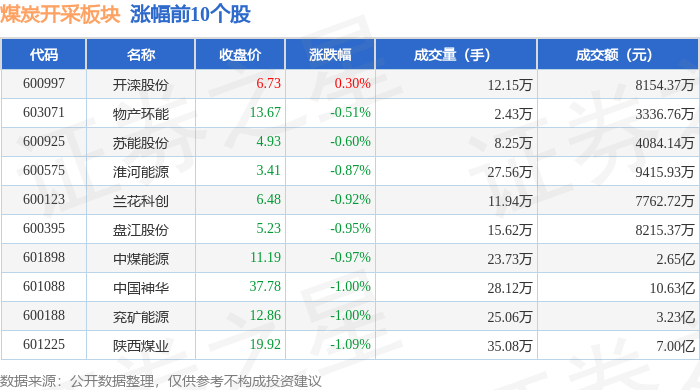
煤炭开采板块9月3日跌1.27%,安源煤业领跌,主力资金净流出6.62亿元
Zheng Xing Xing Ye Ri Bao· 2025-09-03 08:46
Core Viewpoint - The coal mining sector experienced a decline of 1.27% on September 3, with Anyuan Coal Industry leading the drop. The Shanghai Composite Index closed at 3813.56, down 1.16%, while the Shenzhen Component Index closed at 12472.0, down 0.65% [1]. Sector Performance - The coal mining sector's individual stock performance showed mixed results, with notable declines in several companies: - Kailuan Energy Development (600997) closed at 6.73, up 0.30% - Wuchan Zhongda Group (603071) closed at 13.67, down 0.51% - Sunan Energy (600925) closed at 4.93, down 0.60% - Huaihe Energy (600575) closed at 3.41, down 0.87% - Lanhua Sci-Tech (600123) closed at 6.48, down 0.92% - Panjiang Coal and Electricity (600395) closed at 5.23, down 0.95% - China Coal Energy (8681898) closed at 11.19, down 0.97% - China Shenhua Energy (601088) closed at 37.78, down 1.00% - Jiuquan Energy (600188) closed at 12.86, down 1.00% - Shaanxi Coal and Chemical Industry (601225) closed at 19.92, down 1.09% [1]. Capital Flow - The coal mining sector saw a net outflow of 662 million yuan from main funds, while retail investors contributed a net inflow of 422 million yuan. Speculative funds recorded a net inflow of 240 million yuan [1].

招商证券:25H1险资投资余额超去年全年 高股息OCI类配置型股票规模近万亿
智通财经网· 2025-09-03 06:57
Core Insights - The insurance industry is experiencing rapid growth in fund utilization, with a balance of 36.23 trillion yuan as of Q2 2025, reflecting an 8.9% increase from the beginning of the year, driven by premium growth and asset value appreciation [2] - Major listed insurance companies account for nearly 60% of the total investment scale, with a slight decrease in their market share to 58.7% [2] - The allocation of insurance assets is increasingly focused on high-dividend and large-cap growth stocks, with the OCI stock scale nearing 1 trillion yuan [4][5] Investment Trends - As of mid-2025, the stock investment balance for life and property insurance companies reached 3.07 trillion yuan, with a net increase of 640.6 billion yuan in H1, surpassing the total increase for the previous year [1] - The proportion of stocks in the total investment assets of major listed insurance companies rose to 9.3%, with a net increase of 418.9 billion yuan in H1, accounting for 65.7% of the industry's stock investment growth [3] - The average dividend yield of heavily held stocks by insurance funds has slightly decreased to 2.3%, attributed to rising stock prices diluting dividends [4] Regulatory and Market Changes - The insurance sector has seen a surge in shareholding activities, with 30 instances of shareholding increases recorded by the end of August 2025, primarily in high-dividend sectors such as banking and public utilities [5] - New accounting standards and low-interest rates are reshaping the investment environment for insurance funds, with a focus on long-term investments and diversified asset allocation strategies [10] Future Outlook - The insurance industry is expected to maintain double-digit growth in fund utilization, with stock and fund increments potentially approaching 1 trillion yuan [10] - Insurance companies are likely to increase their equity allocation, particularly in growth sectors and high-dividend stocks, in response to regulatory encouragement [10] - There is a growing emphasis on exploring innovative asset types and channels, including overseas investments and new business trials, to enhance portfolio diversification and reduce volatility [10]

