中国人寿

Search documents
42家保险机构参与2月调研
Xin Lang Cai Jing· 2026-02-17 14:23
Group 1 - The core point of the article highlights that investment institutions are actively conducting research on listed companies ahead of the Spring Festival holiday, with a total of 42 insurance institutions participating in the surveys since early February [1] Group 2 - Ping An Pension Insurance leads the research frequency with 7 surveys conducted [1] - Taiping Pension Insurance follows in second place with 6 surveys [1] - Other notable participants include China People's Pension Insurance, China Life Pension Insurance, and Ruizhong Life Insurance, each conducting 4 surveys [1]


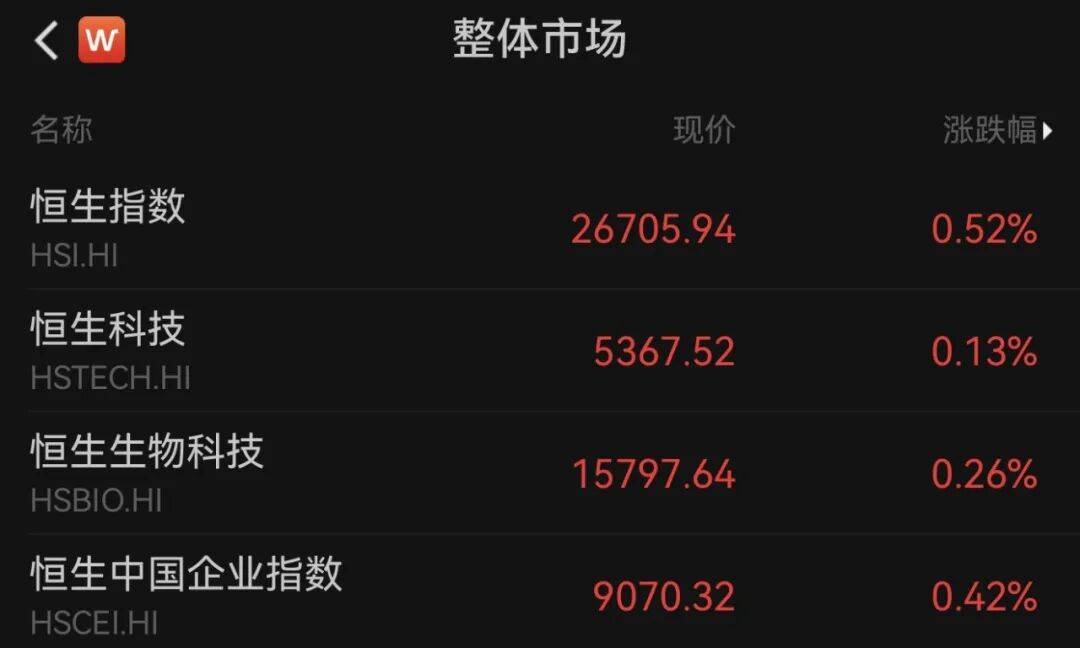
港股16日涨0.52% 收报26705.94点
Xin Hua Wang· 2026-02-16 09:53
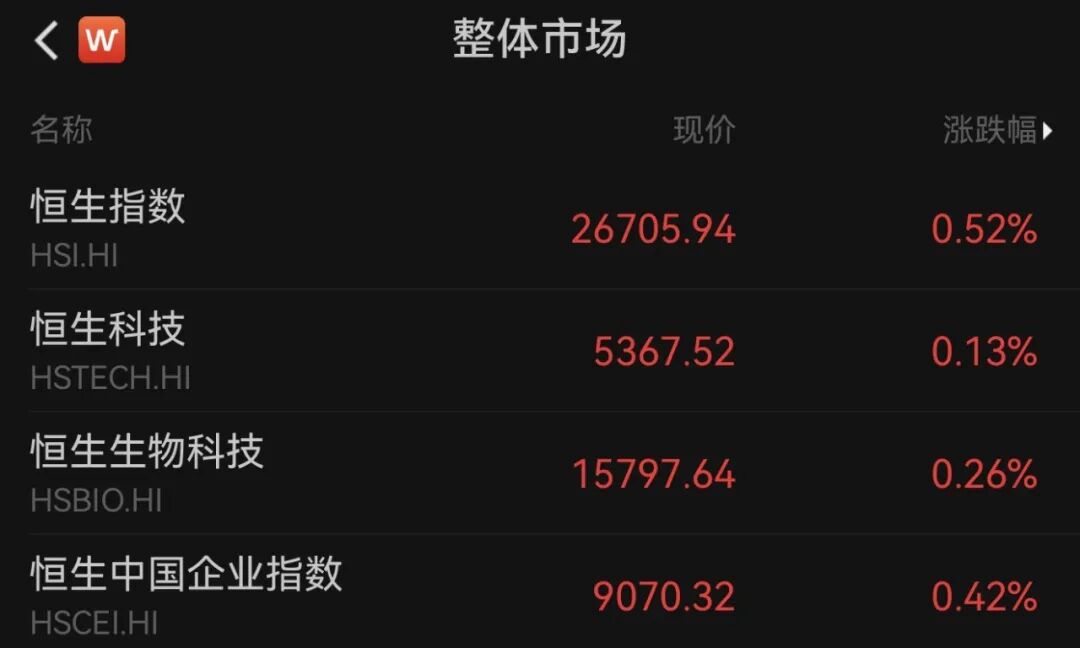
Market Performance - The Hang Seng Index rose by 138.82 points, an increase of 0.52%, closing at 26,705.94 points [1] - The Main Board recorded a total turnover of 84.997 billion HKD [1] - The National Enterprises Index increased by 37.61 points, closing at 9,070.32 points, a rise of 0.42% [1] - The Hang Seng Tech Index saw a slight increase of 7.10 points, closing at 5,367.52 points, up by 0.13% [1] Blue-Chip Stocks - Tencent Holdings increased by 0.19%, closing at 533 HKD [1] - Hong Kong Exchanges and Clearing rose by 0.89%, closing at 408.8 HKD [1] - China Mobile saw a rise of 0.26%, closing at 78.4 HKD [1] - HSBC Holdings decreased by 1.11%, closing at 134.2 HKD [1] Local Hong Kong Stocks - Cheung Kong Holdings increased by 0.72%, closing at 47.24 HKD [1] - Sun Hung Kai Properties rose by 0.75%, closing at 134.7 HKD [1] - Henderson Land Development saw an increase of 0.93%, closing at 32.7 HKD [1] Chinese Financial Stocks - Bank of China rose by 0.22%, closing at 4.66 HKD [1] - China Construction Bank increased by 0.63%, closing at 8.01 HKD [1] - Industrial and Commercial Bank of China decreased by 0.16%, closing at 6.4 HKD [1] - Ping An Insurance rose by 0.43%, closing at 70.65 HKD [1] - China Life Insurance saw a significant increase of 1.93%, closing at 33.72 HKD [1] Oil and Petrochemical Stocks - Sinopec increased by 1.3%, closing at 5.44 HKD [1] - PetroChina rose by 1.44%, closing at 9.18 HKD [1] - CNOOC saw a notable increase of 3.71%, closing at 25.14 HKD [1]
40%保险新品收益不确定
21世纪经济报道· 2026-02-16 07:22
Core Viewpoint - The insurance industry is shifting towards dividend insurance products due to low interest rates, with a focus on "guaranteed returns + floating dividends" as a new wealth management strategy for consumers [3][5][10]. Group 1: Market Trends - Traditional guaranteed whole life insurance is being replaced by dividend insurance, which offers floating returns, as over 40% of new products launched in 2026 are expected to be dividend insurance [5][6]. - The maximum guaranteed interest rate for traditional insurance has dropped to 2.0%, while the maximum for dividend insurance is now 1.75%, making dividend products more attractive despite lower guaranteed returns [5][6]. - Major insurance companies are rapidly launching new dividend insurance products, indicating a consensus in the industry regarding this transition [6][10]. Group 2: Consumer Implications - Consumers must accept the "floating nature" of returns when purchasing dividend insurance, leading to a decrease in guaranteed returns [8][9]. - The structure of dividend insurance includes a guaranteed return influenced by the predetermined interest rate and an uncertain dividend component, which reflects a rebalancing of interests between insurers and clients [8][10]. - The shift to dividend insurance is seen as a way for insurance companies to lower rigid liability costs and mitigate the risk of "interest spread loss" in a prolonged low-interest environment [9][10]. Group 3: Investment Considerations - The realization of dividends is directly tied to the insurance company's operational performance, making the selection of a reliable insurer crucial for consumers [12][13]. - The dividend from these products is derived from the company's "three differences" in mortality, expense, and investment returns, with at least 70% of distributable surplus allocated to policyholders [12][13]. - The investment strategies of leading insurance companies are undergoing significant adjustments, with a projected increase in investable funds, indicating a potential for higher returns for consumers [12][13]. Group 4: Regulatory Environment - Regulatory measures are in place to manage consumer expectations and prevent misleading sales practices regarding dividend levels [15][16]. - Consumers are encouraged to evaluate the historical dividend realization rates of insurance products, which reflect the actual dividends paid compared to projected figures [16][17]. - The decision-making process for consumers should involve assessing their long-term financial needs, selecting appropriate products, and choosing companies based on their operational stability and historical performance [17].

港股三大指数蛇年收涨 机构:马年港股或震荡上行
Zhong Guo Zheng Quan Bao· 2026-02-16 05:51
Market Performance - The Hong Kong stock market closed positively on the last trading day of the Year of the Snake, with all three major indices rising: Hang Seng Index up 0.52%, Hang Seng China Enterprises Index up 0.42%, and Hang Seng Tech Index up 0.13% [1][2] - The Hang Seng Composite Industry Index saw all 12 sectors increase, with the materials, energy, and industrial sectors leading the gains at 3.96%, 2.21%, and 0.94% respectively [2][3] Yearly Performance - For the Year of the Snake (January 29, 2025, to February 16, 2026), the Hang Seng Index increased by 32.04%, the Hang Seng China Enterprises Index by 22.87%, and the Hang Seng Tech Index by 13.63% [4] - The top three performing stocks during this period were Junyu Foundation, Base Champion Group, and Jingxi International, with respective gains of 7,836.51%, 3,725.00%, and 2,736.36% [5] Sector Performance - All 31 first-level industries in the Shenwan classification rose, with 24 industries gaining over 30%, 10 industries over 50%, and 2 industries over 100%. The top three performing sectors were non-ferrous metals (189.59%), defense and military (103.90%), and machinery equipment (74.18%) [6] - The artificial intelligence, non-ferrous metals, and innovative pharmaceuticals sectors led the market, with significant price increases for major companies: Huahong Semiconductor up 337.20%, China Life up 143.70%, SMIC up 83.95%, Alibaba up 78.14%, HSBC up 77.30%, and Tencent up 34.01% [6][7] Market Outlook - Analysts expect the Hong Kong market to continue its upward trend in 2026, driven by factors such as ongoing interest rate cuts by the Federal Reserve, deepening domestic policies, improving corporate earnings, and sustained capital inflows [7] - Recommendations for post-Spring Festival market strategies include focusing on consumption, precious metals, energy, and technology sectors, with a barbell allocation strategy suggested for the second half of the year [7]
港股三大指数蛇年收涨
Sou Hu Cai Jing· 2026-02-16 05:45
Market Performance - The Hong Kong stock market closed positively on the last trading day of the Year of the Snake, with all three major indices rising: Hang Seng Index up 0.52%, Hang Seng China Enterprises Index up 0.42%, and Hang Seng Tech Index up 0.13% [1][2] - The Hang Seng Composite Industry Index saw all 12 sectors increase, with the materials, energy, and industrial sectors leading the gains at 3.96%, 2.21%, and 0.94% respectively [2][3] Yearly Performance - For the Year of the Snake (January 29, 2025, to February 16, 2026), the Hang Seng Index increased by 32.04%, the Hang Seng China Enterprises Index by 22.87%, and the Hang Seng Tech Index by 13.63% [3][4] - The top three performing stocks during this period were Junyu Foundation, Base Champion Group, and Jingxi International, with significant percentage increases [4] Sector Performance - Among the 31 primary industries, all sectors experienced growth, with 24 sectors rising over 30%, 10 sectors over 50%, and 2 sectors over 100%. The top three performing sectors were non-ferrous metals (189.59%), defense and military (103.90%), and machinery equipment (74.18%) [4][5] - The artificial intelligence, non-ferrous metals, and innovative pharmaceuticals sectors led the market, with major stocks like Huahong Semiconductor rising by 337.20%, China Life by 143.70%, and SMIC by 83.95% [5][6] Market Outlook - Analysts suggest that the Hong Kong market's performance exceeded global investor expectations, driven by factors such as the Federal Reserve's interest rate cuts, technology sector revaluation, and significant inflows of southbound and foreign capital [6] - Looking ahead, analysts predict a positive market trend post-Spring Festival, with a focus on sectors like consumption, precious metals, energy, and technology [6]
智通港股沽空统计|2月16日
Xin Lang Cai Jing· 2026-02-16 00:32
Core Insights - The article highlights the top short-selling stocks in the market, with BYD Company Limited (81211) leading with a short-selling ratio of 100.00% [1][2]. Group 1: Short-Selling Ratios - BYD Company Limited (81211) has a short-selling ratio of 100.00% [2][3]. - JD.com (89618) follows with a short-selling ratio of 97.67% [2][3]. - Kuaishou Technology (81024) has a short-selling ratio of 80.79% [2][3]. Group 2: Short-Selling Amounts - Meituan (03690) has the highest short-selling amount at 2.11 billion [2]. - Alibaba Group (09988) follows with a short-selling amount of 1.673 billion [2]. - Xiaomi Corporation (01810) has a short-selling amount of 1.482 billion [2]. Group 3: Deviation Values - BYD Company Limited (81211) has the highest deviation value at 44.67% [3]. - Jinfang Pharmaceutical (02595) has a deviation value of 35.39% [3]. - Kuaishou Technology (81024) has a deviation value of 34.76% [3].





逆势“扫货”!南向资金为何“勇闯”港股?后市关注三大因素
券商中国· 2026-02-15 08:18
Core Viewpoint - The Hong Kong stock market, particularly technology stocks, has been experiencing a price correction, yet southbound funds have been actively buying, with a notable net purchase of 17.893 billion yuan on the last trading day before the holiday, indicating strong investor confidence despite market adjustments [1][4]. Group 1: Market Performance and Investor Behavior - Southbound funds have shown resilience, with a cumulative net purchase amount of 136.151 billion yuan year-to-date, nearly matching the same period last year [4]. - On February 5, southbound funds recorded a single-day net purchase of 22.206 billion yuan, the highest for the year, with several days of net purchases exceeding 10 billion yuan [5]. - Despite the Hang Seng Index closing lower at 26,567.12 points, southbound funds continued to buy, reflecting a contrarian investment strategy [4]. Group 2: Reasons for Market Weakness - Analysts attribute the weak performance of the Hong Kong stock market to liquidity shocks, particularly influenced by the nomination of a hawkish Federal Reserve chair, which has raised concerns about tightening global liquidity [2][7]. - There is a divergence in investor sentiment regarding AI capital expenditures, with concerns that increased spending may negatively impact cash flow and investment returns for major tech companies [8]. - The overall fundamentals of the Hong Kong market are perceived to be weaker than those of the A-share market, although the structural advantages of Hong Kong stocks remain [8]. Group 3: Future Outlook - Analysts believe that the fundamentals supporting the Hong Kong technology sector have not changed, and the current price discount relative to A-shares is near historical highs, suggesting a potential rebound [2][9]. - The Hong Kong technology index is characterized by a combination of oversold valuations, contrarian buying, and positive AI fundamentals, indicating a favorable risk-reward ratio for medium to long-term strategic allocation [9]. - The market adjustment is viewed as a short-term emotional disturbance rather than a fundamental trend reversal, with expectations for a gradual recovery as sentiment stabilizes and leading companies resume buybacks [9].

平安人寿再举牌,疯狂扫货港股金融圈
Xin Lang Cai Jing· 2026-02-15 07:47
Core Viewpoint - Ping An Life has increased its stake in China Life's H-shares, surpassing the 10% threshold, triggering a mandatory disclosure under Hong Kong market rules [2][11]. Group 1: Investment Activities - Ping An Life's investment in China Life's H-shares reached 10% on February 3, 2026, following a series of acquisitions that began in August 2025 [4][14]. - The initial stake in China Life was 5.04% after purchasing 9.5 million shares at an average price of HKD 32.0655 per share [4][13]. - The stake has been incrementally increased through multiple purchases, including 1.0895 million shares at approximately HKD 33.2588 per share, resulting in a current holding of about 10.12% [5][14]. Group 2: Broader Investment Strategy - Ping An is building a substantial high-dividend financial asset pool in the Hong Kong market, acquiring stakes in various banks, including Agricultural Bank of China and China Merchants Bank [6][17]. - The company has made 16 purchases of Agricultural Bank H-shares, increasing its stake from 5% to 20.10%, with holdings reaching approximately 4.618 billion shares [8][17]. - The investment strategy emphasizes asset-liability matching, with a focus on reliable operations, growth potential, and sustainable dividends [9][19]. Group 3: Market Implications - Analysts suggest that the trend of insurance capital investing in other insurance companies reflects a demand for stable returns and may lead to a revaluation of undervalued insurance stocks [6][16]. - The investment behavior indicates a preference for companies with clear governance, stable business models, and improving dividend levels, which are seen as essential for long-term returns [6][19].


平安人寿再举牌,疯狂扫货港股金融圈
21世纪经济报道· 2026-02-15 07:44
Core Viewpoint - Ping An Life has increased its stake in China Life H-shares, surpassing the 10% threshold, indicating a strategic move to build a substantial high-dividend financial asset pool in the Hong Kong market [1][5][6]. Group 1: Investment Activities - Ping An Life's recent acquisition of China Life H-shares reached 10.12% of the total share capital, following a series of incremental purchases [1][5]. - The company has previously made similar moves, acquiring stakes in China Pacific Insurance and China Life in August 2025, triggering regulatory notifications due to crossing the 5% threshold [3][5]. - The continuous buying pattern reflects a broader strategy of acquiring undervalued insurance stocks, which are seen as stable long-term investments [5][6]. Group 2: Market Context - The current low-interest-rate environment and asset scarcity have prompted insurance companies to seek high-yield investments, leading to the phenomenon of "insurance capital buying insurance capital" [1][5]. - Ping An Life's strategy includes a focus on asset-liability matching, ensuring that investments align with the company's liability business [11]. Group 3: Broader Investment Strategy - Ping An Life has also engaged in significant purchases of H-shares from major state-owned banks, including Agricultural Bank and China Merchants Bank, further diversifying its high-dividend asset portfolio [8][9]. - The company has executed multiple transactions to increase its holdings in these banks, with Agricultural Bank's stake rising from 5% to 20.10% [8][9]. - The investment approach is guided by a "three criteria" principle, focusing on reliable operations, growth potential, and sustainable dividends [11].

5.85万亿平安人寿核心高层调整:董事长杨铮到龄退休,85后蔡霆代行职责,开年大手笔举牌中国人寿H股
Xin Lang Cai Jing· 2026-02-14 11:34
Group 1: Leadership Changes - Yang Zheng plans to resign from the position of Chairman due to retirement, with Vice Chairman Cai Ting taking over the responsibilities [3][9] - Cai Ting has been with Ping An Life for 10 years, holding various positions across Ping An Group, Ping An Bank, and Ping An Life [3][10] - Yang Zheng has been a long-time member of Ping An, joining in 1994 and holding multiple leadership roles before becoming Chairman in December 2020 [4][10] Group 2: Market Activities - Since the beginning of 2026, Ping An Life has been active in the secondary market, increasing its stake in China Life H shares [5][11] - On January 22, 2026, Ping An Life purchased 11.891 million shares at an average price of HKD 32.0553, raising its stake from 8.98% to 9.14% [5][11] - On February 2, 2026, the company further increased its holdings by acquiring 10.895 million shares at an average price of HKD 33.2588, bringing its total stake to 10.12% [6][11] Group 3: Financial Performance - In 2025, Ping An Life reported a 11.67% year-on-year increase in insurance business revenue, totaling CNY 470.932 billion [6][12] - The net profit for the same period grew by 23%, reaching CNY 105.566 billion [6][12] - As of the end of the third quarter of 2025, total assets amounted to CNY 5.85 trillion, a 12.71% increase from the beginning of the year [12]