隆基绿能

Search documents
马斯克“带货” 光伏市值涨超2000亿元
Bei Jing Shang Bao· 2026-02-09 17:07
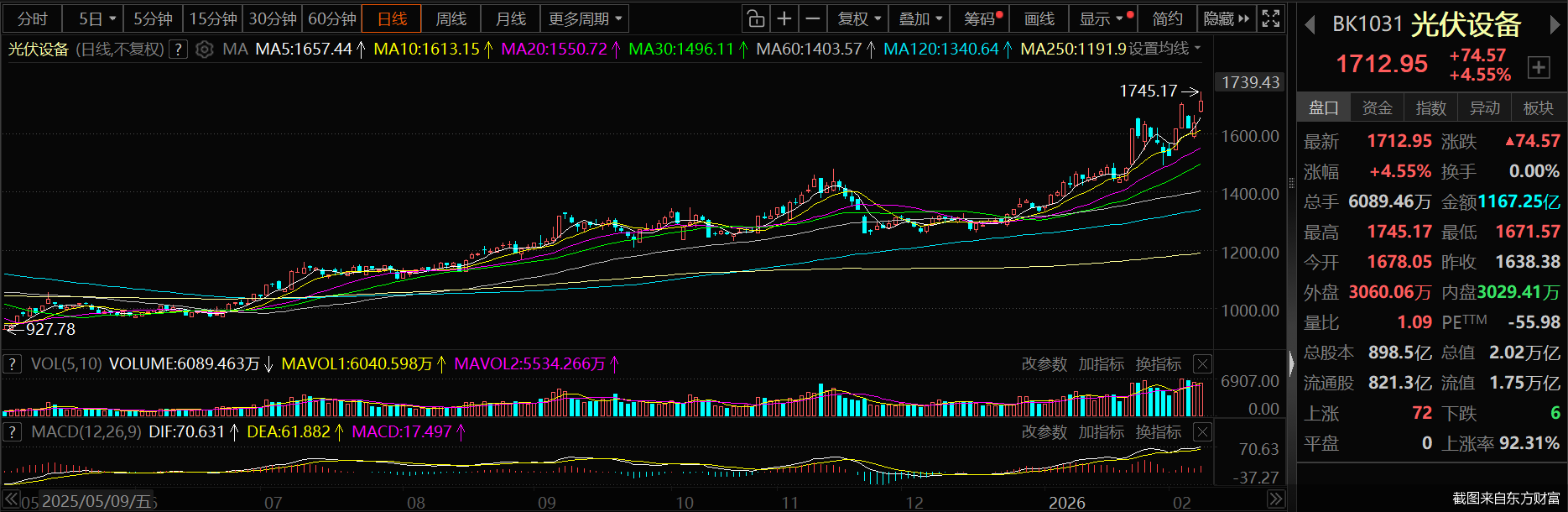
Core Viewpoint - The recent surge in the photovoltaic sector is significantly influenced by Elon Musk's support for space solar power, which has ignited investor interest and led to substantial gains in the A-share photovoltaic market [1][5][12]. Industry Overview - The photovoltaic industry is currently experiencing an oversupply, with the ground-mounted solar segment facing intense competition and a decline in growth prospects. The China Photovoltaic Industry Association projects a decrease in new installed capacity for 2023, estimating between 180-240 GW, a year-on-year decline of 23.81%-42.86% [1][11]. - The emergence of space solar power is seen as a potential solution to the industry's search for new growth avenues, driven by the expanding commercial space market [2][11]. Market Dynamics - Following Musk's endorsement of space solar power, the photovoltaic sector saw a collective market recovery of over 200 billion yuan from January 23 to February 9, with leading companies like GCL-Poly and TCL Zhonghuan experiencing significant stock price increases [1][4][6]. - As of February 9, the photovoltaic equipment sector showed strong performance, with multiple stocks hitting their daily price limits, indicating a clear profit-making trend among investors [4][6]. Corporate Developments - Tesla is reportedly evaluating locations in the U.S. to expand its solar cell manufacturing, which could open opportunities for Chinese equipment manufacturers to enter Tesla and SpaceX's supply chains [5][12]. - Companies like GCL-Poly and Trina Solar have confirmed that they are exploring technologies related to space solar power, although they have not yet secured any related orders [7][9]. Financial Performance - A significant portion of photovoltaic companies are forecasting losses for 2025, with 73.47% of the 49 companies that disclosed earnings predictions expecting net losses. Notable companies like TCL Zhonghuan and Trina Solar are projected to face substantial losses [9][10]. - The total market capitalization of 70 photovoltaic stocks increased from approximately 1.79 trillion yuan to about 1.99 trillion yuan during the recent surge, reflecting strong investor interest [6][9]. Future Outlook - While space solar power presents exciting possibilities, it remains in the early stages of technological exploration and faces challenges related to market conditions, policy, and technological development [2][12][14]. - Experts believe that advancements in commercial space technology and photovoltaic innovations could position space solar power as a new growth driver for the industry [14].





化工新材料龙头,50亿项目终止!
DT新材料· 2026-02-09 16:05
Core Viewpoint - Since 2025, an increasing number of photovoltaic material manufacturers have begun to actively reduce their presence in the photovoltaic sector, with some companies even choosing to exit the market. Recently, another leading company decided to adjust its pace [2]. Group 1: Project Termination - On February 8, Mingguan New Materials announced the termination of its investment in a solar backsheet and functional film production base project in Feidong County, Anhui, with a total investment of 5 billion yuan [3]. - The project was signed in February 2023 and was planned to be constructed in two phases, with the first phase's factory and infrastructure nearly completed, aiming for an annual production of 300 million square meters of solar backsheets and 200 million square meters of functional films [4]. - The direct reason for the project's termination is the overcapacity in the photovoltaic industry leading to a deteriorating market environment, with signs of overcapacity emerging since Q4 2023 [8]. Group 2: Market Dynamics - The photovoltaic industry is expected to experience widespread losses in 2024 and 2025, with the profitability of photovoltaic packaging materials gradually declining due to intensified competition [8]. - By 2026, the global market share of photovoltaic backsheets is projected to drop below 5% [8]. - Mingguan New Materials has decided to optimize the planned capacity of 500 million square meters of backsheets and functional films from the original project and transfer it to Yichun Economic and Technological Development Zone in Jiangxi [21]. Group 3: Financial Performance - In the first half of 2025, the company reported a significant decline in sales, with total sales volume of photovoltaic packaging materials at 63.86 million square meters, a year-on-year decrease of 16%, and sales revenue of 350 million yuan, down 39% [16]. - The company experienced a net loss of approximately 52.71 million yuan in the first half of 2025, marking its first half-year net loss since its listing in 2020 [17]. - The annual net profit forecast for 2025 is expected to be a loss between 125 million and 160 million yuan, representing a decline of 86.35% to 138.53% compared to the previous year [18]. Group 4: Product Development - The company has developed a 0BB functional film (smart grid film) that has received high recognition from leading manufacturers such as Aiko Solar, State Power Investment Corporation, and LONGi Green Energy, indicating a foundation for large-scale implementation [20]. - The company is also adjusting its production strategy to focus on specialized functional films, with an initial construction plan for a new project in Jiangxi to produce 350 million square meters of new battery packaging functional films, with a total investment of 290 million yuan [21].


马斯克引爆光伏 产业链市值“回血”!太空光伏前景几何
Bei Jing Shang Bao· 2026-02-09 14:59
Core Viewpoint - The recent surge in the photovoltaic sector is significantly influenced by Elon Musk's support for space solar power, which has ignited interest and investment in this area, leading to substantial market movements in A-share photovoltaic stocks [1][4][5]. Industry Overview - The photovoltaic industry is currently experiencing an oversupply of capacity, with intense competition leading to a decline in future growth prospects. The China Photovoltaic Industry Association predicts a decrease in new installed capacity in 2026, estimating a range of 180-240 GW, which represents a year-on-year decline of 23.81%-42.86% [1][12]. - The emergence of space solar power is seen as a potential solution to the industry's search for new growth avenues, driven by the expanding demand from commercial space ventures [2][12]. Market Dynamics - Following Musk's endorsement of space solar power, the photovoltaic sector saw a significant market rally, with the total market capitalization of A-share photovoltaic stocks recovering over 200 billion yuan within a short period [3][5]. - On February 9, 2023, leading photovoltaic stocks such as Xiexin Integrated and TCL Zhonghuan reached their daily price limits, reflecting strong investor sentiment and profit-taking opportunities [3][5]. Technological and Developmental Insights - Space solar power involves deploying large solar power stations in space to convert solar energy into electricity, which can then be transmitted back to Earth or used to power satellites and space stations. This technology offers advantages over ground-based solar power, such as uninterrupted sunlight and higher intensity [4][12]. - However, the development of space solar power is still in its early exploratory stages, with various factors such as technological advancements, industry policies, and market conditions influencing its commercialization [2][12]. Company Responses and Market Sentiment - Several leading photovoltaic companies have issued statements regarding their current lack of involvement in space solar power projects, emphasizing that their primary business remains focused on ground-based solar power [9][10]. - Despite the excitement surrounding space solar power, companies express caution regarding the sustainability of stock price increases without corresponding improvements in operational performance [10][11]. Future Outlook - The potential for space solar power to become a significant component of the future energy system is acknowledged, with experts suggesting that it is moving beyond mere concept to the brink of large-scale deployment [13][14]. - The growth of space solar power is contingent upon advancements in technology, cost reductions, and the successful integration of commercial applications, which will require time to validate [14].

马斯克引爆光伏,产业链市值“回血”!太空光伏前景几何
Bei Jing Shang Bao· 2026-02-09 14:53
Core Viewpoint - The recent surge in the photovoltaic sector is significantly influenced by Elon Musk's support for space photovoltaic technology, which has ignited interest and investment in the Chinese capital market [1][2]. Group 1: Market Dynamics - From January 23 to February 9, the A-share photovoltaic sector regained over 200 billion yuan in market value [2][13]. - On February 9, the photovoltaic sector saw a substantial increase, with companies like GCL-Poly and TCL Zhonghuan hitting their daily price limits [4][11]. - The total market capitalization of 70 photovoltaic stocks reached approximately 1,994.06 billion yuan, up from about 1,791.88 billion yuan on January 22 [12][13]. Group 2: Industry Challenges and Opportunities - The photovoltaic industry is currently facing an oversupply situation, with a projected decline in new installations in 2026 by 23.81% to 42.86% compared to previous years [2][20]. - Space photovoltaic technology is emerging as a potential solution to the industry's growth challenges, driven by the increasing demand from commercial space ventures [2][20]. - Despite the excitement around space photovoltaic technology, it remains in the early stages of exploration, with various factors influencing its industrialization process [2][21]. Group 3: Corporate Developments - Tesla is reportedly evaluating locations in the U.S. to expand its solar battery manufacturing business, which could create opportunities for Chinese photovoltaic companies to enter its supply chain [5][6]. - Companies like GCL-Poly and Trina Solar have confirmed that they are exploring the space photovoltaic sector, although they currently do not have related orders impacting their financial performance [15][16]. - Many photovoltaic companies are cautious about the rapid stock price increases, with some issuing risk warnings to investors [14][15]. Group 4: Future Outlook - The Chinese Photovoltaic Industry Association forecasts that the domestic photovoltaic installation scale will rebound after a short-term adjustment, with a projected range of 180 to 240 GW in 2026 [20]. - The development of space photovoltaic technology is seen as a potential new growth area for the industry, although it requires time for technological validation and market acceptance [21][22]. - The successful deployment of low-orbit satellite constellations and advancements in launch capabilities are critical for the growth of space photovoltaic applications [22].
机器人产业“链主”埃夫特求变:拟超10亿元并购IPO撤单企业 补胶接工艺短板
Mei Ri Jing Ji Xin Wen· 2026-02-09 14:26
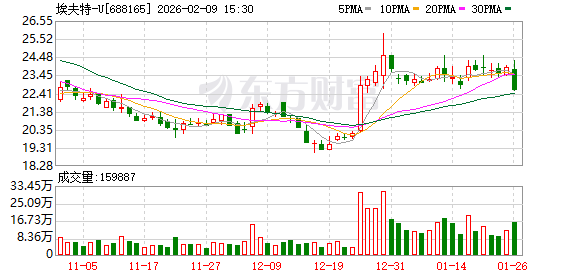
Core Viewpoint - Efort plans to acquire 100% equity of Shanghai Shengpu Fluid Equipment Co., Ltd. to enhance its product line in adhesive processes, addressing a gap in its industrial robot offerings [2][3] Group 1: Acquisition Details - The acquisition involves purchasing 95.97% of Shengpu's shares through a combination of stock and cash, with the remaining 4.03% acquired entirely in cash [2][3] - The preliminary valuation for the 95.97% stake in Shengpu is set between 1 billion to 1.2 billion yuan [2][3][4] - Efort's stock will resume trading on February 10 after being suspended since January 27 [2] Group 2: Company Background - Efort specializes in the R&D, production, and sales of core components, complete machines, and system integration for industrial robots, positioning itself as a leading player in China's industrial robot sector [3] - Shengpu focuses on precision fluid control equipment, with applications in photovoltaic components, power batteries, and automotive parts, boasting a strong client base including major industry leaders [4] Group 3: Financial Performance - Shengpu's financial data shows net profits of 84.58 million yuan in 2023, 60.08 million yuan in 2024, and 40.86 million yuan for the first nine months of 2025 [6] - The acquisition is expected to enhance Efort's business scale and profitability, with potential cost reductions through supply chain integration [6] Group 4: Challenges - Efort has faced continuous losses since its IPO in 2020, with projected net losses for 2025 expected to reach between 450 million to 550 million yuan, marking a significant year-on-year increase [7] - Shengpu previously withdrew its IPO application after initially gaining approval, citing challenges in the photovoltaic industry [7]

江松科技IPO终止 国投证券创业板撤回率达64.29%
Quan Jing Wang· 2026-02-09 12:49
Core Viewpoint - Jiangsong Technology, a leading company in the photovoltaic battery automation equipment sector, has withdrawn its IPO application, highlighting challenges in the industry and raising concerns about the high withdrawal rate of its sponsor, Guotou Securities [1][2]. Group 1: Company Overview - Jiangsong Technology is ranked among the top three in the photovoltaic battery automation equipment market [1][4]. - The company’s IPO application was accepted in June 2025 but was withdrawn in February 2026 after facing extensive inquiries [4]. Group 2: Financial Performance - The company's new order amount plummeted from 4.986 billion yuan in 2023 to 472 million yuan in 2024, and only 338 million yuan in the first half of 2025, indicating a decline of over 90% in just one and a half years [4]. - As of June 2025, the company's backlog of orders decreased from 3.613 billion yuan at the end of 2024 to 2.491 billion yuan, a drop of over 30% within six months [4]. - In 2024, Jiangsong Technology reported a net cash flow from operating activities of -118 million yuan, a significant decline from 393 million yuan in 2023 [6]. Group 3: Industry Challenges - The rapid technological transition from traditional PERC to TOPCon technology has led to a significant slowdown in equipment demand, with TOPCon-related sales accounting for 93.81% of revenue in 2024 [5]. - The market share of TOPCon batteries surged from 23% in 2023 to 71.1% in 2024, indicating a saturation of industry capacity [5]. Group 4: Financial Health - The company's asset-liability ratio reached 82.33% by the end of 2024, significantly higher than the industry average [7]. - Accounts receivable stood at 360 million yuan at the end of 2023, representing 29.07% of that year's revenue, indicating cash collection issues [7]. - The company’s inventory value was 2.146 billion yuan at the end of 2024, making up over 56% of total assets, raising concerns about potential depreciation risks [7].

800亿江西老板,等到了马斯克的“稻草”
创业家· 2026-02-09 10:31
Core Viewpoint - The article discusses the challenges and potential opportunities for JinkoSolar, particularly in light of Elon Musk's interest in space photovoltaic technology, which could provide a new direction for the company amidst its current financial struggles [3][4]. Group 1: Company Overview - JinkoSolar, once a leader in global solar module shipments, has faced significant challenges in recent years, including a 32.63% year-on-year revenue decline and a net loss of 2.909 billion yuan in the first half of 2025 [3][12]. - The company's debt levels have risen, with a debt-to-asset ratio of 74.07% and interest-bearing liabilities of 37.914 billion yuan, indicating financial strain [14]. Group 2: Market Context - The Chinese photovoltaic industry is experiencing a severe downturn, with overcapacity leading to a price collapse; product prices have dropped by over 80% from their 2020 peak [12][14]. - The optimistic demand forecast for the global photovoltaic market in 2025 is only 630 GW, while domestic production capacity exceeds 1100 GW, resulting in a significant supply-demand imbalance [12]. Group 3: Strategic Moves - Elon Musk's exploration of solar technology for space applications has opened a potential new avenue for JinkoSolar, aligning with Musk's vision of deploying solar energy in space [3][16]. - JinkoSolar's management has expressed a commitment to innovation and strategic foresight, with plans to explore opportunities in space photovoltaic technology as a long-term trend [18]. Group 4: Leadership Insights - JinkoSolar's founder, Li Xian-de, has a history of making bold strategic decisions, such as adopting the N-type TOPCon technology early on, which helped the company regain its position in global shipments [9][10]. - Li emphasizes the importance of resilience and foresight in navigating industry cycles, suggesting that current challenges are temporary compared to the long-term trends in the energy sector [18].

隆基绿能今日大宗交易折价成交59.08万股,成交额977.77万元
Xin Lang Cai Jing· 2026-02-09 09:34
Group 1 - The core transaction involved Longi Green Energy, with a total of 590,800 shares traded, amounting to 9.7777 million yuan, which represents 0.12% of the total trading volume for the day [1] - The transaction price was 16.55 yuan per share, reflecting a discount of 13.71% compared to the market closing price of 19.18 yuan [1]


阳光电源涨超6%,南方基金旗下新能源ETF(516160)一度涨近3%,我国经济社会绿色转型加速推进
Xin Lang Cai Jing· 2026-02-09 07:21
截至2026年2月9日 14:55,新能源ETF(516160)一度涨近3%,现涨2.30%,盘中换手2.8%,成交1.95亿 元。跟踪指数中证新能源指数成分股协鑫集成上涨10.04%,TCL中环上涨9.98%,爱旭股份上涨 9.95%,罗博特科,帝尔激光等个股跟涨。 中邮证券表示,分类完善容量电价是在容量市场建立前的过渡,煤电、天然气、抽水蓄能以及电网侧独 立新型储能等领域范围均有涉及。容量电价整体而言,对煤电是上调,抽蓄远期有分化压力(存量和新 增分开,由一站一价过渡到一省一价),独立储能则是首次国家层面建立规则,气电和独立储能参考煤 电。远期而言,发电侧其他可靠性容量(例如核电、光热等等)逐步纳入,甚至用电侧(稳定可调负荷、 V2G等)也会逐步纳入。 新能源ETF紧密跟踪中证新能源指数,中证新能源指数选取涉及可再生能源生产、新能源应用、新能源 存储以及新能源交互设备等业务的上市公司证券作为指数样本,以反映新能源产业相关上市公司证券的 整体表现。指数前十大权重股分别为宁德时代、阳光电源、特变电工、华友钴业、隆基绿能、亿纬锂能 (维权)、赣锋锂业、中国核电、先导智能、金风科技。 新能源ETF(516160) ...

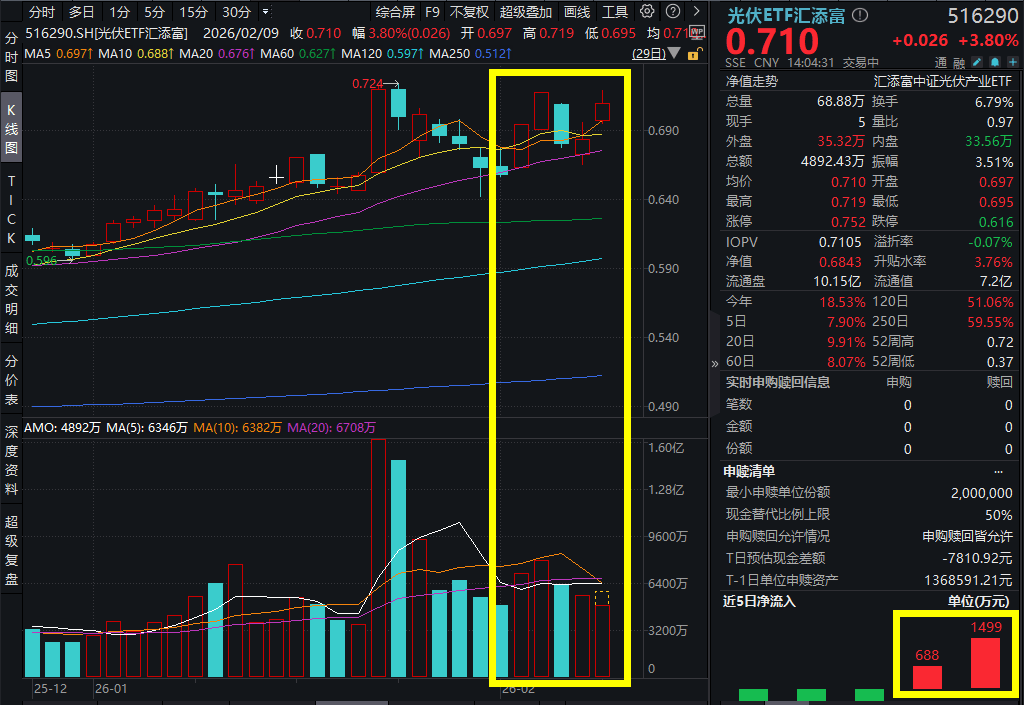
马斯克下注光伏制造,太空光伏板块再掀涨停热潮!协鑫集成喜提四连板,光伏ETF汇添富(516290)涨超3%!太空光伏需求迎指数级增长?
Sou Hu Cai Jing· 2026-02-09 06:35
Core Viewpoint - The A-share market experienced a strong rebound, with significant gains in the photovoltaic and battery sectors driven by news related to space photovoltaic technology and Tesla's plans for solar energy production [1][4]. Group 1: Market Performance - The Shanghai Composite Index rose over 1%, with more than 4,400 stocks increasing in value [1]. - The photovoltaic ETF, Huatai-PineBridge (516290), surged nearly 4%, attracting over 20 million yuan in investment over two consecutive days [1]. - The battery ETF, Huatai-PineBridge (159796), also saw a rise of 1.78%, with a trading volume exceeding 210 million yuan [1]. Group 2: Key Stocks and Trends - Major stocks in the photovoltaic sector, such as GCL-Poly Energy and TCL Zhonghuan, experienced significant price increases, with GCL-Poly hitting the daily limit and TCL Zhonghuan rising nearly 10% [2][4]. - Market rumors indicated that Elon Musk's team visited several Chinese photovoltaic companies, focusing on those with heterojunction and perovskite technology [3]. Group 3: Space Photovoltaic Market Potential - According to CITIC Securities, the demand for space photovoltaic technology is expected to grow exponentially, with projections estimating a market size of over 800 billion yuan by 2030 under conservative scenarios [5]. - The global demand for space photovoltaic systems could reach 1 GW in a conservative scenario and 70 GW in an optimistic scenario by 2030 [5][6]. - The anticipated growth in satellite launches and advancements in solar cell technology, such as P-HJT and perovskite cells, could lead to a hundredfold or even thousandfold market expansion in the next five years [5]. Group 4: Tesla and SpaceX Developments - Tesla plans to establish 100 GW of solar capacity, which is expected to significantly boost the demand for energy storage solutions [7]. - The integration of AI in energy management is projected to drive rapid growth in storage capacity, with Tesla's initiatives potentially leading to over 300 GWh of storage demand [7]. - The competitive landscape for photovoltaic equipment suppliers is expected to favor leading Chinese companies due to their ability to meet high standards and rapid response requirements from Tesla and SpaceX [6].